
 English
 한국어
 Español
 Deutsch
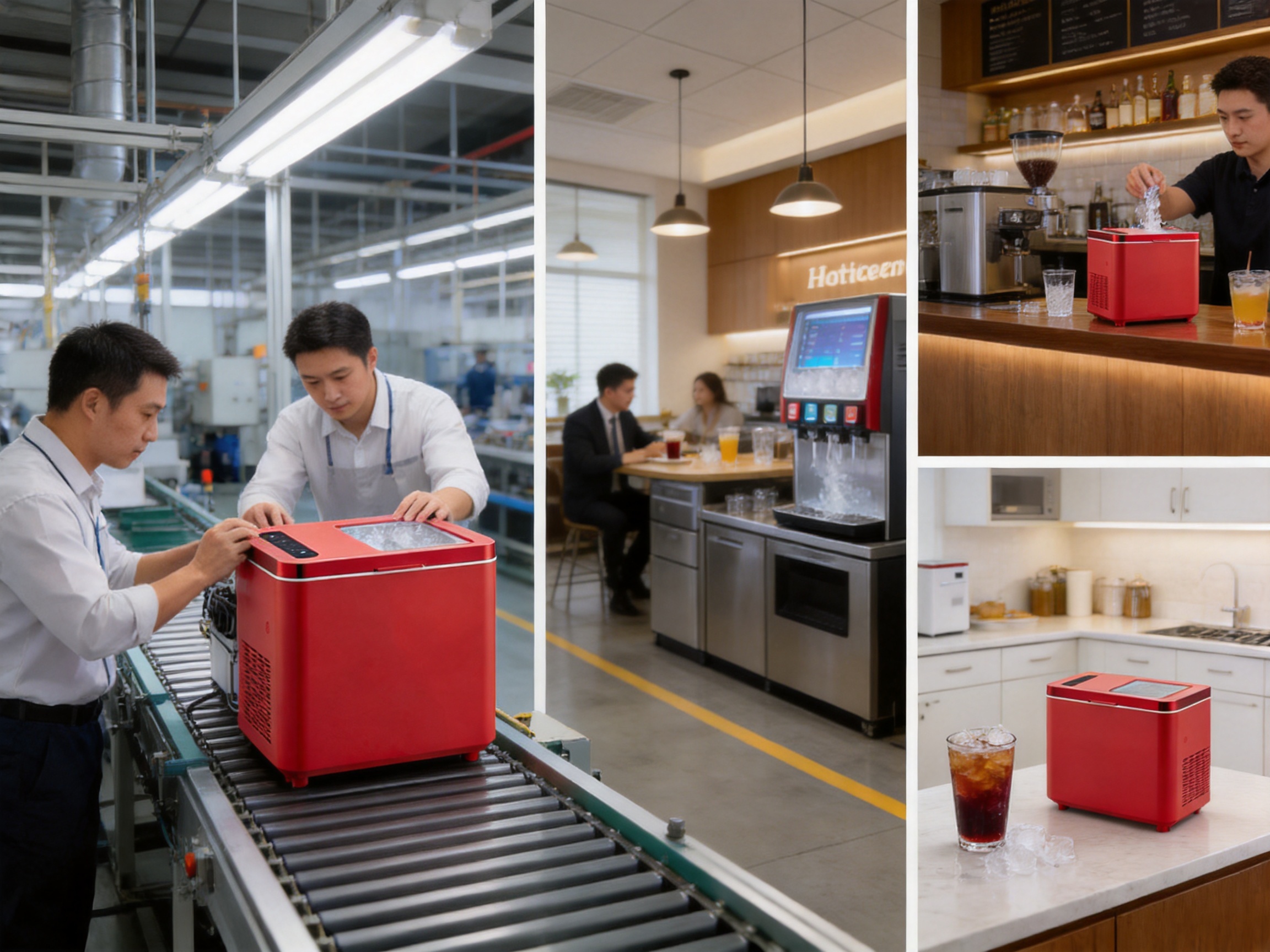
Ice is more than a simple ingredient. In cafés, milk tea shops, fast-food restaurants, offices, hotels, and homes, the quality, shape, temperature, and availability of ice can directly influence the customer experience. A reliable ice maker must therefore do more than freeze water. It should produce ice efficiently, keep the ice accessible, occupy limited space, operate with reasonable energy consumption, and allow staff to maintain high hygiene standards throughout daily use.
The touchscreen ice maker described in this article is a compact bullet ice maker designed around those practical requirements. Its Alien-Z01 configuration combines a modern touchscreen operating experience with a compact machine body, a 150-watt power rating, R600a refrigerant, and a fully opening upper structure that makes the ice-making and storage areas easier to inspect and clean. Its bullet-shaped ice is intended to cool beverages rapidly while offering a pleasant, crunchy texture that is popular in milk tea, soft drinks, coffee, and other cold beverages.
Produced by Alien Technology Co., Ltd., the machine reflects the company’s focus on household appliances, humanized design, reliable quality, intelligent technology, and continuous improvement. Although the product is compact enough for many domestic and small commercial environments, its design also addresses several concerns normally associated with professional beverage service: speed, handling, storage convenience, sanitation, and efficient use of working space.
Understanding the Bullet Ice Maker Concept
Bullet ice is recognized by its rounded, hollow or perforated form. Rather than creating a solid cube, a bullet ice maker freezes water around a cooled surface or mold structure to create pieces with a central opening or recessed center. This geometry gives the ice a larger effective contact area with the beverage than a dense solid block of the same general size.
The increased contact area allows the ice to transfer cold into a drink quickly. This can be especially valuable in busy beverage environments where customers expect a drink to reach a refreshing serving temperature without a long waiting period. It is also useful when drinks are prepared with ingredients that are not fully chilled, such as freshly brewed tea, blended flavor bases, or room-temperature syrups.
The shape offers another practical advantage: bullet ice is generally easier to bite or crunch than very hard, solid ice. The moderate hardness described for this product makes it suitable for customers who enjoy chewing ice while drinking milk tea, fruit beverages, iced coffee, and soft drinks. At the same time, the shape remains substantial enough to provide cooling performance during normal serving periods.
Compared with irregular ice formed in a conventional freezer tray, machine-made bullet ice provides a more consistent appearance and size. Consistency helps beverage businesses create a more predictable serving experience. It can also make drink presentation look more professional, particularly when clear cups allow customers to see the ice.
Product Specifications at a Glance
The Alien-Z01 configuration is engineered as a compact appliance with a straightforward electrical and refrigeration specification. The following table summarizes the core information supplied for this model.
| Specification | Product Information |
|---|---|
| Product type | Touchscreen bullet ice maker |
| Model description | Alien-Z01 |
| Power supply | 220V–240V / 50Hz |
| Current and power | 0.9A / 150W |
| Refrigerant and charge | R600a / 19g |
| Machine dimensions | 325 × 295 × 252 mm |
| Product category | Bullet ice maker |
| Operating interface | Touchscreen control |
| Primary use | Household and small beverage-service applications |
The dimensions of 325 × 295 × 252 millimeters give the machine a relatively compact footprint. This makes it easier to place on a kitchen counter, preparation table, service station, office refreshment counter, or small café workstation. Exact production output will depend on ambient temperature, water temperature, ventilation, operating cycle, and other conditions, so users should evaluate capacity according to their actual service requirements.
Rapid Cooling Through Functional Ice Geometry
One of the product’s main advantages is the rapid cooling effect associated with its perforated or recessed bullet shape. When ice contacts a beverage, heat moves from the warmer liquid into the colder ice. A shape with an opening or larger exposed surface can encourage efficient contact between the ice and the drink, allowing cooling to begin quickly.
For a beverage shop, fast cooling can improve workflow in several ways. Staff may be able to prepare iced beverages more efficiently, especially during busy periods. Customers can receive a cold drink without waiting for a large solid cube to cool the liquid gradually. The ice may also circulate more easily inside a cup or pitcher, helping distribute cooling across the drink rather than leaving only a few large pieces near the surface.
Rapid cooling is useful in more than commercial service. At home, a compact ice maker can provide ice for guests, family meals, outdoor refreshments, and daily coffee or tea. In an office, it can support cold water, soft drinks, and iced coffee without requiring employees to fill and empty traditional freezer trays. In a small hospitality setting, it offers an accessible way to keep cold beverages available without dedicating extensive freezer space to ice production.
The cooling behavior of any ice depends on multiple variables, including the initial beverage temperature, the quantity of ice, the material and size of the cup, and the surrounding environment. Nevertheless, the bullet format is intentionally suited to efficient cooling, making it a practical choice for users who value quick temperature reduction and a refreshing drinking experience.
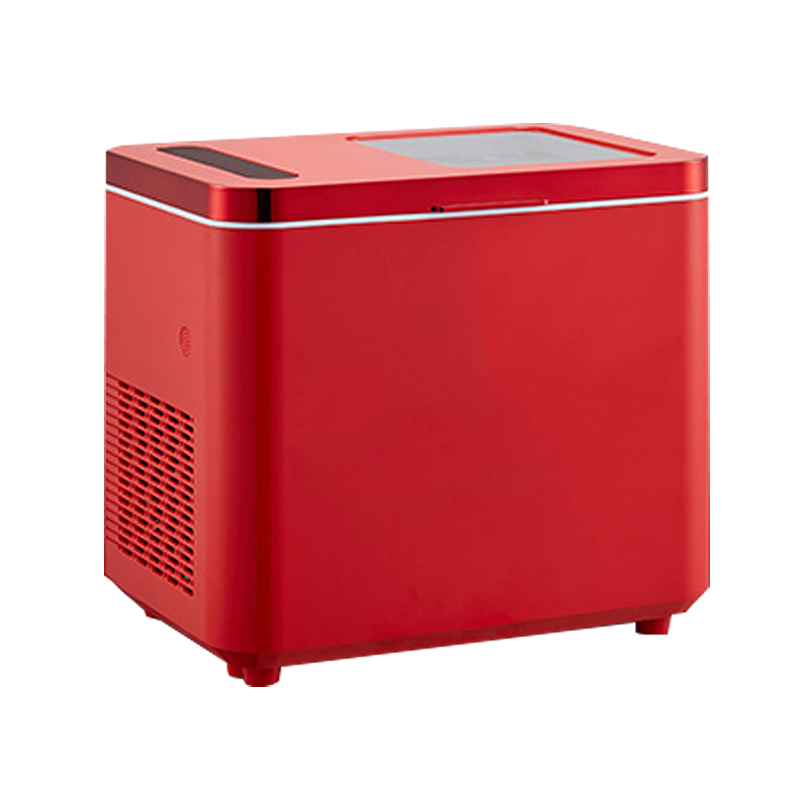
Touchscreen ice maker
Non-Sticky Ice for Easier Storage and Dispensing
Ice that freezes into a single mass can be inconvenient. Staff may need to break it apart before service, and the process can slow down order preparation. Clumped ice may also be difficult to portion consistently, particularly when a business uses scoops, cups, or other manual serving tools.
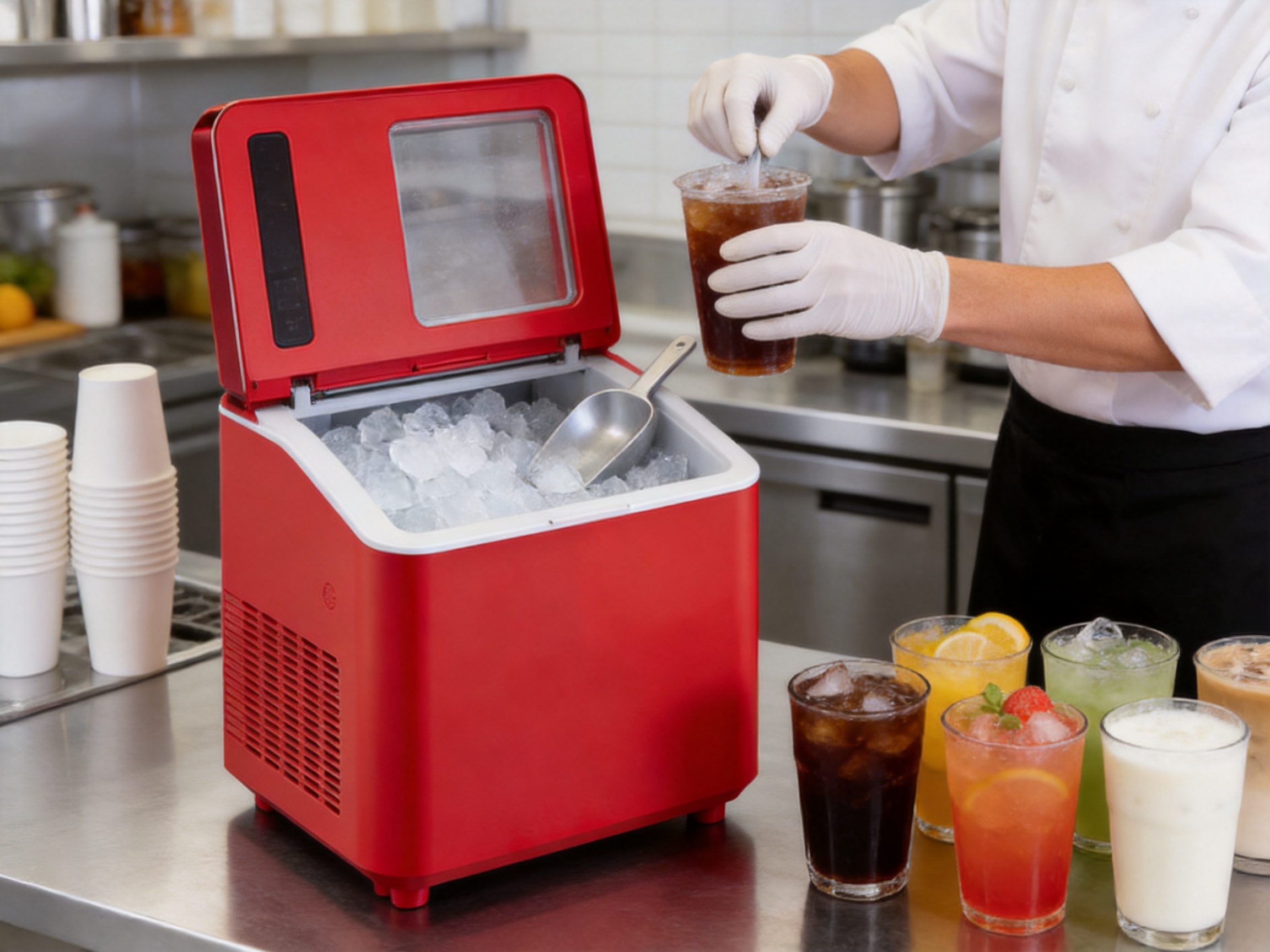
The bullet ice shape helps reduce this problem by creating individual pieces with a rounded profile and a central opening or recessed section. The form can improve flowability during storage and dispensing, allowing pieces to separate more naturally. This makes the ice easier to handle with an ice scoop and more convenient for repeated serving.
For beverage businesses, good flowability can contribute to a smoother preparation routine. A staff member can access ice quickly, add a relatively consistent amount to a cup, and return to the next order without spending unnecessary time breaking apart frozen clusters. The benefit becomes more noticeable during peak service, when small interruptions can accumulate into longer queues.
Non-sticky ice also supports cleaner handling. When pieces separate easily, there is less need for excessive force or repeated contact. Staff can use a dedicated scoop instead of touching ice directly, helping maintain a more hygienic workflow. As with all ice equipment, users should follow appropriate food-handling practices and clean the scoop, storage area, and internal surfaces regularly.
In comparison with ordinary freezer-made ice, machine-produced bullet ice is more uniform in shape and intended use. This consistency supports better presentation in transparent cups, more predictable drink dilution, and simpler portion control. It also gives the product an advantage over ice that must be manually broken from trays or containers before use.
A Pleasant Texture for Modern Beverages
Ice texture matters because it affects both the drink and the customer’s experience. Very dense ice can remain hard for a long time and may be uncomfortable to chew. Extremely soft ice can melt too rapidly and dilute the drink before it is finished. The bullet ice format aims for a balanced experience, offering moderate hardness and a crunchy texture.
This texture is particularly popular in milk tea shops, quick-service beverage outlets, and casual dining locations. Many customers enjoy chewing small pieces of ice while drinking. The shape is also visually distinctive, creating an appearance that differs from standard square cubes or crushed ice.
For milk tea and fruit beverages, the bullet form can help create a familiar commercial presentation. For iced coffee, it provides cooling while maintaining a clear, recognizable ice structure. For soft drinks and flavored water, the rounded pieces can make the drink look more abundant and refreshing inside a transparent cup.
Texture preferences vary from one market to another, so beverage operators can select the quantity of ice according to customer expectations and recipe requirements. The machine’s role is to provide a repeatable supply of a particular ice style, allowing the business to standardize its menu and service process.
Continuous Ice-Making Efficiency
A key difference between an ice maker and a basic freezer tray is the ability to produce ice through a continuing machine cycle. Instead of waiting for a tray to freeze completely and then manually emptying it, an automatic appliance is designed to repeat the processes of water distribution, freezing, harvesting, and storage.
The supplied product information emphasizes continuous ice-making as a major advantage of the bullet ice principle. In a commercial environment, this can support a more dependable supply of ice throughout operating hours. Staff do not need to rely solely on prefilled trays or emergency purchases from outside suppliers.
Efficient ice production is especially important in establishments where cold beverages form a significant part of sales. Milk tea shops, cafés, snack bars, fast-food restaurants, and catering stations can consume substantial quantities of ice over the course of a day. A dedicated machine helps place ice production closer to the point of use, reducing dependence on external storage and simplifying routine preparation.
Actual output varies with model conditions and should be verified with the supplier for a specific application. Ambient heat, ventilation, water temperature, usage frequency, and cleaning condition can all influence the practical production rate. Even so, the continuous operating principle gives the product a clear functional advantage over manual ice trays and ordinary freezer compartments.
When planning an installation, operators should consider both production and storage. A machine that produces ice efficiently must also be positioned where users can access the ice easily without obstructing other work. The compact dimensions of this product can help businesses make better use of limited counter space while keeping ice near the preparation area.
Compact Dimensions for Space-Conscious Workplaces
Space is often one of the most expensive resources in a kitchen or beverage shop. A large appliance can restrict movement, reduce available preparation space, or require costly changes to the counter layout. The machine dimensions of 325 × 295 × 252 millimeters are designed for a compact installation footprint.
This size can be beneficial in small apartments, office kitchens, boutique cafés, milk tea counters, hotel rooms, staff lounges, and mobile or temporary service areas. It may fit in locations where a larger commercial ice maker would be impractical. The relatively low profile also makes it easier to position beneath cabinets or on a dedicated preparation surface, subject to sufficient ventilation and the installation instructions supplied with the product.
A smaller footprint does not mean that placement can be ignored. The machine should have enough surrounding clearance for heat dissipation, access to the power supply, water filling, cleaning, and removal of ice. Users should avoid placing it directly beside heat-producing appliances or in locations exposed to excessive moisture.
Compared with a separate freezer and manual ice trays, a compact automatic ice maker can reduce the amount of space dedicated to ice production. It also reduces the repeated handling required to fill trays, wait for freezing, remove ice, and return trays to the freezer. This can improve convenience without demanding a major kitchen redesign.
Touchscreen Operation and User Convenience
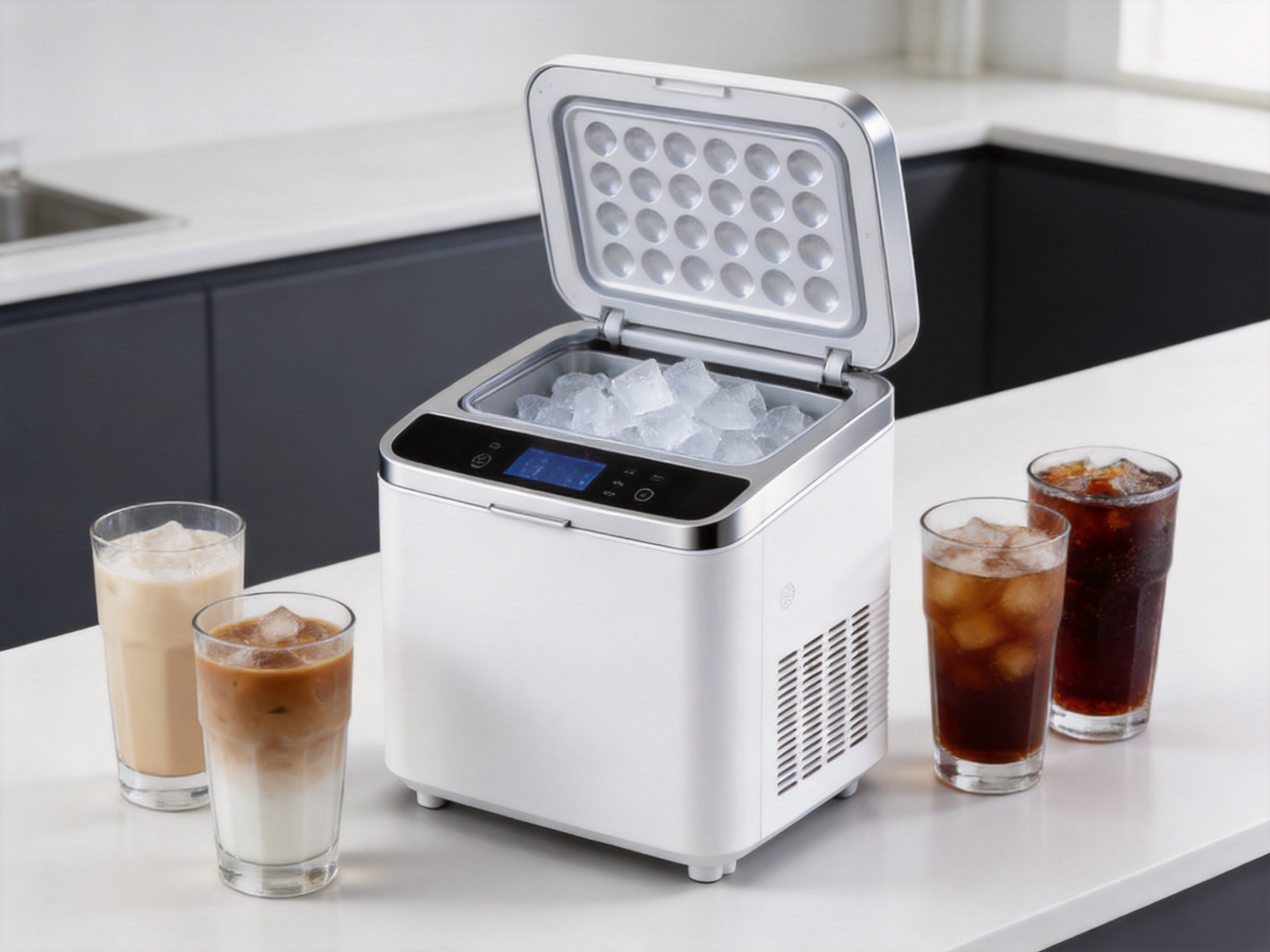
The touchscreen interface gives the product a modern operating experience. A touch control panel can make the machine easier to operate than a collection of mechanical switches, particularly when the functions are presented in a clear and intuitive layout.
For household users, touchscreen control offers a clean appearance that integrates well with contemporary kitchen appliances. For commercial users, it can make routine operation more straightforward for staff members who may need to learn the equipment quickly. A clear interface can help reduce uncertainty during starting, stopping, or selecting available functions.
Touch controls also support a more integrated exterior design. Because there are fewer protruding mechanical components, the front surface can be easier to wipe. This does not eliminate the need for proper sanitation, but it can reduce areas where dust, splash residue, and beverage particles might collect.
Ease of operation is most valuable when combined with clear instructions. Users should become familiar with water requirements, operating modes, cleaning procedures, and indicators before placing the appliance into regular service. For business owners, a short internal operating guide can help employees use the machine consistently and avoid unnecessary misuse.
The touchscreen should be operated with clean, dry hands whenever possible. Water or syrup on the control surface may affect usability and can make cleaning more difficult. A gentle wipe with an appropriate cloth after use can help maintain the appearance of the interface.
Fully Opening Design for Cleaning and Hygiene
Hygiene is one of the most important considerations in any appliance that produces ice for consumption. Ice is often treated like a food ingredient because it is placed directly into beverages. If internal areas are difficult to access, users may struggle to remove residue, standing water, mineral deposits, or other contamination.
This product uses a fully flip-top design that allows users to open the ice storage and ice-making areas more completely. The design is intended to eliminate difficult-to-reach sanitary corners and make daily cleaning and maintenance easier.
A wide opening can improve visibility. Users can inspect the interior instead of relying only on what can be seen through a small access door. Better visibility makes it easier to identify water residue, ice buildup, deposits, or areas that require additional attention.
The open structure also makes routine wiping and drying more practical. After the machine has been emptied and switched off according to the instructions, users can clean accessible surfaces with suitable food-contact-safe cleaning materials. The storage area should be kept dry and free from foreign objects, while the scoop should be washed and dried regularly.
Cleaning frequency should be based on the operating environment and usage level. A machine used continuously in a busy beverage shop may require more frequent attention than one used occasionally at home. Water quality also matters. Hard water can leave mineral deposits, so users should follow the manufacturer’s recommendations for descaling and internal maintenance.
The hygienic advantage of the fully opening design is practical rather than merely visual. A machine that is easier to open, inspect, clean, and dry is more likely to receive consistent maintenance. This supports better long-term performance and helps users maintain a cleaner ice-producing environment.
Refrigeration and Electrical Design
The product is specified for a 220V–240V, 50Hz power supply, with a rated current and power of 0.9A and 150W. These specifications identify the electrical environment for which the appliance is designed. Users should confirm that the local power supply matches the product requirements before operation.
The 150-watt rating reflects a compact appliance designed to perform ice-making duties without the electrical demand associated with much larger refrigeration equipment. Lower rated power can be useful in homes, offices, and small commercial spaces where available electrical capacity must be shared with other appliances.
The machine uses R600a refrigerant with a specified charge of 19 grams. R600a is isobutane, a refrigerant commonly used in various compact refrigeration appliances. As a flammable refrigerant, it must be handled only by qualified personnel during servicing. Users should not attempt to open or repair the refrigeration circuit themselves.
Safe operation depends on correct installation, adequate ventilation, proper grounding where required, and careful handling of the power cord. The machine should not be used if the cord, plug, housing, or control system appears damaged. Any unusual odor, excessive noise, leakage, or abnormal heating should be treated as a reason to stop use and contact an authorized service provider.
Electrical efficiency should be considered together with operating habits. Keeping the machine clean, ensuring adequate ventilation, using suitable water, and avoiding unnecessary repeated opening can support stable performance. A well-maintained appliance is generally better positioned to maintain its designed cooling behavior.
Advantages Over Traditional Ice-Making Methods
Traditional ice trays remain inexpensive and familiar, but they require manual filling, freezer space, waiting time, and repeated handling. They can also produce ice with inconsistent shape and may become difficult to empty when pieces freeze together. The touchscreen bullet ice maker addresses these limitations with automatic production and a dedicated storage area.
Compared with using a standard freezer compartment, a dedicated ice maker keeps ice production separate from frozen food storage. This can help organize the kitchen and reduce the need to reserve freezer shelves for trays or bags of ice. It also makes ice more accessible during beverage preparation.
Compared with irregular crushed ice, bullet ice provides a more consistent piece shape and a balance between cooling performance and crunchability. Crushed ice may cool quickly but can melt rapidly and create inconsistent portions. Bullet ice offers a more structured alternative while still providing substantial contact with the drink.
Compared with large solid cubes, the perforated design may cool beverages more quickly because of its greater exposed area. It can also be easier to chew for customers who prefer a crunchy ice texture. The choice between ice types depends on the beverage and market, but the bullet format is highly versatile for everyday cold drinks.
Compared with large commercial ice systems, the compact machine may be easier to install in limited spaces and more suitable for smaller businesses or households. Large systems may offer higher output, but they also generally require more room, more installation planning, and greater investment. A compact appliance can provide a practical balance for users whose demand does not justify industrial-scale equipment.
Applications Across Different Environments
Milk Tea and Specialty Beverage Shops
Milk tea businesses often need ice that cools drinks quickly, flows easily from storage, and offers a familiar texture. Bullet ice is especially suitable for this environment because it can be scooped efficiently and pairs well with tea, milk, fruit, and flavored syrups.
The compact structure may be valuable at small beverage counters where every section of the work surface must be used efficiently. Positioning the machine near the cup-filling and sealing area can reduce unnecessary movement and help staff maintain a consistent preparation sequence.
Cafés and Coffee Stations
Iced coffee and cold brew require dependable cooling. A dedicated ice maker can support daily service while keeping ice close to the coffee preparation area. Bullet ice offers a distinctive appearance in transparent cups and can help cool freshly prepared coffee beverages.
Café operators should select ice quantities according to the drink recipe. Too much ice may alter the flavor balance, while too little may result in a beverage that is not cold enough. Consistent ice production allows recipes to be standardized more effectively.
Fast-Food and Quick-Service Restaurants
Quick-service operations value speed, simplicity, and repeatability. The machine’s easy-flowing ice can help staff prepare cold drinks without stopping to break apart clumps. Its touchscreen interface can also make routine operation accessible to employees with different levels of technical experience.
In busy environments, cleaning schedules should be integrated into the daily closing or opening procedure. The fully opening structure can help supervisors verify that the machine has been cleaned correctly rather than relying on assumptions.
Offices and Shared Kitchens
An office ice maker can support drinking water, iced coffee, soft drinks, and employee events. A compact footprint is useful where the kitchen counter is shared by several appliances. Automatic production eliminates the need for employees to remember to refill freezer trays.
Homes and Hospitality Spaces
At home, the machine can provide a regular supply of ice for family use and entertaining. It is also suitable for guesthouses, small hotels, recreational rooms, and private hospitality areas where a full commercial system would be unnecessary.
Manufacturing Strengths Behind the Product
Alien Technology Co., Ltd. is located in Zhouxiang, Zhejiang Province, an area known for small household appliance manufacturing and convenient logistics. This location provides access to an established appliance supply chain, supporting the development and production of products such as ice makers, coffee machines, and air fryers.
A concentrated manufacturing region can offer several advantages. Component sourcing may be more efficient, production partners may be readily available, and product development can benefit from local experience with compact electrical appliances. Logistics connections can also support the movement of materials and finished goods for domestic and international business.
The company’s stated mission, “Smart Technology, Simplifying Life, Enhancing Happiness,” reflects an emphasis on practical innovation. In the case of this ice maker, smart technology is expressed through the touchscreen interface, while simplification appears in the compact structure, accessible cleaning design, and automatic ice-making process.
The company also identifies reliable quality, customer satisfaction, continuous improvement, and innovation as important priorities. These values are relevant to an appliance that must operate repeatedly and remain easy to maintain. Ice makers are used in wet environments and may run frequently, so dependable construction, sensible layout, and serviceability are important parts of product quality.
Advanced manufacturing should not be understood only as the use of sophisticated machinery. It also involves accurate assembly, consistency between units, appropriate material selection, controlled testing, electrical safety checks, refrigeration-system integrity, and inspection of the finished product. These areas are especially important for a compact ice maker because several systems must work together within a limited housing.
A modern manufacturing process may include product design review, component inspection, assembly-line control, functional testing, appearance inspection, packaging verification, and final shipment checks. Although specific factory procedures for this model have not been detailed, the product’s compact integration of refrigeration, water handling, touchscreen control, ice storage, and opening structure requires coordinated production disciplines.
The company’s specialization in household appliances can also support cross-product knowledge. Experience with air fryers, coffee machines, and ice makers may help the engineering and production teams understand consumer expectations related to intuitive controls, compact form factors, thermal performance, cleaning, and daily convenience.
Designing for Reliable Daily Use
A successful appliance is not judged only by its first operation. It must remain practical after weeks and months of repeated use. The product’s design addresses daily usability through several connected features: automatic ice production, a compact body, a touchscreen interface, free-flowing ice, and a top structure that can be opened fully for maintenance.
These features work together rather than functioning as isolated selling points. A compact machine is more useful when it is easy to operate. Automatic production is more valuable when the ice can be dispensed without excessive clumping. Efficient cooling is more beneficial when the machine can be cleaned easily enough to maintain consistent operation.
Product reliability also depends on user behavior. Water should be filled according to the instructions, the machine should not be overloaded, and ventilation openings should remain unobstructed. Ice storage should be emptied and cleaned at suitable intervals, particularly when the machine is not used for an extended period.
In a commercial setting, assigning responsibility for cleaning and inspection can improve consistency. Staff should know how to identify unusual sounds, water leakage, poor ice formation, or control-panel problems. Early attention to irregular behavior can help prevent minor issues from becoming larger maintenance problems.
Installation and Operating Considerations
Before installation, users should confirm the voltage and frequency requirements, inspect the machine for shipping damage, and select a stable, level surface. The location should be dry, reasonably cool, and adequately ventilated. It should also provide convenient access for cleaning and allow the top cover to open fully.
The machine should be connected to a suitable power outlet. Extension cords, overloaded sockets, or unstable electrical connections may create safety risks and should be avoided unless specifically permitted by qualified professionals and applicable local requirements.
After positioning the appliance, users should follow the operating instructions for water filling and initial startup. The first production cycle may be handled according to the manufacturer’s cleaning or discard recommendations. Ice intended for consumption should be produced only after the internal areas and water-contact components are appropriately clean.
Users should avoid moving the machine while it is operating unless the instructions specifically allow it. If the appliance must be relocated, it should be switched off, unplugged, emptied, and handled carefully. Refrigeration appliances may require a settling period after transportation or tilting before they are restarted.
During operation, the machine should be monitored for normal water flow, ice formation, and storage behavior. The top should be closed when appropriate to protect the interior from dust and unnecessary exposure. The ice scoop should be stored hygienically and used only for ice.
Maintenance Practices for Long-Term Performance
Regular maintenance is essential for both hygiene and performance. A basic routine should include emptying unused ice, wiping accessible internal surfaces, cleaning the scoop, checking the water-contact area, and drying the storage compartment when appropriate.
Mineral deposits can accumulate when water contains a high concentration of dissolved minerals. These deposits may affect water flow, ice appearance, and cooling performance. Users should follow the recommended descaling method and use only suitable cleaning products. Harsh chemicals or abrasive tools may damage surfaces and should not be used unless approved.
The exterior touchscreen and housing should be cleaned with a soft cloth. Liquid should not be poured directly onto the controls or allowed to enter electrical openings. The machine should be disconnected from power when performing maintenance that requires access to internal areas, unless the official procedure specifically states otherwise.
Commercial users may benefit from a written maintenance log. The log can record cleaning dates, descaling, unusual operating conditions, and service visits. This simple practice helps businesses demonstrate consistent hygiene management and identify changes in performance over time.
Professional servicing should be used for refrigeration-system work, electrical faults, refrigerant handling, or internal repairs. Because the product uses R600a refrigerant, only qualified technicians with appropriate training and equipment should service the sealed cooling system.
Why the Product Is Competitive
The product’s competitive position comes from the combination of features rather than from one specification alone. Its compact size supports flexible installation. Its bullet ice format provides rapid cooling, good flowability, and a popular crunchy texture. Its continuous ice-making principle reduces dependence on manual trays. Its touchscreen contributes to ease of use, while the fully opening structure supports hygiene and maintenance.
Many competing approaches solve only one part of the ice-making problem. A freezer tray may be inexpensive but slow and labor-intensive. A large commercial machine may have high output but require significant space and investment. A basic countertop machine may produce ice but be difficult to clean. The touchscreen bullet ice maker aims to balance convenience, performance, sanitation, and footprint in one appliance.
The product is particularly well suited to users who need more than occasional tray-made ice but do not require a full industrial system. Small retailers, home users, offices, cafés, milk tea counters, and hospitality spaces can benefit from a machine that is approachable, space-conscious, and designed for repeated everyday use.
Its manufacturing background also strengthens its market appeal. Alien Technology Co., Ltd. specializes in small household appliances and has established a business philosophy centered on quality, customer satisfaction, improvement, and innovation. This combination of product specialization and practical design can support cooperation with distributors, retailers, hospitality buyers, and private-label customers.
Q&A: Frequently Asked Questions
What type of ice does this machine produce?
It produces bullet-shaped ice with a perforated or recessed center. This shape is designed to provide efficient beverage cooling, relatively easy dispensing, and a crunchy texture that is popular in milk tea, fast-food, café, and household applications.
Why does bullet ice cool drinks quickly?
The opening or recessed center increases the ice’s exposed contact area with the beverage. Greater contact can encourage faster heat transfer from the drink into the ice, helping reduce beverage temperature efficiently.
Is the ice easy to scoop?
The product information emphasizes non-sticky, high-flowability ice. The rounded shape is intended to reduce clumping during storage and dispensing, making it easier to use an ice scoop and portion ice during beverage preparation.
Can the machine be used in a small kitchen?
Yes. Its stated dimensions are 325 × 295 × 252 millimeters, giving it a compact footprint suitable for many kitchen counters, office refreshment areas, small cafés, and beverage stations. Adequate ventilation and maintenance access must still be provided.
What power supply does the machine require?
The specified power supply is 220V–240V at 50Hz. Users should confirm that their local electrical supply matches these requirements before connecting the machine.
How much power does it use?
The listed current and power are 0.9A and 150W. Actual energy consumption may vary with operating conditions, ambient temperature, production frequency, and maintenance condition.
What refrigerant does the machine use?
The machine uses R600a refrigerant with a specified charge of 19 grams. Refrigeration-system servicing must be performed by qualified personnel because R600a is a flammable refrigerant.
Is the machine easy to clean?
The fully flip-top design allows broader access to the ice storage and ice-making areas. This improves visibility and makes routine cleaning, wiping, inspection, and maintenance more convenient. Users should follow the official cleaning instructions and maintain a regular sanitation schedule.
Is this machine suitable for commercial use?
It can be suitable for small commercial environments such as milk tea shops, cafés, fast-food outlets, offices, and hospitality spaces. Buyers with high-volume requirements should confirm production capacity, storage capacity, operating conditions, and service support with the supplier before purchase.
Can the ice be used for milk tea and iced coffee?
Yes. The bullet shape and crunchy texture are well suited to milk tea, fruit drinks, soft drinks, iced coffee, and other cold beverages. The amount of ice should be adjusted to each drink recipe and customer preference.
What makes this product different from freezer trays?
The machine automates ice production and can produce a more consistent bullet shape. It reduces manual filling, waiting, tray emptying, and freezer-space requirements. It also provides ice closer to the point of beverage preparation.
What should users do if the ice begins to clump?
Users should check whether the storage area is excessively wet, whether the machine is being overfilled, and whether cleaning or defrosting is required. Water quality, ambient conditions, and operating habits can also affect clumping. The manufacturer’s maintenance guidance should be followed.
How can the machine’s service life be supported?
Use the correct power supply, maintain good ventilation, clean the ice-making and storage areas regularly, keep the touchscreen and exterior dry, avoid abrasive cleaners, and arrange professional servicing for electrical or refrigeration problems.
Who manufactures the product?
The product is manufactured by Alien Technology Co., Ltd., a Zhejiang-based company specializing in household appliances including ice makers, coffee machines, and air fryers. The company promotes smart technology, humanized design, reliable quality, customer satisfaction, continuous improvement, and innovation.
Conclusion
The touchscreen bullet ice maker offers a practical response to the needs of modern beverage preparation. Its bullet-shaped ice is designed for rapid cooling, easy flow, and a popular crunchy texture. Its continuous ice-making principle provides a more convenient alternative to freezer trays, while its compact dimensions make it suitable for space-conscious homes and small businesses.
The machine’s 220V–240V, 50Hz electrical specification, 150-watt power rating, and R600a refrigeration system support a compact appliance design. The touchscreen interface gives users a contemporary operating experience, and the fully opening structure makes cleaning and inspection easier. Together, these features support the product’s central goals of convenience, efficiency, hygiene, and flexible placement.
Its advantages are reinforced by the manufacturing experience and appliance specialization of Alien Technology Co., Ltd. Located in a major small-appliance production region in Zhejiang, the company combines product development with a stated commitment to quality, customer satisfaction, continuous improvement, and innovation.
For households, offices, cafés, milk tea shops, fast-food restaurants, and hospitality spaces that need a dependable supply of distinctive cooling ice without installing a large system, this product represents a balanced option. Its strongest value lies in the way its ice shape, controls, compact structure, and maintenance design work together to simplify everyday beverage service.
References
1. Product specification sheet for the Alien-Z01 touchscreen bullet ice maker.
2. Technical information supplied for the 220V–240V, 50Hz electrical system and 150W rated power configuration.
3. Product information concerning bullet ice geometry, cooling performance, flowability, texture, continuous ice-making, compact structure, and cleaning access.
4. General refrigeration appliance maintenance principles for cleaning, ventilation, electrical safety, and professional servicing.
5. General food-service hygiene principles for ice storage, scoop handling, water-contact surfaces, and routine sanitation.
6. Company information supplied by Alien Technology Co., Ltd., including its product categories, manufacturing location, mission, and business philosophy.