
 English
 한국어
 Español
 Deutsch
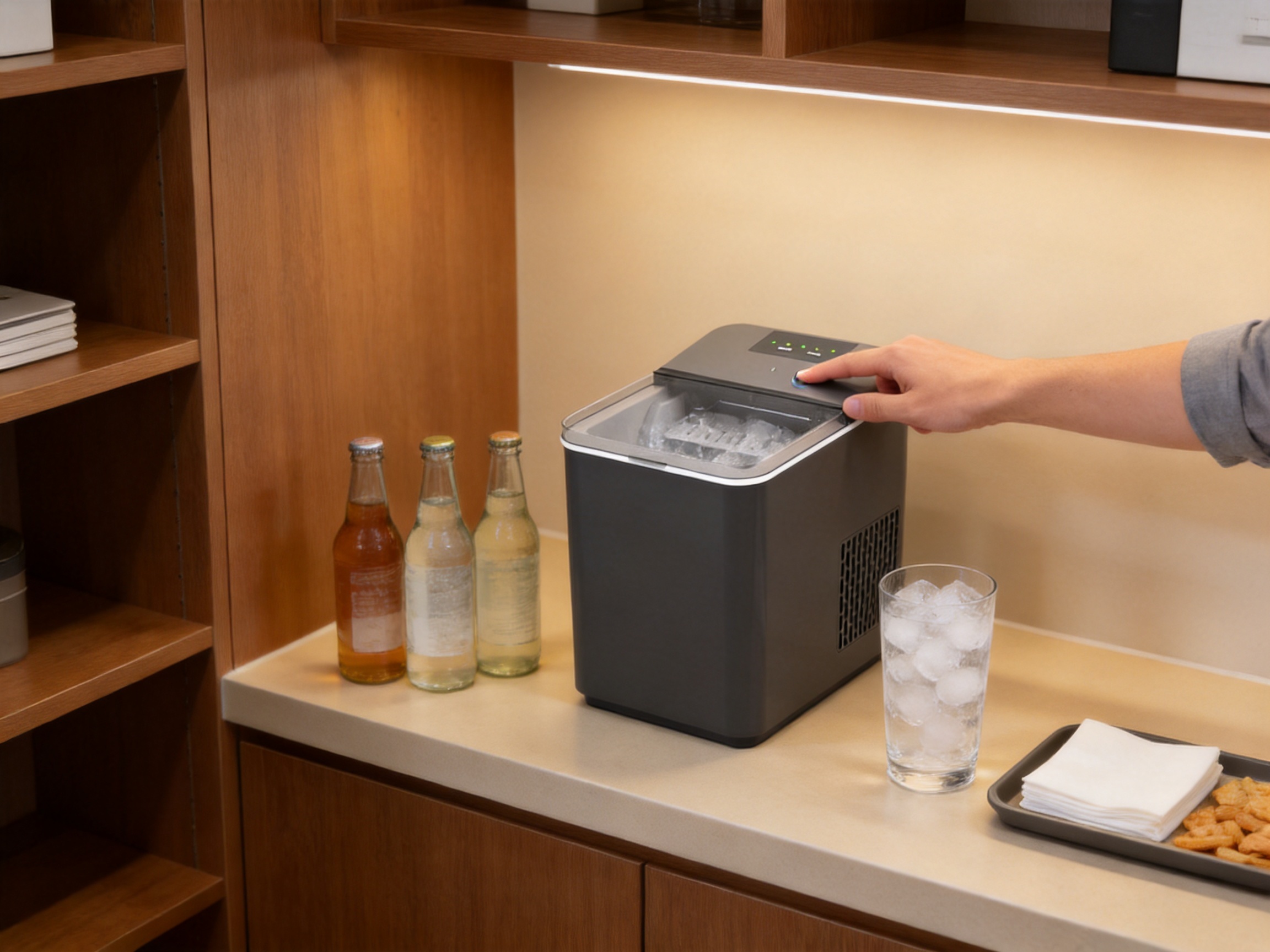
For many households and small businesses, ice is needed at short notice. A family may want chilled drinks during a warm afternoon, an office may need ice for refreshments, or a bar may require a steady supply during a busy service period. Traditional ice trays are inexpensive, but they require advance preparation, freezer space, and regular manual handling. Large commercial ice machines can solve capacity problems, but they often require more space, more complex controls, and a higher investment than many users need.
The Button-Operated Ice Maker is designed to occupy the useful middle ground between manual ice production and large commercial equipment. It provides automatic ice making in a compact form while keeping the control system straightforward. Instead of navigating a complicated interface, the user can start the machine with a simple button operation. This combination of convenience, portability, and practical performance makes the appliance suitable for homes, offices, bars, recreational vehicles, hospitality areas, and small commercial environments.
The product is identified as the Alien-Z03 and belongs to the bullet ice maker category. Its compact dimensions, measuring 313 × 226 × 309 millimeters, make it easier to position on a kitchen counter, service station, office pantry shelf, or other stable work surface. It operates on a 220V–240V, 50Hz power supply and uses a rated current and power specification of 0.9A and 150W. The cooling system uses R600a refrigerant with a 19-gram charge.
More than a simple appliance, this ice maker reflects a design approach centered on reducing daily effort. Its operating concept is easy to understand, its footprint is modest, and its functions address the main concerns of ordinary ice-making users: speed, ease of use, ice availability, energy awareness, noise, cleaning, and maintenance.
A Compact Ice-Making Solution for Everyday Use
Counter space is limited in many homes and workplaces. An ice maker that occupies too much room can create a new inconvenience while solving another one. The Button-Operated Ice Maker has a compact body measuring 313 × 226 × 309 millimeters. This footprint allows users to consider locations that may not be suitable for a full-size commercial machine.
In a home kitchen, the unit can be placed near a refrigerator, beverage station, dining area, or entertainment space. In an office, it can serve a pantry or break room without requiring a dedicated equipment area. In a bar or small café, it can be positioned close to the drink preparation zone. For recreational vehicles and other mobile living environments, its compact construction can be valuable where every centimeter of storage and counter space matters.
A small appliance is also easier to relocate when usage patterns change. Users may move it from a kitchen to a patio during a gathering, from a pantry to a meeting room, or from a storage area to a service counter. Although the machine should always be placed on a stable, level surface with suitable ventilation and electrical access, its dimensions support flexible installation compared with larger fixed ice-making systems.
Compact design does not mean that the appliance is limited to occasional use. The product is intended to produce fresh ice in repeated cycles. Its performance is therefore relevant to both everyday household needs and periods of increased demand, such as parties, family events, office meetings, small celebrations, and hospitality service.
Simple Button Operation Reduces Daily Effort
The central feature of this product is its button-operated control method. Many modern appliances offer numerous settings, digital menus, connected functions, and multi-step programming. Those features can be useful in some applications, but they may also create a learning curve. For an ice maker, many users primarily want to start production quickly and understand the machine’s status without unnecessary complexity.
With one-touch button control, operation is direct. The user can prepare the machine according to the operating instructions, add water, press the appropriate button, and allow the ice-making cycle to begin. This approach is suitable for first-time users and for shared environments where different people may operate the appliance throughout the day.
The simplicity of the controls can also support more consistent use. When an appliance is difficult to understand, users may postpone operating it, select unsuitable settings, or rely on manual workarounds. A clear button-based system reduces those barriers. In a family environment, older children and adults can learn the basic operating process quickly. In an office, employees do not need specialized training before using the machine. In a small business, staff members can incorporate it into beverage preparation without a long setup procedure.
Simple controls also have a practical advantage during busy periods. When a user is preparing drinks, serving guests, or managing several tasks at once, a direct interface helps reduce attention spent on the equipment. The machine is intended to perform its primary function—making ice—without demanding complicated interaction.
Accessible Operation for Different Environments
The same operating principle can be useful in multiple settings. At home, it supports convenient daily hydration and entertaining. In offices, it helps employees prepare cold drinks without repeatedly filling ice trays. In bars and cafés, it provides an additional ice source for beverages and service tasks. In recreational vehicles, it offers an alternative to depending entirely on freezer-based ice storage.
The machine is not described as a substitute for every high-capacity commercial ice system. Instead, its value comes from matching a broad range of moderate-volume needs with an easy operating method. Buyers who prioritize accessible controls may find this more useful than equipment overloaded with functions they do not need.
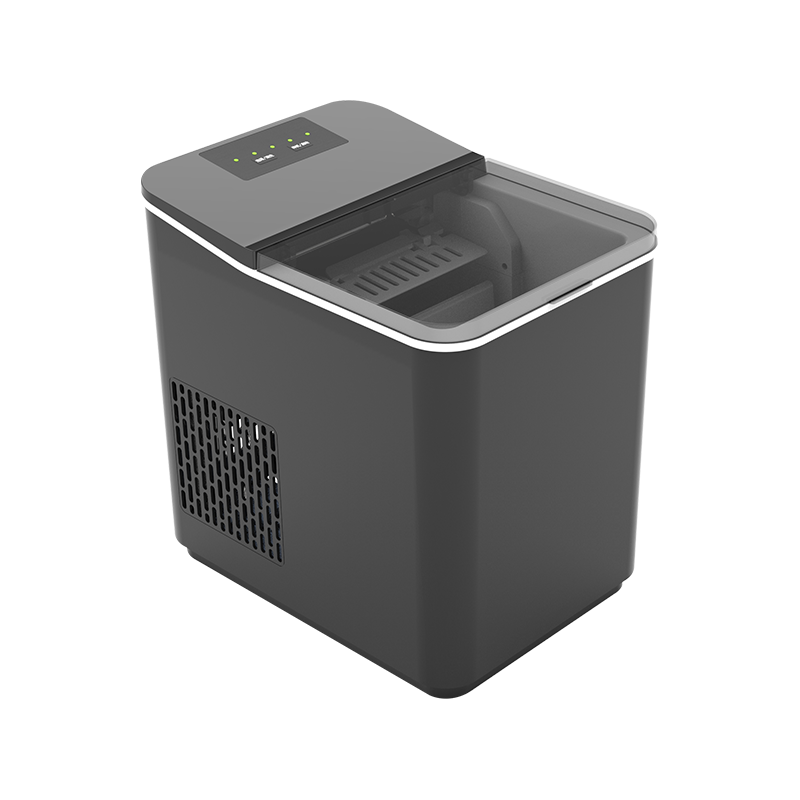
Button-Operated Ice Maker
Fast Ice Production for Short-Notice Demand
Waiting for conventional freezer trays can be inconvenient. Water placed in a tray may require several hours to freeze, and the resulting ice must then be removed manually. The Button-Operated Ice Maker is designed to produce ice in as little as 6–10 minutes per cycle. This cycle time gives users access to fresh ice much sooner than a conventional tray-based method.
Fast production is valuable because ice demand is often unpredictable. A household may unexpectedly receive guests. A worker may need cold drinks during a meeting. A small food-service operation may experience a temporary increase in orders. Instead of waiting for a freezer to complete a long freezing process, the user can begin a new cycle and replenish the available supply more quickly.
The 6–10-minute range should be understood as a stated operating capability rather than a guarantee that every cycle will take exactly the same amount of time. Actual performance can be influenced by factors such as room temperature, water temperature, ventilation, water level, operating condition, and the amount of ice already stored. Nevertheless, a short cycle time remains one of the product’s most important advantages over manual ice trays and slow household freezing methods.
Repeated cycles can help create a continuing supply during gatherings and normal daily operation. Users can remove finished ice when needed and allow the next cycle to begin according to the operating procedure. This supports a more responsive beverage station and reduces the need to plan ice production far in advance.
Fresh Ice When It Is Needed
Freshly produced ice can improve the convenience of drink preparation. Rather than storing large quantities in a freezer, users can make ice closer to the time of consumption. This can reduce dependence on freezer space and help keep the ice-making process separate from the storage of frozen foods.
The product is particularly useful for applications where ice is consumed steadily but not necessarily in industrial quantities. Examples include family kitchens, home bars, office beverage areas, guest rooms, small events, boutique hospitality settings, and recreational travel. In these environments, rapid access may matter more than the extremely high output of a large commercial machine.
Bullet Ice for Drinks and Everyday Applications
The product belongs to the bullet ice maker category. Bullet-style ice is commonly associated with a rounded, hollow or partially hollow form that is easy to use in cold beverages. Its shape can provide practical benefits in daily service because it fits naturally into cups, glasses, bottles, and beverage containers.
Bullet ice can be used for soft drinks, juices, iced coffee, cocktails, mocktails, smoothies, and chilled water. It may also be useful for temporary food presentation or for helping maintain the temperature of ingredients during preparation, provided that users follow appropriate food-safety practices. The appliance’s stated information also identifies applications such as food preservation and beverage service.
The rounded form is often comfortable to handle and visually appealing in a glass. It can help create the appearance of a well-prepared drink without requiring special molds or manual shaping. For home entertaining, the ice contributes to a more convenient serving experience. For small businesses, consistent ice form can support a more uniform presentation across multiple drinks.
Multiple Ice Sizes for Different Preferences
The machine is designed to offer different ice-size choices. This feature allows users to select ice according to the drink, container, or personal preference. Smaller pieces may be suitable for rapidly cooling beverages or fitting into narrow bottles. Larger pieces may be preferred in cocktails, tall glasses, or situations where slower melting is desirable.
Multiple size options provide more flexibility than a basic ice tray, which generally produces only one fixed shape and size. They also allow a household or business to adjust its ice-making routine to different occasions. A family may select one size for everyday drinks and another for weekend entertaining. A small café may choose a size that complements its beverage menu.
The exact suitability of each ice size will depend on the user’s chosen application and the machine’s operating instructions. Ice should always be handled cleanly and stored appropriately after production. The ability to select among sizes, however, gives the appliance a wider practical range than equipment designed around one unchanging ice format.
Energy-Conscious Operation
Energy use is an important consideration when purchasing an appliance that may operate repeatedly. The Button-Operated Ice Maker has a stated current and power specification of 0.9A and 150W. Its design is described as supporting low power consumption and optimized water usage.
A rated power of 150W places the product in a practical range for a compact household appliance. Users should still follow the product instructions regarding electrical connection, operating time, ventilation, and maintenance. Actual energy consumption depends on how frequently the unit runs, the ambient conditions, the water temperature, and the duration of use.
The energy-conscious design is valuable because users can obtain automatic ice production without operating a much larger machine than necessary. When an appliance is correctly matched to the required output, it may help avoid the unnecessary energy demand associated with oversized equipment. This is especially relevant for homes, offices, and small businesses that need regular access to ice but do not require the output capacity of a large institutional system.
Optimized water usage also supports practical operation. Water is consumed as part of the ice-making process, and efficient use can reduce the frequency of refilling. Less wasted water can simplify routine management while supporting more responsible household and workplace practices. Users should use clean water suitable for ice production and follow the recommended filling level to support reliable operation.
Practical Efficiency Compared with Conventional Methods
Efficiency should not be measured only by electrical power. It also includes time, labor, space, and convenience. A tray-based system may use little electricity, but it requires freezer capacity, manual filling, long freezing periods, and repeated removal. The Button-Operated Ice Maker addresses these hidden costs by automating production and shortening the waiting period.
Compared with an oversized commercial machine, the compact unit can be a more proportionate option for moderate demand. Buying equipment that matches the application can reduce unnecessary investment and simplify placement. In this way, the product’s efficiency is connected to its scale: it is designed to provide useful ice production without requiring the infrastructure associated with a much larger installation.
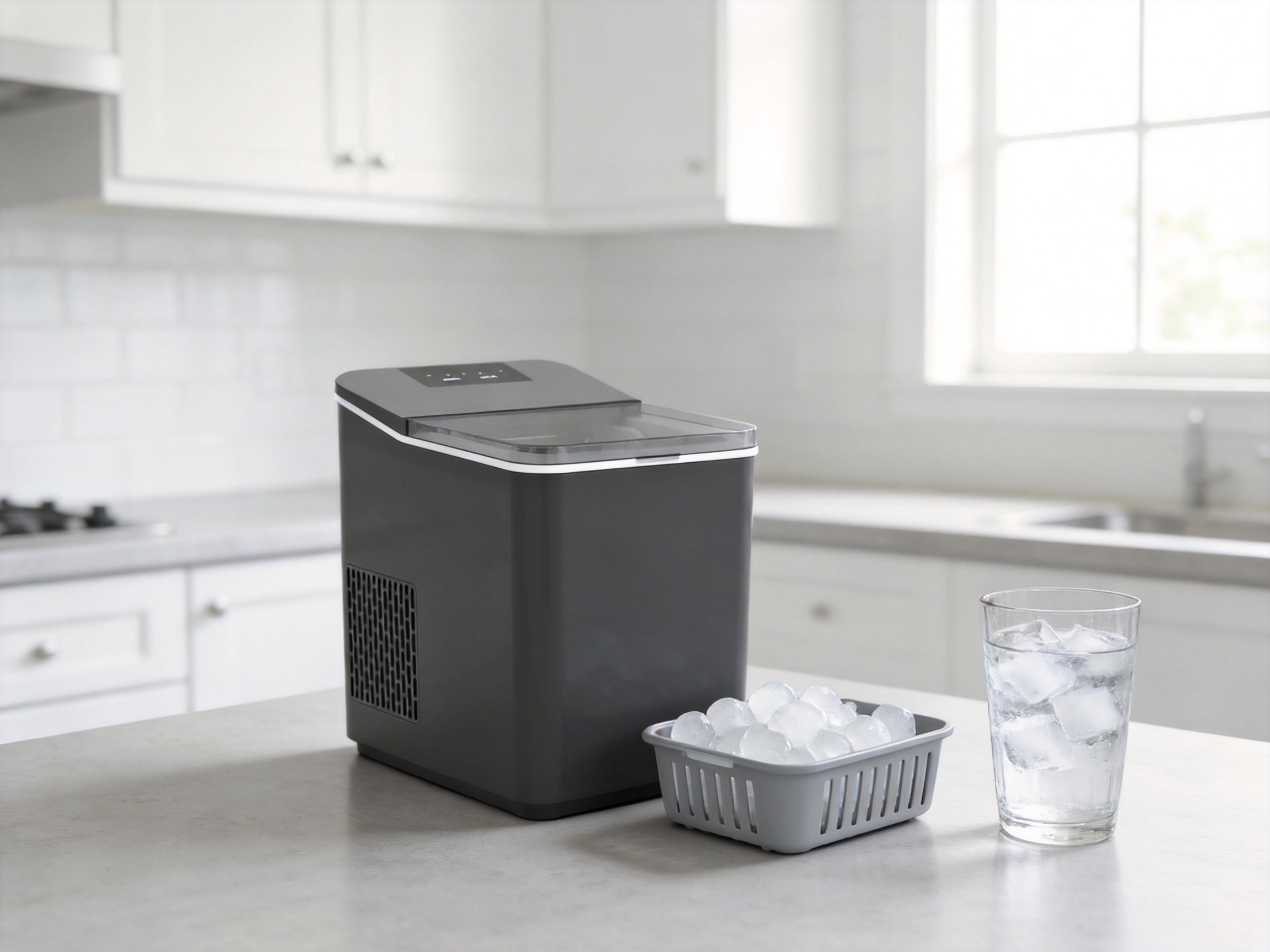
Quiet Operation for Shared Spaces
Noise can influence where an appliance can be used. A machine that is too loud may disturb conversations, work, sleep, or relaxation. The Button-Operated Ice Maker incorporates a noise-reduction design intended to keep operation quiet.
Quiet operation is especially helpful in kitchens connected to living rooms, open-plan offices, guest areas, and small hospitality spaces. Users can operate the machine while people are talking, working, watching television, or preparing meals. In bedrooms or other quiet areas, the reduced operating noise can make the appliance less disruptive, although the product should always be positioned according to safety and ventilation requirements.
Noise performance can vary depending on the surface beneath the machine, the levelness of the installation area, the condition of the unit, and the surrounding environment. A stable, level surface can help reduce vibration. Keeping adequate clearance around the machine can also support proper operation. Even with these considerations, a low-noise design is an advantage over equipment that creates excessive mechanical sound during each cycle.
Suitable for Home and Professional Settings
A quiet appliance is easier to integrate into daily routines. In the home, it can operate during meals or gatherings without becoming the center of attention. In an office, it can serve employees without creating a distracting background noise. In a bar or café, quieter operation contributes to a more comfortable atmosphere for customers and staff.
This characteristic also makes the product more versatile. Users do not need to restrict ice production to a specific time of day solely because of noise concerns. They can produce ice when demand requires it, subject to normal operational instructions and consideration for the surrounding space.
Easy Cleaning and Maintenance
Any appliance that produces an item intended for consumption should be kept clean. The Button-Operated Ice Maker is designed with smooth interior surfaces and a removable ice basket. These features are intended to make routine cleaning faster and simpler.
Smooth surfaces can reduce areas where water residue or debris might collect. A removable ice basket makes it easier to access, empty, wash, and dry the storage area. Together, these design elements can reduce the effort required for regular maintenance compared with appliances that have difficult-to-reach internal spaces.
Users should establish a cleaning routine based on frequency of use, water quality, and the product instructions. The machine should be switched off and disconnected from the power supply before cleaning when required by the instructions. Water should not be allowed to enter electrical components. The ice basket and accessible water-contact areas should be cleaned with appropriate methods, rinsed when necessary, and dried thoroughly.
Regular maintenance is useful for several reasons. It supports hygienic ice production, helps prevent unpleasant odors, reduces mineral buildup, and can contribute to reliable operation. If the appliance is used in an office, restaurant, or other shared environment, a written cleaning schedule can help ensure that responsibility is clear.
Maintenance as a Long-Term Advantage
Easy maintenance is not merely a convenience feature. It can influence the useful life and dependable performance of an appliance. Equipment that is difficult to clean may be neglected, while equipment with accessible components is more likely to receive consistent care.
The removable basket and smooth interior surfaces support a more practical maintenance routine. They also make it easier for users to inspect the ice-contact area. If unusual residue, odor, or reduced performance appears, early cleaning and inspection may help identify the issue before it becomes more serious.
Users should not use abrasive tools, unsuitable chemicals, or unauthorized methods that could damage internal surfaces. Descaling procedures, if required by local water conditions or the product manual, should be performed according to the manufacturer’s instructions. Good maintenance combines appropriate cleaning materials, correct operating practices, and timely attention to unusual sounds or performance changes.
Technical Specifications at a Glance
Product Type |
Button-operated bullet ice maker |
Product Identification |
Alien-Z03 |
Power Supply |
220V–240V / 50Hz |
Current |
0.9A |
Rated Power |
150W |
Refrigerant |
R600a |
Refrigerant Charge |
19g |
Machine Dimensions |
313 × 226 × 309mm |
Ice Category |
Bullet ice |
Operating Method |
One-touch button operation |
Stated Cycle Time |
As little as 6–10 minutes per cycle |
Ice Options |
Multiple ice sizes |
The specifications show that the machine is designed as a compact, moderate-power appliance rather than a large fixed commercial installation. The 220V–240V, 50Hz power range is suitable for markets and facilities that use this electrical standard, while buyers should always confirm compatibility before purchase or installation.
The R600a refrigerant specification identifies the cooling medium used by the appliance. Refrigerant systems should not be opened, modified, or serviced by unqualified users. Any technical service involving the sealed cooling circuit should be handled by appropriately trained personnel and in accordance with applicable safety requirements.
Advantages Over Common Alternatives
Consumers generally compare an ice maker with several alternatives: freezer trays, refrigerator ice dispensers, large commercial ice machines, and basic countertop units with more complicated controls. The Button-Operated Ice Maker offers a balanced set of features that can make it attractive in these comparisons.
Compared with Ice Trays
Ice trays require manual filling, freezer space, and a long waiting period. They also require users to twist or manipulate the tray to release the ice. The Button-Operated Ice Maker automates the freezing process, produces ice more quickly, and can offer multiple ice sizes. It is therefore more convenient for users who need ice regularly or on short notice.
Trays remain a low-cost solution for very occasional use, but they do not provide the same level of speed or automation. The countertop machine is better suited to users who value time savings and a steady supply of fresh ice.
Compared with Refrigerator Ice Systems
Some refrigerators include built-in ice-making systems, but these systems are not available in every model and may depend on the refrigerator’s internal design. They also use freezer space and may be inconvenient when the user needs ice in a separate location.
A standalone ice maker can be placed where ice is actually needed. It can serve a beverage station, office, event area, or recreational vehicle without requiring a refrigerator replacement. This flexibility is a key advantage for users who already own a refrigerator but want faster, more accessible ice production.
Compared with Large Commercial Machines
Large commercial ice machines can produce substantial quantities, but they usually require more space, a larger investment, and a more structured installation. They may be unnecessary for a household, small office, or business with moderate demand.
The compact Button-Operated Ice Maker provides a more proportionate solution for smaller applications. Its simple controls, modest power specification, compact dimensions, and easy-cleaning design reduce the practical barriers associated with larger equipment. It is not intended to replace high-volume commercial infrastructure, but it can be a more efficient choice when the required output is moderate.
Compared with Complicated Countertop Appliances
Some countertop ice makers offer numerous controls that may not be important to every user. A button-operated design emphasizes direct use. It can be particularly appealing to buyers who prefer clear operation over extensive programming.
This focus on simplicity can also reduce training needs in shared spaces. Instead of explaining multiple menus and modes, a household or business can provide basic instructions for starting the machine, selecting an available ice size, monitoring the ice basket, and performing routine cleaning.
Manufacturing Strengths and Product Development Approach
The Button-Operated Ice Maker is manufactured by Alien Technology Co., Ltd., a company located in Zhouxiang, Zhejiang Province. The area is identified as a hub for small household appliances with convenient logistics. This location provides a relevant manufacturing context for a company specializing in appliances such as ice makers, coffee machines, and air fryers.
A manufacturer focused on several related household-appliance categories can develop experience in compact appliance design, component integration, thermal management, user-interface development, assembly coordination, and product quality control. These capabilities are important for an ice maker because the appliance combines a refrigeration system, water-contact components, electrical controls, mechanical structures, and an ice-storage area in one compact body.
The company’s stated mission is “Smart Technology, Simplifying Life, Enhancing Happiness.” This mission is reflected in the product’s emphasis on practical automation rather than unnecessary complexity. A one-touch interface, compact construction, rapid cycle design, multiple ice-size options, low power consumption, quiet operation, and easy maintenance all support the goal of simplifying a daily task.
The company also states that it pursues excellent quality, customer satisfaction, continuous improvement, and innovation. These principles are important in household-appliance manufacturing because the final user evaluates a product through repeated everyday interactions. A machine may be technically functional, but long-term satisfaction also depends on whether it is easy to operate, simple to clean, quiet enough for its environment, and appropriately sized for the intended application.
Integration of Multiple Appliance Functions
Although the product is compact, its manufacture requires the coordinated integration of several systems. The power system must support the specified 220V–240V, 50Hz input. The refrigeration system must operate with the stated R600a refrigerant and charge. The water path must deliver water to the ice-making area. The control system must respond to button input and coordinate the production cycle. The housing must protect internal parts while providing access to the ice basket and cleaning areas.
Successful manufacturing depends on the compatibility of these systems. A well-designed product is not simply a collection of individual components. The parts must fit within the 313 × 226 × 309mm body, work together safely, and support the intended operating experience. The company’s specialization in small household appliances is relevant because these products require careful attention to compact assembly and user-centered details.
Manufacturing in a Specialized Appliance Region
Zhejiang’s established small-appliance manufacturing environment can support access to suppliers, production services, logistics networks, and technical resources. A location within such a manufacturing hub may help a company coordinate component procurement and product distribution more efficiently.
Convenient logistics are particularly valuable for serving customers in different markets. They can support the movement of finished appliances, replacement parts, packaging materials, and production components. The result is a manufacturing and supply structure suited to household appliances that must be produced consistently and delivered reliably.
The company’s business philosophy is described as stable and pragmatic. This approach is well matched to appliances used every day. Innovation is valuable, but it should be combined with dependable construction, understandable controls, and attention to production consistency. The Button-Operated Ice Maker demonstrates this balance by applying useful technology to a familiar need without making the user experience unnecessarily complicated.
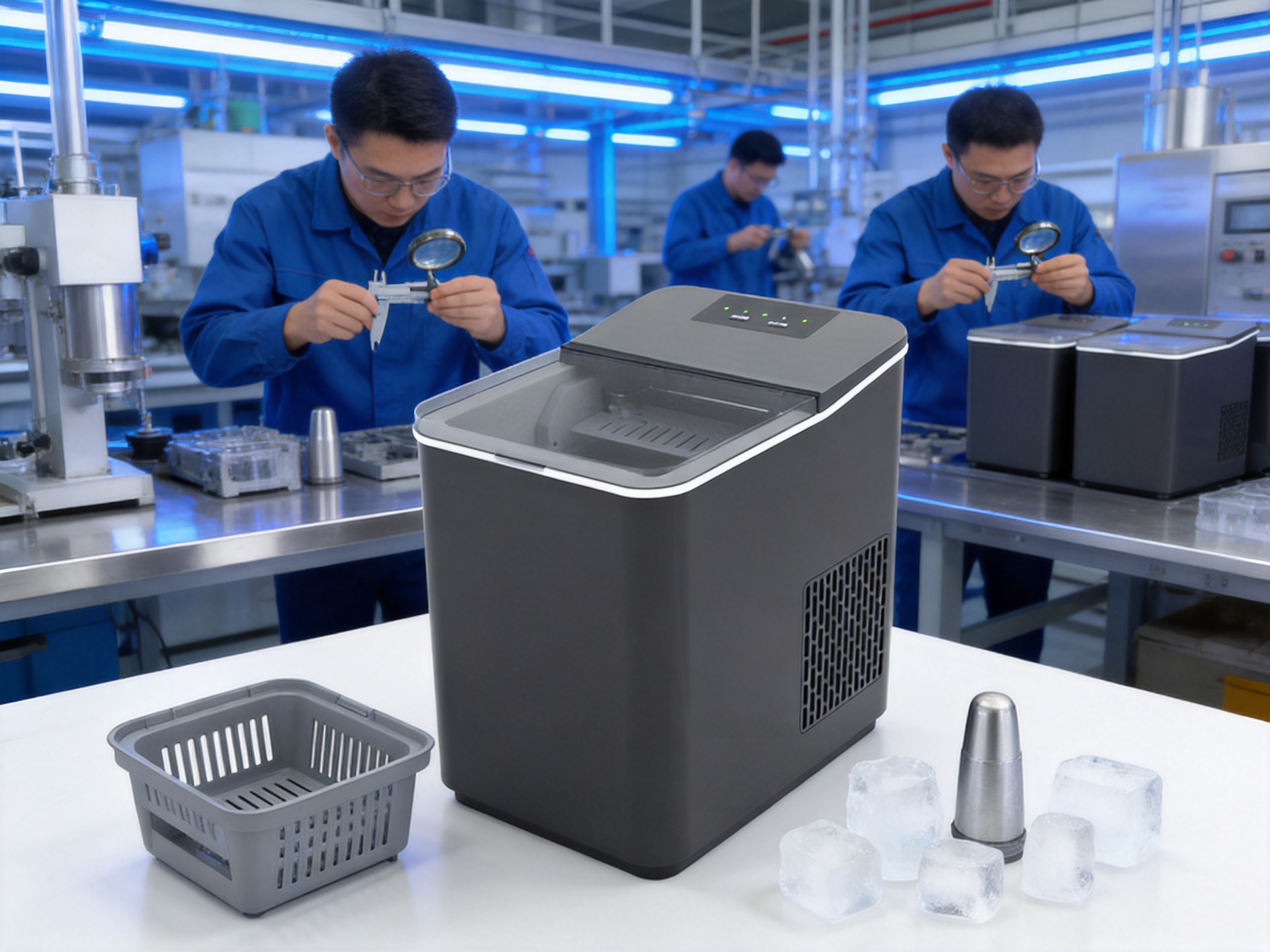
Quality-Oriented Production Considerations
Household ice makers operate in a demanding environment because they combine water, electricity, cooling, repeated thermal cycling, and frequent user contact. Manufacturing quality therefore involves more than appearance. It includes dimensional consistency, secure assembly, reliable electrical connections, appropriate insulation, effective sealing, stable control response, and proper coordination of the refrigeration and water systems.
For a product with a compact body, dimensional control is especially important. Components must be positioned accurately so that the ice basket, water areas, housing panels, control elements, and refrigeration parts function without interference. Consistent assembly can help support quiet operation and reduce unwanted vibration.
Water-contact areas require particular attention because residues and mineral deposits can affect performance and hygiene. Smooth interior surfaces and a removable basket demonstrate an effort to make these areas more accessible to the user. From a manufacturing perspective, such features also reflect the importance of designing for the complete product life cycle, including cleaning and maintenance after the appliance leaves the factory.
The use of a specified refrigerant and charge also requires controlled production procedures. The sealed cooling circuit must be assembled and charged appropriately. Refrigeration-related work should be performed using suitable equipment and trained personnel. Correct handling supports both product performance and safe operation.
Continuous Improvement Through User Needs
Continuous improvement is most effective when it responds to real user concerns. In the ice-maker category, those concerns commonly include waiting time, complex controls, excessive noise, difficult cleaning, limited ice choices, and excessive space requirements. The product addresses each of these areas through a short stated cycle time, one-touch operation, noise reduction, accessible cleaning features, multiple ice sizes, and compact dimensions.
This user-centered approach can help manufacturers prioritize improvements that have a direct effect on satisfaction. It also allows product development to remain practical. Instead of adding features only for novelty, the company can focus on changes that make the machine easier and more dependable to use.
A manufacturer with experience in coffee machines and air fryers can also benefit from cross-category knowledge. These appliances share several development needs, including compact heating or cooling structures, user-friendly controls, easy-cleaning surfaces, energy awareness, and dependable daily operation. Experience gained across product categories can encourage broader engineering and quality perspectives.
Where the Button-Operated Ice Maker Fits Best
Home Kitchens
In a home kitchen, the machine can supplement a refrigerator that does not produce enough ice or does not make ice quickly enough. It may be useful for families that regularly prepare cold beverages, smoothies, iced coffee, and mixed drinks. Its compact size helps preserve counter space, while button operation reduces the effort required to begin a cycle.
The product can also support entertaining. During a party or family gathering, guests may consume ice faster than expected. A countertop machine provides an additional source without requiring the host to buy and store large bags of ice or continually refill trays.
Home Bars and Entertainment Areas
Home bars benefit from convenient access to ice in the same area where beverages are prepared. Moving back and forth to a kitchen freezer can be inconvenient, particularly when the entertainment area is separate. A compact ice maker can help organize the drink station and provide different ice sizes for various beverages.
Quiet operation is useful in social settings because the appliance can work in the background. The simple control method also means that the host does not need to interrupt preparations to manage complicated settings.
Offices and Workplace Pantries
In an office, a dedicated ice maker can serve employees during meetings, lunch breaks, and daily beverage use. The machine can reduce dependence on freezer trays and help maintain a more organized pantry. The one-touch control method is suitable for shared operation, while the compact footprint is practical in areas where storage and counter space are limited.
Workplace users should establish clear procedures for refilling, emptying, cleaning, and reporting any issue. This helps preserve hygiene and ensures that the appliance remains available to everyone.
Bars, Cafés, and Small Food-Service Businesses
Small businesses may need an additional ice source without installing a large commercial machine. The Button-Operated Ice Maker can support moderate beverage demand, special events, temporary service areas, or backup requirements. Multiple ice sizes can provide flexibility for different drinks, and rapid cycles can help replenish the supply during busy periods.
Businesses should evaluate expected demand carefully. If an operation requires continuous high-volume ice production, it may need specialized commercial equipment with a larger storage capacity and output. For moderate requirements, however, a compact unit can offer a useful balance of cost, space, convenience, and operational simplicity.
Recreational Vehicles and Mobile Use
Recreational vehicles often have limited freezer capacity and restricted counter space. A compact ice maker can be helpful during travel when users want fresh ice without relying entirely on campground facilities, roadside purchases, or a small freezer compartment.
Before using the machine in a mobile environment, users should confirm that the available power supply matches the product’s 220V–240V, 50Hz requirement and that the machine can be placed securely. It should not be operated in a way that allows movement, tipping, or inadequate ventilation.
Responsible Installation and Operation
Correct installation supports safe and reliable use. The appliance should be placed on a stable, level surface that can support its weight and resist moisture. Adequate clearance should be maintained around ventilation areas according to the operating instructions. The power supply should match the stated 220V–240V, 50Hz requirement.
Users should inspect the power cord and plug before operation. The appliance should not be used if the cord, plug, housing, or internal components appear damaged. Water should be added according to the recommended level, and the ice basket should be emptied when necessary to maintain available storage space.
Ice intended for consumption should be produced using clean, suitable water. The basket and water-contact areas should be cleaned regularly. Ice that has been exposed to dirt, chemicals, or unsanitary conditions should not be consumed.
The machine should not be modified by the user. In particular, the sealed refrigeration circuit and refrigerant system should be serviced only by qualified personnel. R600a is a flammable refrigerant, so service, disposal, and transportation should follow applicable safety requirements.
Best Practices for Consistent Performance
Users can support consistent results by avoiding extreme ambient conditions, keeping the machine ventilated, and not overfilling the water reservoir. Allowing the unit to remain level helps the water and refrigeration systems operate as intended. Cleaning mineral deposits and residue can also help maintain performance over time.
When the appliance is not required for an extended period, it should be emptied, cleaned, dried, and stored according to the product instructions. This is particularly important before transportation or seasonal storage.
Questions and Answers
What is a button-operated ice maker?
A button-operated ice maker is a countertop appliance that produces ice through a simple control interface. The user supplies water, selects the appropriate available setting when necessary, and starts the production cycle with a button. The Button-Operated Ice Maker is designed to make bullet ice for homes, offices, bars, recreational vehicles, and small commercial spaces.
How quickly can it make ice?
The stated production time is as little as 6–10 minutes per cycle. Actual results can vary according to room temperature, water temperature, ventilation, water level, and operating conditions. The short cycle time is intended to provide ice more quickly than conventional freezer trays.
Does the machine offer different ice sizes?
Yes. The product information states that users can choose from different ice sizes. The most suitable size depends on the beverage, container, serving style, and personal preference.
What type of ice does it produce?
The machine belongs to the bullet ice maker category. Bullet ice is commonly used in soft drinks, juices, iced coffee, cocktails, smoothies, and other chilled beverages.
Where can the ice maker be used?
It is designed for homes, offices, bars, recreational vehicles, and small commercial spaces. It can be placed on a suitable counter or service surface, provided that the location is stable, level, properly ventilated, and connected to a compatible power supply.
How large is the machine?
Its stated dimensions are 313 × 226 × 309 millimeters. This compact size makes it suitable for many counters, pantries, beverage stations, and other areas where space is limited.
What power supply does it require?
The product is specified for 220V–240V and 50Hz operation. Buyers should confirm that their local electrical supply is compatible before use.
How much power does it use?
The stated current and power specifications are 0.9A and 150W. Actual energy consumption depends on operating frequency, cycle duration, ambient conditions, and other factors.
Which refrigerant does it use?
The machine uses R600a refrigerant with a stated charge of 19 grams. The refrigeration circuit should not be opened or serviced by unqualified users.
Is it noisy?
The product incorporates a noise-reduction design intended to support quiet operation. Actual sound levels can be influenced by the installation surface, ventilation, room acoustics, and operating condition.
Is cleaning difficult?
The machine is designed with smooth interior surfaces and a removable ice basket. These features are intended to make cleaning and maintenance more convenient. Users should follow the product instructions and clean the water-contact and ice-contact areas regularly.
Can it replace a large commercial ice machine?
It may be suitable for moderate household, office, hospitality, and small-business requirements, but it is not necessarily a replacement for high-volume commercial equipment. Businesses should compare expected ice demand, operating hours, storage capacity, and local requirements before selecting equipment.
What makes it different from an ice tray?
It automates ice production, offers a much shorter stated cycle time, reduces the need for freezer space, and can provide multiple ice sizes. An ice tray may remain suitable for occasional use, but the machine is more convenient for regular or short-notice demand.
Who manufactures the product?
The product is manufactured by Alien Technology Co., Ltd., a Zhejiang-based company specializing in household appliances such as ice makers, coffee machines, and air fryers.
What are the company’s manufacturing strengths?
The company operates in Zhouxiang, Zhejiang Province, a location associated with small household-appliance manufacturing and convenient logistics. Its stated strengths include specialization in household appliances, a focus on quality and customer satisfaction, continuous improvement, innovation, and a stable and pragmatic business philosophy.
How should users maintain the machine?
Users should clean the ice basket and accessible water-contact surfaces regularly, keep the interior dry when the machine is stored, avoid unsuitable cleaning products, and follow the manufacturer’s operating instructions. Any refrigeration or electrical repair should be handled by qualified service personnel.
Overall Value of the Product
The Button-Operated Ice Maker is built around a clear proposition: provide fresh bullet ice quickly without forcing users to manage a complicated appliance. Its one-touch operation makes the product accessible, while the stated 6–10-minute cycle time addresses the common frustration of waiting for ice. Multiple ice sizes add flexibility, and the compact dimensions make the unit easier to place in homes, offices, bars, recreational vehicles, and small businesses.
Its 150W power specification and low-consumption design support practical everyday use, while the noise-reduction approach makes it more suitable for shared living and working spaces. Smooth interior surfaces and a removable basket address the important task of cleaning. These features work together to create a product focused on convenience rather than unnecessary complexity.
The manufacturer’s location and specialization also contribute to the product’s positioning. Alien Technology Co., Ltd. operates within a recognized small-appliance manufacturing environment and focuses on products that simplify daily life. Its experience across ice makers, coffee machines, and air fryers provides a foundation for developing compact appliances that combine functional systems, practical controls, and user-oriented maintenance features.
For buyers comparing alternatives, the strongest reason to consider this machine is balance. It offers more speed and automation than ice trays, more placement flexibility than refrigerator-based ice systems, less complexity and infrastructure than many large commercial machines, and a straightforward experience compared with overly complicated countertop equipment.
As with any appliance, the best results depend on matching the product to the intended application. Users should confirm electrical compatibility, maintain proper ventilation, clean the machine regularly, and assess whether the expected ice demand is moderate or industrial. When used in an appropriate setting, the Button-Operated Ice Maker can provide a convenient, space-conscious, and efficient way to keep fresh ice available throughout the day.
References
Alien Technology Co., Ltd. Product specification sheet for the Button-Operated Ice Maker, product identification Alien-Z03.
Alien Technology Co., Ltd. Product information describing one-touch operation, cycle time, ice-size selection, energy-conscious operation, noise reduction, and cleaning features.
Alien Technology Co., Ltd. Company profile and manufacturing information concerning household appliances, company mission, quality principles, and business philosophy.
General household-appliance safety guidance concerning electrical compatibility, ventilation, cleaning, water-contact surfaces, and qualified service.
General refrigeration safety guidance concerning the handling and servicing of R600a refrigerant systems.