 English
 한국어
 Español
 Deutsch
Introduction
Fresh ice is no longer limited to a freezer tray or a large commercial ice machine. Compact countertop ice makers have become a practical solution for homes, offices, bars, recreational vehicles, hospitality spaces, and small food-service businesses. They provide ice on demand, reduce dependence on freezer storage, and make it easier to serve chilled drinks whenever they are needed.
The Button-Operated Ice Maker is designed around this idea of convenience. It combines simple one-touch operation, fast ice production, compact dimensions, multiple ice-size options, low power consumption, and quiet performance in a small household appliance. Its straightforward interface makes it suitable for users who want reliable ice without complicated settings, lengthy installation, or extensive technical knowledge.
Behind the product is Alien Technology Co., Ltd., a Zhejiang-based manufacturer specializing in small household appliances, including ice makers, coffee machines, and air fryers. The company’s product development philosophy focuses on humanized design, dependable quality, continuous improvement, and practical innovation. These principles are especially relevant to an appliance that is used frequently and expected to work with minimal user intervention.
This article examines the product’s design, operating advantages, technical specifications, likely use cases, maintenance requirements, manufacturing strengths, and competitive position. It also explains what buyers should consider when comparing a compact ice maker with alternative products.
Button-Operated Ice Maker
Product Overview
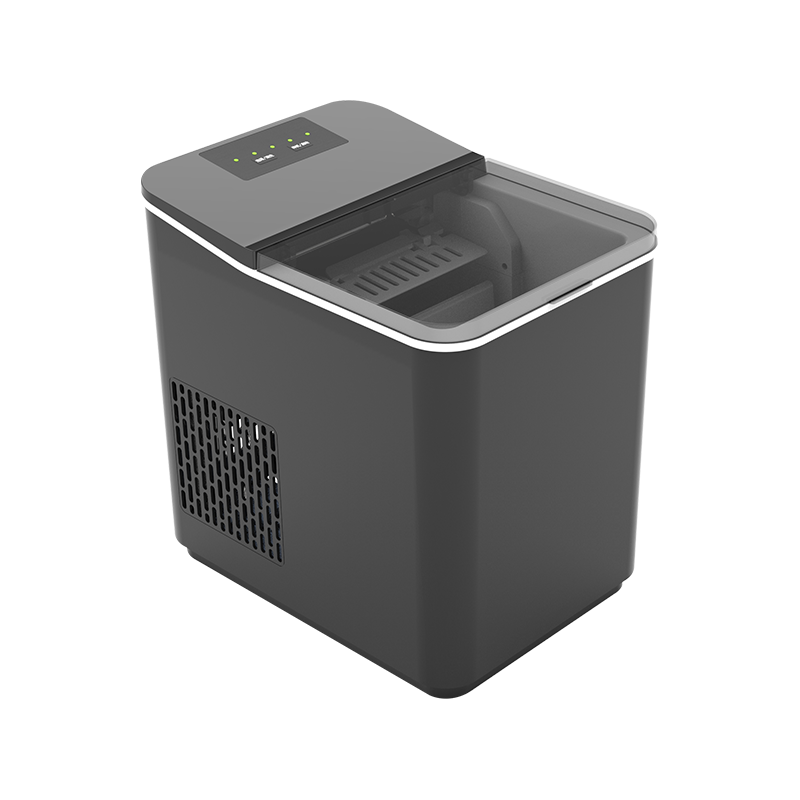
The Button-Operated Ice Maker is a compact bullet ice maker identified by the model description Alien-Z03. It is intended to produce fresh ice in short cycles rather than store a large quantity of ice for extended periods. This operating principle makes it particularly useful for people who need a steady supply of ice during meals, gatherings, working hours, or recreational activities.
The unit uses a one-touch button control system. Instead of navigating multiple menus or adjusting complicated programming options, the user can begin the ice-making process with a simple button press. This makes the machine accessible to different age groups and suitable for locations where several people may use the appliance throughout the day.
Its dimensions are 313 x 226 x 309 millimeters, allowing it to fit on many kitchen counters, service stations, office tables, bar counters, and compact storage areas. The relatively small footprint is an important advantage for users who want an ice maker but do not have space for a full-size appliance.
The machine operates on a 220V-240V, 50Hz power supply and has a rated current and power specification of 0.9A and 150W. It uses R600a refrigerant with a listed charge of 19 grams. These specifications indicate a compact refrigeration system designed for efficient countertop operation.
Product Attribute |
Specification or Description |
Product Type |
Button-operated bullet ice maker |
Model Description |
Alien-Z03 |
Power Supply |
220V-240V / 50Hz |
Current and Power |
0.9A / 150W |
Refrigerant |
R600a, 19g charge |
Machine Dimensions |
313 x 226 x 309 mm |
Operation |
One-touch button control |
Ice Format |
Bullet-shaped ice |
Typical First Cycle |
Approximately 6 to 10 minutes, depending on conditions |
How the Ice Maker Works
A compact ice maker generally works by circulating refrigerant through a sealed cooling system. Water from the internal reservoir is directed toward a chilled ice-making surface. As the surface removes heat from the water, ice forms around the corresponding freezing points. Once the ice reaches the required size, the machine releases it into the removable basket, allowing the next cycle to begin.
The Button-Operated Ice Maker is designed for repeated short cycles. Its stated production time of approximately 6 to 10 minutes per cycle gives users access to fresh ice without waiting for a freezer tray to freeze completely. Actual timing can vary according to room temperature, water temperature, ventilation, water level, and the selected ice size.
Bullet ice is a practical format for everyday drinks. It is generally rounded at one end and hollow or partially hollow, which allows it to cool beverages efficiently while remaining easy to scoop and serve. Bullet ice can be used in soft drinks, iced coffee, fruit beverages, cocktails, smoothies, water bottles, and casual food presentation.
The machine is not intended to replace a high-capacity commercial ice production system. Instead, it serves users who value flexibility, portability, and ease of use. By producing ice when required, it can reduce the need to maintain a large frozen inventory and can help users avoid the inconvenience of filling and emptying traditional ice trays.
One-Touch Operation and Everyday Convenience
One of the clearest advantages of this product is its simple control method. A button-operated design reduces the learning curve and makes the appliance easy to integrate into daily routines. The user adds suitable drinking water, connects the machine to the correct power supply, presses the operating button, and allows the appliance to begin its cycle.
This simplicity is valuable in a busy kitchen. When preparing drinks for guests, users often want to concentrate on food, conversation, or service rather than manage a complicated appliance. A straightforward control system reduces unnecessary steps and allows the ice maker to perform its primary function with minimal supervision.
The same benefit applies to offices and shared spaces. A machine with an intuitive button layout is easier for multiple users to operate correctly. It also reduces the possibility of incorrect settings caused by unfamiliar controls. In an office break room, for example, employees can quickly start a cycle without needing a detailed explanation.
For older users, first-time appliance owners, and family members with different levels of technical confidence, simple operation can be more useful than a large number of advanced settings. The product concentrates on the core function of making ice and avoids adding complexity that may not improve the everyday experience.
One-touch control can also support better consistency. When the operating procedure is easy to understand, users are more likely to use the machine correctly, clean it regularly, and follow the recommended water and placement instructions.
Fast Ice Production for Daily Demand
The product is designed to produce ice in approximately 6 to 10 minutes per cycle. This short cycle time is a major advantage over conventional ice trays, which may require several hours before the ice is ready. It is also useful when unexpected visitors arrive or when a drink station needs additional ice during service.
Fast production does not mean that the machine must operate continuously without attention. Users should consider the capacity of the basket and the amount of ice required for a specific occasion. For casual household use, the machine can provide a convenient supply throughout the day. For a large party or commercial event, several machines or a higher-capacity system may be more appropriate.
The speed of each cycle may be affected by environmental conditions. A warm room, hot water, poor ventilation, or frequent opening of the lid can extend production time. Positioning the machine in a cool, well-ventilated area and filling it with clean, reasonably cool water can help support more consistent performance.
Compared with freezer-based ice production, the principal advantage is availability. Users do not have to plan several hours ahead. They can begin production close to the time they need ice. This is particularly useful for iced coffee, cold beverages, outdoor gatherings, and situations where freezer space is already occupied by food.
Multiple Ice Sizes for Different Uses
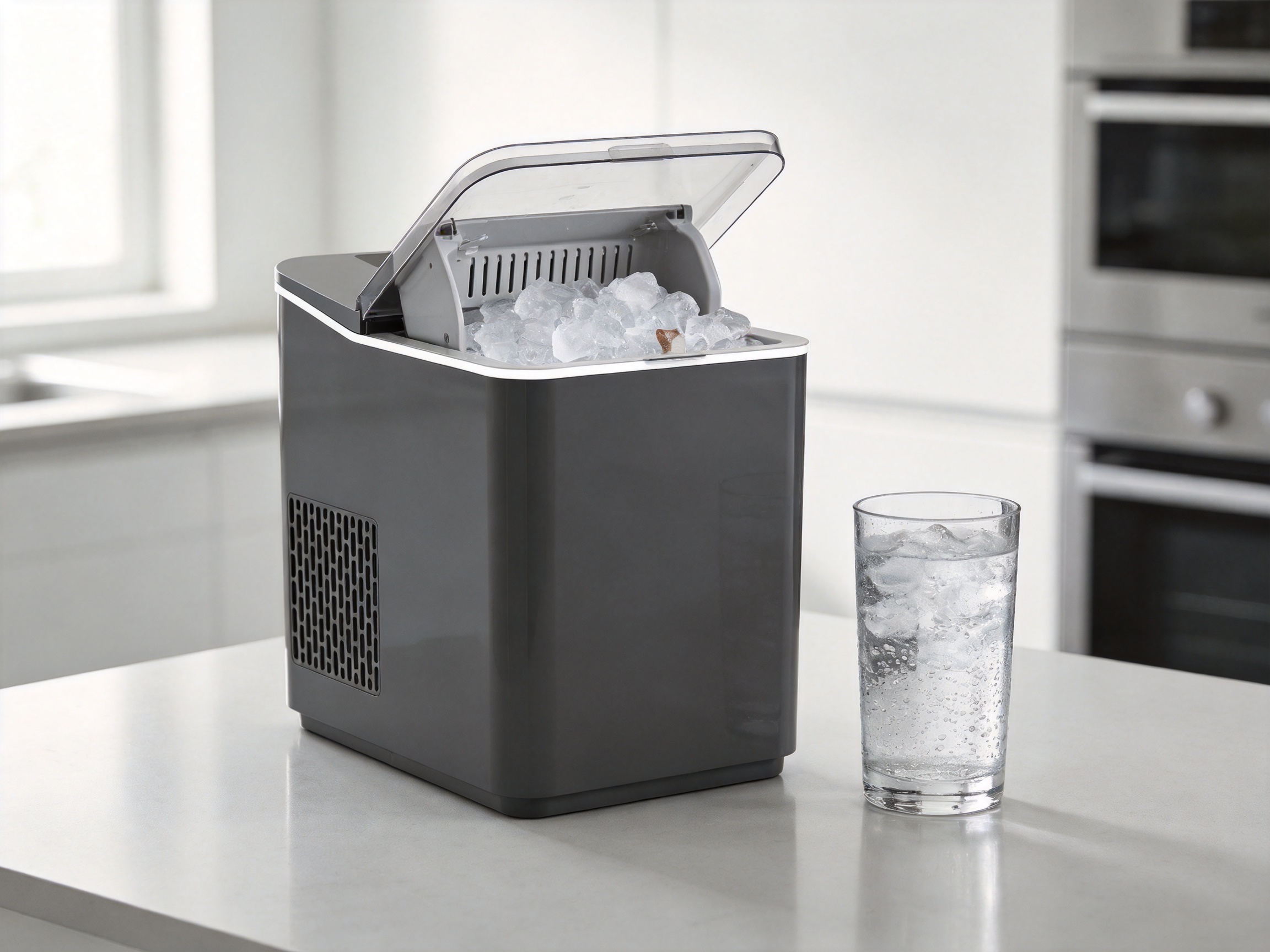
The Button-Operated Ice Maker supports the selection of different ice sizes. This feature gives users greater control over the way ice is used in drinks and food service. Smaller pieces may be suitable for quick cooling, blended drinks, or situations where the ice needs to fit into a narrow bottle. Larger pieces may be preferred for longer-lasting chilling in a glass or serving container.
Different beverage types benefit from different ice formats. A cold soft drink may require a moderate quantity of ice, while a cocktail may benefit from a larger piece that melts more slowly. Smoothies and blended beverages may use ice as part of the texture, while a serving bowl may require ice for temporary cooling rather than direct consumption.
Ice-size selection also provides a degree of personalization. Household members can choose the setting they prefer, and hospitality operators can select an appropriate option for different menus. While a compact machine cannot offer the same range as a specialized commercial ice system, multiple sizes make it more adaptable than a basic single-option device.
Users should remember that the selected size can influence cycle duration. Larger ice pieces may require more freezing time, while smaller pieces may be ready sooner. For the best results, the selected setting should match the intended use rather than always defaulting to the largest option.
Compact Dimensions and Flexible Placement
Measuring 313 x 226 x 309 millimeters, the appliance is designed to occupy limited counter space. Compact dimensions are especially important in modern homes, apartments, office kitchens, recreational vehicles, guest rooms, and small cafés where every surface must be used efficiently.
The machine can be placed near a beverage station, beside a coffee machine, on a kitchen counter, or in an office refreshment area. Its relatively small footprint allows users to keep it available when needed and move it to storage when it is not in use. However, the machine should always be placed on a stable, level surface with sufficient clearance for ventilation.
Compact placement can improve workflow. In a home, the ice maker can stand near the refrigerator and drinkware. In an office, it can be located close to a water dispenser or coffee area. In a bar or hospitality setting, it can provide supplemental ice near a service point without requiring a large floor-standing unit.
Portability is also useful for recreational applications. The product may be suitable for RVs and other mobile environments when the electrical supply matches the appliance requirements. Users should verify voltage, frequency, available counter space, ventilation, and safe operating conditions before installing it in a vehicle or mobile facility.
Energy-Conscious Refrigeration
The rated power of 150W reflects the product’s compact design and supports efficient countertop operation. A smaller machine can be more economical to operate than a large commercial unit when the user’s ice requirements are modest. It also avoids the need to run a large freezer solely for ice production.
Energy consumption in real use depends on several factors, including ambient temperature, production frequency, selected ice size, water temperature, operating duration, and maintenance. A well-ventilated machine generally has a better opportunity to release heat efficiently than one placed tightly against a wall or surrounded by other warm appliances.
The use of R600a refrigerant is another notable technical characteristic. R600a, or isobutane, is widely used in certain compact refrigeration appliances because of its thermodynamic performance and relatively low global warming potential compared with some older refrigerants. Because it is flammable under specific conditions, servicing of the sealed refrigeration system should be performed only by qualified personnel using appropriate procedures.
Energy-conscious operation does not require sacrificing convenience. Users can produce only the amount of ice they need, switch off the machine when the day’s demand is complete, and avoid unnecessary continuous operation. Regular cleaning and proper ventilation can also support efficient heat transfer and stable performance.
Quiet Operation for Shared Environments
Noise is an important consideration for countertop appliances. An ice maker may be used in kitchens, bedrooms, offices, reception areas, or entertainment spaces. Excessive noise can make an appliance uncomfortable to use, especially when people are working, sleeping, watching television, or holding a conversation nearby.
The Button-Operated Ice Maker incorporates a noise-reduction design intended to support quieter operation. The refrigeration compressor, water movement, ice release, and fan may still produce normal operating sounds, but a properly designed compact system can reduce unnecessary vibration and mechanical disturbance.
Placement also affects perceived noise. The machine should be positioned on a firm, level surface rather than on an unstable shelf. Objects should not be placed directly against the housing, and the unit should not touch other appliances or walls in a way that amplifies vibration.
Quiet performance gives the product an advantage over poorly insulated or mechanically noisy alternatives. This is particularly valuable in offices and open-plan living spaces, where appliances must coexist with people for extended periods.
Easy Cleaning and Maintenance
Ice comes into direct contact with water, so hygiene and maintenance are essential. The product is designed with smooth interior surfaces and a removable ice basket, helping users clean the parts that collect water and ice. Regular cleaning can reduce residue, unpleasant odors, and the accumulation of mineral deposits.
A practical cleaning routine begins by switching off and unplugging the machine. Any remaining ice should be removed, followed by draining unused water. The removable basket can be washed with a suitable mild cleaning solution and rinsed thoroughly. The interior surfaces should be wiped with a soft cloth, and all components should be allowed to dry before the machine is used again.
Users should follow the operating instructions supplied with the product regarding descaling, sanitizing, and cleaning intervals. Water quality differs by region. Hard water may leave mineral deposits more quickly, while treated or filtered water may help reduce residue. Regardless of water type, only clean water intended for ice production should be used.
The smooth interior design is helpful because it reduces areas where water can collect. A removable basket also makes it easier to transfer ice and clean the storage area separately from the main housing. These details may appear simple, but they have a direct effect on long-term user satisfaction.
Maintenance should never involve opening the sealed refrigeration system. The R600a refrigerant circuit requires qualified service. If the machine shows signs of refrigerant leakage, unusual overheating, electrical damage, or persistent mechanical failure, it should be disconnected and inspected by an authorized professional.
Advantages Compared with Common Alternatives
Compared with Traditional Ice Trays
Traditional ice trays are inexpensive and familiar, but they require substantial preparation time and freezer space. Users must fill them manually, place them in a freezer, wait for the water to freeze, and remove the ice without spilling or cracking the tray. A countertop ice maker offers faster access and avoids repeated tray handling.
The Button-Operated Ice Maker also provides a more consistent routine. Instead of estimating when trays will freeze, users can start a cycle close to the time of service. The ability to choose different ice sizes gives it additional flexibility.
Compared with Freezer-Mounted Ice Makers
Some refrigerators include built-in ice makers, but these systems depend on the refrigerator’s available space, installation configuration, and internal storage capacity. A standalone unit can provide supplemental ice when the refrigerator is full or when more ice is needed than the built-in system can produce.
A separate appliance is also easier to place near a bar, office table, or outdoor preparation area. It can serve a second location without requiring a new refrigerator or plumbing modification.
Compared with Large Commercial Machines
Large commercial ice machines can produce much greater quantities, but they require more space, higher investment, greater power capacity, and more extensive maintenance. For a household, small office, or modest hospitality operation, such equipment may exceed actual requirements.
The compact product provides a more proportional solution for moderate demand. It focuses on portability, easy operation, and short production cycles instead of maximum volume. This balance can make it more practical for users who need fresh ice regularly but do not operate a large beverage business.
Compared with Complicated Programmable Appliances
Some competing countertop appliances use elaborate displays, multiple menus, and numerous settings. These features can be useful in specialized situations, but they may also increase the learning curve and create more opportunities for user error. The one-touch design of this model emphasizes direct operation and accessibility.
Its competitive strength is therefore not based solely on ice-production speed. It is also based on the combination of speed, simplicity, compactness, selectable ice sizes, quiet operation, and manageable maintenance.
Applications in Homes and Offices
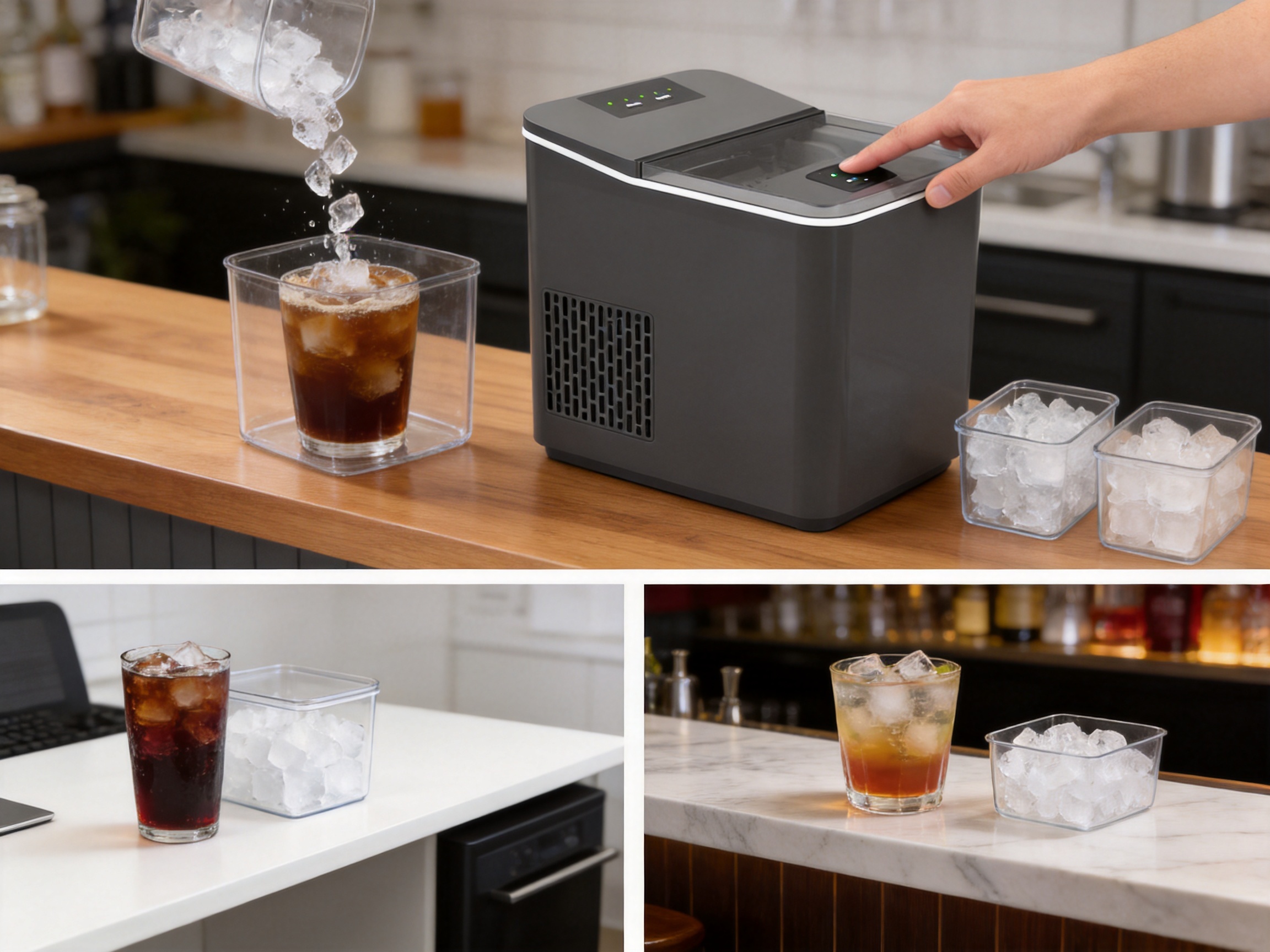
In a home kitchen, the machine can support daily drinks, iced coffee, family meals, weekend gatherings, and seasonal entertaining. It is especially convenient during warm weather, when demand for cold beverages increases. Since it can produce ice close to serving time, users do not need to dedicate a large freezer compartment to ice storage.
In an office, the product can support drinking water, cold refreshments, staff events, meeting rooms, and shared break areas. Its simple controls help different employees use it without detailed training. Its relatively quiet operation makes it suitable for workplaces where background noise should remain limited.
For a home bar, the machine can serve as a supplemental source of bullet ice. It can be positioned near glassware and beverage ingredients, reducing the need to move back and forth to a kitchen freezer. Its selectable ice sizes may also help support different drink recipes.
Applications in Bars, Hospitality, and Small Commercial Spaces
Small bars, cafés, guesthouses, salons, studios, and boutique hospitality locations may benefit from a compact ice maker when their demand is moderate. The appliance can be used as a secondary ice source during busy periods or as a dedicated unit for a specific service area.
Its compact form is useful where floor space is limited. A business can place it near a coffee counter, reception station, drink preparation area, or staff room. The one-touch interface allows employees to begin production quickly, while the removable basket supports easier transfer and cleaning.
Businesses should evaluate expected daily demand before purchasing. A compact machine is suitable for supplemental or moderate production, but operations serving a high volume of beverages may require a larger dedicated system. The product is best positioned as an efficient, accessible appliance for small-scale and flexible ice production.
Use in Recreational Vehicles and Mobile Settings
RVs and mobile leisure spaces often have limited freezer capacity. A compact ice maker can provide an independent source of ice for travel, camping, boating, and outdoor entertainment. Its dimensions make it easier to store than a large appliance, and its rapid cycles can be useful when travelers need ice during a short stop.
Before using the machine in a mobile environment, the electrical supply must be checked carefully. The listed requirement is 220V-240V and 50Hz. Users must confirm that the vehicle or site provides compatible power and that any converter or inverter is properly rated for the appliance.
The machine should be secured against movement, kept level during operation, and protected from excessive heat, rain, and direct sunlight. Water should be drained before transportation, and the appliance should be handled according to the manufacturer’s instructions.
Manufacturing Strengths and Product Development Approach
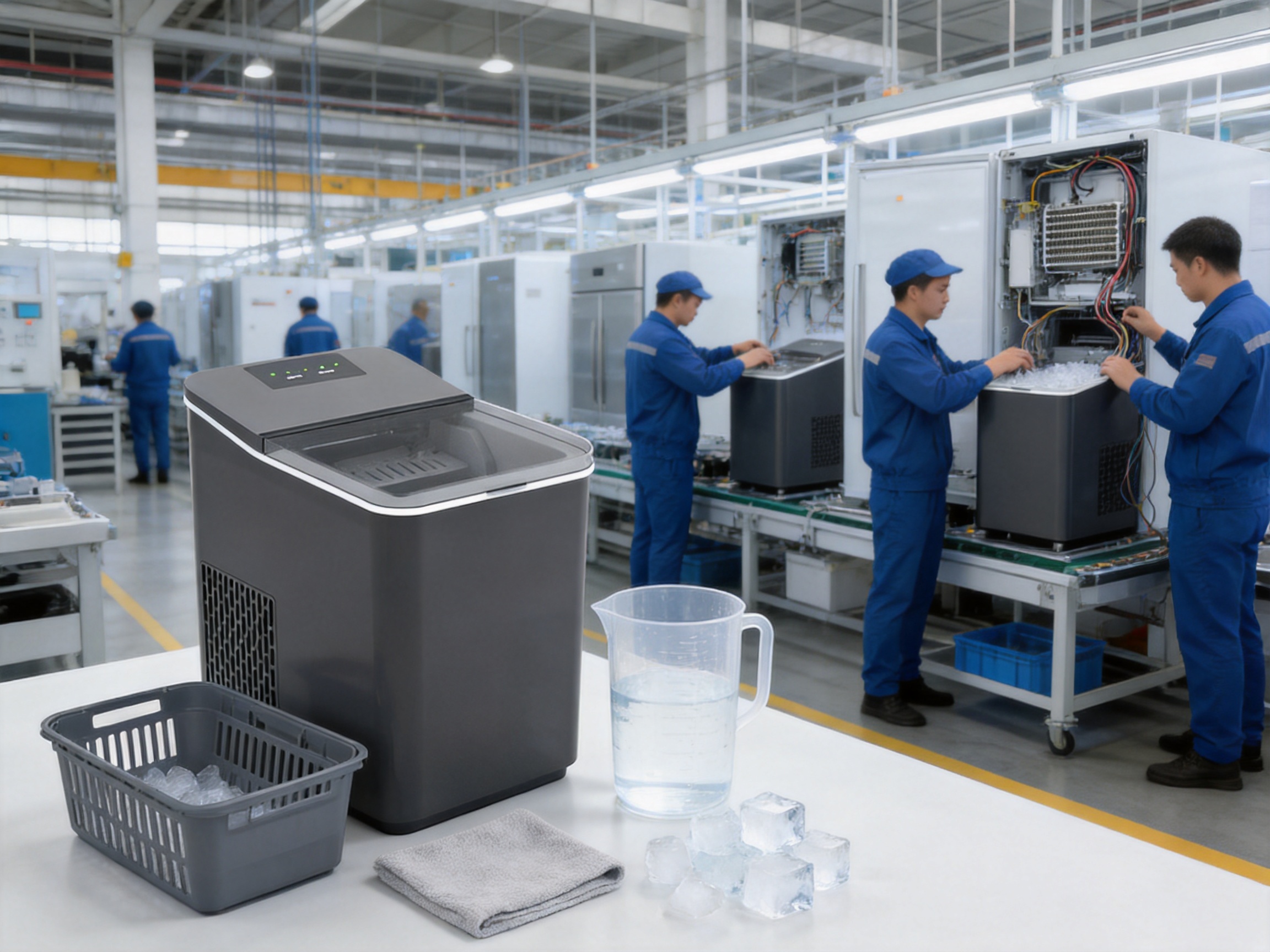
Alien Technology Co., Ltd. is located in Zhouxiang, Zhejiang Province, an area known for the production and logistics of small household appliances. This location gives the company access to an established manufacturing ecosystem, supplier networks, component resources, and transportation connections.
The company specializes in ice makers, coffee machines, and air fryers. Although these products perform different functions, they share important manufacturing requirements: compact mechanical design, electrical safety, thermal management, user-friendly controls, durable plastic and metal components, and repeatable assembly quality.
A manufacturer with experience across several appliance categories can apply cross-product knowledge to product development. Lessons from coffee machine water circuits may inform water-handling design in ice makers. Experience with air fryer thermal management may contribute to better attention to airflow, insulation, and heat dissipation. Shared expertise can support more efficient development and quality-control procedures.
The product’s manufacturing strengths can be understood through the relationship between design simplicity and production consistency. A one-touch control system reduces unnecessary electronic complexity. Smooth interior surfaces simplify assembly and cleaning. A compact housing allows the product to be packaged, transported, and positioned efficiently. These design decisions can support stable production while improving the user experience.
Advanced manufacturing is not limited to robotics or highly complex machinery. It also includes careful component selection, standardized assembly, inspection at key stages, process documentation, electrical testing, functional testing, packaging control, and continuous improvement based on customer feedback. For a small appliance, these practices are essential because reliability depends on many interconnected parts.
Component and Material Coordination
An ice maker contains a refrigeration circuit, compressor, condenser, evaporator or cooling surface, water pump, fan, sensors, control components, wiring, housing panels, water-contact parts, and an ice basket. Each component must work within the intended operating conditions. Manufacturing quality depends on coordinating these parts rather than evaluating them in isolation.
Water-contact components require particular attention because they influence hygiene, durability, and the appearance of the ice. Housing materials must withstand repeated handling, temperature changes, cleaning, and ordinary household use. Electrical parts must be installed securely and protected from unnecessary water exposure.
Assembly and Process Control
Repeatable assembly is important for compact refrigeration appliances. Tubing, wiring, control boards, pumps, and moving parts must be positioned correctly. Consistent fastening helps reduce vibration, while proper sealing supports the integrity of the refrigerant system.
Process control can include work instructions, component checks, visual inspection, electrical safety tests, leak checks, and functional operation tests. A finished machine should be evaluated for its ability to start, circulate water, freeze water, release ice, and respond appropriately to normal operating conditions.
Functional Testing
Testing is especially important for a product that combines water and electricity. Quality-control procedures may examine power consumption, button response, water movement, refrigeration performance, ice release, operating sound, and housing condition. Testing a sample or every unit at defined stages can help identify manufacturing issues before shipment.
The exact testing standards and certifications applicable to a product depend on the destination market. Importers and buyers should confirm the documentation required in their region, including electrical compliance, labeling, packaging, and refrigerant-related requirements.
Continuous Improvement
The company’s stated commitment to continuous improvement and innovation is relevant to appliance manufacturing because user needs change over time. Feedback may reveal opportunities to improve cleaning access, reduce noise, refine button operation, strengthen the basket, improve packaging, or optimize the cooling cycle.
A stable and pragmatic manufacturing philosophy can support long-term product development. Rather than adding features without a clear benefit, manufacturers can focus on improvements that make the appliance safer, easier to use, more durable, and more efficient.
Quality, Reliability, and Buyer Confidence
Reliability is one of the most important factors when choosing an ice maker. Buyers should consider the product’s specifications, intended application, operating environment, maintenance requirements, and available after-sales support. A well-designed appliance still requires proper use, but thoughtful construction can reduce avoidable problems.
The Button-Operated Ice Maker is built around a relatively focused set of functions. It produces bullet ice, offers multiple sizes, operates through a simple button, and includes a removable basket. This focused design can make the product easier to understand and maintain than an appliance overloaded with unnecessary functions.
Buyer confidence also depends on communication. Product specifications should be clear, including voltage, frequency, power, refrigerant type, dimensions, and operating instructions. Clear information helps distributors and end users determine whether the machine is suitable for their market and installation environment.
For business buyers, the manufacturer’s specialization is another consideration. A company that focuses on small household appliances may be able to support product customization, packaging coordination, technical communication, and repeat supply more effectively than a general trading supplier. These capabilities should be confirmed directly during commercial discussions.
Installation and First-Use Recommendations
Before first use, place the machine on a stable, level surface and leave sufficient space around the ventilation areas. Do not position it next to a stove, radiator, oven, or other heat source. The operating area should be dry, clean, and protected from direct water spray.
Check the voltage and frequency before connecting the plug. The listed specification is 220V-240V and 50Hz. The appliance should be connected to a suitable electrical outlet rather than an overloaded extension arrangement. If the local electrical system differs, users should seek advice from a qualified professional.
Allow the machine to stand according to the supplied instructions if it has been transported or stored in a position that could disturb the refrigeration system. Add clean water to the appropriate level, place the basket correctly, and start the first cycle using the button control.
The first batch may be discarded if recommended by the operating instructions. This allows the water-contact surfaces to be rinsed before normal use. Users should also inspect the unit for visible damage, loose components, or unusual noise during the first operating cycle.
Responsible Daily Operation
Use only clean water and do not overfill the reservoir. Overfilling can cause spills or interfere with the machine’s internal water handling. Avoid placing objects on the lid or housing, and do not block ventilation openings.
Remove ice when the basket is full or when the machine indicates that production should pause. Storing ice for too long inside a compact ice maker may cause melting and refreezing, which can affect texture and make pieces stick together.
For the best performance, keep the exterior and surrounding area free from dust and grease. Dust accumulation near ventilation areas can interfere with heat release. Cleaning frequency should be increased in busy kitchens, commercial spaces, or areas with hard water.
Do not use sharp tools to remove ice. If pieces stick together, allow them to loosen naturally or follow the recommended procedure in the manual. Rough handling can damage the basket or internal surfaces.
Frequently Asked Questions
What type of ice does the machine produce?
The product is a bullet ice maker. It produces rounded bullet-shaped ice suitable for soft drinks, iced coffee, cocktails, smoothies, water bottles, and general household use.
How quickly can it make ice?
The stated production time is approximately 6 to 10 minutes per cycle. Actual performance depends on room temperature, water temperature, selected ice size, ventilation, and operating conditions.
Is the machine difficult to operate?
No. It uses one-touch button control. Users can add clean water, connect the machine to the correct power supply, and press the button to begin production.
Can users choose different ice sizes?
Yes. The product is designed to offer multiple ice-size options. The most suitable size depends on the beverage, container, serving method, and desired cooling time.
Where can the ice maker be used?
It is suitable for homes, offices, bars, RVs, kitchens, beverage stations, and small commercial spaces. The installation environment must provide the correct electrical supply, a stable surface, adequate ventilation, and protection from excessive heat or water exposure.
How much power does it use?
The listed power specification is 150W, with a rated current of 0.9A. Actual energy consumption varies with cycle frequency, ambient temperature, selected ice size, and total operating time.
What refrigerant does it use?
The machine uses R600a refrigerant with a listed charge of 19 grams. Because R600a is flammable under specific conditions, the refrigeration system should be serviced only by qualified personnel.
Is it quiet enough for an office?
The product includes a noise-reduction design intended to support quiet operation. Normal compressor, fan, water, and ice-release sounds may still occur. Proper leveling and ventilation can help reduce unnecessary vibration and noise.
How should the machine be cleaned?
Switch off and unplug the appliance, remove remaining ice, drain unused water, and clean the removable basket and interior surfaces with suitable mild cleaning materials. Rinse thoroughly and allow components to dry. Follow the supplied instructions for descaling and sanitizing.
Can it replace a large commercial ice machine?
It is designed for household, office, recreational, and small commercial use rather than high-volume commercial production. Businesses with heavy continuous demand should compare the product’s capacity with their daily requirements and consider whether a larger system is necessary.
What makes it different from a traditional freezer tray?
It produces ice much faster, requires less manual handling, offers multiple ice sizes, and does not occupy a permanent section of freezer space. Its one-touch operation also makes repeated production more convenient.
What should buyers confirm before ordering?
Buyers should confirm the required voltage and frequency, dimensions, expected output, ice-size options, cleaning instructions, warranty terms, packaging details, destination-market compliance, and available technical support.
Why This Product Is a Practical Competitive Choice
The strongest value of the Button-Operated Ice Maker lies in its balance. It is faster than traditional ice trays, smaller and simpler than many commercial systems, and more flexible than a basic freezer-only solution. It combines one-touch operation with multiple ice sizes, compact dimensions, low rated power, quiet-use considerations, and accessible maintenance.
Its advantages are especially clear for users who want convenience without excessive complexity. A family can make ice for meals and guests. An office can provide chilled drinks without relying on the refrigerator. A bar can use it as a supplemental station. An RV owner can gain an independent ice source when compatible power is available.
The company behind the product adds manufacturing depth through its specialization in ice makers and other household appliances. Its location in a recognized small-appliance production region, combined with a stated focus on reliable quality and continuous improvement, supports the product’s position as a practical appliance for international markets.
As with any appliance, performance depends on correct installation, appropriate water, regular cleaning, proper ventilation, and realistic expectations regarding capacity. When used within its intended range, the product offers a convenient way to produce fresh bullet ice quickly and consistently.
Conclusion
The Button-Operated Ice Maker is designed for people who want fresh ice without the waiting time, freezer space, and manual effort associated with traditional methods. Its one-touch control makes operation accessible, while its 6-to-10-minute cycle range supports fast everyday service. Multiple ice sizes improve versatility, and the compact 313 x 226 x 309 millimeter body allows flexible placement in homes, offices, bars, RVs, and small commercial environments.
The 150W power rating, R600a refrigerant system, noise-reduction design, smooth interior, and removable basket contribute to a practical user experience. These features do not attempt to turn the product into a large industrial machine. Instead, they address the needs of users who value efficient, convenient, moderate-volume ice production.
Alien Technology Co., Ltd. supports this product with experience in small household appliance manufacturing and a business philosophy centered on humanized design, quality, customer satisfaction, continuous improvement, and innovation. Through coordinated component selection, repeatable assembly, functional testing, and attention to user feedback, the company can continue refining appliances that simplify everyday routines.
For buyers comparing compact ice makers, the product’s main competitive strengths are its simplicity, speed, flexibility, compact size, quiet-use orientation, and ease of maintenance. It is a sensible choice for users who need ice on demand and want an appliance that is straightforward to operate, practical to clean, and adaptable to multiple settings.
References
1. Product specification sheet for the Button-Operated Ice Maker, model description Alien-Z03.
2. Manufacturer-provided product information concerning operation, ice sizes, cleaning, noise reduction, and intended applications.
3. Manufacturer-provided technical data concerning power supply, rated current, power consumption, refrigerant, refrigerant charge, and machine dimensions.
4. General principles of compact refrigeration appliance design and thermal management.
5. General household appliance guidance for electrical safety, ventilation, water hygiene, cleaning, and maintenance.
6. General technical information regarding R600a refrigerant use in compact refrigeration equipment.
7. General quality-management principles for small household appliance assembly, inspection, functional testing, and continuous improvement.