
 English
 한국어
한국어 Español
 Deutsch
For homes, offices, hospitality settings, recreational vehicles, and compact commercial spaces, a dependable supply of ice can make everyday life easier. Traditional freezer ice trays require long preparation times, occupy valuable freezer space, and often produce less ice than needed. Large commercial ice machines, meanwhile, may be too expensive, too bulky, or too complicated for users who need a practical solution for ordinary daily requirements. A compact countertop ice maker offers a useful middle ground by delivering fresh ice quickly without requiring a permanent water connection or a complex installation process.
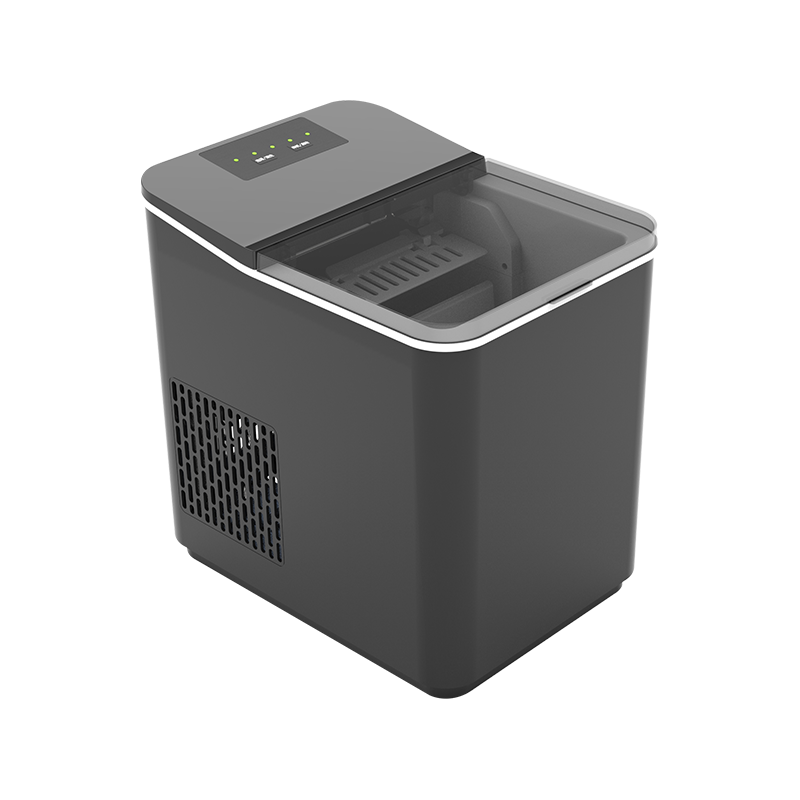
The Button-Operated Ice Maker, identified as the Alien-Z03, is designed around this practical need. Its central appeal is simplicity: users can begin the ice-making process with a straightforward one-touch button operation. Instead of navigating complicated controls, customers can place the machine on a stable surface, add water, select a suitable ice size, and start production. This uncomplicated approach makes the appliance accessible to families, office workers, hosts, travelers, and first-time ice-maker users.
Beyond simple controls, the machine combines a compact body, low operating power, quiet operation, removable components, and flexible use scenarios. It is specified for a 220V–240V, 50Hz power supply, with a rated current and power of 0.9A and 150W. Its dimensions are approximately 313 × 226 × 309 millimeters, allowing it to fit comfortably on many kitchen counters, service stations, office cabinets, and recreational vehicle worktops. The use of R600a refrigerant with a 19-gram charge supports the appliance’s compact refrigeration design.
This article examines the product’s design, operating benefits, technical specifications, user experience, maintenance requirements, application areas, and competitive advantages. It also discusses the manufacturing capabilities and product-development strengths of Alien Technology Co., Ltd., the company responsible for the appliance, while keeping the focus on the practical value of the Button-Operated Ice Maker.
Button-Operated Ice Maker
1. Why Convenient Ice Production Matters
Ice is a small household necessity that can have a significant effect on convenience. Cold drinks, iced coffee, smoothies, cocktails, food displays, temporary cooling, and outdoor gatherings all depend on a reliable supply. In many households, however, ice is still produced through traditional trays or bags purchased from a store. Both methods have limitations.
Ice trays demand planning. Water must be added manually, the tray must be placed flat inside a freezer, and the freezing process can take several hours. The resulting cubes may be difficult to remove, and the quantity is often insufficient when guests arrive unexpectedly. Trays also occupy freezer space that could otherwise be used for food storage. In addition, open trays can absorb odors from the freezer or become contaminated if they are not handled carefully.
Purchased bagged ice can provide a larger quantity, but it creates additional cost and storage concerns. Bags take up space, may melt during transportation, and are not always available when needed. For regular users, repeated purchases can become more expensive than producing ice at home or at the workplace.
A compact automatic ice maker addresses these problems by creating ice on demand. The user does not need to wait overnight, dedicate freezer space to trays, or make repeated trips to a store. A machine that produces ice in approximately 6–10 minutes per cycle can support spontaneous use, provided that water is available and the appliance is operated according to its instructions.
The Button-Operated Ice Maker is particularly suited to users who value direct operation. Its design does not attempt to overwhelm customers with unnecessary functions. Instead, it focuses on essential tasks: adding water, choosing an ice size, starting production, collecting ice, and cleaning the machine after use. This focus can reduce the learning curve and make the appliance suitable for a wide range of age groups.
2. Product Overview and Core Design
The product is a bullet ice maker with the title Button-Operated Ice Maker and the model description Alien-Z03. It is developed as a compact appliance for producing fresh ice in residential and light-duty environments. The bullet-style ice form is commonly appreciated because it is rounded, relatively easy to chew, and suitable for beverages, blended drinks, serving containers, and casual food presentation.
The machine’s 313 × 226 × 309 millimeter footprint reflects a space-conscious design philosophy. It is not intended to replace a large-volume commercial ice-making system. Instead, it serves users who need a small, convenient appliance that can be positioned close to where ice is consumed. The compact form can be especially useful in kitchens with limited counter space, small offices, beverage stations, dormitory rooms where permitted, and RV interiors.
The product’s 150W rated power also reflects its role as a compact appliance. Compared with many large refrigeration and ice-production systems, a 150W input rating can help make the machine more suitable for ordinary household circuits and smaller working environments. Actual energy consumption depends on ambient temperature, water temperature, operating duration, ventilation, and the frequency of ice-making cycles. Nevertheless, the stated rating indicates that the machine is designed with moderate power requirements rather than heavy industrial operation.
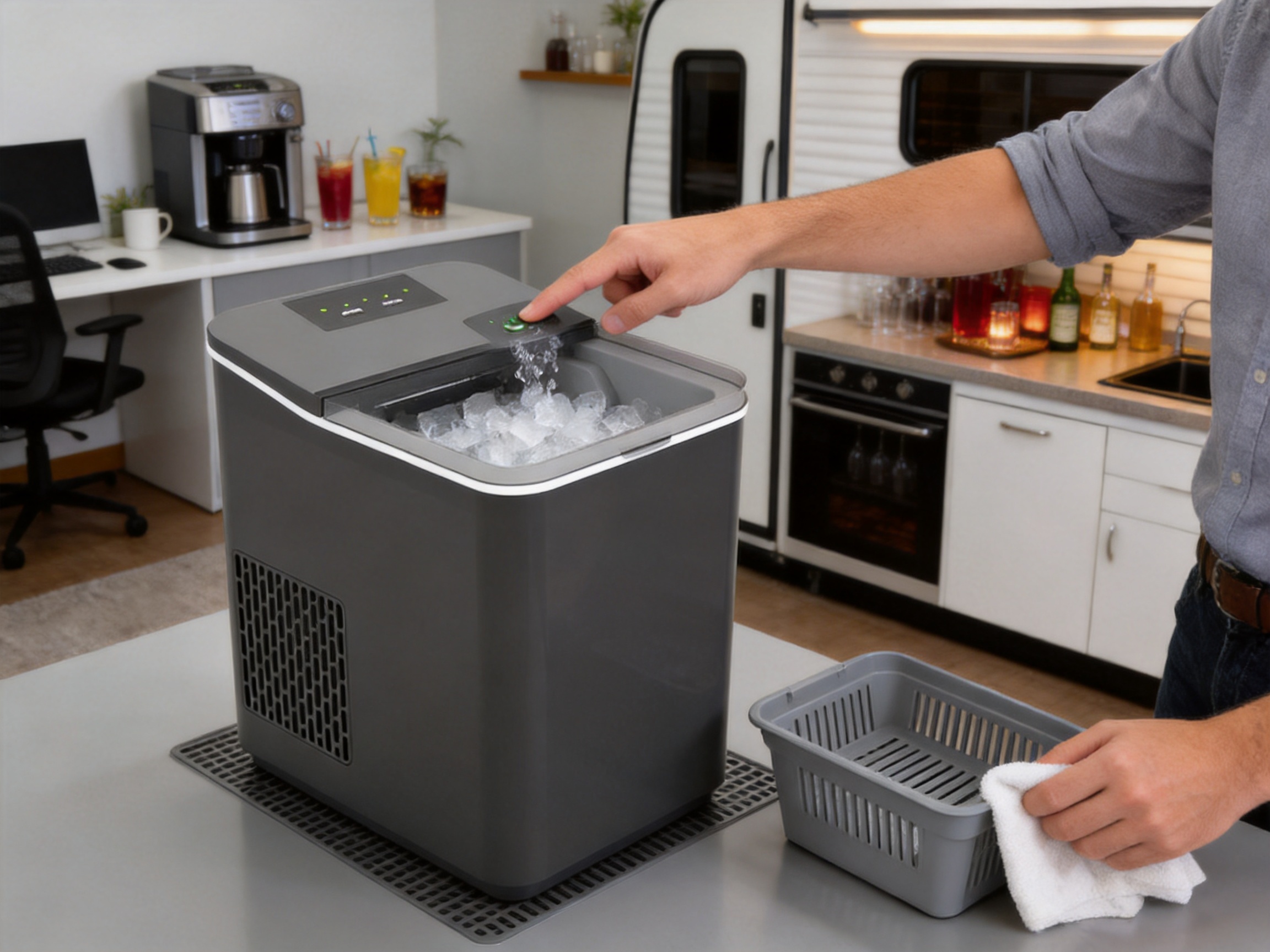
Operation is centered on a one-touch button. This is more than a cosmetic feature. A simplified interface can reduce incorrect settings, shorten user training, and make the machine more approachable for people who do not want to study a detailed control panel. In a busy kitchen or office, the ability to begin production quickly can be more valuable than a large collection of complicated functions.
Important Product Specifications
| Specification | Product Information | Practical Significance |
|---|---|---|
| Product type | Button-operated bullet ice maker | Designed for convenient countertop ice production |
| Model description | Alien-Z03 | Identifies the product configuration |
| Power supply | 220V–240V / 50Hz | Suitable for compatible electrical systems |
| Current and power | 0.9A / 150W | Indicates a compact appliance power requirement |
| Refrigerant | R600a | A refrigerant used in compact refrigeration appliances |
| Refrigerant charge | 19g | Specified charge for the stated system configuration |
| Machine dimensions | 313 × 226 × 309mm | Supports placement in compact spaces |
| Ice production cycle | Approximately 6–10 minutes | Provides relatively quick access to fresh ice |
| Ice selection | Multiple ice sizes | Allows users to match ice to different beverages and uses |
Customers should always confirm the product label, instruction manual, electrical requirements, local safety rules, and current technical documentation before purchase or installation. Performance can vary according to room temperature, ventilation, water temperature, water quality, and operating conditions.
3. One-Touch Operation and User Accessibility
The main difference between a convenient appliance and a frustrating one is often the user interface. Ice makers can involve water filling, cycle selection, collection, and cleaning. If these steps are controlled through an overly complicated interface, occasional users may hesitate to operate the product. The Button-Operated Ice Maker takes a simpler approach by placing the start function within easy reach.
One-touch operation is helpful in several situations. A family member can start a cycle without learning a complicated menu. An office employee can prepare ice for a meeting quickly. A host can replenish a beverage station while attending to guests. In an RV, where work surfaces and storage are limited, a simple control can reduce clutter and confusion.
The simplified control system may also support better consistency. When users can clearly identify the primary operating button, they are less likely to select an unintended program or leave the appliance inactive. This is especially useful for establishments that have multiple staff members using the same equipment. A straightforward operation method can reduce informal training requirements and help standardize daily use.
Ease of use does not mean that the appliance should be operated without care. Users must place the machine on a stable, level surface, maintain adequate airflow around the ventilation areas, use the correct power supply, and follow the manufacturer’s instructions for filling, draining, cleaning, and storage. The benefit of simple controls is that these important procedures can be performed without an unnecessarily complicated operating sequence.
4. Fast Ice Making for Daily and Occasional Needs
The product is designed to produce ice in approximately 6–10 minutes per cycle. The exact duration may vary, but the general benefit is clear: users can begin obtaining ice much sooner than they usually could with a standard freezer tray. This makes the appliance suitable for unexpected visitors, afternoon refreshments, small celebrations, and daily beverage preparation.
Fast production is valuable because demand for ice is rarely perfectly predictable. A household may need only a small amount on a normal morning but require much more when preparing iced coffee, fruit drinks, or a family meal. An office may have little demand during the day but need a dependable supply for a training session or customer meeting. A compact ice maker allows users to respond to these changes instead of preparing a fixed quantity hours in advance.
Cycle speed should be understood as one part of the overall user experience. The machine also needs time for water filling, ice collection, and possible cooling between cycles. Ambient conditions affect refrigeration performance. A well-ventilated room and appropriately cool water can support more efficient operation, while a hot room or restricted airflow may increase cycle time. Customers should therefore consider the stated 6–10-minute cycle as an approximate operating reference rather than a guarantee under every condition.
Even with these variables, fast-cycle production offers an advantage over manual freezing for many small-scale applications. The user can keep a serving container nearby and collect ice as it becomes available. This creates a more active, responsive supply process, which is particularly convenient during gatherings and beverage service.
5. Multiple Ice Sizes for Different Applications
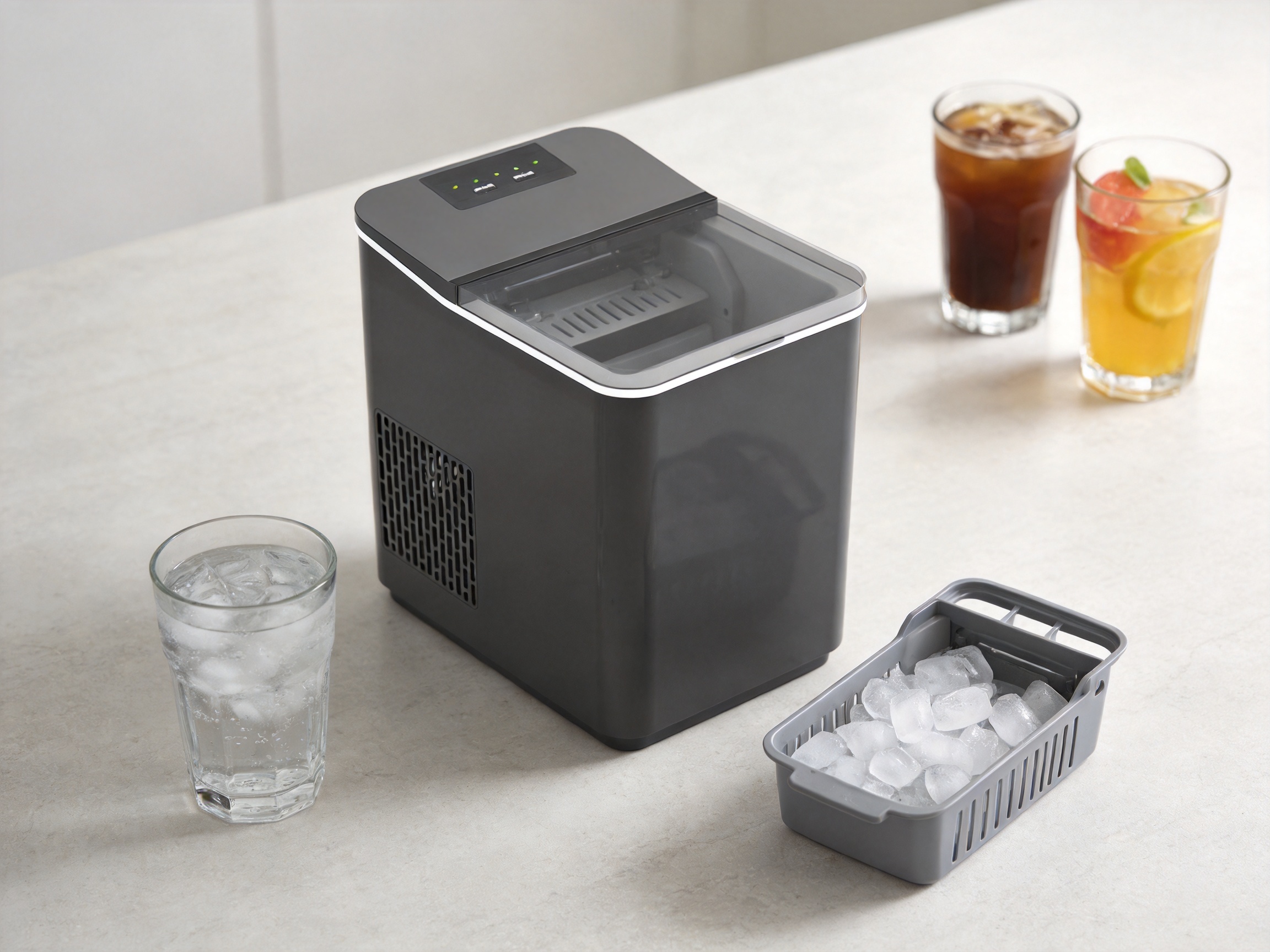
Different drinks and food uses benefit from different ice dimensions. Small pieces may cool a beverage quickly and fit easily into narrow bottles or blended-drink containers. Larger pieces may provide a slower melting rate and a more substantial appearance in a glass. The Button-Operated Ice Maker supports multiple ice-size selections, giving users more flexibility than a fixed-size tray.
For everyday soft drinks and water, users can choose a size that fits their preferred glass and cooling speed. For cocktails, ice size can influence dilution and presentation. For smoothies, smaller pieces may be easier to process, subject to the blender manufacturer’s instructions. For food presentation, selected ice can help create a chilled serving environment for fruit, seafood, or packaged products, although the ice should be used in a hygienic manner and should not replace legally required temperature-control procedures.
Multiple size options can also help families with different preferences. Some users may prefer smaller, easier-to-chew pieces, while others may want larger pieces that remain in a drink for longer. The ability to select between options makes the machine more adaptable without requiring additional equipment.
Ice size is only one factor affecting melting behavior. Room temperature, glass material, beverage temperature, airflow, and the quantity of ice used all influence performance. Users should select the setting that best matches the specific application and should follow the product instructions regarding available sizes and operating procedures.
6. Energy-Conscious Compact Performance
Energy efficiency is increasingly important when selecting household and small-business appliances. A machine that is used frequently should provide useful output without creating unnecessarily high operating costs. The Button-Operated Ice Maker has a rated power of 150W, which is consistent with a compact countertop appliance rather than a large commercial system.
The stated power rating can make the product attractive to customers who want occasional or moderate ice production. It may be easier to integrate into a home kitchen, office refreshment area, bar counter, or travel environment than equipment requiring a high-capacity electrical connection. Users should still verify the outlet and circuit requirements before operation, particularly in RVs, older buildings, or locations where several appliances share one circuit.
Energy use is influenced by operating habits. Allowing the machine to work in a hot, enclosed area may increase cooling demand. Blocking ventilation openings can reduce efficiency and place additional strain on the refrigeration system. Operating the appliance only when ice is needed, keeping the water supply at a reasonable temperature, and cleaning the condenser and surrounding areas according to the instructions can help support stable performance.
The compact design also reduces the physical resources required for placement and transportation. A smaller machine can be delivered, stored, repositioned, or incorporated into an existing beverage station more easily than a full-size ice-production system. This is a practical efficiency advantage even when energy consumption is not the only consideration.
7. Quiet Operation for Shared Environments
Noise is an important but sometimes overlooked characteristic of countertop appliances. Ice makers use refrigeration components, pumps, fans, and mechanical systems that may generate sound during operation. If the noise level is excessive, the appliance can become inconvenient in an office, bedroom-adjacent area, reception space, or open-plan kitchen.
The Button-Operated Ice Maker incorporates a noise-reduction design intended to support quieter operation. A quieter machine is easier to live with because it can produce ice without dominating conversations, disrupting work, or creating an uncomfortable background sound. This is particularly useful when the appliance is operated during early mornings, evenings, meetings, or social events.
Quiet operation does not mean silent operation. Users may still hear the compressor, fan, water movement, or the sound of ice falling into the basket. These sounds are normal for many compact refrigeration appliances. The machine should be placed on a stable surface that does not amplify vibration, and sufficient clearance should be provided around ventilation areas. A level position can also help reduce unnecessary rattling.
Compared with bulky commercial machines intended for high-volume service areas, a compact low-noise design is better matched to personal and semi-professional environments. It can deliver a useful amount of ice while maintaining a more comfortable atmosphere.
8. Cleaning, Hygiene, and Maintenance
Any appliance that handles water and produces ice requires regular cleaning. Water can leave mineral deposits, and a damp internal environment can become unsuitable for continued use if cleaning is neglected. The Button-Operated Ice Maker is designed with smooth interior surfaces and a removable ice basket to make routine maintenance easier.
A removable basket allows users to take out finished ice and clean the storage area separately. Smooth surfaces can reduce the number of places where residue accumulates and may make wiping more effective. These features do not eliminate the need for maintenance, but they can make the cleaning process less time-consuming and more consistent.
A practical cleaning routine should include emptying unused ice, draining remaining water when appropriate, wiping accessible surfaces, cleaning the ice basket, and allowing components to dry according to the instructions. The machine should be disconnected from the power supply before cleaning areas where electrical components could be exposed. Users should not immerse the main appliance body in water unless the instruction manual specifically permits it.
Water quality also affects maintenance. Hard water may create mineral deposits more quickly than filtered or treated water. Users should follow local guidance and the manufacturer’s recommendations regarding suitable water. Cleaning frequency should be increased when the appliance is used heavily, stored for long periods, or operated in a warm and humid environment.
Good hygiene is important not only for the taste and appearance of ice but also for user confidence. A machine that is easy to inspect and clean encourages responsible ownership. This maintenance-friendly construction is a meaningful advantage over products with difficult-to-access interiors or components that are challenging to remove.
Recommended Care Practices
Place the ice maker on a clean, level, and stable surface before use.
Use water that meets the quality requirements stated in the product documentation.
Do not leave old ice or standing water inside the machine for extended periods.
Clean the removable basket and accessible internal surfaces regularly.
Keep ventilation areas free from dust, packaging materials, and surrounding objects.
Disconnect the appliance from power before performing cleaning or maintenance.
Drain and dry the machine before storage or transportation when instructed.
Do not attempt to repair the refrigeration system without qualified technical support.
9. Compact Dimensions and Flexible Placement
Measuring approximately 313 × 226 × 309 millimeters, the Button-Operated Ice Maker is designed for areas where every centimeter matters. Counter space is often limited in modern kitchens, apartments, studio homes, offices, and mobile environments. A compact ice maker can be positioned near a refrigerator, coffee station, bar counter, food-preparation area, or entertainment space without requiring a major redesign.
The product can also be moved when necessary. A household may keep it in the kitchen during the week and place it near an outdoor serving area during a gathering, provided that the operating environment is suitable and the machine is protected from rain, excessive moisture, and unstable surfaces. An office may relocate it between a staff kitchen and a conference area as needs change.
In RVs and other mobile settings, dimensions are especially important. Storage and counter areas are restricted, and equipment must be practical to handle. Users should verify the vehicle’s electrical system, available ventilation, water-handling arrangements, and stability before operating the appliance in a mobile environment.
The compact form also makes the machine suitable for small commercial spaces that do not require the volume of a restaurant-grade ice system. Boutique beverage counters, small event services, temporary kiosks, and office hospitality areas can benefit from an appliance that supplies ice without occupying a large service footprint.
10. Advantages Compared with Common Alternatives
Compared with Traditional Ice Trays
The most obvious advantage over ice trays is speed. A tray typically requires several hours in a freezer, while the product is designed to begin producing ice in approximately 6–10 minutes per cycle. The machine also reduces the need to reserve freezer space and avoids the difficulty of twisting or bending rigid trays to release ice.
The machine offers greater convenience for variable demand. Users can produce ice when required rather than filling multiple trays in advance. Multiple ice-size options provide flexibility that ordinary trays may not offer. The trade-off is that an ice maker requires an electrical connection, water filling, cleaning, and periodic maintenance.
Compared with Buying Bagged Ice
Store-bought ice can be useful for parties or large events, but it requires planning, transport, and suitable storage. A countertop ice maker can produce fresh ice at the point of use and reduce dependence on retail availability. It may also be more convenient for households that need small quantities frequently rather than a large bag occasionally.
For very high-volume events, however, a commercial supplier or larger machine may remain more appropriate. The Button-Operated Ice Maker is best understood as a flexible small-scale solution, not a replacement for industrial ice production.
Compared with Larger Commercial Ice Machines
Large commercial systems can produce greater quantities and may include advanced storage, filtration, and connection systems. They can also require more space, higher investment, professional installation, and stronger maintenance procedures. The Button-Operated Ice Maker offers a simpler alternative for users whose requirements are moderate.
Its compact dimensions, 150W power rating, direct controls, and removable basket make it easier to place and operate. For a home, office, RV, or small beverage station, these attributes may be more valuable than maximum production capacity.
Compared with More Complicated Countertop Models
Some countertop ice makers include extensive electronic menus, digital displays, remote functions, or numerous settings. Such features can be useful, but they may also increase the learning curve and create more possible points of confusion. The one-touch design of this product emphasizes direct operation and accessibility.
This does not mean that a simpler machine is universally better. Customers who require remote monitoring or highly specialized programming may prefer a more sophisticated model. For users who primarily want fast, uncomplicated ice production, however, the button-operated approach is a strong practical advantage.
11. Manufacturing Strengths of the Company
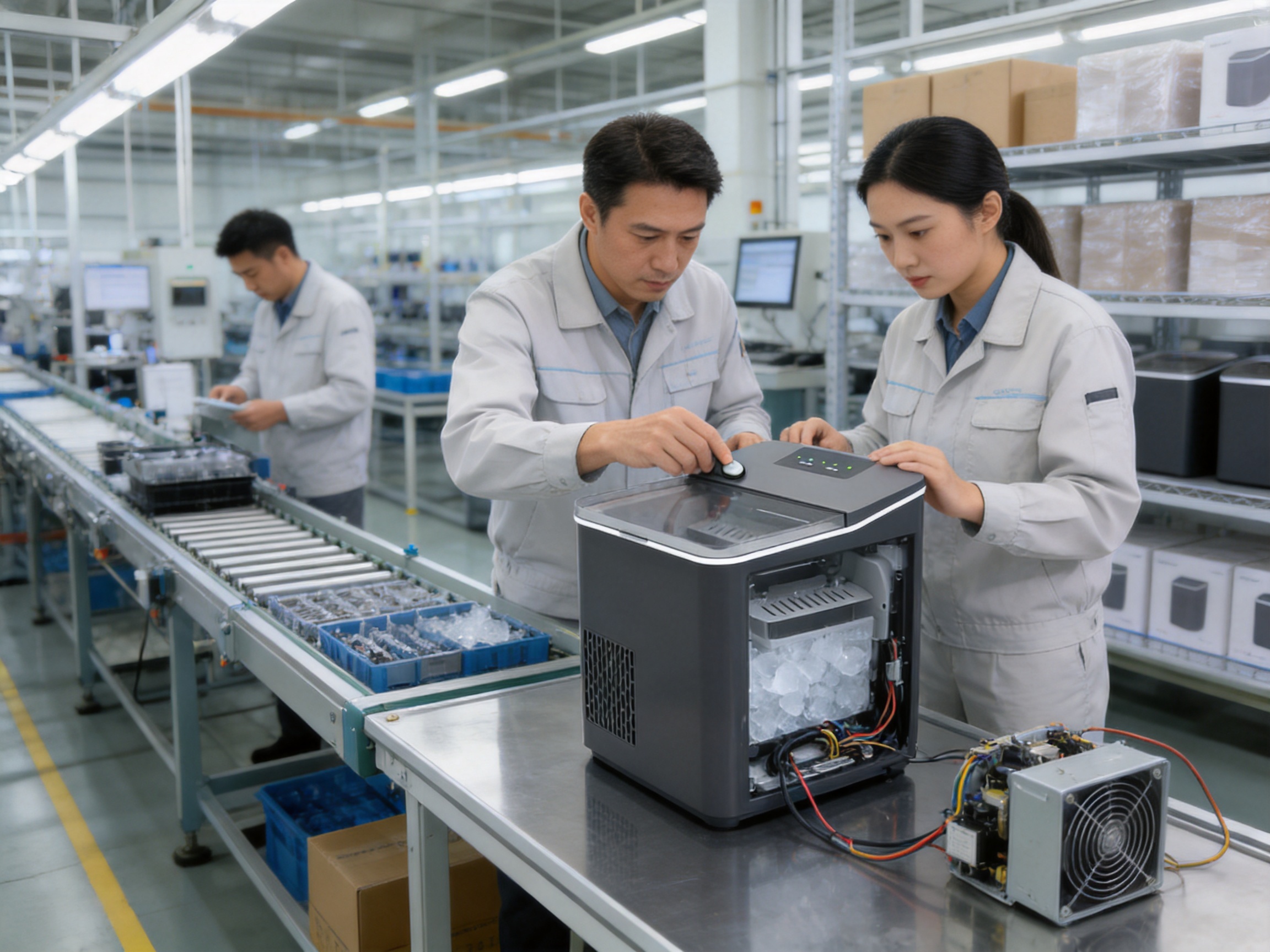
Alien Technology Co., Ltd. is located in Zhouxiang, Zhejiang Province, an area known for the manufacture of small household appliances and supported by convenient logistics. The company specializes in household products including ice makers, coffee machines, and air fryers. This product focus is relevant because these appliances share several development requirements: compact mechanical design, thermal or heating management, user-centered controls, water or food-contact considerations, electrical safety, and repeatable assembly.
A company that concentrates on related small-appliance categories can develop valuable experience across product lines. Lessons learned from compact refrigeration systems may support improvements in ice makers, while knowledge of controls, housing design, thermal protection, and production organization can be applied to coffee machines and air fryers. This category familiarity can help the manufacturer understand the needs of distributors, retailers, private-label customers, and end users.
The company’s stated mission is “Smart Technology, Simplifying Life, Enhancing Happiness.” The Button-Operated Ice Maker reflects this philosophy through a practical combination of automation and simplicity. Rather than requiring users to perform every step manually, it automates the refrigeration and ice-forming process while retaining an accessible control method. The result is a product concept centered on reducing household effort.
The company also emphasizes reliable quality, customer satisfaction, continuous improvement, innovation, and a stable, pragmatic business philosophy. These priorities are important for small appliances because product quality depends on more than appearance. Consistent assembly, dependable electrical connections, effective sealing, controlled refrigeration performance, durable buttons, stable housings, and proper inspection all affect the customer’s experience.
Product Development and Engineering Coordination
Ice makers combine several technical systems in a relatively small enclosure. The refrigeration circuit must operate within the intended power range. Water must be delivered to the ice-forming area. The control system must coordinate the production cycle, and the housing must provide protection while allowing heat dissipation. A successful product therefore requires coordination between mechanical, electrical, thermal, and industrial design considerations.
The compact specifications of the Alien-Z03 suggest a design process that balances internal component placement with external usability. A body measuring 313 × 226 × 309 millimeters must accommodate the refrigeration assembly, water-related components, controls, ice basket, insulation, and ventilation paths. Maintaining this balance is a manufacturing and engineering challenge because reducing size should not compromise access, stability, or serviceability.
The use of R600a refrigerant and a specified 19-gram charge also indicates that the refrigeration system is configured around a compact appliance architecture. Refrigerant handling must be performed using appropriate equipment, trained personnel, and applicable safety procedures. The flammability characteristics of R600a make correct manufacturing, servicing, transportation, and installation practices particularly important. Consumers should never open or modify the sealed refrigeration system themselves.
Process Consistency and Quality Awareness
For a product intended for international markets, manufacturing consistency is essential. Each unit should be assembled according to controlled specifications so that dimensions, electrical components, refrigeration components, controls, and removable parts function as intended. Process consistency supports stable product performance and reduces variation between units.
Quality awareness may include incoming-component checks, assembly inspections, electrical safety checks, functional testing, appearance inspections, packaging verification, and final product review. The precise procedures used by a manufacturer depend on its facilities, market requirements, product configuration, and applicable regulations. The company’s stated commitment to reliable quality and continuous improvement provides a foundation for these activities, while customers and business buyers should request specific compliance and testing documentation for their target market.
Manufacturing strength is also reflected in the ability to coordinate product details with customer requirements. Retailers and distributors may need specific packaging, labeling, manuals, electrical configurations, color options, or private-label arrangements. A manufacturer located in an established small-appliance region with convenient logistics may be positioned to support such cooperation efficiently.
Supply-Chain and Logistics Benefits
Zhejiang is a major manufacturing region with extensive supplier networks, production services, packaging resources, and transportation connections. For a small-appliance producer, access to nearby suppliers can support efficient procurement of housings, controls, motors, refrigeration components, wiring, packaging, and other parts. Convenient logistics can also help shorten transportation coordination and improve responsiveness for export orders.
These regional advantages do not automatically guarantee product quality, but they can support a more organized manufacturing ecosystem. A focused manufacturer can use this environment to manage product development, component sourcing, assembly, quality control, packaging, and shipment through an integrated business process.
For overseas customers, business cooperation should include detailed discussions about order quantity, lead time, packaging, warranty support, spare parts, certifications, destination-market requirements, and after-sales service. Alien Technology Co., Ltd. welcomes contact from new and existing customers for business cooperation, making direct communication an important part of evaluating a potential supply relationship.
12. Application Scenarios
Home Kitchens
In a home kitchen, the ice maker can support daily water consumption, iced tea, coffee drinks, smoothies, mocktails, and family meals. Its size allows it to complement rather than replace the refrigerator. Families can produce ice when needed without filling the freezer with trays.
Home Bars and Entertainment Areas
For people who host friends or maintain a home bar, fast ice production can improve the serving experience. Multiple ice sizes allow users to choose an appropriate format for different glasses and beverages. The compact design can fit near a beverage counter, reducing the need to carry ice repeatedly from another room.
Offices and Meeting Rooms
Offices often need ice for water dispensers, refreshments, client meetings, staff events, and employee kitchens. A simple button-operated machine is easy for multiple users to understand. Its quiet design is also beneficial in shared environments where excessive noise can be distracting.
Bars, Cafés, and Small Hospitality Businesses
Small hospitality businesses with moderate demand may use a compact ice maker as an auxiliary appliance or backup unit. It can support a service station, temporary beverage counter, tasting room, or event setup. Businesses with continuous high-volume requirements should evaluate production capacity and commercial regulations carefully before selecting any countertop machine.
RVs and Recreational Use
Travelers often value compact equipment that provides comfort without consuming excessive storage space. An ice maker can support cold drinks during road trips, camping stays, and outdoor gatherings. Before using the product in an RV, customers must confirm compatibility with the vehicle’s electrical supply and ensure that the appliance is stable, ventilated, protected from moisture, and safely secured during transport.
Small Events and Temporary Beverage Stations
At a family celebration, office party, market stall, or small private event, on-demand ice production can reduce the need to purchase and transport several bags of ice. The machine can be placed close to the serving area, provided that a suitable power source and clean water are available.
13. Installation and First-Use Considerations
Before operating the Button-Operated Ice Maker, customers should inspect the packaging and appliance for transport damage. The machine should be placed on a level surface with sufficient clearance around the ventilation areas. It should not be positioned next to a heat source, in direct sunlight, near standing water, or in a location where it could be knocked over.
Allowing the appliance to stand after transport may be necessary, particularly if it has been carried or tilted. The correct waiting period should be taken from the instruction manual or product support documentation. This precaution allows the refrigeration system to settle before operation.
Users should verify that the available electrical supply matches the specified 220V–240V, 50Hz requirement. A suitable grounded outlet should be used where required by local regulations. Extension cords, adapters, and power strips should not be used unless they are specifically appropriate for the appliance and approved for the intended electrical load.
After adding the recommended amount of water, users can select an ice size and begin the cycle through the button control. The first batch may be discarded if recommended by the instructions, as this can help remove residual manufacturing dust or odors. Ice should be stored and handled hygienically after collection.
14. Responsible Use and Safety
Safe use begins with reading the product documentation. The appliance contains electrical parts and a refrigeration system, so it should not be opened, modified, or repaired by unqualified individuals. The R600a refrigerant specified for the machine is flammable, making it especially important to avoid puncturing refrigeration lines or using unauthorized repair methods.
The machine should be kept away from children when they are not supervised, particularly during cleaning or when handling the ice basket. Water should not be spilled onto the control area or power connection. If the power cord, plug, housing, or refrigeration system appears damaged, the appliance should be disconnected and inspected by an authorized professional.
Users should not block air vents or place objects on top of the appliance if doing so restricts heat dissipation. The machine should not be used outdoors in rain or exposed to conditions beyond those specified by the manufacturer. Ice intended for consumption should be produced, collected, and stored under clean conditions.
These precautions are not unique to this product; they are standard considerations for compact electrical refrigeration appliances. Following them helps protect users, preserve product performance, and extend the operating life of the machine.
15. What Buyers Should Evaluate Before Purchase
Customers should first determine how much ice they actually need. The Button-Operated Ice Maker is intended for household, office, travel, entertainment, and small-scale use. If a business requires continuous high-volume production, a commercial machine with a larger storage bin and higher output may be more suitable.
Electrical compatibility is another essential consideration. The product is specified for 220V–240V and 50Hz operation. Buyers in other electrical regions should confirm whether a different model is available rather than relying on an unsuitable converter or transformer.
Available counter space should be measured before purchase. The stated dimensions are approximately 313 × 226 × 309 millimeters, but users should also allow room for ventilation, water filling, cable routing, and access to the ice basket. The machine should not be squeezed between objects in a way that restricts airflow.
Buyers should also ask about warranty coverage, replacement parts, manuals, packaging, shipment protection, market certifications, and after-sales support. Commercial buyers may need additional information about production capacity, testing procedures, private-label options, minimum order quantities, and delivery schedules.
16. Long-Term Value and Ownership Experience
The value of an ice maker is determined not only by its purchase price but also by how often it is used, how much time it saves, and how easy it is to maintain. A product that removes the need to prepare freezer trays or purchase emergency bags of ice can provide ongoing convenience. Its compact format may also allow users to avoid the cost and space requirements of a larger machine.
Durability depends on correct operation and maintenance. Regular cleaning, proper ventilation, careful handling, and compliance with the recommended power supply can support reliable performance. A removable basket and smooth interior surfaces may reduce the effort required for routine care, encouraging users to maintain the machine more consistently.
The one-touch interface can also improve ownership satisfaction over time. Appliances that are used frequently benefit from controls that remain clear and intuitive. Users do not need to remember complicated sequences each time they want to produce ice, which supports a more natural daily routine.
For businesses, long-term value additionally depends on operational reliability, delivery support, spare parts, service responsiveness, and documentation. These factors should be discussed with the manufacturer or supplier before placing an order. The company’s focus on customer satisfaction and business cooperation provides a basis for such discussions.
17. Frequently Asked Questions
Q1. What kind of ice does this machine produce?
The product is described as a bullet ice maker. It is designed to produce bullet-style ice suitable for cold beverages, cocktails, smoothies, casual food presentation, and general household use.
Q2. How quickly can it make ice?
The product information states that it can produce ice in approximately 6–10 minutes per cycle. Actual timing may vary according to room temperature, water temperature, ventilation, water level, and operating conditions.
Q3. Is the machine difficult to operate?
No. The product is designed around one-touch button operation. Users generally add water, choose an available ice size, and start the machine. The instruction manual should always be followed for the complete operating sequence.
Q4. Does it offer different ice sizes?
Yes. The product information states that multiple ice sizes are available. The precise options and selection method should be confirmed in the current user manual or product documentation.
Q5. What electrical supply does it require?
The stated power supply is 220V–240V at 50Hz. Buyers should confirm compatibility with their local electrical system before ordering and should use the product only with an appropriate power connection.
Q6. How much power does it use?
The listed current and power are 0.9A and 150W. Actual energy consumption may vary with operating duration, ambient temperature, ventilation, and the number of ice-making cycles.
Q7. What are the machine dimensions?
The stated dimensions are approximately 313 × 226 × 309 millimeters. Users should provide additional clearance for ventilation, operation, cleaning, and cable access.
Q8. What refrigerant does it use?
The appliance is specified as using R600a refrigerant with a 19-gram charge. Because R600a is flammable, the sealed refrigeration system should only be serviced by appropriately qualified professionals using approved procedures.
Q9. Is it suitable for a commercial business?
It may be suitable for small offices, beverage stations, boutique hospitality settings, temporary events, or businesses with moderate ice demand. Businesses requiring continuous high-volume production should compare the machine’s capacity with their specific requirements and consider commercial-grade alternatives if necessary.
Q10. Can it be used in an RV?
The product information lists RVs among its potential application environments. Before use, customers should verify the RV’s electrical compatibility, provide stable placement and ventilation, protect the machine from moisture, and secure it appropriately during travel.
Q11. How should the machine be cleaned?
The removable ice basket and smooth interior surfaces are intended to make cleaning easier. Users should empty old ice, drain water as directed, clean accessible surfaces, and follow the manufacturer’s instructions. The main electrical body should not be immersed in water.
Q12. Does quiet operation mean the machine is silent?
No. The machine includes a noise-reduction design, but refrigeration appliances normally produce some sound from the compressor, fan, water movement, and ice collection. A stable, level installation can help reduce vibration and rattling.
Q13. What makes this product different from a freezer tray?
It can produce ice much faster than traditional freezing trays, does not require the same amount of freezer space, provides multiple ice-size choices, and allows users to make ice when needed rather than preparing it hours in advance.
Q14. What makes the manufacturer suitable for business cooperation?
Alien Technology Co., Ltd. specializes in small household appliances, including ice makers, coffee machines, and air fryers. It is located in Zhouxiang, Zhejiang Province, a region associated with small-appliance manufacturing and convenient logistics. The company emphasizes reliable quality, customer satisfaction, improvement, innovation, and cooperation with new and existing customers.
Q15. Is the machine a replacement for a large commercial ice system?
Not necessarily. It is a compact appliance intended for homes, offices, bars, RVs, small commercial spaces, and similar applications. A large restaurant, hotel, or event venue with heavy continuous demand should evaluate a higher-capacity system.
18. Conclusion
The Button-Operated Ice Maker is designed to make fresh ice production more accessible, more flexible, and less time-consuming. Its strongest advantages are its direct one-touch control, approximate 6–10-minute ice-making cycles, multiple ice-size options, compact 313 × 226 × 309 millimeter body, 150W rated power, noise-reduction design, and maintenance-friendly interior.
Compared with traditional freezer trays, it offers faster access and reduces freezer-space requirements. Compared with repeatedly buying bagged ice, it provides on-demand production at the point of use. Compared with large commercial systems, it offers a more compact and approachable option for moderate requirements. These benefits make it relevant to households, offices, beverage stations, small businesses, recreational vehicles, and private events.
The product also reflects the development direction of Alien Technology Co., Ltd.: using practical technology to simplify everyday tasks. The company’s specialization in ice makers and other household appliances, its location within Zhejiang’s small-appliance manufacturing environment, its logistics advantages, and its stated focus on quality, customer satisfaction, continuous improvement, and innovation support its role as a potential manufacturing partner.
Customers should evaluate electrical compatibility, space, expected ice demand, cleaning requirements, warranty support, and local compliance documentation before purchasing. When correctly selected, installed, and maintained, the Button-Operated Ice Maker can provide a convenient source of fresh bullet ice while fitting naturally into modern kitchens, offices, hospitality environments, and mobile lifestyles.
References
1. Alien Technology Co., Ltd. Product information for the Button-Operated Ice Maker, model description Alien-Z03.
2. Alien Technology Co., Ltd. Technical specifications for product power supply, rated current, rated power, refrigerant, refrigerant charge, and machine dimensions.
3. Alien Technology Co., Ltd. Product information describing one-touch operation, fast ice making, multiple ice sizes, energy-conscious design, quiet operation, and cleaning features.
4. General appliance safety guidance concerning electrical refrigeration equipment, ventilation, cleaning, and qualified servicing.
5. General technical guidance concerning the handling and servicing of R600a refrigerant in compact refrigeration appliances.
6. General food-hygiene principles for the production, handling, storage, and serving of ice intended for beverages and food presentation.