
 English
 한국어
한국어 Español
 Deutsch
In busy food and beverage environments, ice is more than a simple accessory. It affects drink temperature, presentation, service speed, customer satisfaction, and daily operating efficiency. Restaurants, milk tea shops, cafés, fast-food counters, convenience stores, catering businesses, and home users all need ice that is easy to produce, convenient to dispense, pleasant to chew, and simple to keep hygienic. The Touchscreen Ice Maker, identified as the Alien-Z01 and categorized as a Bullet Ice Maker, is designed to answer these practical needs in a compact and accessible format.
This model combines a 150-watt operating system, a 220V–240V/50Hz power supply, a compact body measuring 325 × 295 × 252 millimeters, and a carefully considered bullet-style ice format. Its design focuses on fast cooling, high flowability, efficient ice production, space conservation, and easy cleaning. These characteristics make it suitable for users who want reliable ice-making performance without installing a large, complicated, or space-intensive commercial machine.
The machine is manufactured by Alien Technology Co., Ltd., a Zhejiang-based appliance producer specializing in ice makers, air fryers, coffee machines, and related household appliances. The company operates in Zhouxiang, an area known for small household appliance manufacturing and convenient logistics. Its product philosophy is summarized by the mission “Smart Technology, Simplifying Life, Enhancing Happiness.” That mission can be seen in the product’s compact construction, touchscreen-oriented operation, practical maintenance design, and focus on everyday convenience.
Rather than treating ice production as a basic refrigeration task, this product presents a more complete user experience. It addresses the form of the ice, the speed of cooling, the ease of storage, the cleanliness of the machine, the available countertop space, and the needs of businesses that must serve drinks efficiently. The result is a versatile appliance that can support both domestic routines and demanding light-commercial applications.
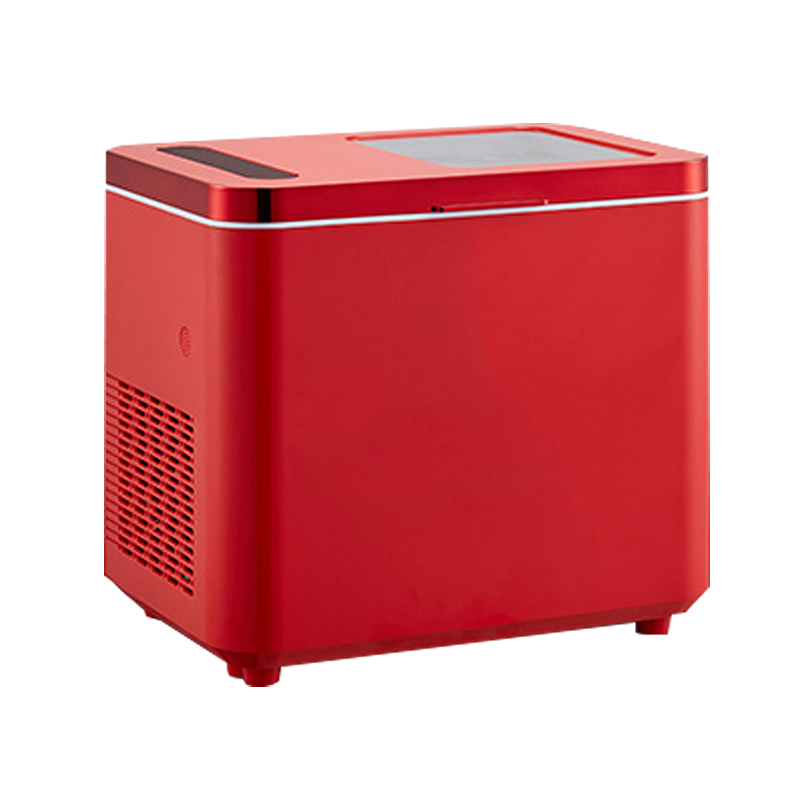
Touchscreen ice maker
Product Overview
The Touchscreen Ice Maker is a compact bullet ice machine developed for users who need a steady supply of conveniently shaped ice. Its product description is Alien-Z01, while its product category is Bullet Ice Maker. The appliance uses a 220V–240V/50Hz electrical supply and operates at a rated current and power of 0.9A and 150W respectively. It uses R600a refrigerant with a charge of 19 grams.
With dimensions of 325 × 295 × 252 millimeters, the machine is designed to occupy limited counter space. Its footprint is suitable for kitchens, beverage preparation counters, office refreshment areas, cafés, small restaurants, and retail environments where every centimeter matters. A compact appliance can be placed close to the point of use, reducing unnecessary movement between an ice storage area and a drink preparation station.
The product’s bullet ice shape is particularly important. Bullet ice is generally recognized by its rounded or cylindrical form and hollow or perforated center. This design gives the ice a larger surface area in contact with the surrounding beverage. As a result, drinks can cool rapidly, an advantage for iced tea, milk tea, soft drinks, fruit beverages, cocktails, and other chilled products.
The hollow center also contributes to the texture of the ice. Compared with dense solid cubes, bullet ice can be easier to bite and more comfortable to chew when produced at an appropriate hardness. This makes it popular in drink shops and fast-food settings, where customers may enjoy chewing the remaining ice after finishing a beverage. The shape is therefore not merely functional; it can also become part of the customer experience.
The touchscreen-oriented product concept further supports simple operation. Although the supplied technical information does not specify every control function, the touchscreen design indicates an emphasis on accessible user interaction. A modern interface can help users select operating modes, monitor the machine, and manage routine use more conveniently than a collection of difficult-to-identify mechanical switches.
Key Technical Specifications
Product Type | Touchscreen Bullet Ice Maker |
Product Description | Alien-Z01 |
Power Supply | 220V–240V / 50Hz |
Current | 0.9A |
Rated Power | 150W |
Refrigerant | R600a |
Refrigerant Charge | 19g |
Machine Dimensions | 325 × 295 × 252mm |
Ice Style | Bullet or hollow-centered ice |
Rapid Cooling Through Ice Geometry
One of the product’s most important advantages is the rapid cooling behavior of its bullet-shaped ice. A perforated center increases the contact area between the ice and the beverage. When ice has more exposed surface area, heat can transfer from the liquid to the ice more efficiently. This allows a drink to reach a refreshing temperature in a shorter period, assuming suitable beverage volume and environmental conditions.
This characteristic is valuable in commercial service. A customer ordering a cold drink usually expects it to be served promptly and at a consistent temperature. In a milk tea shop, café, or fast-food restaurant, staff may need to prepare many drinks within a short period. Ice that cools efficiently can support faster preparation and reduce the need to use excessive quantities of ice.
Bullet ice can also distribute itself effectively within a cup. Its rounded form allows spaces between individual pieces, helping chilled liquid move around the ice. This can support a balanced cooling effect rather than leaving only the area immediately next to a solid cube thoroughly chilled.
Compared with large solid cubes, hollow-centered ice may cool beverages more quickly because of its greater relative surface area. Compared with very small crushed ice, it may provide a more controlled melting experience and a cleaner visual appearance. This balance makes the format suitable for both performance and presentation.
The practical result is an ice product that works well in iced coffee, fruit tea, milk tea, carbonated drinks, lemonade, juice, smoothies, and mixed beverages. Businesses can select the ice style that best matches their menu, while households can enjoy quickly chilled drinks without waiting for conventional freezer trays to freeze.
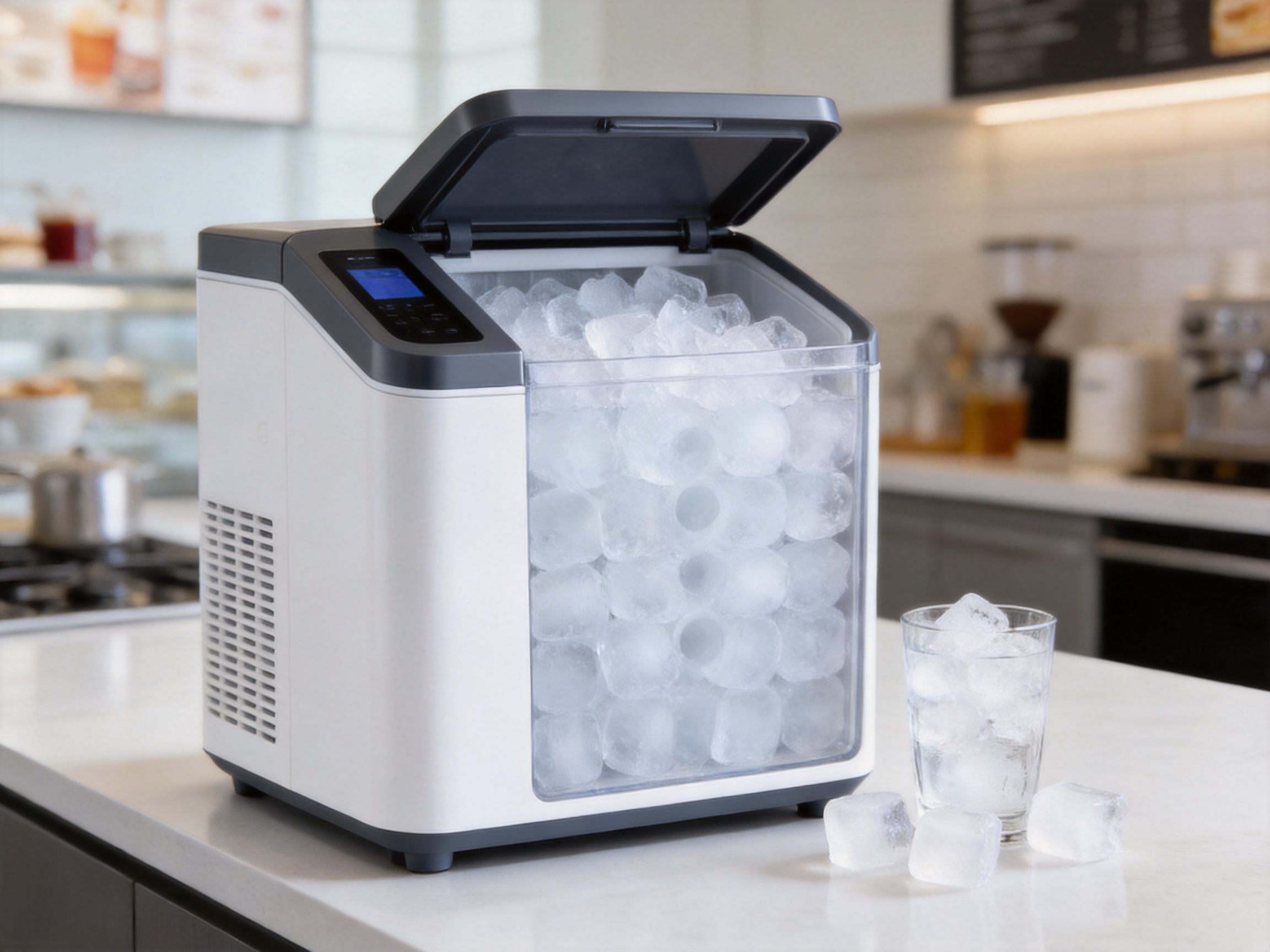
Non-Sticky Ice and High Flowability
Another major advantage is the ice’s non-sticky and highly flowable form. Ice pieces that clump together can be difficult to store, scoop, or deliver into a cup. Clumps slow down service and may require staff to break them apart manually. This creates inconvenience and can interrupt the rhythm of a busy beverage counter.
The bullet shape is designed to reduce unnecessary sticking during storage and dispensing. Individual pieces can move more freely, making them easier to handle with an ice scoop. This is important for commercial operators because simple and predictable dispensing helps staff work faster and with less effort.
High flowability also creates compatibility with automatic or semi-automatic dispensing systems. When ice pieces move smoothly, they are less likely to obstruct an outlet or create irregular portions. Although the exact dispensing equipment used will depend on the operator, a free-flowing ice format offers a useful foundation for organized service.
For small businesses, this advantage can reduce dependence on manual intervention. Staff can focus on drink preparation, customer service, and order fulfillment rather than repeatedly separating frozen clusters. In a home environment, the same characteristic makes it easier to transfer ice from the machine into a glass, storage container, or cooler.
Ice flowability also contributes to cleaner handling. When staff do not need to force apart large clumps, there may be less splashing, less accidental contact, and less risk of dropping pieces onto the counter or floor. Proper hygiene still depends on correct cleaning and handling procedures, but a manageable ice form supports a more orderly workflow.
Why Flowability Matters in Different Settings
In a milk tea shop, staff may prepare drinks continuously during peak periods. A free-flowing ice supply helps maintain speed when a large number of orders arrive at once. In a restaurant, it can simplify the work of filling glasses and pitchers. In an office or home kitchen, it reduces the need to manipulate frozen pieces with excessive force. In catering, it can make ice easier to transfer into insulated containers.
These benefits distinguish the machine from basic ice trays and some freezer-based alternatives. Conventional trays may produce ice that is slow to release, uneven in size, or difficult to store neatly. A dedicated ice maker can create a more repeatable supply of uniform pieces while keeping the production process separate from the main food freezer.
Texture, Hardness, and Customer Appeal
Ice quality is judged not only by temperature but also by texture. The product information emphasizes moderate hardness, meaning that the bullet ice is not intended to be as hard and dense as a fully solid cube. This creates a crunchy texture that many consumers find enjoyable.
Texture can influence how customers perceive a beverage. In milk tea shops and fast-food restaurants, customers often chew the remaining ice after drinking. Ice that is excessively hard may be uncomfortable or difficult to bite. Ice that melts too quickly may disappear before the beverage is finished. Bullet ice offers a middle ground: it can provide cooling performance while also delivering a distinctive crunch.
The hollow center contributes to this experience. Because the structure is not completely solid, the ice can be easier to break or bite than a dense cube of the same outside dimension. At the same time, its shape remains substantial enough to be visible in a transparent cup and attractive in a finished drink.
For businesses, this can become a small but meaningful point of differentiation. Customers may associate a particular beverage with the texture of its ice. A shop that serves milk tea, flavored tea, fruit drinks, or specialty cold beverages can use bullet ice as part of its product presentation and service identity.
Texture preferences vary by consumer and beverage type. Some users prefer very hard ice, while others prefer softer or more chewable pieces. The suitability of this machine is strongest for applications where moderate hardness, rapid cooling, and chewability are desirable. Buyers should match the ice style to their menu and customer expectations.
Efficient Ice-Making Principles
The machine is based on a continuous ice-making principle. Continuous production is valuable because it allows the appliance to create ice repeatedly instead of relying on a single batch of conventional freezer trays. This can provide a more convenient supply for users who need ice throughout the day.
In commercial models, continuous ice-making principles are associated with strong production capacity over time. The exact output of a particular appliance depends on ambient temperature, water temperature, ventilation, operating conditions, and the duration of use. Even without presenting an unverified production figure, the design objective is clear: the machine is intended to produce a large quantity of ice per unit of operating time compared with manual freezing methods.
This approach is more efficient for recurring beverage preparation. A household that regularly makes iced drinks does not need to remember to fill trays in advance. A small business can produce fresh ice during operating hours rather than purchasing and storing all ice externally. This can improve convenience and may help reduce dependence on packaged ice, subject to the business’s required volume and local food-safety practices.
The 150-watt rated power reflects an effort to balance ice-making performance with manageable energy use for a compact appliance. Actual energy consumption will vary according to operating duration, room temperature, water temperature, ventilation, and the frequency of ice production. Users should place the machine in a suitable environment and follow the operating instructions to support efficient performance.
Continuous ice production also supports a more consistent workflow. Rather than waiting for an entire tray to freeze and then releasing all pieces at once, users can maintain a developing supply. This is particularly useful when drinks are prepared at irregular intervals throughout the day.
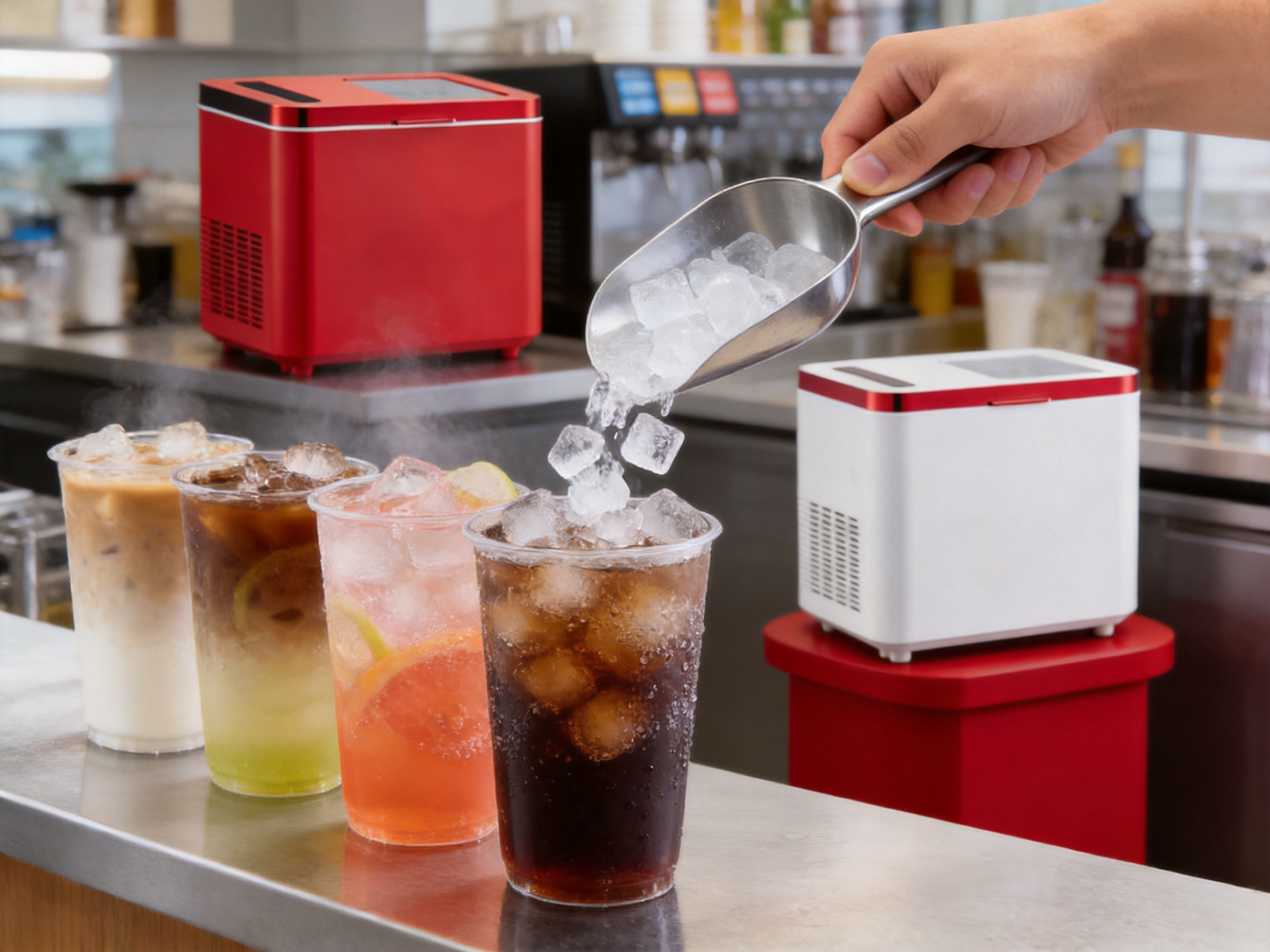
Space-Saving Construction
Space is a major concern in modern kitchens and commercial beverage stations. Countertops are often occupied by coffee machines, blenders, fryers, refrigerators, cups, syrups, ingredients, and point-of-sale equipment. A large ice maker may provide high output but be impractical for a small shop or compact home.
The Touchscreen Ice Maker measures only 325 × 295 × 252 millimeters. Its compact dimensions allow it to fit into many areas where a larger commercial ice machine would not. Users may place it on a kitchen counter, a service station, an office pantry surface, or a small beverage preparation table, provided that the location offers appropriate stability, ventilation, water access, and electrical safety.
Space efficiency does not mean that performance must be sacrificed. The product information specifically identifies compact structure as an advantage of its operating principle. By using an ice-making method suited to bullet-shaped ice, the machine can maintain a relatively small body while supporting useful production efficiency.
A compact design also improves mobility. While the machine should be handled carefully and according to its instructions, a smaller appliance is generally easier to reposition during cleaning, renovation, seasonal changes, or changes in counter layout. This flexibility can be valuable for businesses that frequently reorganize their service area.
For households, the smaller footprint helps the appliance coexist with other equipment. Users may keep it available for parties, family meals, weekend beverages, or special occasions without permanently dedicating a large section of the kitchen to ice production.
Flip-Top Access and Hygienic Maintenance
Cleaning is one of the most important factors in any appliance that handles water and produces ice for consumption. The product features a fully flip-top design that allows users to open the ice storage and ice-making areas more completely. This design supports easier access for routine cleaning and maintenance.
Restricted access can create hidden corners where moisture, residue, or mineral deposits accumulate. A top that opens widely makes it easier to inspect the interior and reach areas that require attention. This helps users identify standing water, ice fragments, or deposits before they become larger maintenance concerns.
Easy access also encourages more regular cleaning. A complicated machine may be cleaned less often because users find the process inconvenient. By contrast, a design that opens fully can make daily or periodic cleaning more manageable. The manufacturer’s emphasis on eliminating unsanitary corners reflects a practical understanding of how maintenance affects long-term user experience.
Users should still follow the product manual and applicable food-safety guidance. Ice-making components, water-contact surfaces, storage areas, scoops, and surrounding counters should be cleaned using appropriate methods. The machine should be dried and maintained according to the instructions, and water quality should be suitable for ice production.
Hygiene is not achieved by construction alone. It depends on a complete routine that includes clean water, clean hands, proper storage, regular inspection, correct drainage, and timely descaling where necessary. The fully opening design makes these actions easier to perform, supporting a cleaner and more reliable operation.
Maintenance Benefits for Commercial Operators
For a commercial operator, maintenance time has a direct relationship with operating cost. If workers can open the appliance quickly, inspect its interior, remove ice residue, and wipe accessible surfaces without disassembling complex sections, the daily process becomes more efficient.
Simple maintenance also supports staff training. New employees can understand a straightforward cleaning routine more easily than a complicated procedure involving many removable parts. Clear responsibilities and repeatable cleaning steps help businesses maintain more consistent hygiene standards across shifts.
The flip-top structure may also make it easier to conduct visual checks. Operators can confirm whether the storage area is clean, whether ice is accumulating normally, and whether any unusual moisture or residue is present. Early observation can help identify maintenance needs before they interrupt service.
Refrigeration System and Practical Operating Design
The Touchscreen Ice Maker uses R600a refrigerant with a 19-gram charge. R600a, or isobutane, is widely used in certain refrigeration applications because of its thermodynamic characteristics and suitability for compact systems. As with all refrigerants, it must be handled by qualified personnel when service or recovery is required.
The use of a specified refrigerant and charge demonstrates that the machine is designed around a defined refrigeration system rather than an improvised cooling arrangement. Proper refrigeration design affects freezing performance, operating stability, product life, and serviceability.
The 220V–240V/50Hz power specification makes the appliance suitable for electrical environments using this voltage and frequency range. Buyers should confirm local electrical compatibility before purchase and use the machine with a safe, properly grounded supply as required by local regulations and the product manual.
The stated current of 0.9A and rated power of 150W position the machine as a relatively modest-power appliance within its product class. This is useful for locations where electrical capacity is limited, although users should avoid sharing unsuitable extension cords or overloaded circuits with other high-power appliances.
Operating conditions influence the actual result of any ice maker. High room temperatures, warm incoming water, blocked ventilation, frequent lid opening, and insufficient clearance can affect production time and energy use. For best results, the machine should be placed on a stable surface, kept away from excessive heat, and provided with adequate airflow.
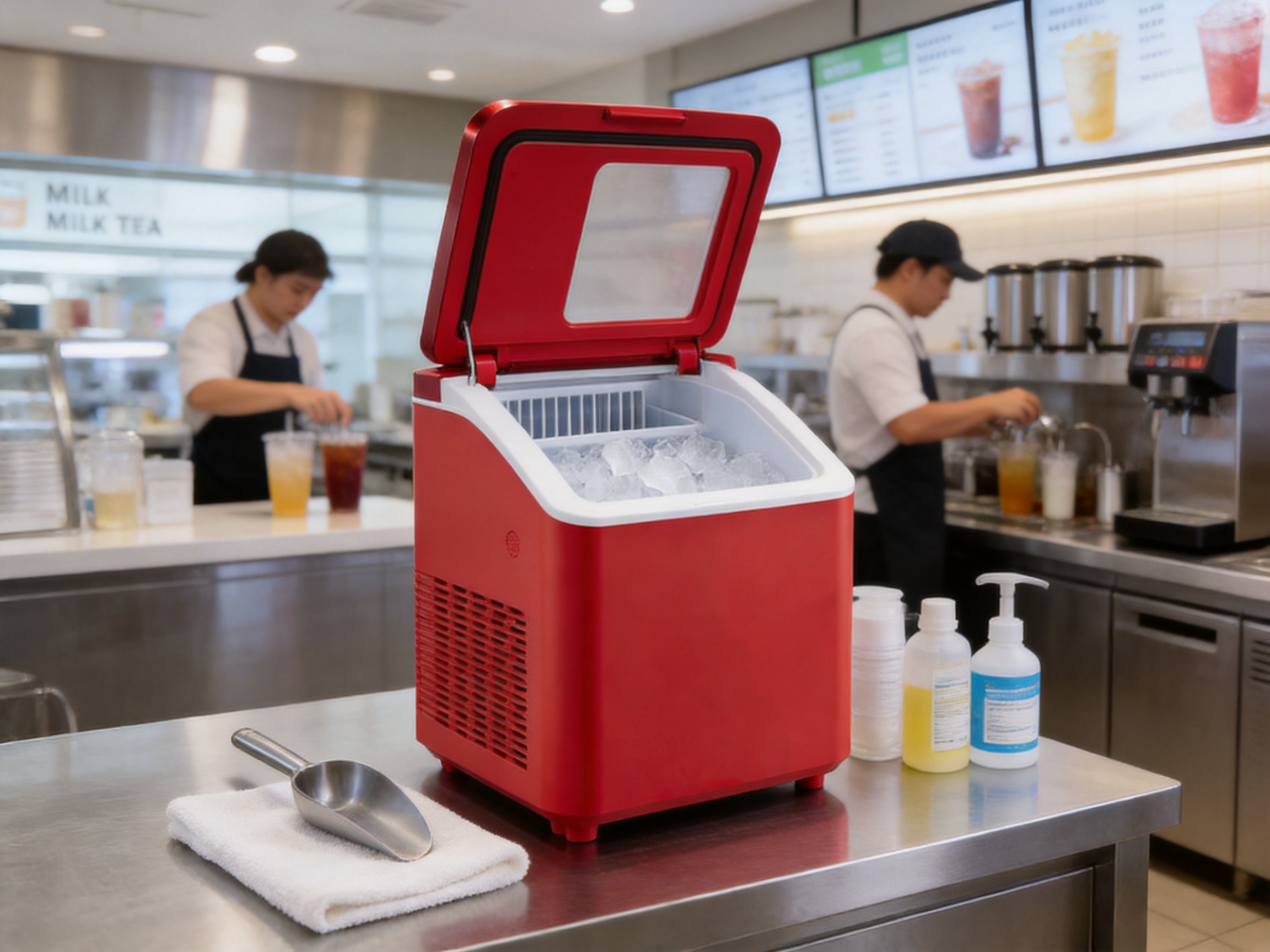
Advantages Compared with Common Alternatives
Compared with Manual Ice Trays
Manual ice trays are inexpensive and familiar, but they require advance preparation and freezer space. They usually produce limited quantities, and the ice may be difficult to release. Tray ice can also vary in size and may absorb odors from other frozen foods.
The Touchscreen Ice Maker offers on-demand production, a dedicated ice storage area, and a repeatable bullet shape. Users do not need to wait for a household freezer to freeze multiple trays. This makes the machine more convenient for frequent beverage preparation and social gatherings.
Compared with Large Commercial Ice Machines
Large commercial machines can deliver very high output, but they often require more floor or counter space, greater installation planning, and a larger investment. They may be excessive for small beverage shops, offices, home users, or businesses with moderate ice requirements.
The compact dimensions of this model provide an alternative for operations that need useful ice production without committing to a full-size commercial installation. Its 150-watt power rating and countertop-oriented structure may also be more appropriate for smaller service points.
Compared with Solid Cube Ice
Solid cubes are dense and can melt relatively slowly, but they may cool beverages less rapidly than hollow-centered pieces of comparable size. They can also be harder to chew. Bullet ice increases exposed surface area and offers a more approachable texture for consumers who enjoy crunchy ice.
Compared with Crushed Ice
Crushed ice cools quickly because of its high surface area, but it can melt rapidly, create excess water in a drink, and be more difficult to handle cleanly. Bullet ice can provide fast cooling while retaining a more substantial, organized shape that is easier to scoop and visually appealing in a beverage.
Compared with Clumping Ice Formats
Some ice shapes are more likely to form compact clusters during storage. Clumping can slow dispensing and create additional work for staff. The non-sticky, free-flowing character of bullet ice is intended to make handling easier and support smoother service.
Manufacturing Strengths and Product Development Approach
Alien Technology Co., Ltd. is based in Zhouxiang, Zhejiang Province, an area associated with small household appliance manufacturing and convenient logistics. This location provides a practical environment for sourcing components, coordinating production, managing supply chains, and serving domestic and international customers.
The company specializes in ice makers, coffee machines, air fryers, and other household appliances. This product focus indicates experience across several categories that require heating, cooling, electrical control, user interfaces, structural design, and food-contact considerations. Knowledge developed across these categories can support more integrated appliance development.
The company’s stated mission is “Smart Technology, Simplifying Life, Enhancing Happiness.” In the Touchscreen Ice Maker, this philosophy is reflected through a design that emphasizes direct use rather than unnecessary complexity. The appliance combines a modern control concept with a compact body, practical ice geometry, and an accessible cleaning structure.
Advanced manufacturing is not limited to the use of a touchscreen. It also includes the coordination of refrigeration, electrical systems, molded housing components, water-contact areas, storage design, assembly processes, inspection procedures, and packaging. A reliable appliance must ensure that these elements work together consistently.
The product’s specified electrical data, refrigerant charge, dimensions, and operating structure demonstrate a defined engineering approach. Standardized specifications help manufacturers control production and help buyers evaluate whether the appliance fits their operating environment.
The company also emphasizes reliable quality, customer satisfaction, continuous improvement, and innovation. These principles are important in a product category where long-term value depends on more than initial appearance. A well-designed ice maker must remain convenient after repeated cycles of filling, freezing, harvesting, storage, dispensing, cleaning, and maintenance.
Manufacturing strength is also connected to responsiveness. A company that specializes in a focused group of appliances can better understand recurring customer requirements, such as smaller footprints, easier cleaning, simpler controls, dependable refrigeration, and compatibility with different business formats. Feedback from households and food-service operators can guide product refinement over time.
For business customers, supplier capability matters as much as product specifications. Buyers may require stable communication, practical logistics, product documentation, after-sales coordination, packaging support, and consistent production. Alien Technology Co., Ltd. presents itself as open to cooperation with new and existing customers, making the product relevant to distributors, wholesalers, retailers, and commercial buyers.
Applications in Home and Commercial Environments
At home, the machine can support iced coffee, tea, fruit drinks, soft drinks, parties, family meals, and seasonal refreshment. Its compact footprint is suitable for users who do not want to permanently occupy a large area with an appliance. The bullet ice shape adds a café-style touch to homemade beverages.
In milk tea shops, the machine’s rapid cooling and chewable texture are particularly relevant. Milk tea customers often expect generous ice options and may value the texture of the ice as part of the drink. The free-flowing format can also help staff prepare orders efficiently.
In cafés, bullet ice can be used for iced coffee, cold brew drinks, flavored beverages, and blended-drink preparation. The machine can be positioned near the beverage station, reducing the need for staff to walk to a distant freezer.
In fast-food restaurants, speed and consistency are essential. The ice maker can support regular drink service, particularly where a smaller footprint is useful or where a supplementary ice source is needed during busy periods.
In offices, the appliance can provide a convenient source of ice for employees and visitors. It may be suitable for break rooms, meeting areas, staff kitchens, and hospitality spaces, provided that the expected demand is consistent with the machine’s capacity.
For catering and events, a compact ice maker can provide additional flexibility. Operators should assess the required production volume, access to water and electricity, transport conditions, and the need for insulated storage. The appliance may be used as part of a broader ice-management plan rather than as the only source for very large events.
How to Achieve Better Daily Performance
Users should begin by placing the machine on a level, stable surface. A balanced position helps support proper operation and reduces the likelihood of movement or vibration. The appliance should not be placed directly beside equipment that releases excessive heat unless the installation instructions specifically permit it.
Adequate ventilation is important for refrigeration equipment. Airflow around the machine helps the cooling system release heat. Blocking vents or pushing the appliance tightly against a wall may reduce efficiency and increase operating stress. The required clearance should always follow the product documentation.
Clean water should be used for ice production. Water quality affects taste, appearance, mineral accumulation, and maintenance frequency. If local water contains a high level of minerals, users should pay particular attention to cleaning and descaling guidance.
The storage area should not be overloaded beyond its intended design. Ice should be transferred or used regularly so that the storage compartment remains organized. Scoops and other handling tools should be kept clean and stored in a hygienic manner.
Regular cleaning should include the water-contact areas, ice-making area, storage compartment, lid surfaces, and exterior touchpoints. Users should follow the recommended cleaning agents and procedures, avoiding chemicals or tools that could damage food-contact surfaces.
When the machine is not used for an extended period, it should be emptied, cleaned, dried, and stored according to the manual. This reduces the chance of odor, residue, or stagnant water. Proper care helps preserve the machine’s convenience and supports a longer service life.
Purchasing Considerations for Businesses
Businesses should evaluate their average and peak ice requirements before purchasing. A compact countertop machine is highly suitable when the operation needs flexible, recurring ice production but does not require the output of a large centralized system. If demand is exceptionally high, the business may need multiple units or a larger commercial solution.
The available counter area should be measured carefully. The machine’s 325 × 295 × 252-millimeter dimensions should be considered alongside ventilation clearance, access for filling and cleaning, and space for scooping or transferring ice.
Electrical compatibility is another essential consideration. The product is designed for 220V–240V and 50Hz operation. Buyers in regions with different electrical standards should consult the manufacturer or a qualified technician before ordering.
Businesses should also consider how the ice will be used. Bullet ice is especially suitable for drinks where quick cooling, a crunchy texture, and attractive presentation are valued. Menu planning, customer preferences, cup sizes, and dispensing methods should all be taken into account.
Finally, buyers should evaluate supplier support. Documentation, packaging, spare-part availability, communication, logistics, and after-sales service can affect the total value of an appliance. A specialized manufacturer with experience in household appliances may be able to provide more focused support than a general trading supplier.
Safety and Responsible Use
Because the product combines electricity, water, refrigeration, and ice intended for consumption, it should be operated responsibly. Users should read the supplied instructions before first use and should not modify electrical or refrigeration components without professional authorization.
The R600a refrigerant is flammable under certain conditions. The refrigeration circuit should not be punctured, opened, or repaired by unqualified personnel. If the machine is damaged, unusual odors are detected, or the refrigeration system appears compromised, users should disconnect the appliance if safe to do so and seek qualified service.
The appliance should be kept away from children unless supervised. Touchscreen controls and the ice storage area should be used with clean hands, and the ice scoop should not be placed on unclean surfaces. Ice intended for consumption should be handled as a food product.
Electrical cords should be protected from water, heat, crushing, and sharp edges. The machine should be connected to a suitable outlet, and users should avoid unsafe adapters or overloaded extension cables. Any local electrical requirements should be observed.
Safety, hygiene, and maintenance work together. A clean machine is not automatically safe if it is electrically overloaded, and a properly powered machine is not hygienic if the water system is neglected. The best results come from following the complete operating and maintenance procedure.
Q&A
What type of ice does the machine produce?
The machine produces bullet-style ice, also described as hollow-centered or perforated ice. This form is designed to cool drinks quickly and provide a moderately hard, crunchy texture.
Why does bullet ice cool beverages quickly?
The perforated center increases the ice’s exposed contact area. This allows heat to transfer from the beverage to the ice efficiently, helping the drink become cold in a relatively short time.
Is the ice easy to scoop?
The product is designed to produce non-sticky, high-flowability ice. Individual pieces are intended to resist excessive clumping, making them easier to scoop and dispense.
Can the machine be used in a milk tea shop?
Yes. Its cooling performance, chewable texture, free-flowing shape, and compact structure are well suited to milk tea shops and similar beverage businesses. The operator should confirm that the expected daily demand matches the machine’s capacity.
Is the appliance suitable for home use?
Yes. Its compact dimensions and modest 150-watt rated power make it suitable for many household kitchens, offices, and small refreshment areas, provided that the electrical supply is compatible.
What are the machine’s dimensions?
The machine measures 325 × 295 × 252 millimeters. Users should also allow additional space for ventilation, cleaning, filling, and ice transfer.
What power supply does it require?
The specified power supply is 220V–240V at 50Hz. Buyers should verify compatibility with the electrical standard in their location before use.
What refrigerant does it use?
The product uses R600a refrigerant with a 19-gram charge. Refrigerant service should be performed only by appropriately qualified personnel.
How does the flip-top design help with cleaning?
The fully flip-top structure provides broader access to the ice storage and ice-making areas. This makes it easier to inspect, wipe, clean, and maintain the interior while reducing difficult-to-reach areas.
Does the machine make ice continuously?
The product uses a continuous ice-making principle, allowing repeated production over time. Actual production depends on operating conditions such as ambient temperature, water temperature, ventilation, and usage frequency.
Is bullet ice harder than solid cube ice?
Bullet ice is described as having moderate hardness. It is not intended to be as dense or hard as solid ice cubes, which gives it a more approachable crunchy texture.
Can the ice be used in automatic dispensing systems?
The ice’s non-sticky, free-flowing form is designed to facilitate scooping and support automatic ice dispensing systems. Compatibility should be confirmed with the specific dispensing equipment.
Who manufactures the Touchscreen Ice Maker?
The machine is manufactured by Alien Technology Co., Ltd., a Zhejiang-based company specializing in ice makers, coffee machines, air fryers, and other household appliances.
What should buyers consider before ordering?
Buyers should consider electrical compatibility, available counter space, ventilation, expected ice demand, water quality, cleaning requirements, intended beverage applications, logistics, documentation, and supplier support.
Conclusion
The Touchscreen Ice Maker offers a practical combination of compact design, bullet-shaped ice, rapid cooling, high flowability, moderate hardness, continuous production principles, and accessible maintenance. Its 325 × 295 × 252-millimeter body allows it to serve users who need dependable ice without installing a large machine, while its 150-watt system is suited to many home, office, and small-business environments.
Its strongest distinction lies in the way the ice format supports several needs at once. The perforated center helps cool drinks rapidly, the rounded shape can resist clumping, the texture is enjoyable for many customers, and the ice remains convenient to scoop. These advantages make it relevant to milk tea shops, cafés, restaurants, fast-food businesses, offices, and households.
The fully flip-top design adds an important hygiene advantage by making the ice-making and storage areas easier to reach. This supports regular inspection and cleaning, which are essential for any appliance that produces ice for consumption. The defined power supply, refrigerant specification, and compact structure further demonstrate a product developed around practical engineering requirements.
Behind the product is a specialized appliance manufacturer with experience in ice makers, coffee machines, air fryers, and related household products. Based in Zhejiang’s small-appliance manufacturing environment, Alien Technology Co., Ltd. combines focused product knowledge, convenient logistics, a stated commitment to reliable quality, and an interest in continuous improvement.
For users seeking fast beverage cooling, efficient countertop ice production, easy handling, and straightforward maintenance, this bullet ice maker presents a balanced solution. It is especially valuable where space is limited but drink quality and service speed remain important.
References
1. Product specification sheet for the Touchscreen Ice Maker, product description Alien-Z01.
2. Manufacturer-provided technical data for power supply, current, rated power, refrigerant, refrigerant charge, and machine dimensions.
3. Manufacturer-provided product information concerning rapid cooling, high flowability, moderate hardness, continuous ice-making efficiency, compact construction, and flip-top cleaning access.
4. Manufacturer profile for Alien Technology Co., Ltd., including company specialization, manufacturing location, mission, and business philosophy.
5. General refrigeration engineering principles concerning surface area, heat transfer, compact refrigeration systems, and refrigerant handling.
6. General food-service equipment practices concerning ice handling, cleaning routines, water quality, storage hygiene, and electrical safety.