
 English
 한국어
한국어 Español
 Deutsch
Reliable access to fresh ice can make everyday routines more convenient, whether the ice is needed for a glass of water, a family gathering, a café service area, an office pantry, an RV, or a small hospitality business. A countertop ice maker provides a practical alternative to buying bags of ice or waiting for a freezer to produce enough cubes. The Button-Operated Ice Maker is designed around this need, combining straightforward controls, compact dimensions, efficient operation, and fast ice production in a machine that is easy to place and simple to use.
Unlike complicated appliances that require a long learning process, this ice maker uses a one-touch button operating concept. Users can begin the ice-making process with minimal preparation and without navigating a complex control panel. Its compact structure measures 313 x 226 x 309 millimeters, allowing it to fit comfortably on many kitchen counters, office work surfaces, bar counters, service stations, and mobile living spaces.
The product is identified as a bullet ice maker and is described as the Alien-Z03 model. It is manufactured by Alien Technology Co., Ltd., a household appliance company based in Zhouxiang, Cixi City, Zhejiang Province. The company specializes in ice makers, air fryers, coffee machines, and other small household appliances. Its stated mission is to simplify life through smart technology, humanized design, dependable quality, and continuous improvement.
This article examines the product’s operating concept, practical advantages, specifications, applications, maintenance requirements, and competitive position. It also considers how a specialized small-appliance manufacturer can create value through product planning, component selection, production control, assembly consistency, inspection, and customer-oriented improvement.
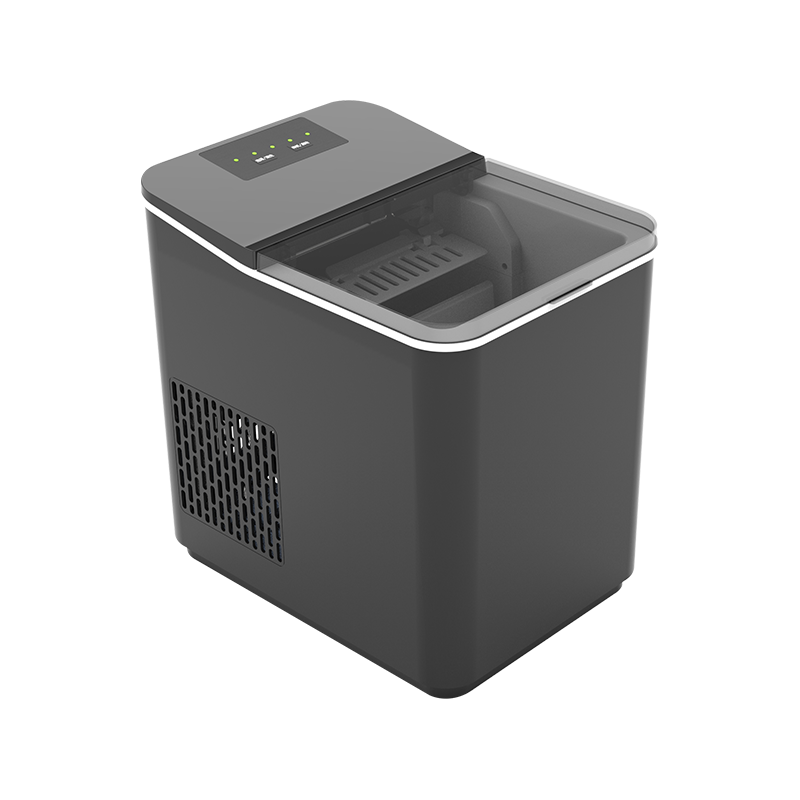
Button-Operated Ice Maker
1. Product Overview and Design Purpose
The Button-Operated Ice Maker is intended for users who want ice available on demand without dedicating a large amount of freezer space to ice trays or packaged ice. It is particularly suitable for locations where a full-size commercial ice machine would be excessive, but where an ordinary freezer cannot keep up with daily demand.
Its central design principle is simplicity. A user adds water, selects the desired operating setting when applicable, and activates the machine using the button control. This direct operating method is useful for families, offices, bars, cafés, rental properties, mobile homes, and small commercial settings where several people may use the same appliance. The machine does not depend on a complicated interface to deliver its primary function.
The product’s compact format also supports flexible installation. It can be positioned near a beverage preparation area, beside a coffee machine, within a home bar, in an office break room, or in an RV kitchen. Because the dimensions are relatively small, users can move the appliance when required rather than treating it as a permanent installation.
A countertop ice maker should be evaluated not only by its ability to freeze water, but also by how well it fits into a user’s routine. Fast preparation, uncomplicated controls, accessible cleaning, quiet operation, manageable energy consumption, and a durable internal structure all affect the overall experience. The Button-Operated Ice Maker is designed with these practical requirements in mind.
Core Product Identity
Product Type |
Bullet Ice Maker |
Model Description |
Alien-Z03 |
Operating Concept |
Button-operated ice production |
Power Supply |
220V-240V, 50Hz |
Rated Current and Power |
0.9A and 150W |
Refrigerant and Charge |
R600a, 19g |
Machine Dimensions |
313 x 226 x 309 millimeters |
Primary Use Environments |
Homes, offices, bars, RVs, and small commercial spaces |
2. One-Touch Operation for Everyday Convenience
The most visible advantage of this product is its button-operated control system. Many users do not need an appliance with numerous modes, menus, or programmable settings. They need a clear method to begin making ice and to understand the machine’s basic operating status. A physical or clearly defined button can provide an immediate interaction that is easy to remember.
This approach is valuable in shared environments. In an office, a visitor or employee can use the machine without receiving detailed instructions. In a family kitchen, children and older adults may find a direct button easier to understand than a touchscreen interface. In a bar or small food-service space, staff can start the machine quickly while performing other tasks.
Simple operation can also reduce user error. When the product has a clear primary control, there is less risk that a user will select an unsuitable program or overlook an important step. The machine’s interface is therefore aligned with a practical household appliance philosophy: the technology should support the user instead of becoming an additional task.
The one-touch concept does not mean that the ice maker lacks useful functionality. The product information indicates fast ice making, multiple ice sizes, efficient water and energy use, quiet operation, and easy cleaning. These functions are organized around an accessible operating experience rather than an unnecessarily complicated control structure.
Benefits of a Direct Control System
A direct button interface is easy to learn, which makes the appliance suitable for first-time ice-maker owners. It also supports quick start-up during parties, meal preparation, or beverage service. Users can focus on filling glasses, preparing food, or serving guests rather than studying a technical manual.
Another benefit is consistency. When the operating sequence is straightforward, different users are more likely to use the appliance in the same manner. Consistent use can help reduce unnecessary strain on the machine and support predictable performance over time.
For retailers and distributors, simple operation can also reduce product explanation requirements. A product that is immediately understandable is easier to demonstrate in a showroom, online video, product listing, or hospitality supply catalog. This can improve customer confidence and reduce concerns about after-sales support.
3. Fast Ice Making for Changing Daily Demands
According to the supplied product information, the machine can produce ice in approximately 6 to 10 minutes per cycle. The exact time may vary with room temperature, water temperature, ventilation, water level, selected ice size, and other operating conditions. Nevertheless, this cycle range gives users a useful advantage over conventional ice trays, which may require several hours before the ice is ready.
Fast production is particularly helpful when ice demand changes unexpectedly. A family may need additional ice during a weekend gathering. An office may require more cold drinks during a meeting. A small café or bar may experience a temporary increase in demand. An RV user may want ice during travel without purchasing a large bag from a store. In these situations, a countertop unit can provide a flexible supplementary supply.
Speed also supports better planning. Users do not necessarily need to prepare a large quantity of ice in advance. They can begin a cycle closer to the time when ice will be used. This can help reduce the need to store excess ice in a freezer or cooler, where it may absorb odors, freeze together, or take up valuable space.
The ice maker’s value is therefore based not only on its production rate, but on its ability to shorten the distance between demand and availability. This is one of the main areas where a dedicated countertop ice maker can outperform the ice-making function of a standard freezer.
Bullet Ice for Beverages and Everyday Uses
The product is categorized as a bullet ice maker, meaning it is designed to produce rounded or bullet-shaped pieces rather than traditional flat freezer cubes. Bullet ice is commonly selected for beverages because its shape is convenient to handle and can provide a pleasant cooling experience.
Bullet ice can be used in water, soft drinks, iced tea, juice, cocktails, smoothies, and other cold beverages. It can also be useful for casual food presentation or temporary cooling applications. Users should follow appropriate food-safety practices and avoid treating the ice maker as a substitute for specialized food preservation equipment.
The supplied information also indicates multiple ice-size options. Different sizes can be selected according to the beverage, serving style, and personal preference. Smaller pieces may be suitable for quick cooling, while larger pieces may be preferred when a slower melting rate is desirable. The ability to choose among sizes can make the machine more versatile than a basic appliance with only one fixed output.
4. Compact Construction for Flexible Placement
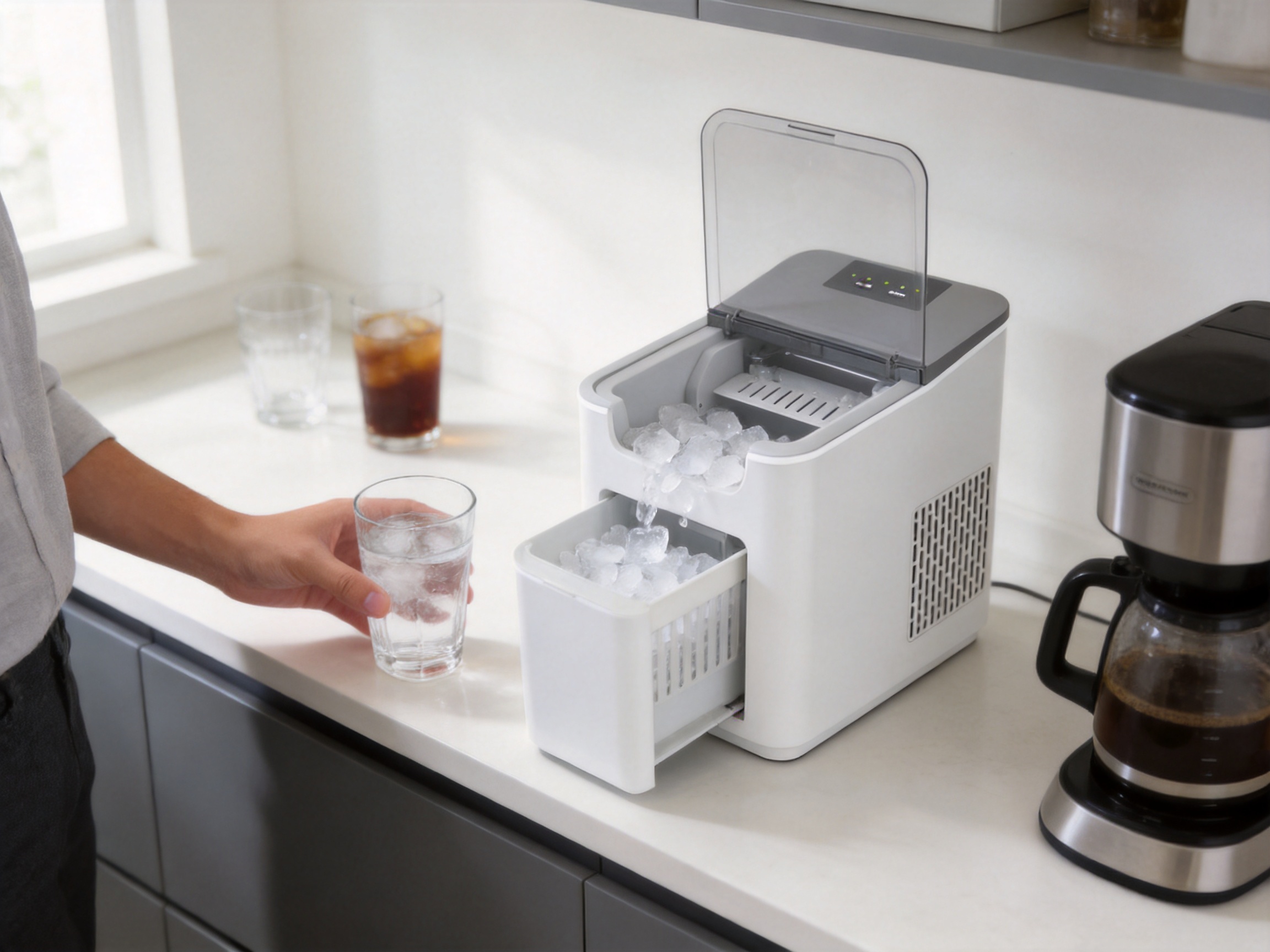
With dimensions of 313 x 226 x 309 millimeters, the Button-Operated Ice Maker is designed for spaces where a large appliance would be inconvenient. Counter space is limited in many modern kitchens, offices, recreational vehicles, and small service areas. A compact product can be installed close to the point of use and stored when it is not needed.
The narrow footprint is especially useful for beverage stations. A user can position the ice maker next to a coffee machine, water dispenser, blender, or drinks refrigerator. In a home bar, it can remain within reach of glasses and mixers. In an office, it can support a shared refreshment area without requiring construction or plumbing work.
Portability is another practical advantage. The machine can be moved between rooms or taken on suitable trips when a compatible power supply is available. RV users should confirm that the vehicle’s electrical system and operating conditions are appropriate for the stated 220V-240V, 50Hz supply before use.
Compact design must be balanced with ventilation and safe placement. Users should leave sufficient space around the appliance as recommended by the product instructions, keep the air openings clear, and place the machine on a stable, level, dry surface. These basic practices help support reliable cooling and reduce unnecessary stress on the refrigeration system.
Compared with Large Ice Machines
A large commercial ice machine may be appropriate for a restaurant, hotel, or high-volume catering operation, but it can be excessive for a home or small office. Such machines often require more space, greater investment, dedicated installation, and more extensive maintenance. The Button-Operated Ice Maker offers a different value proposition: moderate, flexible, on-demand production in a countertop format.
The product is not intended to replace high-capacity industrial equipment. Its competitive advantage is right-sizing. It provides a convenient amount of ice for everyday users without requiring the infrastructure associated with a large machine. For many households and small businesses, this balance between capacity, footprint, and simplicity may be more valuable than maximum output.
Compared with Freezer Ice Trays
Freezer trays are inexpensive and simple, but they require significant waiting time and occupy freezer space. Removing ice from trays can also be inconvenient, and the supply may be insufficient during gatherings. A dedicated ice maker automates the freezing and collection process, offering faster access and greater convenience.
The Button-Operated Ice Maker is therefore positioned between manual ice trays and large commercial equipment. It is more convenient than a tray-based method while remaining more compact and accessible than a heavy-duty machine.
5. Electrical and Refrigeration Specifications
The machine is designed for a 220V-240V, 50Hz power supply. Its stated current and power specifications are 0.9A and 150W. These figures provide users and distributors with essential information for evaluating compatibility, electrical planning, and operating expectations.
The 150W rating reflects a relatively modest power requirement for a refrigeration-based countertop appliance. Actual energy use can vary according to ambient temperature, cycle duration, operating frequency, ventilation, water temperature, and standby behavior. Users should consult the final product documentation for detailed energy information and operating instructions.
The listed refrigerant is R600a, with a charge of 19 grams. R600a, or isobutane, is commonly used in various modern refrigeration appliances. As with all flammable refrigerants, the appliance should be handled, transported, installed, serviced, and disposed of according to applicable safety requirements and the manufacturer’s instructions. Users should not attempt to open or repair the sealed refrigeration system themselves.
Specification Category |
Stated Value |
Practical Importance |
Voltage and Frequency |
220V-240V, 50Hz |
Confirms electrical compatibility for the intended market |
Current |
0.9A |
Helps users evaluate circuit requirements |
Rated Power |
150W |
Indicates the appliance’s nominal electrical demand |
Refrigerant |
R600a |
Supports the cooling process in the refrigeration circuit |
Refrigerant Charge |
19g |
Provides a reference for qualified service personnel |
Dimensions |
313 x 226 x 309mm |
Assists with placement, packaging, and storage planning |
6. Efficiency and Responsible Daily Use
The product information highlights efficient operation and optimized water usage. For users, efficiency means more than a low nominal power rating. It also includes making an appropriate amount of ice, avoiding unnecessary cycles, keeping the appliance clean, and operating it in a suitable environment.
Users can support efficient performance by placing the machine away from ovens, direct sunlight, radiators, and other heat sources. Good airflow around the appliance allows the refrigeration system to reject heat more effectively. Overcrowding the surrounding space may cause longer cycles and increase energy consumption.
Using clean water at a reasonable temperature can also support consistent operation. Extremely warm water may require additional cooling work before ice formation begins. At the same time, users should avoid exceeding the recommended water level, since overfilling can interfere with operation and create spills.
Water efficiency is connected to planning. A user should make the amount of ice needed rather than running repeated cycles without a purpose. The removable ice basket makes it easier to collect ice and transfer it to a cooler, serving container, or freezer when appropriate.
Although the machine is designed to reduce waste, all ice makers require responsible cleaning and water management. Stale water should not be left in the reservoir for extended periods. Regular emptying and rinsing can help maintain freshness and protect the internal water path.
7. Quiet Operation for Shared Spaces
Noise is an important consideration for countertop appliances. An ice maker may be placed in a kitchen connected to a living room, an office near workstations, or a bedroom area in a compact apartment or RV. The supplied information describes the product as incorporating a noise-reduction design intended to keep operation quiet.
Quiet operation improves comfort without requiring users to move the machine away from the point of use. It is helpful during conversations, meetings, study periods, and evening routines. In hospitality settings, reduced operating noise can contribute to a more pleasant atmosphere for guests.
Some sound is normal because the appliance contains a refrigeration compressor, fan, water movement components, and ice-release mechanisms. However, the product’s design objective is to manage these operating sounds rather than allowing them to become unnecessarily disruptive.
Correct placement also affects perceived noise. A stable, level surface can reduce vibration. Contact with walls, loose shelves, or lightweight counters may amplify sound. Users should avoid placing objects on top of the unit and should ensure that the machine is not touching nearby items during operation.
8. Easy Cleaning and Maintenance
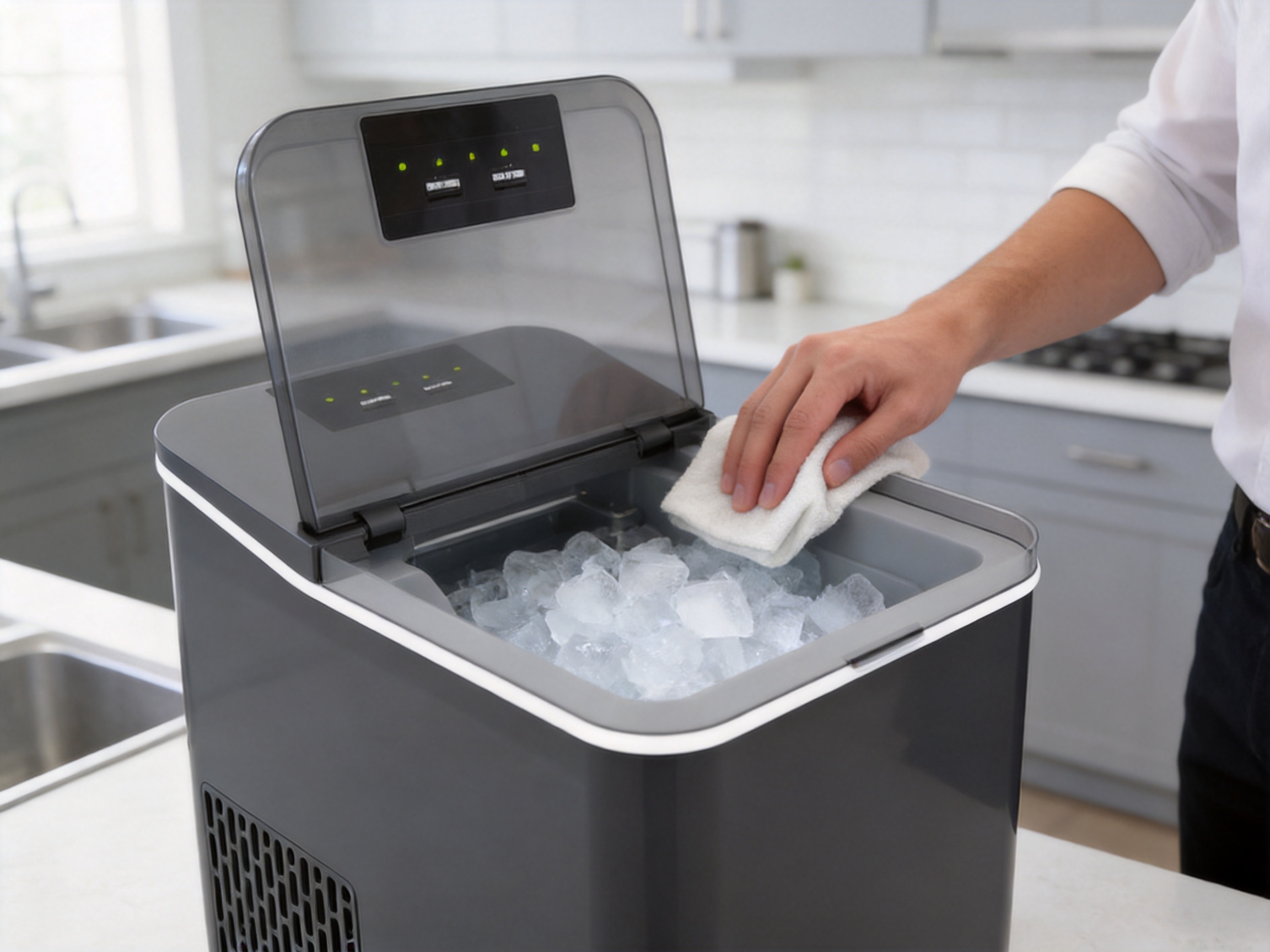
Cleaning is essential for any appliance that handles drinking water and produces ice for consumption. The Button-Operated Ice Maker is designed with smooth interior surfaces and a removable ice basket, features that can simplify routine care.
A removable basket allows users to take out the finished ice and access the interior more easily. Smooth surfaces reduce the number of places where water residue or particles can collect. Together, these features can make cleaning less time-consuming than maintaining a complicated internal structure.
Recommended Basic Cleaning Routine
Before cleaning, users should disconnect the appliance from the power supply and follow the official instruction manual. The ice basket should be removed and washed using a suitable method. Interior surfaces can generally be wiped with a clean, soft cloth and an appropriate mild cleaning solution, provided that the product instructions permit it.
The water reservoir should be emptied regularly. Standing water can develop an unpleasant odor and may affect the taste of newly produced ice. After cleaning, the interior should be rinsed appropriately and allowed to dry as recommended.
Users should avoid abrasive pads, harsh chemicals, and sharp tools that could damage smooth surfaces or internal components. The appliance should never be immersed in water. Electrical parts, controls, and the refrigeration system must be protected from direct water exposure.
The ice basket should also be cleaned even when the water reservoir appears clean. Ice may be handled frequently, and residue can transfer from hands, scoops, containers, or surrounding surfaces. A clean storage basket supports better hygiene and product quality.
Maintenance and Service Considerations
The external surfaces should be kept free from dust and grease, particularly around ventilation areas. Restricted airflow can affect cooling efficiency. Users should inspect the power cord and plug periodically and stop using the machine if damage is observed.
Refrigerant-related service should only be performed by qualified professionals with appropriate equipment and training. Because R600a is flammable, users should not puncture, modify, or attempt to recharge the refrigeration circuit. Professional service is also important for preserving the integrity of the sealed system.
A simple maintenance routine can extend the useful life of the appliance. Regular cleaning, suitable placement, correct water levels, and prompt attention to unusual sounds or performance changes are practical ways to protect the investment.
9. Competitive Advantages in the Countertop Ice-Maker Market
The countertop ice-maker category includes products with different control systems, sizes, cooling designs, noise levels, and ice shapes. The Button-Operated Ice Maker competes by combining several user-focused advantages rather than relying on a single feature.
Accessibility
The one-touch design makes the machine approachable for a wide range of users. Competing products with overly complex interfaces may create hesitation, especially for customers who want a simple appliance rather than a connected or highly programmable device.
Speed
A stated production cycle of approximately 6 to 10 minutes provides faster access to ice than manual freezer trays. This is valuable for users who do not want to plan ice production many hours in advance.
Flexibility
Multiple ice sizes allow users to adapt the product to beverages, serving conditions, and personal preferences. This gives the machine a broader use range than a fixed-size ice maker.
Space Efficiency
The compact dimensions make the product suitable for locations where a larger appliance cannot be installed. It can serve as a primary ice source for a household or as a supplementary unit for a small business.
Operating Comfort
Noise-reduction design supports use in kitchens, offices, bedrooms, and other shared areas. This feature can distinguish the appliance from machines that are effective but intrusive during operation.
Maintenance Convenience
Smooth internal surfaces and a removable ice basket simplify cleaning. Easy maintenance is a competitive advantage because it influences hygiene, long-term satisfaction, and the likelihood that users will care for the appliance properly.
Balanced Power Demand
The 150W rated power specification gives the product a practical position for countertop use. It is not presented as a high-output industrial machine; instead, it is designed to deliver useful ice production in a relatively compact household appliance format.
10. Manufacturing Strengths and Product Development Approach
Alien Technology Co., Ltd. is located in Zhouxiang, Zhejiang Province, an area recognized in the supplied company information as a hub for small household appliance manufacturing and logistics. This location can support access to component suppliers, production services, packaging resources, transportation networks, and experienced appliance labor.
A specialized manufacturing environment is valuable because small appliances require coordination among mechanical design, refrigeration engineering, electrical control, plastics, sheet-metal or structural components, assembly, inspection, packaging, and after-sales service. A company that works across ice makers, coffee machines, and air fryers can develop practical experience with multiple appliance systems and consumer expectations.
Product Planning and Humanized Design
The company’s stated commitment to humanized design is reflected in the product’s emphasis on one-touch operation, compact placement, quiet performance, and easy cleaning. Humanized design begins with identifying daily inconveniences and then reducing the number of steps required to complete a task.
For an ice maker, this may include designing a control layout that is immediately understandable, shaping the internal basket for easy removal, providing accessible water-filling areas, and ensuring that surfaces can be wiped without difficulty. These decisions may appear simple, but they have a direct effect on customer satisfaction.
Refrigeration System Integration
Ice makers require the coordinated operation of a compressor, condenser, evaporator, fan or airflow system, water circulation components, temperature sensing, and ice-release mechanisms. The machine must freeze water efficiently and then release the ice without creating excessive resistance or unnecessary noise.
Proper integration requires attention to component matching, refrigerant charge, thermal transfer, insulation, airflow, electrical protection, and assembly accuracy. The listed R600a refrigerant and 19-gram charge represent key design parameters for the sealed cooling system. Maintaining consistency in these parameters is essential for reliable production.
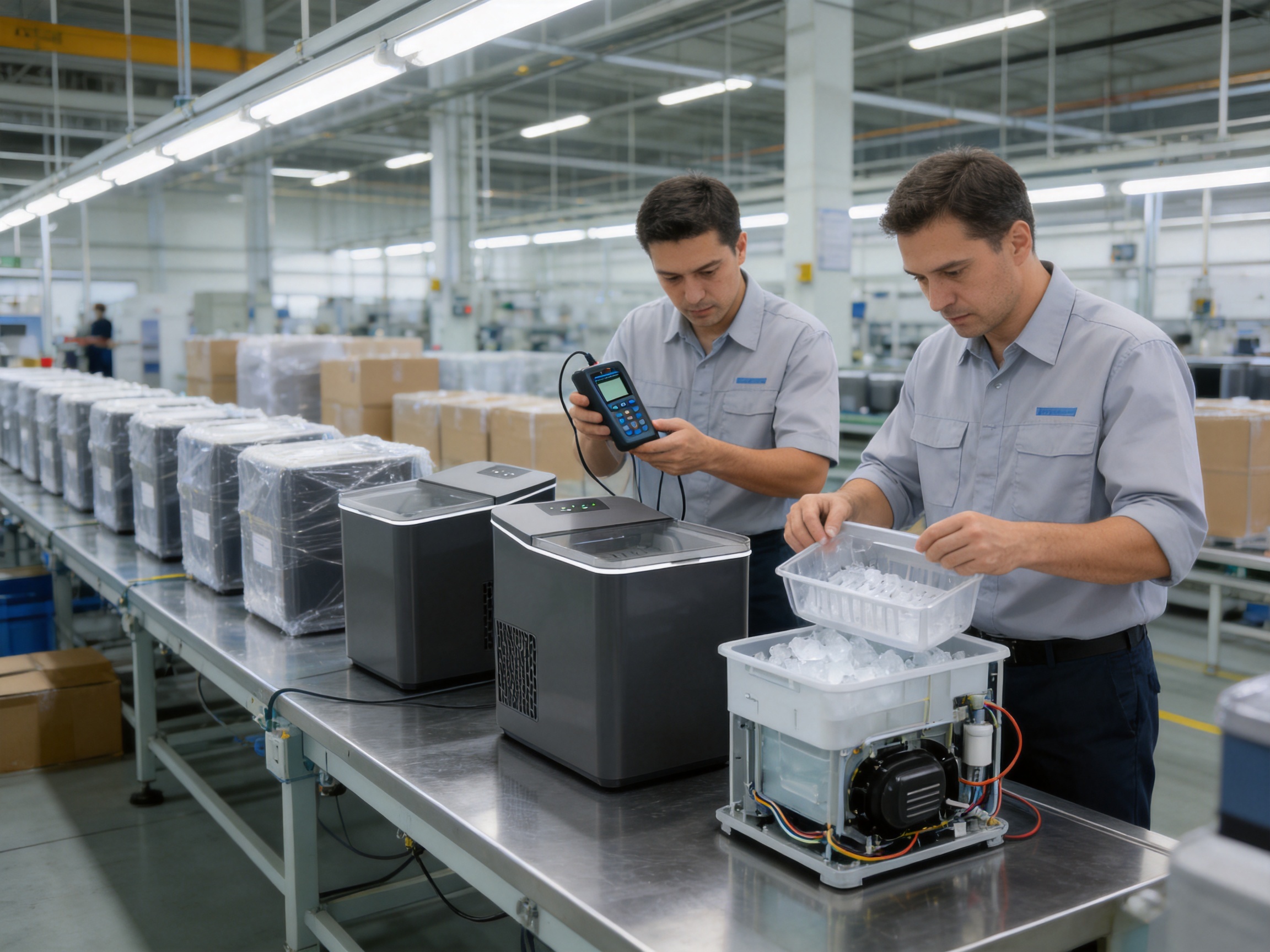
Because refrigeration performance can be affected by ambient conditions, manufacturing evaluation should include testing under different temperatures and operating scenarios. A robust production process typically verifies cooling behavior, ice-release performance, electrical operation, leakage protection, and abnormal-condition response before products are packaged for shipment.
Component and Assembly Control
Small-appliance quality depends heavily on assembly consistency. A product may have a sound design but perform poorly if wiring, seals, fasteners, tubing, sensors, or water-path components are installed inconsistently. A disciplined manufacturing process should therefore use defined work instructions, controlled component specifications, inspection points, and traceable quality records.
Assembly workers need clear procedures for electrical connections, insulation, tubing placement, water-system installation, control-panel fitting, and enclosure assembly. Torque requirements, connector engagement, sealing points, and cable routing should be controlled where applicable. These practices help reduce variation between units.
For an ice maker, water leakage and refrigeration-system integrity are especially important. Production inspection should look for visible defects, loose connections, abnormal vibration, control errors, and incomplete cleaning before final packaging. Such controls protect both the product and the customer experience.
Functional Testing
Functional testing can confirm that each machine responds to its operating controls, fills and manages water correctly, begins the cooling process, forms ice, releases ice, and stops or signals appropriately under relevant conditions. Testing may also evaluate sound, vibration, power behavior, and the consistency of ice formation.
The stated power supply, current, and power rating provide a basis for electrical verification. Testing should be conducted using procedures appropriate to the intended market and applicable requirements. Products destined for different regions may need different plugs, labels, manuals, packaging, or compliance documentation.
Although the supplied company information does not list specific certifications, buyers and distributors should request the appropriate technical documents for their target market. A responsible manufacturer should be prepared to clarify product specifications, testing arrangements, material information, and applicable regulatory requirements.
Continuous Improvement
The company describes continuous improvement and innovation as part of its business philosophy. In practical manufacturing, continuous improvement can involve analyzing customer feedback, studying service issues, reducing assembly variation, improving packaging protection, refining noise control, and making maintenance more convenient.
Feedback from distributors and end users can reveal issues that may not appear during initial testing. For example, customers may request a clearer water-level indicator, a more accessible drain, improved basket handling, a quieter fan, or packaging that better protects the machine during transportation. A manufacturer that treats such feedback as a source of product development can strengthen future versions.
11. Supply Chain and Business Cooperation Advantages
For importers, distributors, retailers, and hospitality suppliers, the manufacturer’s location in Zhejiang can offer logistical advantages. Zhouxiang and the surrounding region have experience in small household appliance production, which can facilitate cooperation with component suppliers, packaging factories, freight providers, and technical service partners.
Alien Technology Co., Ltd. states that it welcomes new and existing customers for business cooperation. This is relevant to buyers seeking private-label programs, product sourcing, distribution arrangements, or ongoing supply relationships. Any commercial agreement should define order quantities, lead times, packaging requirements, quality standards, warranty responsibilities, spare parts, inspection procedures, and shipment terms.
A strong supplier relationship requires more than an attractive product specification. Buyers should evaluate communication speed, sample approval procedures, production scheduling, documentation quality, quality-control arrangements, and responsiveness to technical questions. A manufacturer’s ability to coordinate these details can reduce risk throughout the product life cycle.
The company’s product range across ice makers, coffee machines, and air fryers may also support category expansion. A distributor that begins with countertop ice makers could later explore complementary beverage or kitchen appliances from the same supplier. This can simplify communication and create opportunities for coordinated packaging, sales channels, and after-sales support.
12. Recommended Applications
Home Kitchens
In a household, the machine can provide fresh ice for water, soft drinks, iced tea, cocktails, smoothies, and family events. It is useful when the freezer is full or when the family needs more ice than the freezer can produce.
Home Bars and Entertainment Areas
A home bar benefits from having ice close to glasses and beverage ingredients. The compact design allows the ice maker to be placed near the serving area, reducing trips to the kitchen during gatherings.
Offices
Office users can keep ice available for drinking water, cold beverages, meetings, and employee refreshment areas. The simple control system makes shared use convenient, while the quiet design helps reduce disturbance in work environments.
Bars and Small Hospitality Businesses
Small bars, guesthouses, cafés, and food-service businesses may use the machine as a supplementary ice source. It can assist during peak periods, support a secondary beverage station, or provide additional capacity without installing a large commercial system.
RVs and Mobile Living Spaces
For RV users, the product can provide on-demand ice during travel or outdoor activities, provided that the electrical supply and installation conditions are compatible. Its compact format is useful where storage and counter space are limited.
Events and Temporary Service Areas
The appliance may also be useful for temporary beverage stations, private events, office functions, and small gatherings. Its portability allows organizers to position it close to the service area, subject to safe electrical access and stable placement.
13. Safe and Effective Use Practices
Users should read the operating instructions before first use and confirm that the voltage and frequency match the local electrical supply. The machine should be placed on a stable, level surface with adequate ventilation. It should not be operated outdoors in rain, near standing water, or in a location exposed to excessive heat.
Only clean, suitable drinking water should be used when the ice is intended for consumption. The water reservoir should not be filled beyond its indicated level. Ice should be transferred using clean hands or an appropriate scoop, and the basket should not be used to store unrelated materials.
The product should be disconnected before cleaning, moving, or inspecting accessible parts. Users should not remove the outer casing, alter the electrical system, puncture refrigeration tubing, or attempt unauthorized repairs. Any issue involving the compressor, refrigerant, wiring, or sealed system should be referred to qualified service personnel.
If the appliance produces an unusual smell, smoke, severe vibration, repeated electrical interruption, or unexpected leakage, operation should stop immediately. The machine should be disconnected if this can be done safely, and professional assistance should be obtained.
Proper use protects performance and supports the manufacturer’s intended safety objectives. It also helps preserve the product’s appearance, reduce avoidable service requests, and extend the useful operating life of the appliance.
14. Purchasing Considerations for Distributors and End Users
End users should first consider how much ice they normally need and where the machine will be used. A countertop unit is most valuable when convenience, flexibility, and moderate production are more important than industrial capacity. Buyers should compare physical dimensions with the available counter area and leave room for ventilation and access.
Electrical compatibility is another essential consideration. The listed supply is 220V-240V at 50Hz, so purchasers should verify compatibility before ordering. Importers should also confirm plug type, labeling, instruction language, packaging configuration, and market-specific compliance documents.
Distributors may wish to request a sample for evaluation. A complete sample review can include checking controls, cycle timing, ice shape, noise, water handling, cleaning access, surface quality, packaging protection, and documentation. Testing should be performed under realistic conditions rather than relying solely on a product photograph or specification sheet.
Commercial buyers should discuss warranty terms and service procedures in advance. Important questions include how technical issues are diagnosed, whether replacement parts are available, how defective units are handled, and whether the supplier can provide troubleshooting guidance. Clear communication before purchase can prevent misunderstandings after delivery.
Packaging is also important because refrigeration appliances can be affected by impact, vibration, tilting, and rough handling. Buyers should confirm whether the packaging includes sufficient protection for the compressor, exterior panels, basket, controls, and water-related components. Storage and transportation instructions should be followed carefully before the product is started.
15. Why the Product Offers Practical Long-Term Value
The long-term value of an ice maker comes from the relationship between convenience, reliability, maintenance, energy use, and serviceability. A low purchase price alone does not guarantee value if the machine is difficult to clean, noisy, awkward to operate, or poorly suited to the user’s space.
The Button-Operated Ice Maker addresses several of these factors in one compact product. Its direct control reduces operating complexity. Its fast cycle range reduces waiting time. Its multiple ice sizes increase flexibility. Its compact dimensions expand placement options. Its stated noise-reduction design supports shared environments. Its smooth interior surfaces and removable basket make routine maintenance easier.
The manufacturing company’s focus on small household appliances is another source of potential value. Specialized experience can support more informed design decisions, stronger component coordination, and better understanding of the issues that affect daily appliance use. The company’s stated emphasis on quality, customer satisfaction, innovation, and stable business practices provides a foundation for long-term cooperation.
Users should still maintain realistic expectations. A countertop ice maker is designed for convenient production, not unlimited commercial output. Performance depends on environmental conditions, water quality, use frequency, and maintenance. When selected for an appropriate application and operated correctly, however, the product can provide a dependable and practical source of fresh ice.
16. Questions and Answers
Q1: What type of ice does the machine produce?
The product is categorized as a bullet ice maker. It is designed to produce bullet-shaped ice suitable for water, soft drinks, iced tea, cocktails, smoothies, and other everyday beverages.
Q2: How quickly can it make ice?
The supplied information states that ice can be produced in approximately 6 to 10 minutes per cycle. Actual timing may vary depending on ambient temperature, water temperature, selected ice size, ventilation, and other operating conditions.
Q3: Is the machine difficult to operate?
The machine is designed for one-touch button operation. This makes it suitable for first-time users, families, offices, bars, RVs, and shared spaces where a simple operating process is preferred.
Q4: Can users choose different ice sizes?
The product information indicates that multiple ice sizes are available. Users can select an appropriate size for different beverages and serving preferences, subject to the controls and settings provided with the final product version.
Q5: Where can the ice maker be used?
It is intended for homes, offices, bars, RVs, and small commercial spaces. The machine should be used indoors or in another dry, protected environment with a compatible 220V-240V, 50Hz power supply.
Q6: What are the machine’s dimensions?
The stated dimensions are 313 x 226 x 309 millimeters. Users should also allow additional space around the appliance for ventilation, safe operation, cleaning, and access to the power connection.
Q7: What is the rated power?
The stated current and power are 0.9A and 150W. Actual energy use can vary according to operating conditions and frequency of use.
Q8: Which refrigerant does the product use?
The listed refrigerant is R600a, with a charge of 19 grams. Because R600a is flammable, refrigeration-system service should be performed only by qualified professionals following applicable safety procedures.
Q9: Is the product quiet?
The product information describes a noise-reduction design intended to support quiet operation. Some sound from the compressor, fan, water movement, and ice-release process is normal, and placement on a stable surface can help reduce vibration.
Q10: How should the machine be cleaned?
Users should disconnect the machine before cleaning, remove and wash the ice basket, empty the water reservoir, and wipe suitable interior surfaces with a clean, soft cloth and an approved mild cleaning method. The instruction manual should always take priority.
Q11: Can the user repair the refrigeration system?
No. Users should not open the casing, puncture tubing, or attempt to recharge or repair the sealed refrigeration system. Refrigerant and electrical work should be handled by qualified service personnel.
Q12: Who manufactures the product?
The Button-Operated Ice Maker is manufactured by Alien Technology Co., Ltd., located at No. 138, Huixiang'an Road, Zhouxiang Town, Cixi City, Zhejiang Province. The company specializes in ice makers, coffee machines, air fryers, and other household appliances.
Q13: What should importers ask before placing an order?
Importers should confirm specifications, sample approval, minimum order quantity, lead time, packaging, plug configuration, labeling, warranty terms, inspection procedures, spare parts, technical documentation, and market-specific compliance requirements.
Conclusion
The Button-Operated Ice Maker is designed to make fresh ice more accessible without the size, complexity, or installation demands of larger ice-making equipment. Its one-touch control system supports easy operation, while the stated 6-to-10-minute cycle range provides fast access to ice for daily use and unexpected demand.
Its bullet ice format, multiple size options, compact 313 x 226 x 309-millimeter structure, 150W rated power, quiet-operation design, and removable ice basket give the product a balanced position in the countertop appliance market. It is suitable for homes, offices, bars, RVs, and small commercial environments that need flexible ice production rather than industrial-scale output.
The product’s strengths are also connected to its manufacturing background. Alien Technology Co., Ltd. operates in a Zhejiang small-appliance manufacturing hub and focuses on ice makers, coffee machines, air fryers, and related household products. Its stated commitment to humanized design, quality, customer satisfaction, continuous improvement, and innovation supports a product-development approach centered on practical user needs.
For the best results, users should verify electrical compatibility, provide adequate ventilation, use clean water, follow cleaning procedures, and obtain professional service for refrigeration or electrical faults. When applied to the right setting and maintained properly, the Button-Operated Ice Maker offers a convenient and space-conscious way to keep fresh ice available whenever it is needed.
References
1. Product specification sheet for the Button-Operated Ice Maker, model Alien-Z03.
2. Product information describing one-touch operation, cycle timing, ice-size selection, energy-saving design, noise reduction, and cleaning features.
3. Manufacturer information for Alien Technology Co., Ltd., including company location, product categories, mission, and business philosophy.
4. General refrigeration appliance safety principles concerning electrical compatibility, ventilation, refrigerant handling, and professional servicing.
5. General small-appliance maintenance practices concerning water hygiene, removable components, surface cleaning, and safe operation.