
 English
 한국어
한국어 Español
 Deutsch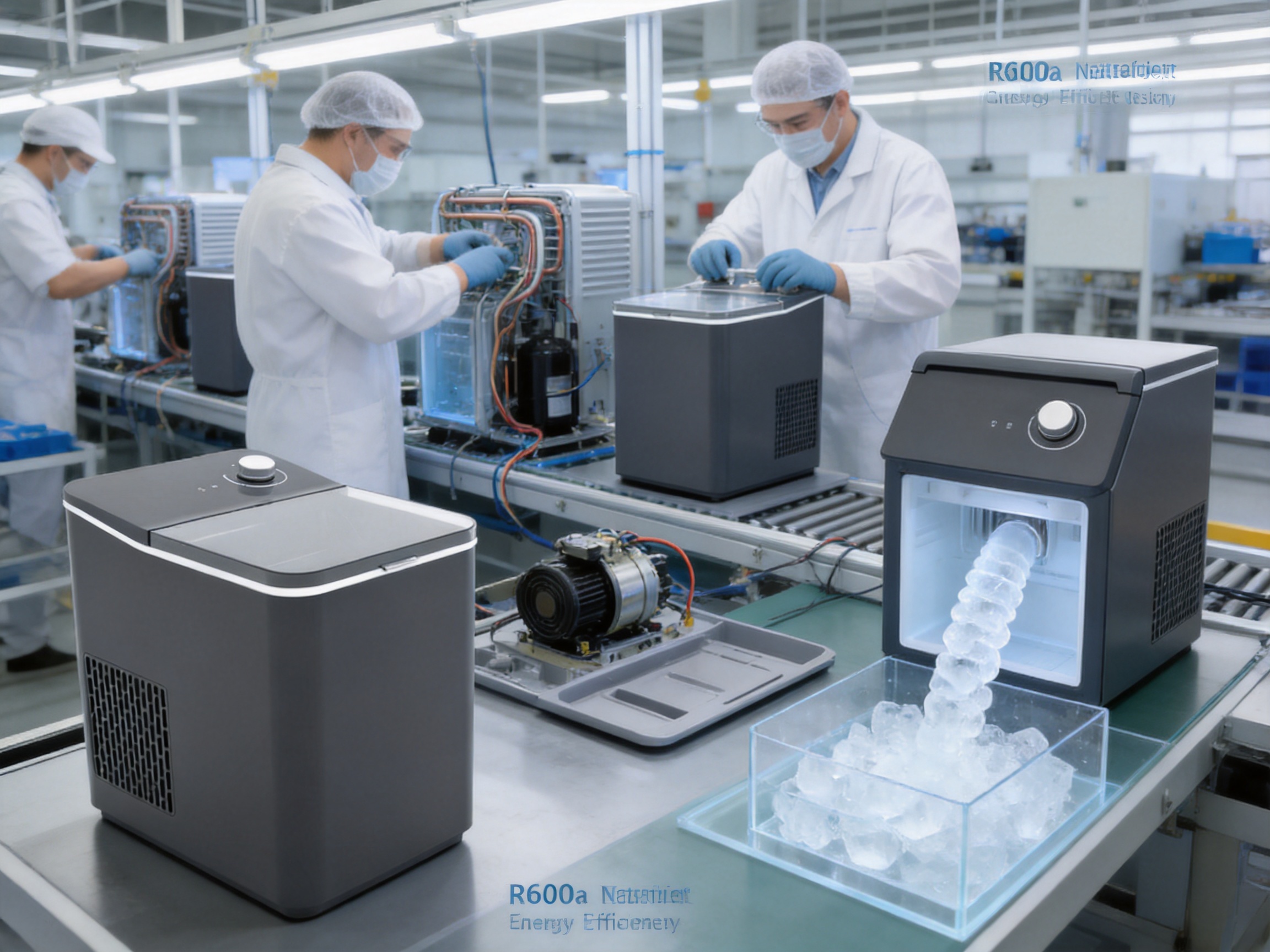
For households, offices, hospitality settings, and small commercial beverage stations, a reliable ice maker can make everyday drinks more convenient. The Knob-type ice maker, identified as the Alien-Z02, is designed around a simple but useful idea: provide fresh bullet-shaped ice in a compact appliance that is easy to place, easy to operate, and economical to run. Rather than requiring a large freezer compartment or a complicated built-in installation, this countertop machine creates ice when it is needed and supports a broad range of cold beverages.
Its design combines a high-performance refrigeration system, a 150-watt electrical system, R600a natural refrigerant, compact dimensions, and a straightforward control concept. These features position the machine as a practical alternative to oversized ice makers, freezer trays, and appliances that offer unnecessary complexity for ordinary home use. It is suitable for mixing drinks, cooling juices, preparing cocktails, serving guests, and maintaining a steady supply of ice during daily activities.
The product is manufactured by Alien Technology Co., Ltd., a household appliance company based in Cixi, Zhejiang Province, an area recognized for its strong small-appliance supply chain and convenient logistics. The company focuses on ice makers, coffee machines, air fryers, and related household products. Its stated mission is to use smart technology to simplify life and enhance happiness, while emphasizing reliable quality, humanized design, continuous improvement, and innovation.
Understanding the Product Concept
The Knob-type ice maker belongs to the bullet ice maker category. Bullet ice is recognizable by its rounded, hollow shape. This structure is not only visually distinctive but also useful in beverage preparation. The hollow center and curved exterior allow the ice to cool drinks efficiently while giving it a shape that is easy to handle and mix with other ingredients.
Unlike conventional ice cubes produced in a freezer tray, bullet ice is formed inside a dedicated refrigeration appliance. The machine is designed to create ice directly from water through a controlled freezing process. This means users do not need to wait for an entire freezer tray to freeze, remove individual cubes from a rigid mold, or reserve a large amount of freezer space.
The appliance is especially suitable for users who want fresh ice on demand. A family can use it during breakfast, outdoor meals, weekend gatherings, or celebrations. A small office can place it in a pantry or break area. A home bar can use it for mixed drinks and cocktails. In each situation, the main value is convenience: the machine is dedicated to ice production rather than requiring another appliance to perform the task.
The knob-type control concept also supports a more direct user experience. Many consumers prefer controls that are immediately understandable and do not require a long learning process. A simple control arrangement can be advantageous in kitchens, guest rooms, rental properties, and hospitality environments where different people may use the machine. The product description identifies the appliance as a knob-type model, so its operating philosophy is centered on accessibility and straightforward daily use.
Key Product Specifications
The published technical data provides a clear overview of the appliance’s electrical and refrigeration configuration. These specifications are important because they help users evaluate whether the machine is suitable for a particular kitchen, countertop, bar, or outdoor service area.
Product Category | Bullet Ice Maker |
Product Name | Knob-type ice maker |
Model Description | Alien-Z02 |
Power Supply | 220V–240V, 50Hz |
Current and Power | 0.9A / 150W |
Refrigerant and Charge | R600a / 19g |
Published Machine Dimensions | 313 × 226 × 309 millimeters |
Product Family | Household small appliances |
The power rating of 150 watts reflects a compact appliance intended for countertop operation rather than heavy industrial ice production. Its 220V–240V, 50Hz electrical configuration is appropriate for markets using that voltage and frequency standard. Users should always confirm local electrical compatibility before purchase or operation.
The listed current of 0.9 amperes provides additional information about the machine’s electrical demand. A moderate electrical requirement can make the product convenient for ordinary household circuits, although the appliance should still be connected according to local electrical safety guidance. A stable power supply helps the compressor and other internal components operate consistently.
The published dimensions are another important advantage. At approximately 313 × 226 × 309 millimeters, the machine is compact enough for many kitchen countertops, bar counters, office pantries, and recreational areas. The product information also presents another dimensional reference of approximately 325 × 295 × 252 millimeters, which may reflect a different measurement method, packaging reference, or product-view orientation. Buyers should confirm the final external dimensions and clearance requirements with the supplier before installation.
Why Bullet Ice Is Valuable for Beverages
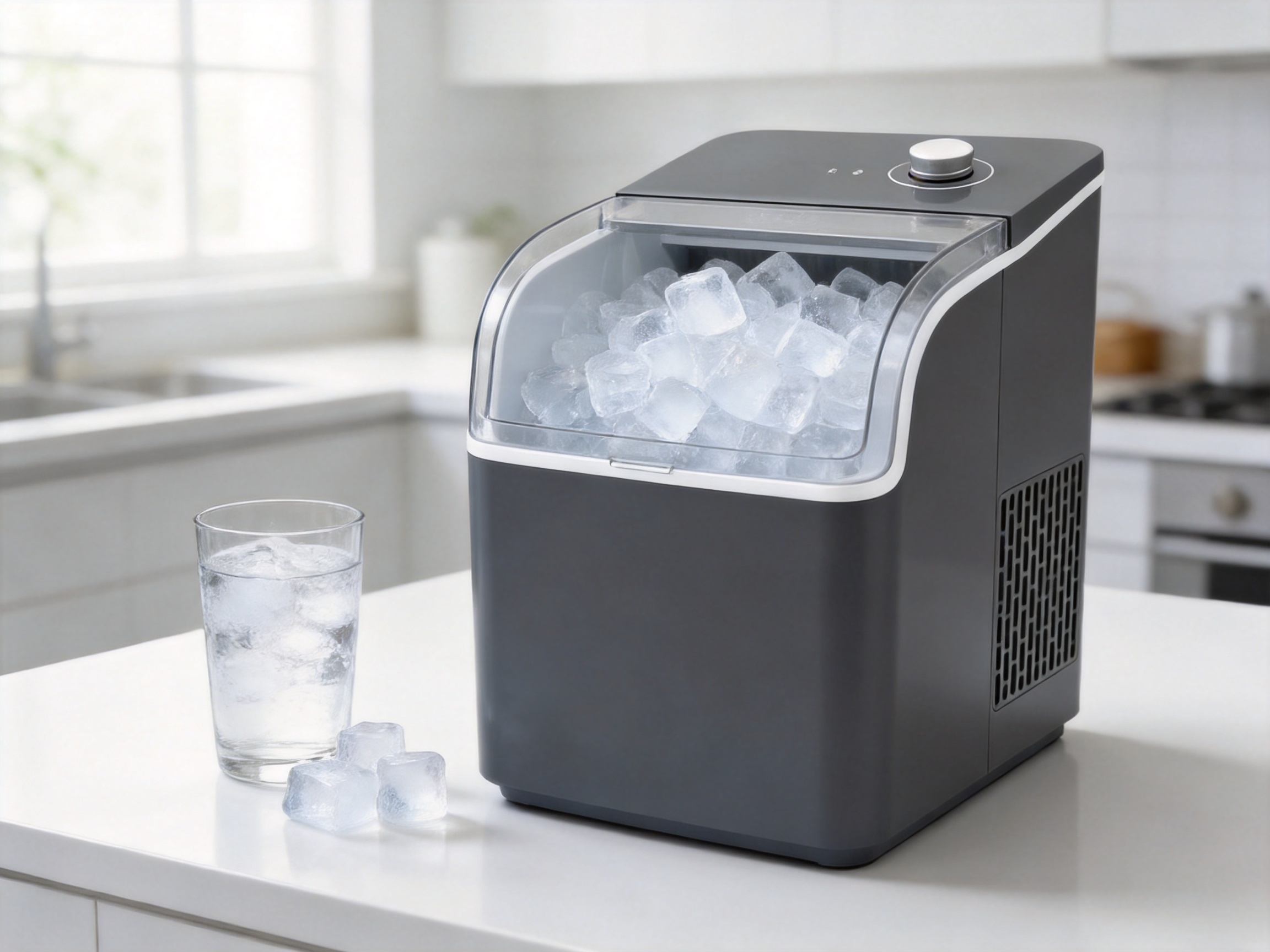
Ice shape affects more than appearance. Bullet ice has a rounded body and a hollow center, creating a balance between cooling performance, handling convenience, and drink presentation. It is suitable for water, soft drinks, fruit beverages, iced coffee, tea, cocktails, mocktails, and blended drinks.
The hollow structure allows liquid to circulate around more of the ice’s surface. This can help cool a beverage effectively while preserving the visual character of the drink. The rounded form also reduces sharp edges, making the ice comfortable to scoop and less likely to damage delicate glasses during normal use.
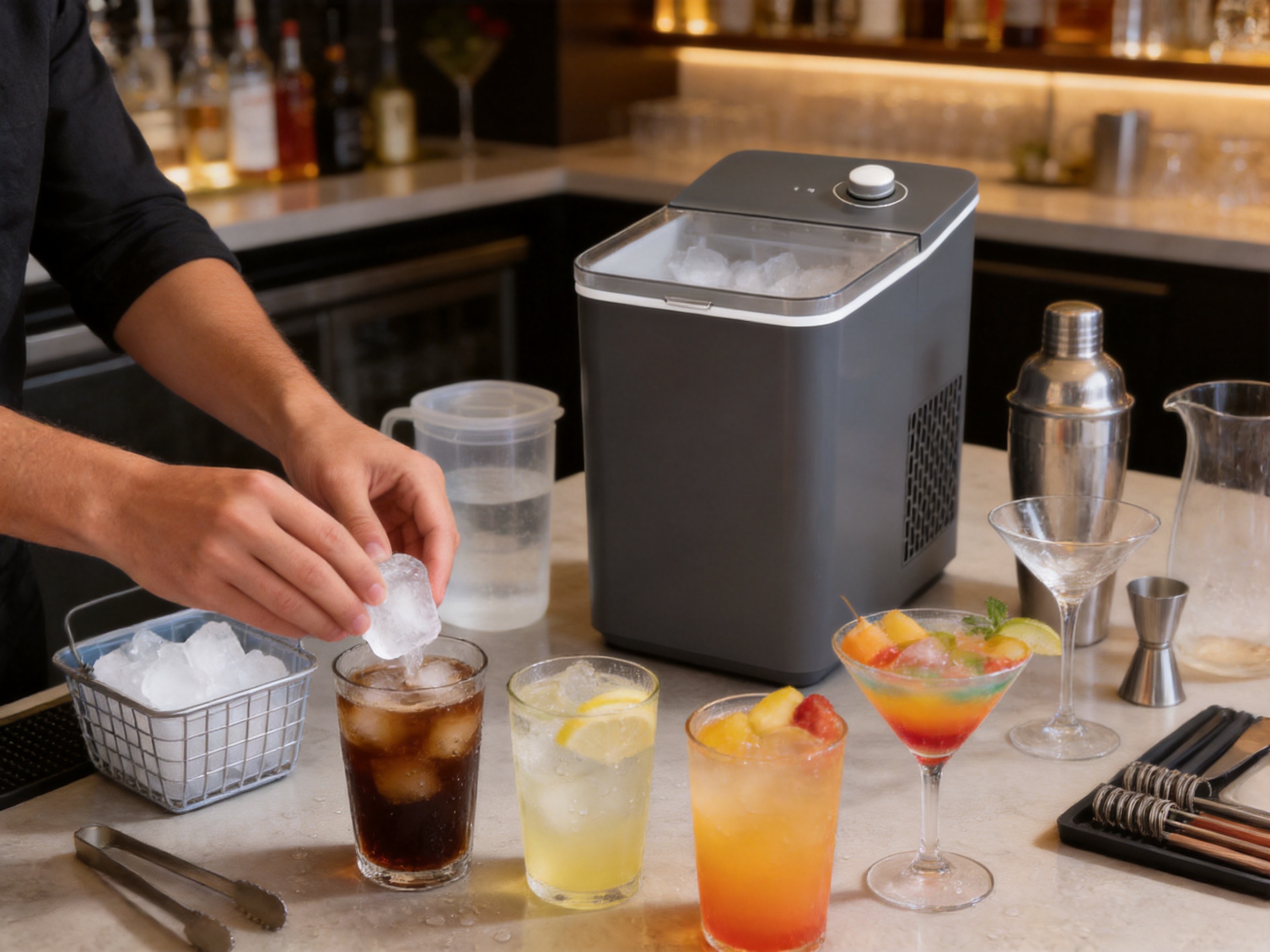
For cocktails and mixed beverages, bullet ice offers a practical middle ground. It is more distinctive than ordinary small cubes, but it remains easy to produce and use in everyday quantities. It can be added to a serving glass, beverage pitcher, or insulated container. The shape is also attractive in clear drinks where the ice contributes to the overall presentation.
The product information notes that bullet ice is less prone to melting because of its unique shape and hollow center. Melting behavior depends on beverage temperature, room temperature, ice size, airflow, and serving conditions, so no ice shape can eliminate melting. However, the design can provide a useful balance between surface area and volume. For consumers, the practical result is a versatile ice format that works well for fast cooling and routine beverage service.
Compact Design for Modern Living Spaces
One of the strongest advantages of this ice maker is its compact footprint. Modern kitchens often have limited counter space, and many users do not want a large appliance that remains permanently installed. A smaller ice maker can be stored when not needed, moved between rooms, or positioned beside a coffee machine, air fryer, beverage station, or compact refrigerator.
The machine can be placed on a kitchen countertop for daily use. It can also support a home bar, where fast access to ice is important when preparing drinks. In an office, the appliance can serve a small team without occupying the space required by a full-size commercial system. During outdoor activities, it may be used in a suitable sheltered location where electrical access and operating conditions are appropriate.
Compactness also improves flexibility for retailers, guesthouses, apartments, dormitories, and temporary event areas. A conventional freezer may be essential for food storage but inconvenient for frequent ice production. A dedicated countertop ice maker separates the two tasks and gives users greater control over how and when ice is produced.
Despite its small size, the product is designed to provide a dedicated refrigeration function. This is an important distinction from ice trays, which depend on the freezer temperature and available space. The machine is also more specialized than general-purpose cooling equipment because its internal system is configured specifically for ice formation.
When positioning the appliance, users should leave suitable ventilation space around the housing, keep it on a stable and level surface, and avoid placing it near direct heat sources. Adequate airflow helps the refrigeration system release heat efficiently. A level position can also support proper water management and stable operation.
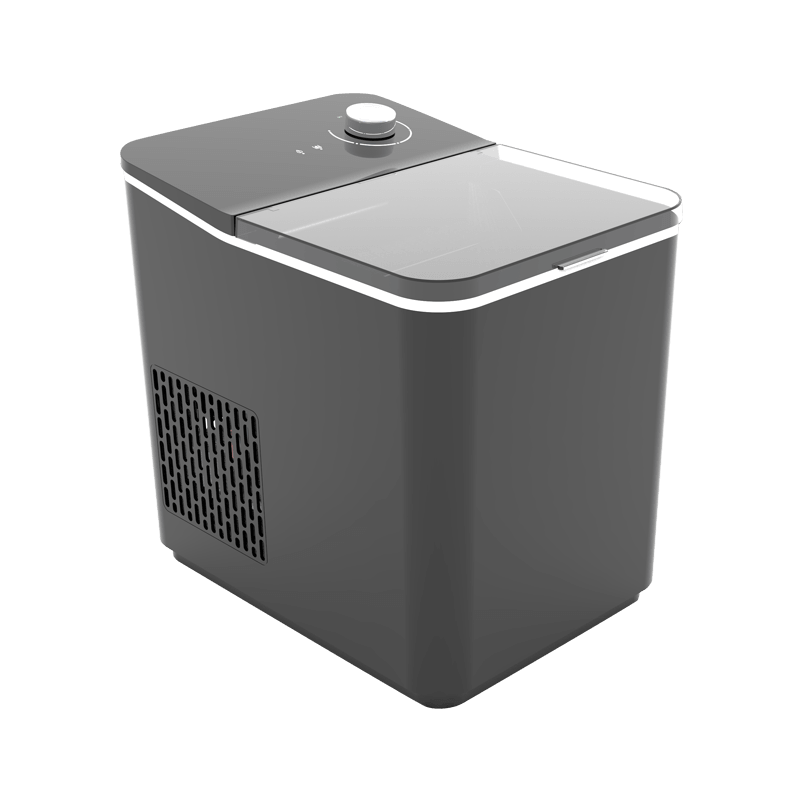
Knob-type ice maker
Refrigeration Performance and R600a Technology
The Knob-type ice maker uses R600a, or isobutane, as its refrigerant, with a listed charge of 19 grams. R600a is a natural hydrocarbon refrigerant widely used in certain modern refrigeration appliances because of its effective thermodynamic performance and low global warming potential compared with many older refrigerants.
The use of R600a reflects an effort to align the product with current environmental priorities. Refrigerant selection influences the environmental profile of a cooling appliance, and natural refrigerants are increasingly considered in appliance design where they can be applied safely and effectively. The listed 19-gram charge is relatively small, consistent with the compact format of the machine.
Refrigeration performance is not determined by refrigerant alone. It depends on the compressor, condenser, evaporator, insulation, airflow, water temperature, ambient temperature, control system, and manufacturing accuracy. A well-coordinated system allows the refrigerant to absorb heat from the water during the freezing stage and release that heat through the condenser.
The product’s 150-watt power rating suggests an effort to balance ice-making capability with household energy consumption. Actual electricity use will vary according to operating time, ambient conditions, water temperature, usage frequency, and the duration of the ice-making cycle. Nevertheless, a compact machine with a moderate power requirement can be an attractive choice for users who want dedicated ice without operating a large appliance.
Because R600a is flammable under certain conditions, the refrigeration circuit should not be opened, modified, or repaired by unqualified individuals. Users should follow the product manual, avoid puncturing the housing, and use authorized service procedures if a refrigeration issue occurs. Proper manufacturing, sealed-system integrity, and responsible servicing are essential parts of safe appliance operation.
Advantages Over Conventional Ice-Making Methods
Compared with Freezer Trays
Freezer trays are inexpensive and familiar, but they require advance planning. Users must fill the tray, place it in a freezer, wait for the water to freeze, and remove the ice manually. The process can be inconvenient when a large amount of ice is needed quickly. Trays can also spill, occupy valuable freezer space, and produce ice in limited quantities.
A dedicated ice maker improves convenience by creating ice in a self-contained appliance. It does not require users to reserve multiple freezer trays or reorganize frozen food. Its bullet ice format is also more consistent than ice made in flexible trays, where cube size and shape can vary depending on water level and handling.
Compared with Large Built-In Ice Machines
Large built-in ice machines may be appropriate for restaurants, hotels, and high-volume food-service operations, but they can be excessive for ordinary homes and small beverage stations. They usually require more installation space, greater planning, and potentially more complex plumbing or drainage arrangements.
The Knob-type ice maker is aimed at a different use case. Its countertop form and compact electrical design are intended to reduce installation barriers. Users can benefit from dedicated ice production without committing to the cost, space, and infrastructure associated with a large commercial unit.
Compared with Oversized Countertop Models
Some countertop ice makers include larger housings, extensive digital interfaces, or additional functions that may not be necessary for every user. Extra features can increase the purchase price, occupy more space, and create additional components that require maintenance.
The knob-type operating concept emphasizes direct control. For consumers who value simplicity, a focused appliance can be more practical than a feature-heavy model. The machine’s value comes from its core function, compact size, refrigeration configuration, and ease of integration into daily routines.
Compared with Imported or Uncoordinated Components
Product reliability depends on how well the electrical, refrigeration, structural, and control systems work together. A manufacturer with experience across multiple household appliance categories can apply broader design knowledge to product development. Alien Technology Co., Ltd. works across ice makers, coffee machines, and air fryers, giving it an appliance-focused production environment rather than a single-product perspective.
This category experience can support better attention to user interfaces, thermal management, housing design, assembly consistency, and practical kitchen use. Although specific factory certifications and testing results should be confirmed directly with the supplier, the company’s stated emphasis on quality, customer satisfaction, improvement, and innovation provides a useful foundation for evaluating its manufacturing approach.
Manufacturing Strengths and Production Philosophy
Alien Technology Co., Ltd. is located in Zhouxiang, Zhejiang Province. The region is associated with small household appliance manufacturing and convenient logistics. This location can support access to component suppliers, production services, packaging resources, engineering support, and domestic and international transportation networks.
A strong manufacturing location is valuable because appliance production involves more than final assembly. It requires coordinated sourcing of electrical parts, compressors, refrigeration components, plastic housings, control elements, insulation materials, wiring, fasteners, packaging, and testing equipment. Proximity to an established supply chain can improve communication among production partners and support more efficient order fulfillment.
The company’s product range includes ice makers, coffee machines, and air fryers. These categories share several technical and commercial requirements: compact housing design, heat or cold management, accessible controls, food-contact considerations, electrical safety, and repeatable assembly. Experience across these products can encourage the transfer of useful manufacturing practices from one category to another.
For an ice maker, manufacturing quality is particularly important in the sealed refrigeration system. Tubes, joints, evaporator surfaces, compressor connections, and refrigerant charging must be handled accurately. Small deviations can affect cooling performance, energy consumption, noise, and long-term reliability. A disciplined production process should therefore include appropriate inspection of the refrigeration circuit and verification of the finished appliance.
Electrical assembly is equally important. The power cord, wiring, switch or control mechanism, compressor relay, overload protection, and internal connections must be installed consistently. A well-organized assembly process reduces the possibility of loose connections, incorrect routing, or damage during housing installation. Final testing should confirm that the machine powers on correctly and operates as intended.
Housing production also affects user experience. The outer shell must protect internal components while remaining compact and visually suitable for a kitchen or beverage area. Proper molding, fitting, fastening, and surface inspection help ensure that panels align correctly and that the finished appliance presents a clean appearance.
Water management is another manufacturing consideration. Ice makers must guide water through the correct internal path, support freezing at the intended location, and allow finished ice to separate or fall into the collection area. Consistent component placement and accurate assembly help maintain the relationship between the water system, evaporator, ice storage area, and control mechanism.
The company’s stated commitment to continuous improvement is relevant to these details. Improvement may involve refining component tolerances, simplifying assembly steps, enhancing inspection procedures, reducing material waste, improving packaging protection, or responding to user feedback. Such work is often less visible than the final product design but can have a significant impact on reliability and customer satisfaction.
Quality Control Considerations
Consumers and business buyers should assess an ice maker through several quality dimensions rather than looking only at appearance. Electrical stability, refrigeration performance, water handling, noise, structural fit, control response, and service support all contribute to the overall value of the product.
At the component level, incoming inspection can help verify that parts meet required specifications before entering assembly. This may include checking dimensions, materials, electrical ratings, compressor characteristics, tubing condition, control components, and visible surface quality.
During assembly, process controls can help maintain consistency. Workers or automated stations may follow defined procedures for wiring, fastening, sealing, insulation placement, and housing installation. Clear work instructions and traceable production records can support repeatability across batches.
Finished-product testing is also important. A suitable inspection program may include power-on testing, control-function testing, refrigeration-cycle verification, leak inspection, water-flow checks, ice-formation observation, and appearance inspection. The exact tests and acceptance standards should be confirmed with the manufacturer for a specific order.
For overseas buyers, quality assurance may also include sample approval, pre-shipment inspection, carton-drop evaluation, labeling verification, and documentation review. These measures can be especially useful when products are distributed across different markets with different electrical, packaging, and consumer-information requirements.
Alien Technology Co., Ltd. presents itself as a manufacturer focused on reliable quality and customer satisfaction. Buyers seeking private-label, wholesale, or business cooperation should discuss quality-control procedures, available reports, production capacity, lead times, warranty terms, spare parts, and after-sales support before placing an order.
Energy Awareness and Responsible Use
The appliance’s moderate power rating and R600a refrigerant support an energy-conscious product profile, but responsible use remains important. Users can help the machine operate efficiently by placing it in a cool, ventilated area away from ovens, radiators, direct sunlight, and other heat-producing appliances.
Starting with reasonably cool, clean water may help reduce the workload required to freeze each batch. The appliance should not be operated with blocked ventilation openings, and the exterior should be kept free from dust that could restrict heat release. If the user will not operate the machine for an extended period, it should be cleaned, dried, and stored according to the manual.
Energy consumption also depends on how often the machine runs. Producing only the amount of ice needed for a particular occasion can reduce unnecessary operating time. Users may transfer finished ice to an insulated container when appropriate, allowing the appliance to produce ice in planned cycles rather than running continuously.
Environmental responsibility includes correct end-of-life handling. Because the product contains a refrigeration circuit and electrical components, it should not be dismantled or discarded carelessly. Local recycling and appliance-disposal rules should be followed, and refrigerant handling should be left to qualified personnel.
Practical Applications in Different Settings
Residential Kitchens
In a family kitchen, the ice maker can support everyday hydration, iced tea, lemonade, smoothies, cold coffee, and weekend meals. Its compact form allows it to coexist with other countertop appliances. It can remain available during periods of frequent use and then be moved to storage when counter space is needed.
Home Bars and Entertainment Areas
For home bars, ice is a central part of drink preparation. Bullet ice can be used in mixed drinks, spirit-based beverages, mocktails, and soft drinks. Its rounded shape provides a more distinctive presentation than ordinary freezer ice and can be produced close to the serving area.
Offices and Break Rooms
Small offices may not need a commercial ice system, but employees and visitors can still benefit from convenient access to ice. The appliance can be installed in a pantry or break room, provided that the surface is stable and the electrical supply is suitable.
Guesthouses and Short-Term Accommodation
Guesthouses, serviced apartments, and small lodging facilities can use countertop ice makers as an amenity. A compact appliance may be easier to deploy than a built-in solution, particularly where rooms or common areas have limited space. Clear operating and cleaning instructions should be supplied to users.
Outdoor and Recreational Use
The product information identifies outdoor areas as one possible placement environment. Outdoor use should be limited to suitable sheltered locations that protect the appliance from rain, splash, excessive humidity, dust, and direct sunlight. The power source must be safe and appropriate, and the product should not be exposed to conditions outside its operating instructions.
Ease of Operation and Daily Maintenance
A compact ice maker delivers the greatest value when it is easy to operate and maintain. Before first use, the machine should be placed on a stable surface, allowed to settle if it has been transported according to the manufacturer’s instructions, and connected to a compatible power supply. The water reservoir should be filled with clean water to the recommended level without overfilling.
Because the model is described as knob-type, users can expect a direct operating approach rather than a complicated sequence of digital commands. The exact control functions should be confirmed in the user manual, but the general principle is simple: add water, select or activate the desired operation, and collect the ice when produced.
Regular cleaning helps protect ice quality and maintain the appliance’s internal water path. The reservoir, ice collection area, and accessible surfaces should be cleaned at suitable intervals. Users should avoid harsh chemicals or abrasive materials that could damage food-contact surfaces or the exterior finish.
Standing water should not be left inside the machine for long periods. If the product will not be used, draining and drying it can help reduce odors and residue. Cleaning frequency depends on water quality, use frequency, storage conditions, and the manufacturer’s maintenance guidance.
Ice should be handled with clean utensils or washed hands. The collection area should not be used to store unrelated objects. Keeping the appliance dedicated to ice production supports better hygiene and helps prevent contamination.
Maintenance should never involve unauthorized opening of the refrigeration circuit. If the machine fails to cool, produces unusual sounds, shows signs of leakage, or develops an electrical fault, it should be disconnected and inspected by qualified service personnel.
Design Balance: Simplicity, Capacity, and Space
Every countertop ice maker involves design trade-offs. A smaller housing is easier to place but may not match the production volume of a large commercial appliance. A simple control system may be easier to understand but may not provide the scheduling or monitoring functions of an advanced digital model. The value of the Knob-type ice maker lies in its balance for everyday use.
The product is not presented as an industrial ice plant. Instead, it is a compact household appliance intended to provide convenient bullet ice without demanding extensive installation or counter space. This focused purpose can be an advantage for consumers who prioritize practicality over maximum output or elaborate controls.
Its 150-watt power specification, small footprint, and lightweight countertop concept indicate a product designed for ordinary environments. It can be integrated into a kitchen routine without requiring a dedicated utility room. Buyers should nevertheless compare expected ice demand with the product’s actual production capacity, cycle time, storage capacity, and operating instructions before making a purchasing decision.
For distributors, the compact design can also simplify packaging, warehousing, display, and transport. A product that fits easily into a retail appliance section or online fulfillment process may be more convenient to handle than a larger system. Final carton dimensions and shipping weight should be confirmed separately with the manufacturer.
Business Cooperation and Supplier Value
Alien Technology Co., Ltd. welcomes contact from new and existing customers for business cooperation. This may be relevant to importers, distributors, retailers, hospitality suppliers, private-label businesses, and companies developing household appliance portfolios.
A supplier evaluation should include more than a product photograph. Buyers may wish to request technical specifications, user manuals, packaging details, available colors or finishes, sample units, production lead times, minimum order quantities, warranty terms, spare-parts policies, and inspection procedures.
It is also useful to clarify whether the model is offered for original equipment manufacturing, private labeling, or standard distribution. Product labels, manuals, cartons, plugs, and compliance markings may need to be adapted for the destination market. Electrical compatibility is particularly important because the listed product is designed for 220V–240V, 50Hz operation.
The company’s concentration on small household appliances can be valuable for buyers seeking multiple product categories from one manufacturing partner. Ice makers, coffee machines, and air fryers can be marketed together as part of a modern kitchen or beverage-appliance range. A coordinated supplier relationship may simplify communication, product development, packaging planning, and order management.
Buyers should also establish clear procedures for handling quality claims and after-sales issues. A reliable cooperation framework may include batch records, sample confirmation, defect classification, replacement policies, technical support, and communication channels for improvement feedback.
How the Product Supports a Modern Appliance Portfolio
The Knob-type ice maker fits naturally into a broader household appliance ecosystem. A coffee machine can prepare hot coffee, while the ice maker supports iced coffee and chilled beverages. An air fryer can support meals and snacks, while the ice maker adds convenience for drinks and entertaining. Together, these products reflect a lifestyle centered on efficient, compact, and practical countertop equipment.
This portfolio approach is consistent with the company’s mission of simplifying daily life. Instead of designing appliances only for large kitchens, small-appliance manufacturers can address the needs of apartments, offices, recreational areas, and flexible living spaces. Compact appliances allow consumers to build customized food and beverage stations based on their routines.
The ice maker also supports hospitality and beverage presentation. Freshly produced bullet ice can improve the perceived quality of a drink service, especially when the shape is visible through transparent glassware. For retailers, the product can appeal to consumers looking for convenience, entertaining support, and a dedicated alternative to freezer-based ice production.
Product Selection Checklist
Before purchasing the machine, consumers and buyers should consider the following questions:
Electrical Compatibility | Is the available power supply compatible with 220V–240V, 50Hz operation? |
Available Space | Does the countertop provide enough room for the appliance and ventilation clearance? |
Expected Ice Demand | Is the intended use household, office, hospitality, or higher-volume service? |
Water Quality | Is clean water available, and can the reservoir be maintained regularly? |
Operating Environment | Will the appliance be protected from heat, rain, excessive humidity, and dust? |
Service Requirements | Are cleaning, storage, warranty, and repair procedures understood? |
Commercial Needs | Are packaging, labeling, certification, and order requirements suitable for the target market? |
Answering these questions helps match the product to the user’s needs. A compact appliance is most successful when its capacity, placement, electrical configuration, and maintenance expectations are understood in advance.
Safety and Responsible Use
Users should read the operating instructions before switching on the machine. The appliance should be connected to a properly installed outlet and should not be operated with a damaged cord, plug, housing, or water system. If moisture reaches electrical components, the machine should be disconnected and inspected before further use.
The product should be kept away from children when they are not supervised. Ice can be a choking hazard for young children, and the appliance should not be treated as a toy. Users should also avoid placing fingers or utensils inside moving or cooling areas while the machine is operating.
Cleaning should be performed with the appliance disconnected when required by the manual. Water should not be poured over the exterior in a way that could enter electrical components. The refrigeration circuit should remain sealed, and any service involving refrigerant should be completed by qualified professionals.
Safe operation also includes correct placement. The machine should stand level, remain stable, and have sufficient airflow. Blocking ventilation openings or positioning the appliance beside a strong heat source can reduce cooling performance and increase stress on internal components.
Q&A
What type of ice does the machine produce?
The machine is a bullet ice maker and is designed to produce bullet-shaped ice with a rounded exterior and hollow center. This format is suitable for soft drinks, water, iced coffee, cocktails, mocktails, and other cold beverages.
Is this ice maker suitable for home use?
Yes. Its compact countertop design, moderate 150-watt power rating, and direct operating concept make it suitable for many homes. It may also be used in offices, small hospitality settings, home bars, and other locations where a compact ice supply is useful.
What power supply does it require?
The published specification is 220V–240V at 50Hz, with a listed current of 0.9 amperes and power rating of 150 watts. Users should verify local electrical compatibility before operation.
What refrigerant does it use?
The machine uses R600a, or isobutane, with a listed charge of 19 grams. Because R600a is a flammable refrigerant, the sealed refrigeration system should not be opened or modified by unqualified individuals.
How compact is the appliance?
The published machine dimensions are approximately 313 × 226 × 309 millimeters. The product information also provides another dimensional reference of approximately 325 × 295 × 252 millimeters, which may relate to a different measurement method or orientation. Buyers should confirm final product dimensions and clearance requirements with the supplier.
Can it replace a commercial ice machine?
It is designed primarily as a compact household and light-use countertop appliance. It may not be appropriate for restaurants, hotels, or other operations requiring continuous high-volume ice production. Businesses should compare the machine’s confirmed output and storage capacity with their expected demand.
Why is bullet ice useful for drinks?
Bullet ice has a hollow center and rounded shape that can provide effective beverage cooling and an attractive appearance. It is easy to add to glasses, pitchers, and drink containers and is suitable for a wide range of cold beverages.
Where can the ice maker be placed?
It can be placed on a stable kitchen countertop, bar counter, office pantry surface, or suitable sheltered outdoor area. It should be protected from rain, direct sunlight, excessive humidity, dust, and nearby heat sources, with adequate ventilation around the housing.
Is the control system complicated?
The product is described as a knob-type ice maker, indicating a direct and straightforward control approach. Exact operating functions should be confirmed in the supplied manual, but the design is intended to be accessible for ordinary daily use.
How should the appliance be maintained?
The water reservoir, ice collection area, and accessible surfaces should be cleaned regularly using the methods recommended by the manufacturer. Standing water should be drained when the appliance will not be used for an extended period. The refrigeration circuit should be serviced only by qualified personnel.
What should business buyers ask the manufacturer?
Business buyers should request information about minimum order quantities, lead times, packaging, labeling, customization, warranty terms, inspection procedures, production capacity, spare parts, technical documentation, and market-specific compliance requirements.
What makes the manufacturer relevant to appliance buyers?
Alien Technology Co., Ltd. specializes in household appliances including ice makers, coffee machines, and air fryers. Its location in Zhejiang provides access to a mature small-appliance manufacturing and logistics environment. The company also emphasizes reliable quality, customer satisfaction, continuous improvement, and innovation.
Conclusion
The Knob-type ice maker is a practical solution for consumers who want fresh bullet ice without the size and installation demands of a large commercial machine. Its compact form, 220V–240V power configuration, 150-watt rating, R600a refrigerant, and direct control concept support convenient use in kitchens, home bars, offices, guesthouses, and suitable outdoor areas.
Its bullet ice format adds value to everyday beverages by combining attractive presentation with useful cooling performance. The hollow, rounded shape is well suited to drinks ranging from water and juice to iced coffee and cocktails. By producing ice in a dedicated appliance, the machine offers an alternative to freezer trays and reduces the need to reserve freezer capacity for ice.
The product also reflects the strengths of a manufacturer focused on small household appliances. Alien Technology Co., Ltd. operates from a region with a developed appliance supply chain and applies its experience across ice makers, coffee machines, and air fryers. Its stated commitment to quality, customer satisfaction, continuous improvement, and innovation supports its role as a potential supplier for both household users and business customers.
As with any refrigeration appliance, final performance depends on correct installation, suitable water, appropriate ventilation, regular cleaning, and responsible servicing. Buyers should confirm final dimensions, production capacity, certifications, packaging, and support terms with the manufacturer. When matched with the right application, this compact bullet ice maker can provide a convenient, space-conscious, and environmentally considerate addition to a modern beverage and kitchen environment.
References
1. Alien Technology Co., Ltd. Product specification sheet for the Knob-type Ice Maker, model Alien-Z02.
2. Alien Technology Co., Ltd. Product information concerning bullet ice design, countertop placement, refrigerant selection, and household applications.
3. General refrigeration engineering principles concerning vapor-compression systems, heat transfer, compressor operation, and refrigerant charging.
4. General guidance on the use of R600a isobutane refrigerant in compact refrigeration appliances.
5. General household appliance design principles concerning electrical safety, ventilation, water hygiene, maintenance, and countertop placement.