
 English
 한국어
 Español
 Deutsch
Ice has traditionally been treated as a simple household commodity: freeze water, separate the cubes, and add them to a drink. However, not all ice provides the same experience. Conventional cubes can be hard on the teeth, slow to cool beverages, awkward to chew, and inconvenient to use in food presentation or cold therapy. A modern chewable ice maker addresses these limitations by producing a softer, smaller, and more adaptable form of ice designed for drinks, desserts, food displays, and everyday household use.
The Home Chewing Ice Maker, identified as the Alien-ZJ01, is developed around this changing expectation. Instead of focusing only on producing large, rigid cubes, it is designed to provide a soft texture, pleasant chewing sound, fast cooling performance, and flexible mixing characteristics. Its compact dimensions, moderate electrical demand, and practical household format make it suitable for kitchens, beverage areas, family gatherings, small cafés, offices, and other environments where convenient ice production is important.
This article examines the product’s principal advantages, its practical applications, its technical specifications, and the manufacturing strengths behind it. It also explains why chewable ice can outperform conventional ice in several important situations and provides a detailed question-and-answer section for buyers, distributors, and business partners.
Understanding the New Generation of Chewable Ice
Chewable ice is different from the large, hard cubes commonly found in freezers or traditional ice dispensers. Its smaller particle structure creates a softer texture that is easier to bite and more comfortable to consume. Many users appreciate this texture because it provides a satisfying chewing experience without the intense hardness associated with ordinary frozen cubes.
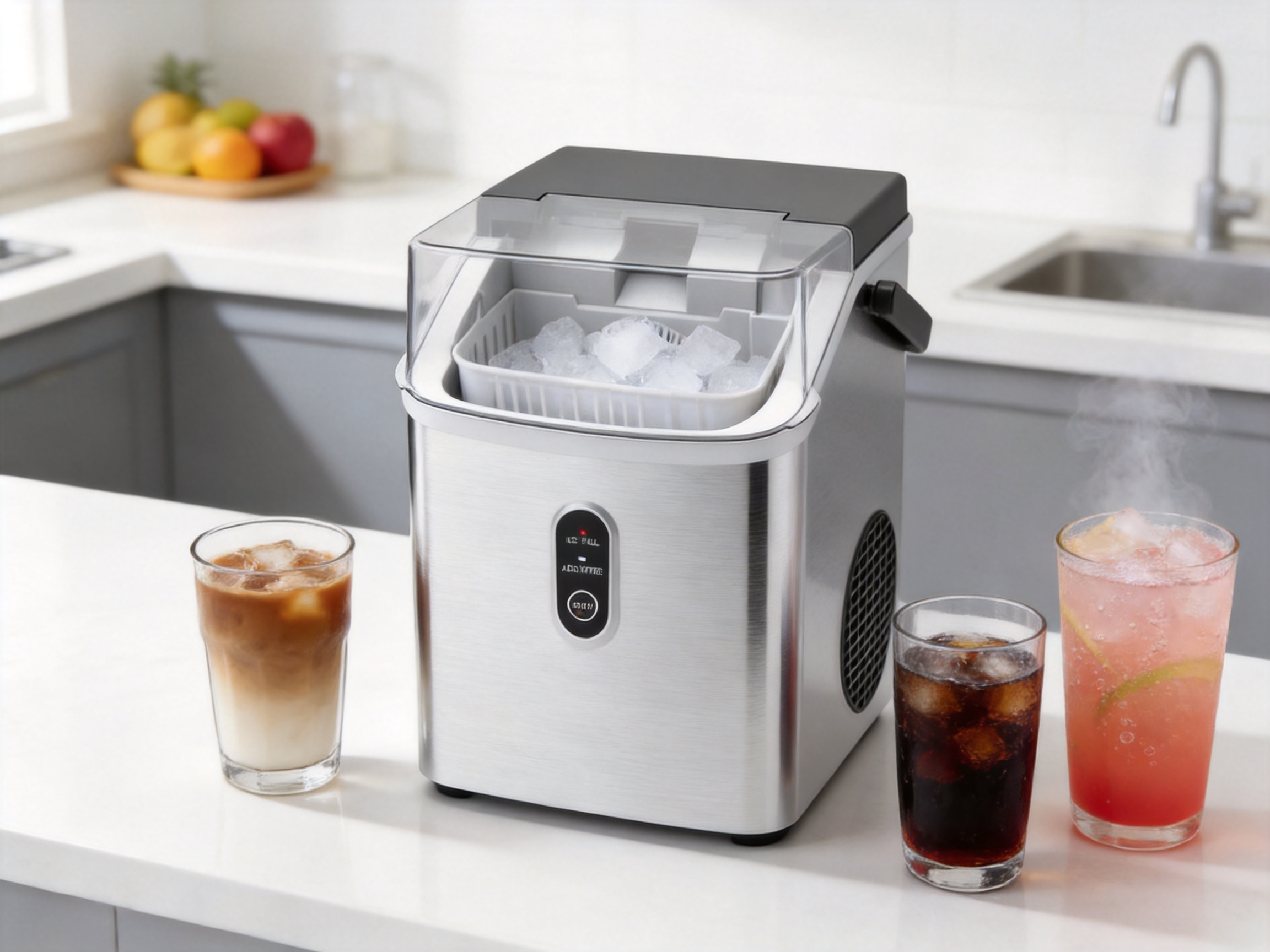
The appeal of chewable ice is not limited to texture. Smaller particles offer more surface area in relation to their volume. When they are added to a beverage, more ice comes into contact with the liquid at the same time. This allows the drink to cool quickly and evenly. Whether the beverage is iced coffee, carbonated soda, fruit juice, tea, or a mixed drink, chewable ice can contribute to rapid temperature reduction.
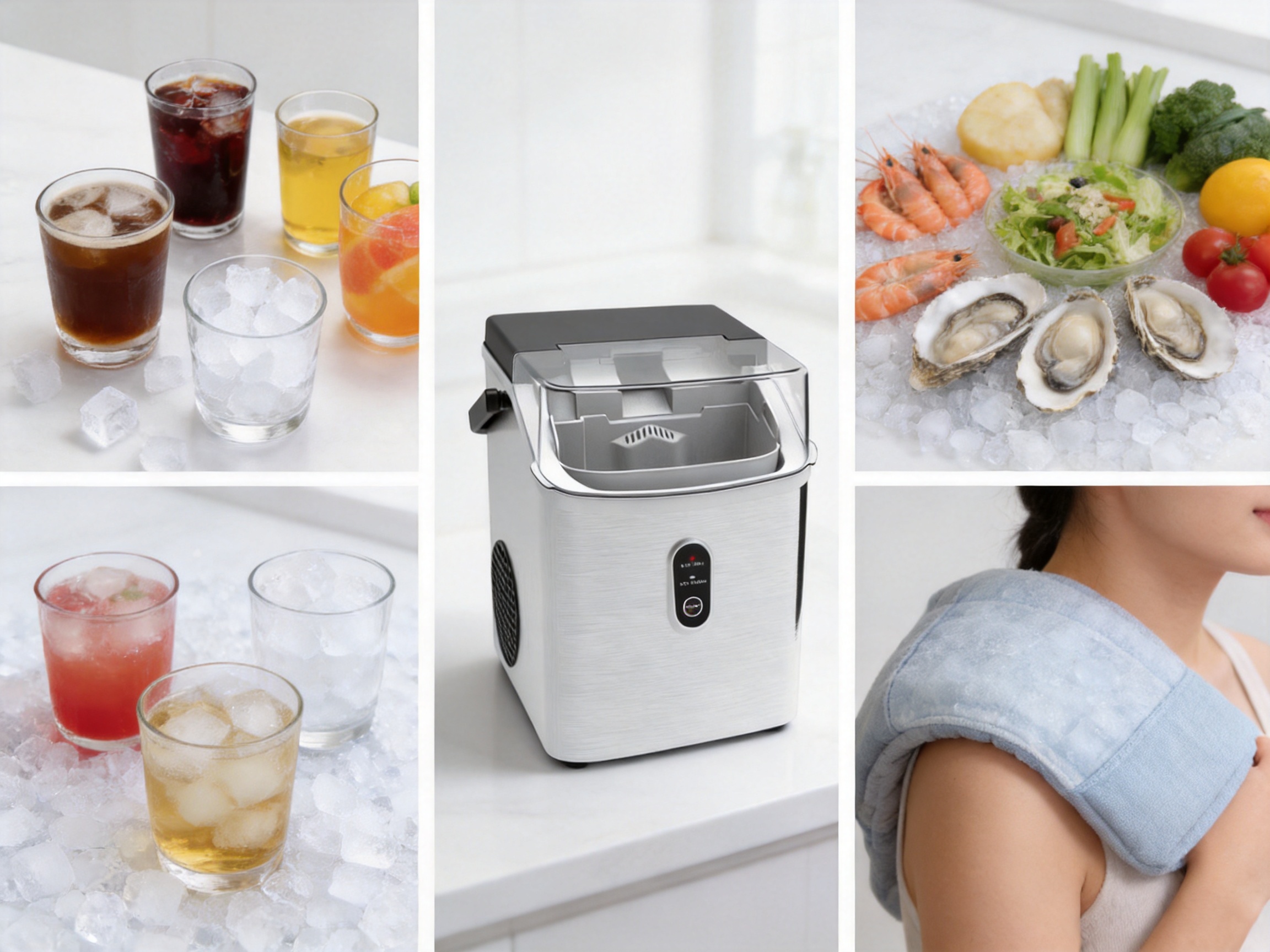
Another important characteristic is adaptability. Because the ice is soft and easy to scoop, it can be blended into beverages or combined with other ingredients. It may be used as a base for smoothies, shaved-ice-style refreshments, frozen desserts, and other cold recipes. It can also surround food items in display environments, helping create an attractive presentation while supporting short-term cooling and preservation.
The Home Chewing Ice Maker is therefore more than a basic appliance for making frozen water. It is a compact food-and-beverage tool that supports multiple household and commercial-style uses. Its design responds to the need for convenience, fast cooling, simple operation, and a more enjoyable ice texture.
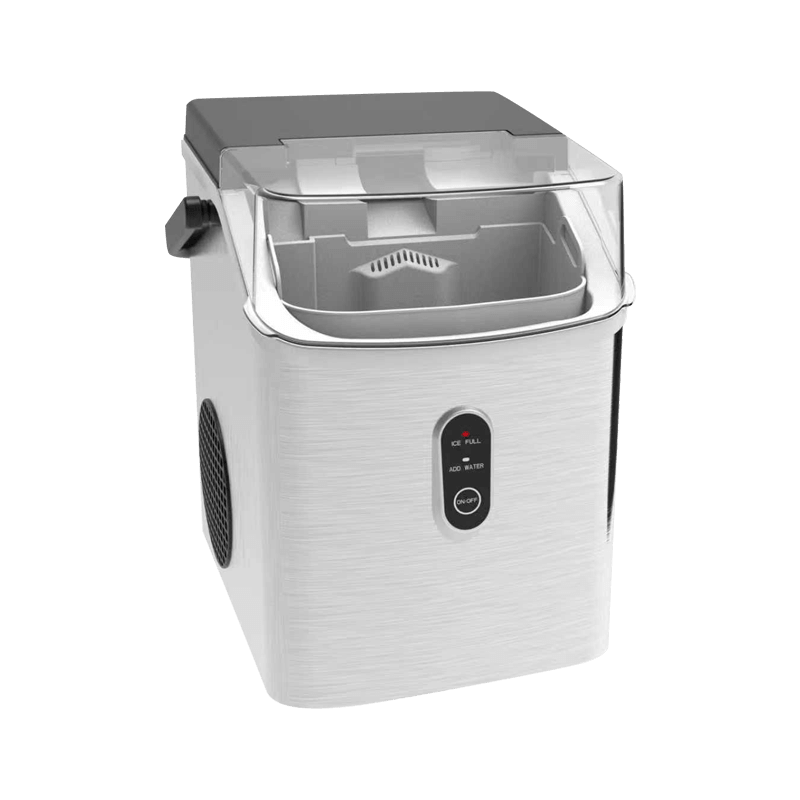
Home chewing ice maker
Core Product Advantages
1. A Softer and More Enjoyable Texture
The defining advantage of this product is its soft chewable ice. Traditional ice cubes are often too hard to chew comfortably. Some people avoid chewing them because of dental sensitivity, while others dislike the sharp edges and solid resistance of standard cubes. Chewable ice offers a gentler alternative with a texture that is easier to bite and more pleasant to consume.
The product’s soft texture also creates a distinctive sensory experience. Users can enjoy a light crunch and a satisfying sound without needing to break through a dense block of ice. This quality makes the ice attractive for casual drinks, family occasions, parties, and beverage service. It can turn an ordinary cold drink into a more enjoyable experience.
For households with different preferences, chewable ice provides greater flexibility. Some people want ice mainly to cool a beverage, while others enjoy eating the ice after the drink has been finished. A conventional cube may perform the first function but not the second. The Home Chewing Ice Maker is designed to satisfy both needs.
2. Faster Beverage Cooling
Rapid cooling is a practical benefit that directly affects everyday convenience. Large cubes may remain frozen for a long time, but they often cool a beverage relatively slowly because only a limited surface area is exposed to the liquid. Chewable ice consists of smaller particles, allowing more contact between ice and beverage.
This larger contact area helps lower the temperature of drinks quickly. It is particularly useful for iced coffee, soda, juice, tea, and other beverages that are served immediately after preparation. A user does not need to wait as long for a freshly poured drink to reach a refreshing temperature.
Rapid cooling can also be valuable when preparing drinks for several people. During a gathering, the ability to cool beverages quickly reduces preparation time and helps maintain a consistent serving temperature. In a small food-service setting, fast cooling can contribute to a smoother workflow, especially when drinks are prepared continuously.
The small structure of the ice also helps distribute cooling throughout a drink. Instead of one or two large pieces floating at the top, smaller particles can spread more evenly through the container. This makes the cooling effect more consistent from the first sip to the last.
3. Effective Coating for Food Display
Chewable ice can be used for more than beverages. Its soft particles can surround and cover food products, creating a cooling bed for display purposes. This is useful for salad bars, seafood counters, oyster displays, sashimi presentations, and other settings where food must remain visually appealing and cool for a period of time.
Compared with hard, angular cubes, smaller ice particles can conform more closely to the shape of the food or display tray. They can fill gaps around vegetables, seafood, fruit, and prepared dishes. This provides a more complete coating and can create an attractive, even presentation.
In a food-service environment, appearance is closely connected to customer confidence. A neatly arranged bed of clean, uniform ice can make fresh ingredients appear more appealing. The ice can also help support temperature management during short-term presentation, although it should not replace proper refrigeration, food-safety procedures, or legally required temperature controls.
For home users, the same property can be useful when arranging seafood, fruit, salads, or chilled ingredients for a meal. The appliance therefore supports both practical cooling and decorative presentation.
4. Useful for Cold Compress Applications
The soft, conformable structure of chewable ice can be advantageous for cold compresses. When placed in a suitable clean container or wrapped appropriately, the ice can conform more easily to areas such as the forehead, shoulder, knee, arm, or ankle than rigid cubes would.
This flexibility makes it easier to distribute cooling across an uneven body surface. Hard cubes tend to create isolated pressure points, whereas smaller soft particles can form a more comfortable layer. Users should always protect the skin with an appropriate cloth or medical-grade covering and follow professional advice when treating injuries or medical conditions.
The product is intended primarily as a household ice maker, not as a medical device. Nevertheless, its ice texture gives it a useful secondary role for general household cold applications.
5. Versatility in Recipes and Frozen Drinks
Chewable ice can be used as a direct ingredient in blended beverages, smoothies, frozen juices, and shaved-ice-style desserts. Because it is easy to scoop and mix, it can be incorporated into recipes without the same difficulty associated with large, hard cubes.
For a smoothie, the ice can help create a cold, dense texture. For a fruit drink, it can produce a refreshing consistency while reducing the need to prepare ice separately. For a simple dessert, it can serve as a base for syrup, fruit, condensed milk, or other toppings, depending on the recipe.
This versatility reduces the need for multiple specialized ice products. One appliance can support ordinary drinks, frozen refreshments, food presentation, and occasional cold-compress use. Such flexibility is especially valuable in smaller kitchens where counter space and storage capacity are limited.
Technical Specifications and Practical Meaning
The product is specified for a 220V/60Hz power supply. Its listed current and power are 0.55A and 130W. The refrigerant is R600a with a charge of 19 grams. The machine dimensions are 224 by 333 by 325 millimeters.
Specification |
Listed Value |
Practical Significance |
Power supply |
220V/60Hz |
Designed for electrical systems matching this voltage and frequency |
Current and power |
0.55A / 130W |
Moderate household energy demand for a compact appliance |
Refrigerant |
R600a |
Modern refrigerant type used in many compact refrigeration appliances |
Refrigerant charge |
19g |
Specified charge for the product refrigeration system |
Machine dimensions |
224 x 333 x 325mm |
Compact footprint suitable for many kitchen or service areas |
The compact size is one of the appliance’s strongest practical characteristics. Measuring 224 millimeters in one dimension, 333 millimeters in another, and 325 millimeters in height, the machine can fit into many household kitchens, beverage stations, office pantries, and small service counters. Buyers should still measure the intended installation location and leave sufficient clearance for ventilation, operation, cleaning, and maintenance.
The listed 130W power rating suggests a moderate electrical requirement for a compact ice-making appliance. Actual energy consumption may vary according to ambient temperature, operating duration, water temperature, ice production conditions, and usage frequency. Nevertheless, the rating supports the product’s positioning as a practical home appliance rather than a large industrial ice system.
The use of R600a reflects a refrigerant choice commonly associated with compact refrigeration equipment. Because refrigerants require specialized handling, users should not attempt to open, recharge, modify, or repair the sealed refrigeration system themselves. Installation and service should be performed by qualified personnel when required.
The 220V/60Hz specification is particularly important for international buyers. Electrical compatibility must be confirmed before purchase, import, or installation. A plug adapter alone does not change voltage or frequency. Distributors should verify the intended market requirements and determine whether a regional version is available before placing a commercial order.
Advantages Over Conventional Ice Makers
More Comfortable Than Hard-Cube Production
Many conventional ice makers are optimized for producing rigid cubes or thick bullet-shaped pieces. These formats are useful for long-lasting cooling, but they are not always comfortable to chew. The Home Chewing Ice Maker is differentiated by its focus on texture. Its purpose is not simply to freeze water, but to produce ice that can be enjoyed directly.
This makes it especially attractive to users who regularly chew ice, families seeking a softer option, and businesses that want to offer a distinctive beverage experience. The product addresses a specific consumer preference that ordinary ice machines often overlook.
Better Contact with Beverages
Large ice cubes can cool a drink, but they often provide limited contact during the early stages of serving. Chewable ice has a smaller particle size and can spread throughout a beverage. This can create a faster and more uniform cooling effect.
For iced coffee and soda, this quality is particularly valuable. The drink can become cold soon after serving, while the small ice pieces provide a texture that some consumers actively prefer. The combination of cooling performance and chewability gives the product a broader appeal than a machine producing only large cubes.
Greater Use Beyond the Beverage Glass
A conventional cube maker is generally limited to ice production for drinks. The Home Chewing Ice Maker supports additional functions, including food coating, frozen recipes, desserts, and cold compress applications. This broader range of uses can improve the value of the appliance for both households and small commercial operations.
When an appliance serves several purposes, it can be used more frequently throughout the day. Increased usefulness can help justify the purchase for buyers who do not want a machine dedicated to only one type of drink.
More Convenient Handling
Soft ice is easier to scoop and mix. Users do not need to crush hard cubes manually before adding them to a smoothie or frozen drink. This reduces preparation effort and avoids the noise, mess, and safety concerns that can accompany manual ice crushing.
The product’s convenient format can be especially helpful for older users, busy families, office workers, and food-service staff who need ice that can be handled quickly. Ease of use is a significant competitive advantage because a well-designed appliance should reduce work rather than create additional preparation steps.
Manufacturing Strengths Behind the Product
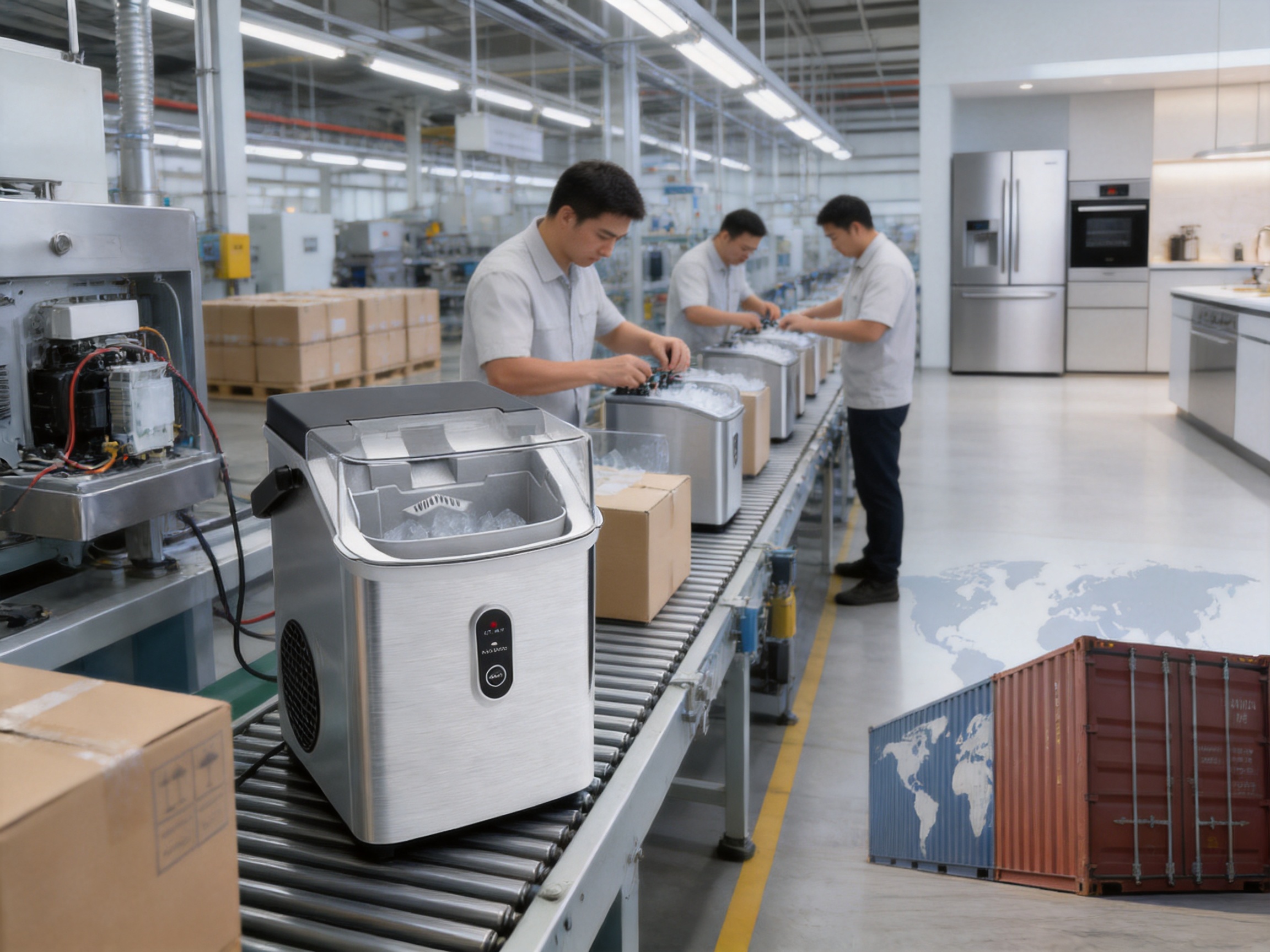
The Home Chewing Ice Maker is produced by Alien Technology Co., Ltd., a company located in Zhouxiang, Zhejiang Province. The region is recognized as a significant manufacturing area for small household appliances, supported by an established industrial network, supplier resources, logistics connections, and technical experience.
A location within a mature small-appliance manufacturing cluster can provide several advantages. Component sourcing can be more efficient, production knowledge can be shared across related industries, and logistics can support domestic and international distribution. These conditions help manufacturers respond to market requirements while maintaining a practical approach to product development.
Humanized Product Design
The company’s stated mission emphasizes smart technology, simplified living, and improved household happiness. This philosophy is reflected in the product’s user-centered characteristics. Soft ice, easy scooping, compact dimensions, and multifunctional use all address ordinary daily needs rather than adding unnecessary complexity.
Humanized design begins with understanding how people actually use an appliance. Consumers want to pour in water, operate the machine with minimal effort, obtain useful ice, and clean the product without complicated procedures. Although specific controls and cleaning instructions should be confirmed in the final product manual, the appliance’s overall concept is clearly directed toward straightforward household operation.
Focus on Reliable Quality
Reliability is essential for any refrigeration appliance. The product contains an electrical system, a cooling system, and components that must work together repeatedly. A dependable manufacturing approach requires attention to assembly consistency, electrical connections, refrigeration integrity, structural fit, and product inspection.
Alien Technology Co., Ltd. identifies reliable quality and customer satisfaction as important business priorities. These priorities are particularly relevant to distributors and commercial buyers, who need products that can support customer expectations after delivery. Stable quality can reduce returns, service complaints, and operational interruptions.
For international buyers, product quality also includes packaging, documentation, electrical configuration, labeling, and communication. A manufacturer that values continuous improvement is better positioned to refine these supporting details as market feedback is received.
Continuous Improvement and Innovation
Small appliances are competitive products. Manufacturers must improve not only appearance but also performance, convenience, energy use, noise control, safety, and durability. The company’s commitment to continuous improvement and innovation supports a development process in which user feedback can guide future product updates.
For a chewable ice maker, useful areas of improvement may include faster production, easier cleaning, improved insulation, quieter operation, better storage design, simplified controls, and enhanced compatibility with different household environments. These possibilities demonstrate why product development should be treated as an ongoing process rather than a single launch event.
Practical and Stable Business Philosophy
The company describes its business philosophy as stable and pragmatic. This approach can be valuable in the household appliance industry, where long-term cooperation depends on consistent supply, realistic product claims, responsive service, and dependable communication.
Distributors and importers often need more than a visually attractive sample. They require clear specifications, production coordination, packaging support, quality control, and cooperation on market-specific requirements. A stable manufacturing partner can help buyers plan more confidently and build a product range around dependable supply.
Experience Across Related Appliance Categories
Alien Technology Co., Ltd. specializes in ice makers, coffee machines, and air fryers. Experience across these categories can support broader understanding of household appliance design. Each product type involves heating or cooling systems, electrical safety, user interfaces, food-contact considerations, and the need for convenient cleaning.
Knowledge gained from related products can contribute to better component coordination and a more complete understanding of consumer expectations. For example, users of coffee machines and air fryers also value simple controls, compact placement, reliable operation, and easy integration into daily routines. These shared requirements can inform the development of ice-making appliances.
Applications in Homes and Small Businesses
Home Kitchens
In a home kitchen, the appliance can support everyday drinks, family meals, weekend gatherings, and frozen desserts. Its compact dimensions make it suitable for kitchens where a full-size ice system would be impractical. Users can produce chewable ice when needed instead of relying solely on freezer trays or pre-purchased bags.
The appliance may be especially useful during warm seasons, when cold drinks are consumed more frequently. It can also help households prepare iced coffee and cold beverages with greater consistency. Because the ice is easy to scoop and mix, children and adults can participate in preparing simple refreshments under appropriate supervision.
Home Entertainment
Parties and family gatherings often require more ice than a household freezer can produce conveniently. A dedicated chewable ice maker can support a steady supply for drinks and serving trays. The attractive texture can also become part of the entertainment experience, particularly for guests who enjoy chewing soft ice.
For hosts, the machine can reduce the need to purchase and transport bags of ice. It may also support attractive food displays, chilled fruit arrangements, and dessert preparation during an event.
Offices and Break Rooms
In an office environment, a compact ice maker can improve the shared beverage area. Employees can use the ice for water, soda, iced coffee, tea, and other drinks. The softer texture may be more appealing than hard cubes for people who prefer to chew ice after finishing a beverage.
Its moderate power rating and relatively small footprint are practical for a pantry or break room, provided that the electrical system and ventilation conditions are suitable. Regular cleaning and responsible shared use remain essential.
Cafés and Beverage Counters
Small cafés, dessert shops, and beverage counters may use chewable ice as an ingredient or serving component. Its rapid cooling characteristics can help staff prepare cold beverages efficiently, while its texture can give drinks a distinctive identity.
Before commercial use, businesses should evaluate production capacity, duty cycle, sanitation procedures, local regulations, water quality, and the suitability of the 220V/60Hz electrical specification. The product can be valuable for small-scale service, but buyers should match the appliance to actual demand rather than assuming that a compact household unit will meet high-volume industrial requirements.
Food Displays and Catering
Caterers and food-display operators can use chewable ice around salads, seafood, oysters, sashimi, fruit, and other chilled foods. Its small particles can create a smooth visual layer that fills spaces more effectively than large cubes.
Food businesses must still observe strict hygiene procedures. Ice that contacts food should be produced, stored, handled, and replaced according to applicable food-safety standards. The appliance’s versatility is an advantage, but safe operating discipline is essential.
Operation, Care, and Responsible Use
Although the product is designed for convenience, good operating habits help maintain performance. Users should place the machine on a stable, level surface with appropriate ventilation. The water used should be clean and suitable for consumption when the ice is intended for food or drinks.
The water reservoir and ice-contact areas should be cleaned according to the product manual. Regular cleaning helps reduce residue, odor, and microbial growth. Users should avoid touching ice with unclean hands and should use clean utensils when transferring it to food or beverages.
The machine should not be overloaded, moved while operating, or exposed to unnecessary moisture around electrical components. The refrigeration system should remain closed. Because R600a is a flammable refrigerant used within a sealed system, repairs involving the refrigeration circuit should be carried out only by qualified technicians.
Before purchase, users should verify the electrical requirements. The listed specification is 220V/60Hz, and operation on an incompatible power supply may damage the machine or create a safety risk. International distributors should confirm regional product configuration, plug style, labeling, manuals, and regulatory requirements.
When used for cold compresses, the ice should be placed in a clean, suitable covering and should not be applied directly to skin for excessive periods. When used for food displays, it should not be considered a substitute for refrigeration or formal temperature monitoring.
Why the Product Is Suitable for Global Distribution
The global small-appliance market increasingly favors products that combine compact design, recognizable benefits, and multiple uses. The Home Chewing Ice Maker fits these trends because it solves a clear consumer problem while offering additional applications.
Its primary selling point is easy to communicate: soft, chewable ice for drinks and daily use. The secondary benefits strengthen the commercial proposition: faster cooling, easy scooping, food-display support, frozen recipes, compact dimensions, and moderate power demand.
For distributors, the product can be positioned in several market segments. It may appeal to home beverage enthusiasts, families, office managers, cafés, dessert businesses, catering companies, and retailers specializing in kitchen appliances. Different markets can emphasize different functions without changing the basic product concept.
The manufacturer’s location in Zhejiang provides access to a strong small-appliance supply environment. Its product range across ice makers, coffee machines, and air fryers can also support buyers seeking multiple household appliance categories from one supplier. The stated focus on customer satisfaction, quality, innovation, and continuous improvement provides a foundation for business cooperation.
At the same time, responsible distribution requires transparent communication. Buyers should receive accurate information about voltage, frequency, dimensions, refrigerant, power, maintenance, capacity, and intended use. The product should be marketed as a compact chewable ice maker rather than being presented as a high-volume industrial machine unless production data confirms that application.
Purchase Considerations for Buyers
Consumers should first consider where the appliance will be placed. The listed dimensions are compact, but clearance is needed for ventilation, water filling, ice removal, and cleaning. The location should have a suitable electrical outlet and a stable surface.
Second, buyers should consider how they plan to use the ice. If the primary goal is chewing comfort, iced coffee, soda, smoothies, or food presentation, the product’s texture and versatility are strong advantages. If the buyer needs very large quantities for a busy restaurant or high-volume event operation, production capacity and duty-cycle information should be requested before purchase.
Third, buyers should confirm local voltage and frequency. The listed model is specified at 220V/60Hz. This point is essential for safe operation and should be checked before ordering in any country or region.
Finally, buyers should ask about warranty coverage, spare parts, cleaning instructions, packaging, manuals, shipping conditions, and after-sales support. These factors influence the long-term value of an appliance as much as the initial product specification.
Questions and Answers
Q1: What makes the Home Chewing Ice Maker different from a standard ice-cube machine?
The main difference is the texture of the ice. The product is designed to create soft, chewable ice rather than only hard, rigid cubes. It also provides a smaller particle structure that can cool drinks quickly and can be used in smoothies, food displays, desserts, and cold-compress applications.
Q2: Why does chewable ice cool drinks quickly?
Its smaller particle size provides a larger total contact area between the ice and the beverage. More ice surface is exposed to the liquid at the same time, which supports faster cooling. The particles can also distribute more evenly throughout the drink.
Q3: Is the ice suitable for iced coffee and soda?
Yes. Iced coffee, soda, tea, juice, and similar beverages are among the most suitable applications. The ice can lower the drink temperature quickly and adds a soft texture that some consumers enjoy chewing.
Q4: Can the ice be used to make smoothies?
Yes. Its soft, scoopable structure makes it convenient to mix with beverages and other ingredients. Users should follow the instructions for their blender or mixing equipment and avoid exceeding the equipment’s recommended load.
Q5: Can businesses use this machine for seafood or salad displays?
It can be used to create a cooling and visually attractive ice layer around seafood, salads, oysters, sashimi, vegetables, and other chilled foods. Businesses must follow all applicable food-safety, sanitation, and temperature-control requirements.
Q6: What is the listed power requirement?
The listed power supply is 220V/60Hz. The current and power are specified as 0.55A and 130W. Buyers should confirm that their electrical system matches these requirements before operation.
Q7: What refrigerant does the appliance use?
The listed refrigerant is R600a, with a charge of 19 grams. Because the refrigeration circuit is a specialized sealed system, only qualified technicians should service or repair it.
Q8: Is the machine easy to place in a small kitchen?
The listed dimensions are 224 x 333 x 325 millimeters, giving the appliance a compact format. Users should measure their available space and leave room for ventilation, cleaning, water filling, and ice removal.
Q9: Can the ice be used as a cold compress?
The soft texture can conform to body areas and may be useful for general cold-compress purposes when handled safely. The ice should be wrapped or placed in a suitable clean covering and should not be applied directly to skin for excessive periods. The product is not a medical device.
Q10: Who manufactures the product?
The product is manufactured by Alien Technology Co., Ltd., located in Zhouxiang, Cixi City, Zhejiang Province. The company specializes in ice makers, coffee machines, and air fryers and emphasizes humanized design, reliable quality, customer satisfaction, continuous improvement, and innovation.
Q11: Is this an industrial ice-making system?
The product is presented as a compact home chewing ice maker. It may also suit offices, small cafés, catering applications, and food displays, but buyers requiring high-volume production should request detailed capacity and duty-cycle information before selecting it for commercial operations.
Q12: What should distributors verify before importing it?
Distributors should verify voltage and frequency, plug configuration, dimensions, packaging, labeling, manuals, warranty terms, production capacity, shipment requirements, local regulations, and after-sales support. They should also confirm whether the product configuration is suitable for the destination market.
Conclusion
The Home Chewing Ice Maker represents a practical shift from ordinary hard cubes toward a more comfortable, versatile, and enjoyable form of ice. Its soft texture is the central advantage, providing a pleasant chewing experience while also supporting fast beverage cooling. Its smaller particles offer broad contact with drinks, its easy handling supports recipes and frozen refreshments, and its conformable structure can be used for food presentation and general cold-compress purposes.
The product’s compact 224 x 333 x 325 millimeter format, 130W power rating, and clearly stated 220V/60Hz specification make it suitable for many home and small-service environments, provided that electrical and installation requirements are confirmed. R600a refrigeration technology and a 19-gram listed charge further define the appliance’s technical profile, while specialized service remains necessary for refrigeration-system maintenance.
Behind the product is a Zhejiang-based manufacturer with experience in ice makers, coffee machines, and air fryers. Its emphasis on smart technology, humanized design, reliable quality, customer satisfaction, continuous improvement, and innovation provides important support for both product development and business cooperation. The company’s location within a strong small-appliance manufacturing region also offers supply-chain and logistics advantages.
For consumers, the appliance can make daily drinks more refreshing and enjoyable. For businesses, it can add flexibility to beverage service, food presentation, catering, and dessert preparation. For distributors, it offers a clearly differentiated product with several marketable benefits. As demand grows for convenient, multifunctional, and user-friendly kitchen appliances, chewable ice makers are well positioned to become an increasingly valuable part of the modern home and beverage environment.
References
1. Product specification sheet for the Home Chewing Ice Maker, model Alien-ZJ01.
2. Product information concerning chewable ice texture, rapid cooling, food coating, cold-compress use, and recipe versatility.
3. Manufacturer profile and corporate information for Alien Technology Co., Ltd.
4. General household refrigeration appliance safety and maintenance principles.
5. General food-service guidance concerning hygienic ice handling, chilled food presentation, and temperature control.
6. General technical reference material concerning compact refrigeration appliances and R600a refrigerant handling.