
 English
 한국어
한국어 Español
 Deutsch
Modern households increasingly expect kitchen appliances to do more than perform a single basic function. A useful appliance should be compact, easy to operate, efficient in daily use, dependable over time, and flexible enough to fit different lifestyles. The knob-type bullet ice maker described in this article is designed around these expectations. It provides a practical way to produce fresh ice at home, in a small office, at a bar counter, or in an outdoor leisure area without depending entirely on a freezer’s limited ice-making capacity.
This bullet ice maker combines a compact countertop format with a high-performance refrigeration system. Its purpose is straightforward: make usable ice quickly and conveniently whenever chilled drinks, cocktails, iced coffee, fruit beverages, or other cold refreshments are needed. The product uses R600a refrigerant, operates on a 220V–240V/50Hz power supply, and has a rated current and power specification of 0.9A/150W. Its listed machine dimensions are 313 × 226 × 309 millimeters, allowing it to occupy considerably less counter space than many larger commercial-style ice machines.
What makes the product especially practical is its bullet-shaped ice. The ice has a distinctive hollow center and rounded form, helping it cool beverages efficiently while maintaining a visually attractive appearance. Bullet ice is suitable for everyday drinks, mixed beverages, cocktails, cold tea, iced coffee, and other refreshments where quick cooling and easy serving are important.
The appliance is manufactured by Alien Technology Co., Ltd., a Zhejiang-based household appliance company specializing in ice makers, coffee machines, and air fryers. The company’s product development philosophy centers on humanized design, reliable quality, intelligent technology, continuous improvement, and practical service. These values are reflected in an ice maker that focuses on convenience rather than unnecessary complexity.
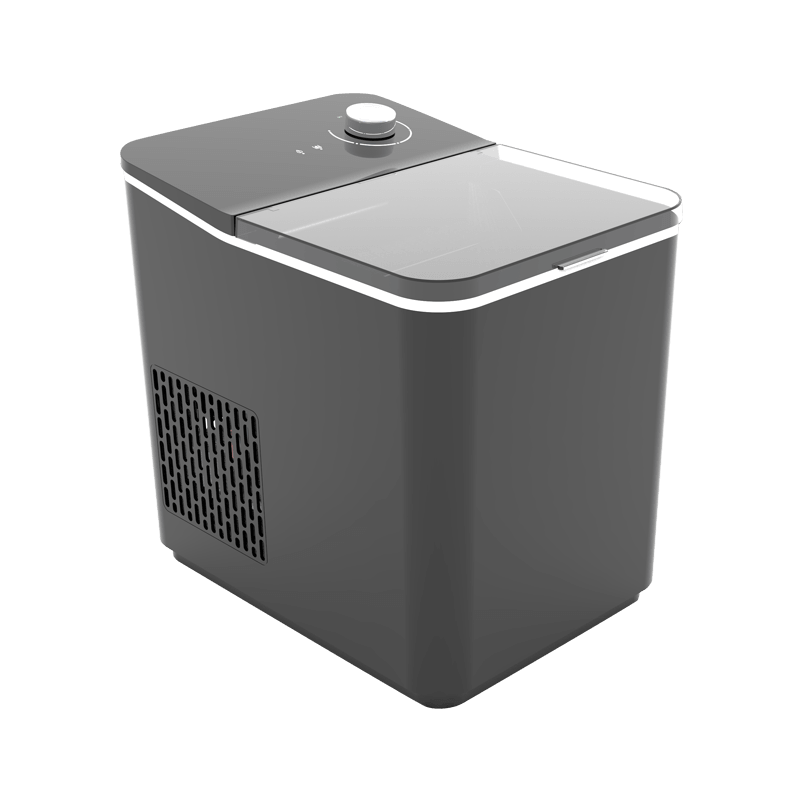
Knob-type ice maker
Designed for Everyday Ice-Making Convenience
One of the main strengths of this appliance is that it addresses a common household problem: the need for ice often arrives faster than a conventional freezer can provide it. Traditional freezer ice trays require advance preparation, take a long time to freeze, and must be manually refilled. Built-in freezer ice makers may offer more automation, but they can be expensive, difficult to install, or unavailable in smaller refrigerators. A countertop ice maker provides a separate and flexible solution.
The knob-type control design is particularly suitable for users who prefer a direct and understandable interface. Instead of navigating multiple menus or relying on a complicated digital system, the user can operate the machine through a simple control structure. This can be beneficial in kitchens, beverage stations, recreational rooms, small offices, and outdoor settings where straightforward operation is more valuable than an elaborate interface.
A simple control design also supports faster familiarization. Family members, guests, employees, and older users can generally understand a knob-based appliance without needing to study a detailed operating sequence. In a busy environment, the user can focus on filling the water reservoir, selecting the desired operation, and collecting the finished ice.
The product is described as a home bullet ice maker, but its usefulness extends beyond the kitchen. It can be placed on a bar counter for drink preparation, on a countertop in an office pantry, near a beverage station during gatherings, or in suitable outdoor areas where access to fresh ice is needed. Its compact form makes it easier to move than a full-size freestanding ice machine.
Bullet Ice: Functional Shape with Beverage Appeal
The ice produced by this appliance has a bullet-style shape with a hollow center. This form is widely appreciated because it combines practical cooling performance with a distinctive appearance. The rounded edges are comfortable to handle, while the hollow center creates a characteristic visual profile that works well in transparent glasses and beverage pitchers.
Bullet ice is useful for beverages that need rapid cooling. It can be added to soft drinks, fruit juices, iced tea, iced coffee, mixed drinks, mocktails, cocktails, and water. Because the shape is relatively smooth and rounded, it can blend naturally into a drink without appearing overly harsh or angular. The form also makes it suitable for casual home entertaining, where presentation is nearly as important as temperature.
The hollow center contributes to the ice’s functional design. According to the supplied product information, the shape makes the ice less prone to melting and helps it cool drinks while preserving their flavor. In practical terms, ice that cools efficiently can reduce the time required to bring a beverage to a refreshing temperature. It also helps users prepare drinks when they do not have enough pre-frozen ice stored in the freezer.
For families, the appeal is convenience. For hosts, the appeal is presentation and availability. For beverage-focused businesses and small hospitality settings, the appeal is the ability to provide a steady source of attractive ice without dedicating space to a large commercial machine. The same product can therefore serve multiple use cases while maintaining a small countertop footprint.
Compact Size for Flexible Placement
Space efficiency is a major consideration when choosing a countertop appliance. Modern kitchens often contain coffee makers, air fryers, kettles, blenders, microwaves, and food preparation equipment. An ice maker must therefore provide useful capacity without overwhelming the counter.
The supplied technical information lists the machine dimensions as 313 × 226 × 309 millimeters. The product information section also describes the product as measuring 325 × 295 × 252 millimeters. Since two dimensional sets are provided, buyers and distributors should confirm the final dimensional specification for the exact production version, packaging configuration, or sales listing before installation. Regardless of the dimensional reference used, the product is positioned as a compact appliance intended for countertop placement.
A compact structure provides several advantages over larger competitors. It allows the user to install the machine in a smaller kitchen, place it beside other beverage appliances, or move it when the counter is needed for food preparation. It can also be more convenient for seasonal use. For example, the machine may be stored when not needed and brought out for parties, holidays, family events, or warmer weather.
Placement flexibility is another important benefit. The product can be used on a kitchen countertop, bar counter, office pantry surface, or suitable outdoor table. It is important to place the appliance on a stable, level, dry surface with sufficient ventilation and access to the correct electrical supply. Users should also follow the operating and cleaning instructions supplied with the final unit.
Compared with larger floor-standing ice makers, a compact countertop model can reduce installation complexity. There is no stated requirement for permanent plumbing in the supplied information, and the product is presented as a home appliance rather than a permanently installed commercial system. This makes it appropriate for customers seeking convenience without remodeling a kitchen or beverage area.
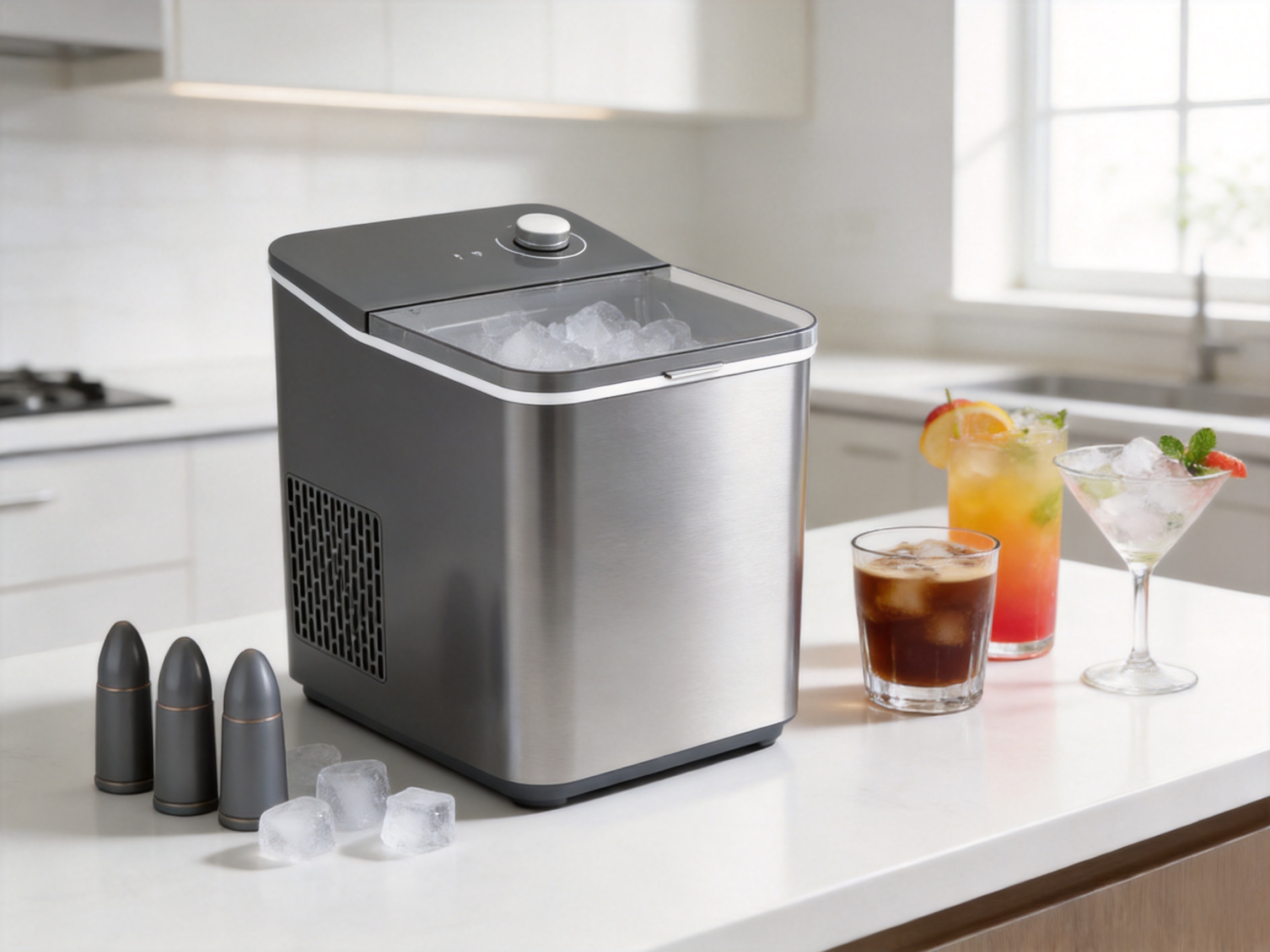
Refrigeration Performance and Stable Operation
The appliance uses a refrigeration system designed to produce bullet ice in a relatively short time. Quick ice making is one of the product’s central selling points. When a household runs out of ice unexpectedly, the ability to produce fresh ice on demand is more useful than relying on ice trays prepared many hours earlier.
The rated power specification is 150W, with a current rating of 0.9A. These figures position the machine as a comparatively manageable countertop appliance rather than a high-power commercial unit. The product is designed for a 220V–240V, 50Hz electrical supply. Buyers should confirm compatibility with the electrical standards in their region and use the appliance only with the appropriate power connection.
Stable operation depends on several factors, including correct placement, adequate ventilation, proper water filling, regular cleaning, and compliance with the operating instructions. A refrigeration appliance performs best when heat can dissipate freely from the housing. Keeping the ventilation area unobstructed can support reliable operation and help the refrigeration system work efficiently.
The product information identifies R600a, or isobutane, as the refrigerant and lists a charge of 19 grams. R600a is a natural hydrocarbon refrigerant commonly associated with efficient refrigeration performance and low global warming potential. Its use reflects the broader movement toward refrigerants with reduced environmental impact compared with some older refrigerant types.
Because R600a is flammable, safe handling is important. Users should not puncture, modify, or attempt to repair the sealed refrigeration system. Any service involving the refrigerant circuit should be performed by a qualified professional. This safety consideration applies to household refrigeration products generally and should be included in product instructions, packaging, and after-sales support.
Environmental Considerations
Environmental responsibility is increasingly important in the household appliance market. Customers are evaluating not only the purchase price and appearance of an appliance but also its refrigerant, power demand, service life, and material efficiency. The use of R600a supports the product’s environmental positioning because it offers low global warming potential while maintaining useful refrigeration performance.
Using a natural refrigerant does not eliminate the need for responsible operation. Energy consumption is influenced by ambient temperature, ventilation, water temperature, usage frequency, maintenance, and the condition of the refrigeration system. Users can support efficient operation by placing the machine away from direct heat sources, allowing enough ventilation space, avoiding unnecessary repeated operation, and cleaning the appliance according to the recommended schedule.
A compact appliance can also contribute to practical resource efficiency. Its smaller physical size requires less space in the home and may reduce the material and logistics burden associated with oversized equipment. A right-sized product is often a more sustainable choice than purchasing a much larger machine whose capacity is rarely needed.
Long-term durability is another part of environmental performance. An appliance that remains useful for many years can reduce the need for frequent replacement. This is why manufacturing consistency, product testing, component selection, quality inspection, and responsive after-sales service are important. The company’s stated focus on reliable quality and continuous improvement supports this long-term perspective.
Advantages Compared with Conventional Ice-Making Methods
Compared with Ice Trays
Ice trays are inexpensive and familiar, but they require planning. Water must be added manually, the tray must be placed in a freezer, and the user must wait for the ice to freeze. Tray ice can also absorb freezer odors if it is stored for a long time. A dedicated ice maker provides a faster and more organized alternative for households that use ice regularly.
The bullet ice maker also avoids the inconvenience of repeatedly twisting or bending ice trays. The finished ice can be collected from the machine when needed, which is useful during gatherings or busy meal preparation. The dedicated appliance can operate independently of the freezer, freeing freezer space for food.
Compared with Freezer-Mounted Ice Makers
Many refrigerators include built-in ice makers, but not every refrigerator has this feature. Retrofitting one may be impractical or expensive. A countertop appliance can provide ice-making functionality without replacing the refrigerator or changing its internal structure.
A separate ice maker also gives users greater flexibility. The refrigerator can remain focused on food storage while the countertop machine serves beverages. This division can be especially helpful when a family is hosting guests or when several people need ice at the same time.
Compared with Large Commercial Units
Commercial ice machines may offer higher production volume, but they are often larger, heavier, more expensive, and more demanding to install. A household customer who only needs ice for drinks may not require that level of capacity. The compact bullet ice maker is a more proportionate choice for domestic use, small offices, beverage counters, and occasional hospitality applications.
Its 150W rated power and compact form make it easier to integrate into spaces where a commercial unit would be excessive. The machine is not intended to replace high-volume restaurant equipment, but it can offer a practical balance between performance, portability, and space use for smaller-scale applications.
Compared with Buying Bagged Ice
Purchasing bagged ice can be convenient, but it requires repeated trips, storage space, and planning. Bagged ice may also melt during transport or occupy a significant amount of freezer space. Producing ice at the point of use provides greater control over availability and can be more convenient for households that frequently serve cold drinks.
Users should still follow proper hygiene practices, including using clean water, regularly cleaning the water-contact surfaces, and storing or serving the ice appropriately. The advantage of a countertop ice maker is not only supply but also the ability to make fresh ice when required.
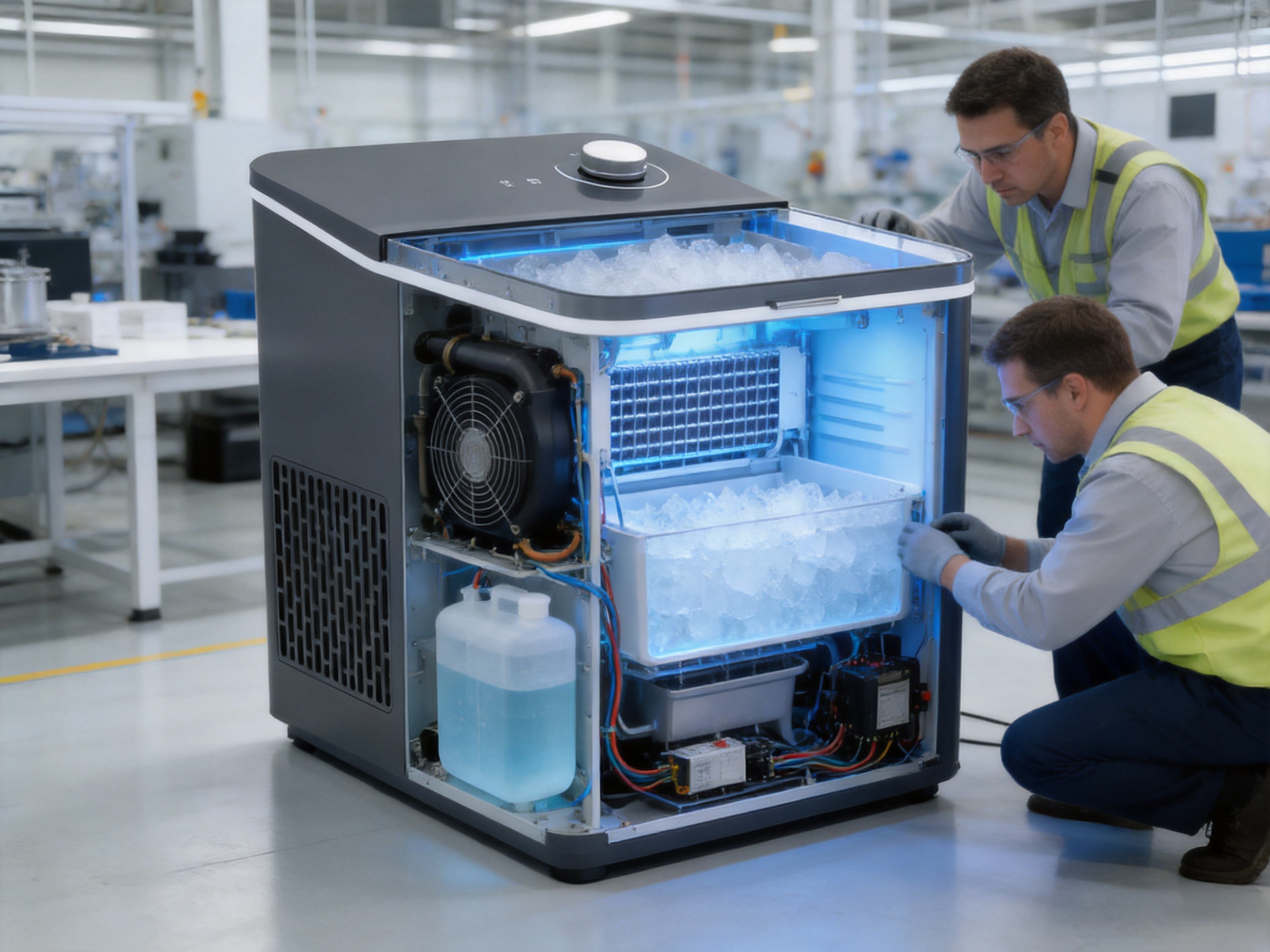
Manufacturing Strengths and Product Development Philosophy
Alien Technology Co., Ltd. is located in Zhouxiang, Cixi City, Zhejiang Province, an area known for small household appliance manufacturing and convenient logistics. The company specializes in ice makers, coffee machines, and air fryers. This product focus gives the company experience in developing appliances that combine heating, cooling, airflow, water handling, controls, and compact household design.
The company’s stated mission is “Smart Technology, Simplifying Life, Enhancing Happiness.” This mission is reflected in the decision to create practical appliances that solve everyday problems without demanding complicated installation or specialized operation. In the case of the bullet ice maker, smart product development is expressed through compact design, direct controls, efficient refrigeration, and a shape suited to common beverage applications.
A strong household appliance manufacturer must coordinate several stages of product development. These stages can include market research, concept design, industrial design, mechanical engineering, refrigeration-system integration, electrical development, component sourcing, assembly, testing, packaging, and after-sales support. The product’s specifications show an emphasis on integrating these elements into a small and usable form.
Compact appliances require careful engineering because internal components must fit within a limited enclosure. The refrigeration system, water path, ice-forming components, control mechanism, wiring, insulation, and external housing must work together without compromising accessibility or safety. A compact design is therefore not simply a smaller version of a large product; it requires deliberate space planning and manufacturing coordination.
The company’s specialization across several household appliance categories can also support cross-category knowledge. Coffee machines and ice makers both involve water management and beverage preparation. Air fryers and ice makers both require thermal management, control interfaces, airflow considerations, and durable housings. Experience across these product types can encourage a broader understanding of household usability and appliance reliability.
Quality Control Priorities for a Countertop Ice Maker
Quality control is essential for any product that combines electricity, water, refrigeration, and repeated daily use. A reliable manufacturing process should address incoming materials, component consistency, assembly accuracy, electrical safety, sealing, control function, refrigeration performance, noise behavior, and final appearance.
For an ice maker, water-contact components must be produced and assembled carefully. The water path should be checked for leakage, correct fit, and cleanliness. The ice-forming system should be inspected to ensure that water reaches the appropriate areas and that the finished ice can be released and collected properly. The external housing should be assembled with consistent gaps and secure fastening.
The refrigeration system requires particular attention. The listed refrigerant is R600a with a 19-gram charge, so accurate charging and sealed-system integrity are important. A professional production process should control refrigerant filling, inspect connection points, and verify cooling performance. The final unit should be handled according to appropriate safety procedures because of the flammable nature of hydrocarbon refrigerants.
Electrical testing is also important. The machine is specified for 220V–240V/50Hz operation, with a rated current of 0.9A and power of 150W. Quality inspection can verify that the unit operates correctly within its intended electrical range and that controls, wiring, insulation, and protective components function as designed.
Final inspection should also confirm the accuracy of product labels, manuals, packaging, dimensions, and specifications. This is especially relevant because the supplied information includes two different dimensional descriptions. Clear specification management helps distributors, retailers, installers, and end users plan the product correctly.
Supply Chain and Logistics Advantages
The company’s location in Zhejiang provides access to a dense household appliance manufacturing ecosystem. A mature regional supply chain can support the sourcing of housings, refrigeration components, electrical parts, packaging materials, controls, and other appliance components. It can also facilitate communication between design, manufacturing, and supplier teams.
Convenient logistics are valuable for both domestic and international business. A well-organized logistics network can help shorten delivery cycles, support export orders, and improve the availability of replacement components. For wholesale customers, private-label buyers, distributors, and project purchasers, reliable logistics can be as important as the product itself.
The company welcomes new and existing customers for business cooperation. This suggests that the product may be relevant not only to individual consumers but also to importers, retailers, hospitality suppliers, online sellers, and appliance distributors. Business customers can evaluate the product according to target market requirements, packaging needs, electrical standards, order quantities, and after-sales arrangements.
Manufacturing strength is not limited to production volume. It also includes the ability to communicate accurately, adjust product details responsibly, coordinate orders, and maintain consistency across batches. A company that pursues continuous improvement can use customer feedback and market experience to refine controls, dimensions, packaging, appearance, and functional details over time.
Humanized Design for Different User Groups
The product is suitable for users who value practical access to fresh ice without the complexity of a large appliance. Families can use it during everyday meals, celebrations, and weekend gatherings. Individuals who prepare iced coffee or cold tea can keep it near a beverage station. Office users can place it in a pantry or break room. Hosts can position it close to a bar counter for convenient drink preparation.
The compact format may also benefit people living in apartments, dormitory-style accommodation, small homes, recreational vehicles, or other spaces where a full-size ice machine is not practical. As long as the power supply, ventilation, and placement requirements are suitable, the machine can provide a dedicated source of ice in locations where freezer capacity is limited.
The knob-type interface supports a sense of familiarity. Many users prefer controls that provide an immediate physical response rather than requiring a sequence of touchscreen commands. A knob can be easy to identify, rotate, and understand, particularly in environments where users may be wearing gloves, working quickly, or sharing the appliance with others.
Humanized design also includes the relationship between the product and the surrounding space. A small appliance is easier to place, clean around, move, and store. Its role is clear: it occupies a manageable area and provides ice when needed. This direct relationship between form and function is one of the product’s strongest practical qualities.
Cleaning, Maintenance, and Responsible Use
Regular care is important for any appliance that uses water and produces consumable ice. Users should read the instructions supplied with the final product and follow the manufacturer’s recommended cleaning process. The water reservoir, ice collection area, and other user-accessible surfaces should be kept clean and dry when the machine is not in use.
Clean drinking water should be used unless the instructions specify otherwise. Water quality can affect taste, odor, mineral deposits, and the appearance of the internal components. In areas with hard water, users should pay attention to mineral buildup and perform the recommended cleaning or descaling procedure.
The appliance should be placed on a level surface. It should not be operated in a location where water can enter electrical components or where the power cord may be damaged. Ventilation openings should remain unobstructed, and the machine should be kept away from direct heat sources such as ovens, cooktops, and strong sunlight.
The refrigeration circuit should not be opened by the user. Since the machine uses R600a, repairs involving the refrigerant must be left to qualified technicians. Users should also avoid modifying the housing, controls, electrical system, or internal water path. Proper maintenance protects the user, supports product performance, and can extend the service life of the appliance.
Commercial and Wholesale Potential
Although designed for home use, the product can interest a wide range of business buyers. Small cafés, beverage kiosks, offices, boutique hotels, guesthouses, event planners, and catering operations may need a compact supplemental ice source. The appliance can also be included in appliance retail portfolios alongside coffee machines, air fryers, kettles, and other countertop products.
For distributors, the product offers several clear marketing points: compact size, bullet-shaped ice, direct knob control, R600a refrigerant, 150W rated power, and flexible countertop placement. These features can be communicated easily to customers without requiring a highly technical sales explanation.
Retailers may position the product as a seasonal appliance for summer, outdoor entertaining, holiday gatherings, and cold beverage preparation. Online sellers can emphasize its space-saving design and use cases. Hospitality suppliers can present it as a convenient supplemental unit for locations that do not require the production volume of a large commercial machine.
Business buyers should confirm order specifications, packaging details, electrical requirements, labeling, warranty terms, production lead times, and after-sales support before placing an order. They should also confirm the final product dimensions because the supplied materials present two dimensional references. Clear communication at the purchasing stage helps reduce installation and fulfillment problems.
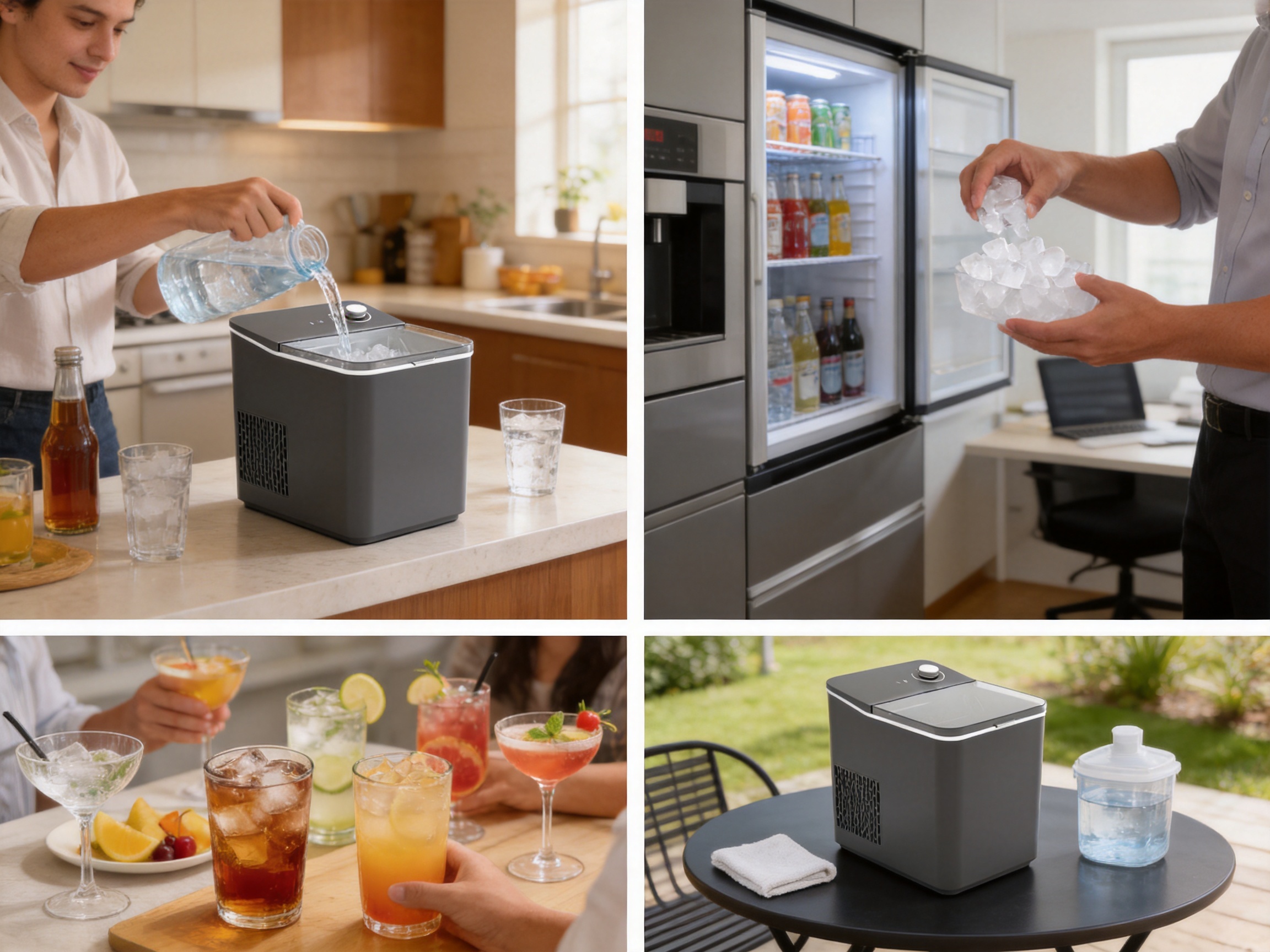
Positioning Against Competing Products
Competition in the countertop ice maker market is broad. Some competing products emphasize digital touchscreens, some focus on large capacity, and others compete primarily on price. This product follows a different path by emphasizing practical operation, compact placement, bullet-shaped ice, and a focused refrigeration system.
Against touchscreen models, the knob-type design can appeal to buyers who prefer simplicity and physical controls. A touchscreen may provide a modern appearance, but it can also introduce more electronic complexity than some users need. A direct control layout may be easier to operate and easier to explain in a shared household or commercial environment.
Against oversized models, the compact design provides a clear space advantage. Many households do not need industrial output and would rather have an appliance that fits comfortably beside existing kitchen equipment. The product’s size allows it to serve customers who would otherwise reject an ice maker because of limited counter space.
Against low-cost products with minimal environmental positioning, the use of R600a provides a stronger sustainability message. The refrigerant’s low global warming potential aligns with current environmental expectations and gives distributors a meaningful feature to discuss with environmentally conscious buyers.
Against products with unclear manufacturing support, the company offers experience in several household appliance categories and is located within a major small-appliance production region. Its focus on reliable quality, customer satisfaction, continuous improvement, and innovation can provide a stronger foundation for long-term business cooperation than a purely short-term trading model.
The product is not positioned as a replacement for every type of ice machine. Very large restaurants, high-volume bars, and industrial food-service facilities may require larger equipment. Its advantage lies in serving the space between freezer trays and commercial machines: a practical, portable, relatively compact appliance for regular household and light-duty beverage use.
Specification Summary
Product Type |
Knob-type bullet ice maker |
Product Description |
Alien-Z02 |
Category |
Bullet Ice Maker |
Power Supply |
220V–240V / 50Hz |
Rated Current / Power |
0.9A / 150W |
Refrigerant / Charge |
R600a / 19g |
Listed Machine Dimensions |
313 × 226 × 309 mm |
Additional Dimensions in Product Information |
325 × 295 × 252 mm |
Primary Ice Form |
Bullet-shaped ice with a hollow center |
Recommended Placement |
Kitchen countertops, bar counters, office beverage areas, and suitable outdoor areas |
The two dimensional references should be confirmed with the supplier before final purchase, installation, packaging design, or retail publication. Product dimensions may vary according to the exact model version, measurement method, enclosure configuration, or listing format.
Frequently Asked Questions
What type of ice does this machine produce?
The machine produces bullet-shaped ice with a hollow center. This style is suitable for soft drinks, iced coffee, cocktails, mocktails, fruit beverages, tea, and general household cooling needs.
Is the appliance intended for home use?
Yes. It is described as a home bullet ice maker, but its compact format may also suit offices, beverage stations, small hospitality locations, and other light-duty applications.
How is the product operated?
The product uses a knob-type control design. Its direct interface is intended to make operation straightforward for users who prefer physical controls over more complicated digital menus.
What power supply does it require?
The listed power supply is 220V–240V at 50Hz. The rated current and power are 0.9A and 150W. Buyers should confirm regional electrical compatibility before use.
What refrigerant does it use?
The appliance uses R600a, or isobutane, with a listed charge of 19 grams. R600a is associated with efficient refrigeration performance and low global warming potential. Because it is flammable, the refrigeration circuit should only be serviced by qualified professionals.
Where can the ice maker be placed?
It can be placed on a suitable kitchen countertop, bar counter, office pantry surface, or outdoor table. The surface should be stable, level, dry, and capable of supporting the appliance. Adequate ventilation must be maintained.
Is this machine suitable for a large restaurant?
The product is primarily designed for home and compact countertop use. It may serve as a supplemental ice source in a small business, but high-volume restaurants, bars, and commercial kitchens should compare its output with their specific demand before purchasing.
Why is bullet ice useful?
Bullet ice has a rounded shape and hollow center. It is visually appealing, easy to use in beverages, and designed to cool drinks efficiently. It works well for everyday refreshments and social events.
How should the machine be maintained?
Users should follow the cleaning and maintenance instructions supplied with the final unit. The water-contact areas and ice collection area should be kept clean, suitable drinking water should be used, and mineral buildup should be addressed according to the recommended procedure.
Are the listed dimensions consistent?
The supplied materials include two dimensional references: 313 × 226 × 309 millimeters and 325 × 295 × 252 millimeters. Buyers should verify the final dimensions for the exact model and configuration before planning placement or packaging.
What distinguishes this product from a conventional ice tray?
The dedicated ice maker can produce fresh bullet ice without waiting for a tray to freeze inside a freezer. It also operates independently of freezer space and provides a more convenient option for gatherings, beverage preparation, and regular ice use.
What is the company’s manufacturing background?
Alien Technology Co., Ltd. is based in Zhejiang Province and specializes in household appliances including ice makers, coffee machines, and air fryers. The company emphasizes reliable quality, customer satisfaction, continuous improvement, innovation, practical business cooperation, and humanized product design.
Conclusion
The knob-type bullet ice maker offers a focused solution for households and small beverage environments that need fresh ice without the size and complexity of a commercial machine. Its main advantages include a compact countertop format, direct knob operation, bullet-shaped ice with a hollow center, 150W rated power, and a refrigeration system using R600a refrigerant.
Its value is clearest when compared with conventional alternatives. It is faster and more convenient than relying only on ice trays, more flexible than a refrigerator-mounted system, smaller and easier to place than many commercial machines, and more controllable than repeatedly purchasing bagged ice. The product does not attempt to serve every possible market segment; instead, it concentrates on practical everyday ice production in a manageable form.
The manufacturer’s location in Zhejiang’s small-appliance production region, experience across ice makers, coffee machines, and air fryers, and stated commitment to reliable quality and continuous improvement provide a strong foundation for product development and business cooperation. Careful integration of refrigeration, water management, electrical controls, housing design, and quality inspection is essential to producing a dependable countertop appliance.
For consumers, the machine can simplify cold beverage preparation and make entertaining more convenient. For retailers and distributors, it offers a clear product story built around compact design, simple control, environmental refrigerant selection, and flexible use. For business buyers, it can serve as a practical supplemental ice source where space and installation simplicity matter.
Before purchase, users and commercial partners should confirm the final dimensions, electrical compatibility, operating instructions, warranty provisions, packaging details, and service arrangements. With correct installation, responsible use, and regular maintenance, this compact bullet ice maker can become a useful part of a modern beverage preparation area.
References
1. Product specification sheet for the knob-type bullet ice maker, including power supply, rated power, refrigerant, charge, and machine dimensions.
2. Product information for the Alien-Z02 bullet ice maker, including design features, intended applications, bullet-ice characteristics, and compact-placement guidance.
3. Company profile of Alien Technology Co., Ltd., including manufacturing location, household appliance categories, corporate mission, and business cooperation information.
4. General household refrigeration safety principles concerning ventilation, electrical compatibility, maintenance, and professional servicing of sealed refrigerant systems.
5. General appliance design and manufacturing practices related to water-contact components, refrigeration-system inspection, electrical testing, assembly quality, packaging, and after-sales support.