
 English
 한국어
 Español
 Deutsch
Choosing the right ice maker can make a noticeable difference in the quality, appearance, and convenience of everyday drinks. A suitable machine should do more than produce frozen water. It should fit comfortably into the home, use energy responsibly, create ice with practical characteristics, and support a wide range of serving occasions. The Home Ice Cube Maker, identified as Alien-ZF01, is designed around these expectations. It combines a compact body, a 140-watt power system, R290 refrigerant, and regular square ice cubes in a format intended for household use.
Rather than focusing only on speed or a large commercial footprint, this model emphasizes balanced performance. Its regular ice shape offers better stacking, attractive presentation, and a slow melting rate that can help preserve the flavor of beverages. The dimensions of 325 x 295 x 252 millimeters make it suitable for kitchens, home bars, offices, entertainment rooms, and other locations where counter space is limited.
The product is manufactured by Alien Technology Co., Ltd., a Zhejiang-based household appliance producer specializing in ice makers, coffee machines, and air fryers. The company’s business philosophy centers on humanized design, reliable quality, continuous improvement, and practical innovation. These principles are visible in the product’s straightforward control concept, compact form, refrigerant selection, and focus on useful ice characteristics rather than unnecessary complexity.
A Practical Ice-Making Solution for the Home
Home users often need ice in a way that differs from restaurants, hotels, and large beverage operations. A commercial kitchen may require very high output and continuous production, while a household generally needs a convenient appliance that can be placed on a counter and used when needed. The Alien-ZF01 is positioned for this second type of environment. Its compact footprint helps it fit into ordinary kitchen arrangements without demanding the installation space associated with larger machines.
The machine measures 325 millimeters in length, 295 millimeters in width, and 252 millimeters in height. This size gives users flexibility when deciding where to place it. It can be considered for a kitchen worktop, a beverage station, a home bar, a dining area, or an office pantry. Its relatively small dimensions are especially useful for apartments and compact homes, where every section of counter space must serve a purpose.
A compact appliance also offers a practical advantage during storage and relocation. Users may place the machine on a counter during a gathering and move it to a storage area afterward, provided that standard handling and operating instructions are followed. The small form therefore supports occasional entertainment as well as regular use. Instead of purchasing bags of ice for every event, a household can keep an ice-making appliance ready for drinks, food preparation, and cooling applications.
The design also favors simplicity. The product is identified as a knob-type ice maker, suggesting a direct and familiar operating approach. A physical control can be useful for users who prefer clear mechanical interaction over complicated menus. This type of control is easy to understand across different age groups and can make the appliance feel approachable in a shared household environment.
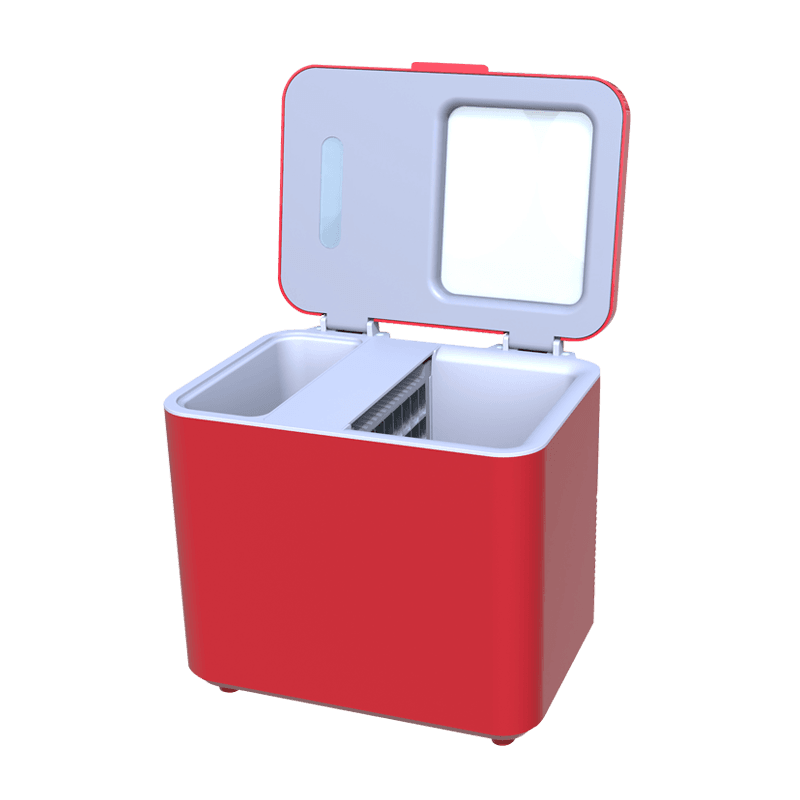
Home ice cube maker
Regular Square Ice Cubes with Functional Advantages
One of the most important features of this product is its focus on regular square ice cubes. Shape affects more than appearance. It influences how ice occupies a glass, how tightly it can be stored, how it interacts with beverages, and how quickly it melts. Square cubes provide a consistent format that is useful in both everyday and presentation-focused applications.
Solid, dense cubes generally melt more slowly than smaller or irregular pieces because they have a relatively low surface area compared with their total volume. When placed in a drink, a dense square cube can provide extended cooling while limiting excessive dilution. This characteristic is especially valuable for whiskey, neat spirits, cocktails, iced coffee, and other beverages where the original flavor profile should remain clear.
Slow melting does not mean that the ice never melts. All ice will eventually change into water when exposed to warmer surroundings. The practical advantage is that the cube may remain useful for longer before it significantly changes the concentration of a beverage. For consumers who prefer drinks that stay chilled without quickly becoming watery, this is an important performance consideration.
Regular cubes also have a clean and professional appearance. In a transparent glass, a neat cube can enhance the visual presentation of a drink. This makes the machine suitable not only for family use but also for entertaining guests. A well-presented drink can feel more carefully prepared, whether it is a simple glass of water, a soft drink, an iced tea, a cocktail, or a premium spirit.
Compared with irregular ice fragments, square cubes are easier to handle and arrange. They can be placed into glasses with greater predictability and can be used consistently from one serving to the next. Their geometry creates a more uniform appearance, which is helpful when a user wants a beverage station to look organized and refined.
Advantages Compared with Irregular Ice
Irregular ice pieces often have uneven edges, variable sizes, and a less predictable melting pattern. They may be useful for certain cooling purposes, but they do not always provide the same visual or storage benefits as regular cubes. A square format offers a more controlled balance between volume, surface area, and presentation.
Regular cubes can also be easier to count and portion. When preparing several drinks, users can add a similar number of cubes to each glass and achieve a more consistent appearance. This is useful for family meals, small celebrations, and home beverage service. Consistency is one of the qualities that separates a purpose-designed ice maker from improvised ice trays or ice collected from irregular household sources.
The square format further supports freezer organization. Cubes with predictable dimensions can be placed together more efficiently than pieces with random shapes. This helps reduce wasted space when ice is transferred to a storage container or freezer compartment. For households that prepare ice ahead of time, stacking efficiency can translate into more usable storage capacity.
Slow-Melting Ice for Better Beverage Control
Ice affects a drink in two ways: it lowers the temperature and adds water as it melts. The first effect is usually desirable, while the second must be managed carefully. If ice melts too rapidly, a beverage may become diluted before it can be enjoyed. Dense, solid cubes are valuable because they can provide cooling over a longer period while reducing the rate at which water enters the drink.
This characteristic is particularly relevant to premium whiskey and other neat spirits. Many people enjoy such beverages for their aroma, body, and finish. Excessive dilution can change those qualities quickly. A slow-melting square cube allows the user to observe how the drink develops over time without the immediate watering effect associated with crushed ice or very small pieces.
The same principle applies to cocktails. A cocktail served over a stable cube can retain a more deliberate balance between its ingredients. Drinks containing citrus, syrups, spirits, and bitters may benefit from ice that cools steadily rather than disappearing rapidly. The product therefore supports both casual refreshments and more carefully prepared home beverages.
Iced coffee is another suitable application. Coffee enthusiasts often want a cold drink that remains flavorful rather than becoming weak. Large, solid cubes can help maintain a stronger taste for longer, especially when the coffee is served slowly. The appliance can therefore complement a home coffee routine as well as a traditional cold-drink setup.
For water, juice, soda, and tea, the benefit is straightforward: the drink can remain cool during a meal or conversation. The cube’s appearance also adds a polished touch to transparent glassware. A simple drink can look more inviting when served with clean, uniform ice.
Versatile Use Beyond Beverage Service
Although beverages are the most obvious application, the product can support several other household tasks. The supplied product information identifies uses including drink service, ice buckets, kitchen preparation, and ice packs. This range gives the appliance value throughout the home rather than limiting it to occasional cocktail preparation.
In an ice bucket, regular cubes can help maintain the temperature of bottles and containers. Their consistent shape allows the ice to settle around items in a relatively organized way. During meals or gatherings, an ice bucket filled with cubes can support the serving of chilled water, soft drinks, wine, or other refreshments.
In the kitchen, ice may be used for cooling ingredients or assisting with preparation. Some cooking methods call for rapid cooling after heating, while certain food preparation tasks benefit from a cold environment. The exact use depends on the recipe and food-safety practices, but having a convenient supply of clean ice can make the kitchen more flexible.
Ice can also be placed in a suitable pack or container for general cooling purposes. A household might use it to help keep food cold during short transport, maintain a chilled serving area, or support temporary cooling needs. Users should select appropriate food-safe containers and follow responsible handling procedures whenever ice comes into contact with food or beverages.
This versatility gives the Home Ice Cube Maker a strong advantage over appliances designed only for one narrow serving purpose. Instead of being a decorative bar accessory that is rarely used, it can become a practical part of daily household routines.
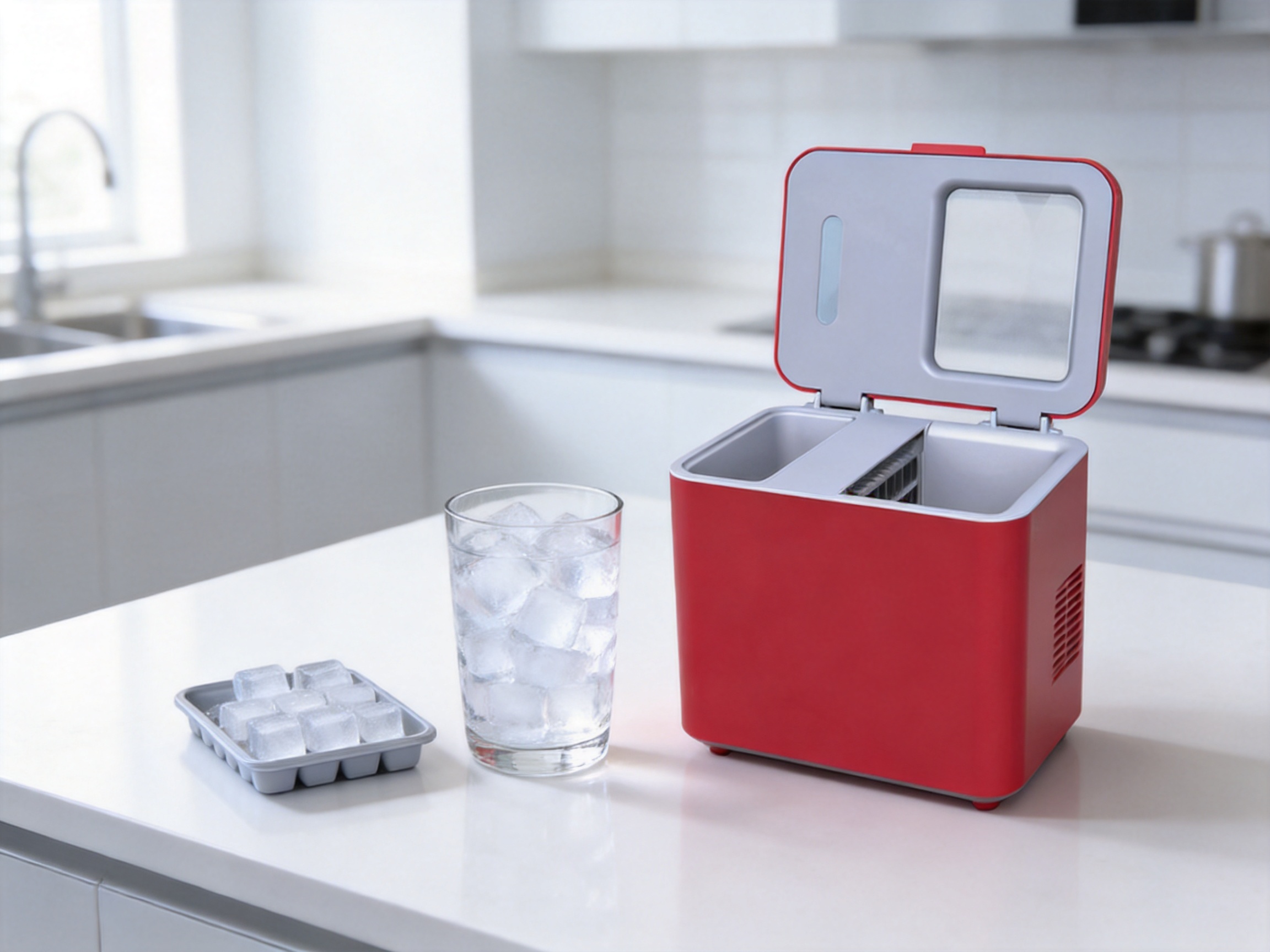
Electrical Performance and Refrigerant Selection
The product operates on a 220-volt, 50-hertz power supply. This specification should be checked against the electrical standards of the intended installation location before purchase or use. Using an appliance with the correct voltage and frequency is essential for safe and reliable operation.
The stated current and power rating are 0.65 ampere and 140 watts. A 140-watt system represents a modest electrical load for a household ice maker. This supports the product’s positioning as a compact appliance rather than a large, high-consumption commercial machine. Actual energy use can vary according to ambient temperature, operating duration, ventilation, and usage conditions, but the rated power provides users with a clear reference for planning daily operation.
The machine uses R290 refrigerant with a charge of 26 grams. R290 is propane used as a refrigerant and is recognized in modern refrigeration discussions for its low global warming potential compared with many older refrigerant options. Because it is flammable, appliances using R290 must be designed, handled, transported, installed, and serviced according to applicable safety requirements. Users should not attempt to open the sealed refrigeration system or perform unauthorized repairs.
The refrigerant specification demonstrates that the product is built around a contemporary cooling approach. Selecting an appropriate refrigerant is an important part of appliance engineering because it influences environmental considerations, system design, servicing requirements, and overall performance. The R290 system contributes to the product’s modern technical profile while emphasizing the need for responsible handling.
A well-designed compact refrigeration system must manage several factors at once. It needs to remove heat effectively, fit inside a small body, operate with a reasonable electrical demand, and maintain dependable performance in a household environment. The Alien-ZF01’s combination of compact dimensions, 140-watt rated power, and R290 refrigerant reflects an effort to balance these requirements.
Compact Engineering and Space Efficiency
Space efficiency is an increasingly important consideration in home appliances. Kitchens are often equipped with refrigerators, ovens, coffee machines, air fryers, kettles, and other devices. An ice maker must therefore justify the counter area it occupies. The Alien-ZF01’s 325 x 295 x 252 millimeter body allows it to serve a specific function without the footprint of a larger commercial unit.
The relatively low height can be useful beneath cabinets or on shelving arrangements where vertical clearance matters. At the same time, the width and depth provide a stable base for a countertop appliance. Users should always leave the ventilation clearance recommended by the operating instructions and avoid placing the unit where heat, moisture, or obstruction could affect performance.
Compact engineering also reduces visual disruption. A smaller ice maker can integrate into an existing beverage corner instead of dominating the kitchen. This is an advantage over bulky alternatives that may require a dedicated stand or a permanent installation location. The appliance can remain accessible without making the room feel crowded.
The product’s compact body is especially suitable for apartments, small offices, guest areas, recreational rooms, and holiday properties. In these environments, portability and efficient use of available space may be more important than maximum commercial output. The machine can help provide a dedicated supply of ice while respecting the limitations of the room.
Manufacturing Strengths of the Producer
Alien Technology Co., Ltd. is located in Zhouxiang, Zhejiang Province, an area known for small household appliance manufacturing and convenient logistics. The company specializes in ice makers, coffee machines, and air fryers. This product focus is significant because it indicates experience in developing appliances that combine heating, cooling, food-related use, compact structures, and everyday user interaction.
A manufacturer working across several small-appliance categories can develop valuable expertise in common engineering areas. These include electrical integration, thermal management, housing design, controls, component coordination, assembly discipline, packaging, and product usability. Experience across related appliances can support more efficient product development and a broader understanding of household needs.
The company states a mission centered on smart technology, simplified living, and enhanced happiness. In practical terms, this means that technology should support the user rather than create unnecessary complexity. The Alien-ZF01 reflects this direction through a straightforward knob-type control, a compact body, and a clear focus on useful ice characteristics.
The company also emphasizes reliable quality, customer satisfaction, continuous improvement, and innovation. These principles are particularly relevant to refrigeration appliances. An ice maker must work repeatedly in a moist environment, maintain consistent cooling behavior, and remain easy for the user to operate and clean. Reliability is therefore not an optional feature; it is a central part of product value.
The manufacturer’s stable and pragmatic business philosophy can also benefit business customers. Importers, distributors, retailers, hospitality operators, and private-label partners often need suppliers that communicate clearly, maintain product consistency, and support long-term cooperation. A practical approach can help create a stronger foundation for repeat orders and market development.

Process-Oriented Product Development
Although individual factory procedures may vary by production batch and market requirement, a quality small appliance generally depends on a disciplined sequence of development and manufacturing steps. These steps begin with product specification. For the Alien-ZF01, the key specifications include the 220-volt, 50-hertz supply, 0.65-ampere current, 140-watt power rating, R290 refrigerant with a 26-gram charge, compact dimensions, and square ice output.
Clear specifications help coordinate design, procurement, assembly, inspection, packaging, and customer communication. When the electrical and physical requirements are defined in advance, each production stage can be evaluated against a common standard. This is especially important for products intended for international business, where voltage, frequency, labeling, packaging, and regulatory expectations may differ between markets.
The next stage is mechanical and electrical integration. The refrigeration system, control mechanism, housing, wiring, and supporting components must work together inside the compact enclosure. A small footprint creates a design challenge because there is less room for component placement, airflow, service access, and insulation. Careful arrangement is therefore essential to maintain a balance between compactness and dependable operation.
Assembly quality is another important factor. Electrical connections must be secure, the housing must be fitted correctly, and the refrigeration circuit must be handled according to the requirements of the chosen refrigerant. The final product should be checked for visible defects, control operation, electrical behavior, and general functionality before packaging.
Testing and inspection provide a bridge between design intention and actual customer experience. A manufacturer committed to reliable quality can use inspection procedures to identify problems before shipment. These may include appearance checks, dimensional verification, control checks, operational testing, and review of packaging condition. The precise inspection plan depends on the company’s internal quality system and the requirements of the target market.
Continuous improvement completes the process. Feedback from customers, distributors, service teams, and production staff can reveal opportunities to improve the product. Improvements may involve control feel, housing details, packaging protection, instructions, assembly efficiency, or user convenience. This ongoing approach is consistent with the company’s stated commitment to improvement and innovation.
Quality, Reliability, and User Confidence
For an appliance used around food and beverages, user confidence matters greatly. Customers expect a machine to be easy to understand, stable during operation, and suitable for repeated household use. They also expect the exterior to be practical to maintain and the product information to be clear.
The Home Ice Cube Maker supports confidence through transparent specifications. Buyers can review the power supply, rated current, power consumption, refrigerant type, charge, and dimensions before making a purchasing decision. This information is useful for consumers, retailers, installers, and importers because it reduces uncertainty during selection and placement.
A regular ice format also improves predictability. Users know what type of ice the machine is intended to produce and can select the appliance according to their beverage and storage preferences. Predictability is a major advantage over relying on improvised methods that may produce inconsistent sizes, shapes, or quantities.
Routine care remains important for any ice-making appliance. Users should follow the operating and cleaning instructions supplied with the product, use suitable water, keep the exterior and accessible areas clean, and avoid blocking ventilation openings. The machine should be placed on a stable surface and handled carefully during relocation. These practices support hygiene, performance, and service life.
Because the product uses R290, users should also treat the refrigeration system responsibly. The sealed circuit should not be punctured or modified. If a technical issue occurs, service should be performed by qualified personnel familiar with the appliance and refrigerant requirements. Correct care protects both the user and the equipment.
Comparison with Common Alternatives
Evaluation Factor | Home Ice Cube Maker | Basic Ice Tray | Large Commercial Ice Machine |
Ice Shape | Regular square cubes | Tray-dependent and often limited in quantity | Varies by commercial model |
Space Requirement | Compact countertop format | Minimal appliance space but requires freezer space | Substantially larger installation area |
Convenience | Dedicated ice-making appliance | Requires manual filling and freezer time | Designed for high-volume operation |
Presentation | Uniform, professional-looking cubes | Depends on tray quality and handling | Usually optimized for commercial service |
Suitable Environment | Homes, offices, beverage stations, and small gatherings | Occasional household use | Restaurants, hospitality, and high-demand locations |
The comparison shows why a compact countertop ice maker occupies a useful middle position. An ice tray has a low initial cost and requires no dedicated appliance, but it depends on freezer capacity and manual preparation. It may also produce fewer cubes at a time and can be inconvenient when ice is needed quickly or in larger quantities.
A commercial machine can provide high output, but its size, price, installation requirements, and operating demands may be excessive for a normal household. The Home Ice Cube Maker is intended to serve users who want a dedicated source of regular cubes without committing to a large commercial system.
Compared with irregularly shaped ice, square cubes provide more consistent presentation and more efficient storage. Compared with a tray, the appliance offers a more specialized and convenient process. Compared with a large commercial unit, it is more appropriate for spaces where compactness and simplicity are priorities.
Applications in Different Household Settings
In a family kitchen, the machine can support daily cold drinks, meals, weekend cooking, and informal entertaining. It can be placed near a refrigerator or beverage area, allowing users to access ice without repeatedly filling trays. Its regular cubes are suitable for water, juice, tea, soda, and family-style refreshments.
In a home bar, the product’s slow-melting characteristics become especially relevant. Square cubes can support spirits, cocktails, and other carefully prepared drinks. The clean geometry also contributes to the appearance of the serving area. Home bartenders can use the machine as a practical tool for improving both drink temperature and presentation.
In an office pantry, a compact ice maker can make cold beverages more convenient for employees and visitors. The relatively modest 140-watt rating and small body may be easier to accommodate than a larger appliance, subject to the office’s electrical and placement requirements.
In an entertainment room or recreation area, the product can reduce the need to carry ice from another part of the home. During a gathering, an ice bucket can be replenished as needed. The machine’s versatility is useful when guests have different beverage preferences.
In a guesthouse, rental property, or holiday residence, an ice maker can be an attractive convenience feature. Visitors may appreciate having access to fresh ice for drinks and food storage. Property operators should establish appropriate cleaning, maintenance, and usage procedures to ensure consistent hygiene between users.
Commercial and Distribution Potential
Although the product is designed for home use, its compact appearance and clear specifications may also make it relevant to distributors and retailers serving small-appliance markets. Retailers can present it as a practical countertop solution for consumers who want more convenience than an ice tray but do not need a commercial installation.
Its square-cube positioning gives distributors a clear marketing message. Many ice makers compete primarily on speed or output, while this product can be presented around a broader set of benefits: slow melting, professional appearance, storage efficiency, versatility, and compact design. These points can appeal to consumers interested in beverage quality and home entertaining.
The manufacturer’s location in Zhejiang, a recognized small-appliance production area with convenient logistics, may support business cooperation and export planning. The company welcomes new and existing customers for cooperation, creating potential opportunities for importers, wholesalers, retailers, hospitality suppliers, and private-label partners.
Business buyers should confirm target-market requirements before ordering. Important topics may include voltage and frequency, labeling, packaging language, product documentation, electrical compliance, refrigerant handling rules, warranty arrangements, spare parts, order quantities, and inspection standards. Clear communication at the beginning of a project helps ensure that the product and commercial plan match the destination market.
For retailers, product education will be important. Customers should understand that this is a compact household ice maker, not a high-volume commercial system. They should also be informed about the importance of correct placement, ventilation, cleaning, and qualified service for refrigeration-related issues. Accurate communication protects customer satisfaction and supports the reputation of both the retailer and manufacturer.
Design Philosophy: Simplifying Daily Life
The value of a small appliance is often determined by how naturally it fits into everyday routines. A product that is technically capable but difficult to understand may create frustration. The Home Ice Cube Maker follows a simpler concept: provide a dedicated ice-making function in a compact body, using a straightforward control approach and producing a useful, attractive ice format.
This philosophy aligns with the manufacturer’s goal of simplifying life through smart technology. Smart technology does not necessarily mean a complicated interface or a large number of digital functions. It can also mean selecting the right features, arranging them efficiently, and removing unnecessary obstacles between the user and the desired result.
The square-cube design is an example of practical intelligence. It addresses melting behavior, visual appeal, storage efficiency, and versatility at the same time. The compact dimensions address space limitations. The 140-watt specification addresses the need for a household-oriented electrical profile. The knob-type control addresses ease of use. Together, these choices create a coherent product rather than a collection of unrelated features.
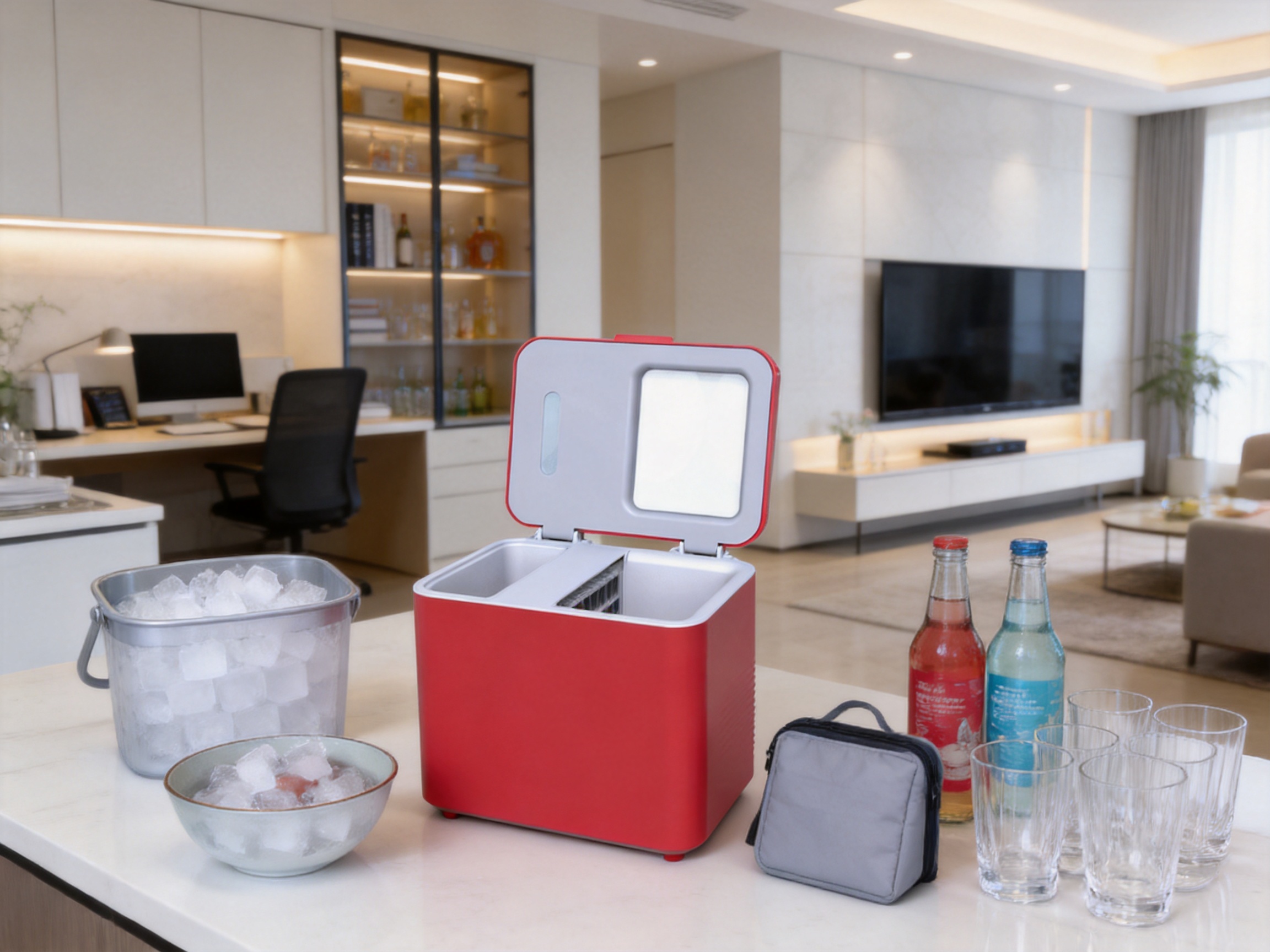
Responsible Operation and Maintenance
Proper operation begins with placement. The machine should be set on a level, stable surface with suitable ventilation. It should not be installed beside a strong heat source or in a location where water could reach electrical components. Adequate clearance helps the refrigeration system release heat and supports consistent performance.
Users should verify the electrical supply before connecting the machine. The stated requirement is 220 volts and 50 hertz. A suitable outlet and safe electrical connection are essential. Extension cords, adapters, or voltage converters should only be used when permitted by applicable instructions and safety requirements.
Cleaning should be performed according to the manufacturer’s instructions. Ice-making appliances require attention to water-contact areas, removable components, exterior surfaces, and storage regions. Regular cleaning can help maintain an acceptable hygienic environment and preserve the taste and appearance of ice.
The ice maker should not be overloaded, moved roughly during operation, or opened for unauthorized refrigeration repairs. Because the unit contains R290, any work on the sealed cooling system should be left to qualified service personnel. Users should also follow local procedures for appliance disposal and refrigerant management at the end of the product’s life.
When these basic practices are followed, the product can deliver greater reliability and a better ownership experience. Maintenance is not separate from product quality; it is part of the partnership between the appliance design and the user’s daily habits.
Frequently Asked Questions
What type of appliance is the Home Ice Cube Maker?
It is a compact countertop ice-making appliance intended for household and similar small-scale environments. It produces regular square ice cubes for beverages, ice buckets, kitchen preparation, and other cooling uses.
What are the machine’s dimensions?
The stated dimensions are 325 x 295 x 252 millimeters. Users should also allow additional clearance for ventilation and operation according to the product instructions.
What power supply does the machine require?
The product is specified for a 220-volt, 50-hertz power supply. The stated current is 0.65 ampere, and the rated power is 140 watts. The electrical requirements should be confirmed against the installation location before use.
What refrigerant does it use?
The machine uses R290 refrigerant with a stated charge of 26 grams. R290 requires responsible handling because it is flammable. The sealed refrigeration system should only be serviced by qualified personnel.
Why are square ice cubes advantageous?
Regular square cubes can provide a clean appearance, efficient stacking, predictable portioning, and a relatively slow melting rate when they are solid and dense. These characteristics are useful for spirits, cocktails, iced coffee, soft drinks, and other beverages.
Does slow-melting ice prevent dilution completely?
No. Ice will eventually melt in a warmer environment. The benefit of a dense cube is that it may melt more slowly than smaller or more irregular pieces, helping reduce rapid dilution while keeping the beverage cold.
Can the ice be used for purposes other than drinks?
Yes. The product information identifies uses including ice buckets, kitchen preparation, and ice packs, in addition to drink service. Users should apply appropriate food-safety and handling practices for each purpose.
Is this machine intended for restaurants and large commercial operations?
Its compact dimensions and household-oriented design make it most suitable for homes, offices, beverage stations, small gatherings, and similar environments. Businesses with high and continuous ice demand should compare the product with equipment specifically designed for commercial output.
What type of control does the product have?
The product is identified as a knob-type ice maker. This suggests a direct physical control approach designed for straightforward operation.
How should the machine be maintained?
Users should follow the supplied instructions for cleaning, water handling, placement, ventilation, and storage. The exterior and accessible water-contact areas should be kept clean, and refrigeration-system repairs should be performed only by qualified professionals.
Who manufactures the product?
The product is manufactured by Alien Technology Co., Ltd., a company located in Zhouxiang, Zhejiang Province. The company specializes in household appliances including ice makers, coffee machines, and air fryers.
What strengths does the manufacturer emphasize?
The company emphasizes humanized design, reliable quality, customer satisfaction, continuous improvement, innovation, and a stable and pragmatic business philosophy. It also welcomes business cooperation with new and existing customers.
Conclusion
The Home Ice Cube Maker offers a balanced solution for users who want convenient access to attractive, slow-melting square ice without the space demands of a commercial machine. Its 325 x 295 x 252 millimeter body is suited to countertop use, while the 140-watt rating supports a compact household appliance profile. The 220-volt, 50-hertz electrical specification and R290 refrigerant provide clear technical information for installation planning and responsible operation.
Its strongest product advantage is the focus on regular square cubes. Dense cubes can cool drinks for longer while limiting rapid dilution, and their neat appearance supports professional-style beverage presentation. Their regular geometry also improves stacking, storage, handling, and portion consistency. These benefits make the machine relevant to whiskey, spirits, cocktails, iced coffee, soft drinks, water, food preparation, ice buckets, and general cooling needs.
The product is supported by a manufacturer with experience in small household appliances and a stated commitment to quality, innovation, continuous improvement, and customer satisfaction. Located in Zhejiang’s small-appliance manufacturing region, Alien Technology Co., Ltd. combines product specialization with convenient logistics and a practical approach to cooperation.
For households, offices, retailers, and business partners seeking a compact ice-making solution, the model presents a useful combination of space efficiency, straightforward operation, modern refrigeration technology, and versatile ice performance. Its design demonstrates that an appliance does not need to be large or complicated to make a meaningful improvement to everyday life.
References
1. Product specification sheet for the Home Ice Cube Maker, model Alien-ZF01.
2. Household refrigeration appliance design and maintenance principles.
3. General technical literature on R290 hydrocarbon refrigerant applications.
4. Food and beverage service guidance concerning ice handling and storage.
5. Small-appliance product development and quality-control practices.
6. Manufacturer-provided company information for Alien Technology Co., Ltd.