
 English
 한국어
한국어 Español
 Deutsch
Home ice making has moved from being an occasional convenience to an important part of everyday kitchen life. Families use ice for water, juice, iced coffee, smoothies, cocktails, mocktails, outdoor meals, and entertaining. However, traditional freezer ice trays can be slow, inconvenient, and difficult to manage. They occupy valuable freezer space, often produce unevenly shaped ice, and require users to plan ahead. A household ice maker offers a more practical alternative by producing ice on demand in a dedicated appliance.
The knob-type ice maker described in this article is designed for users who want fast access to compact bullet-shaped ice without installing a large built-in system. It combines a compact countertop format, a simple control concept, a high-performance refrigeration system, and an environmentally considerate R600a refrigerant. With a rated power of 150 watts and a current of 0.9 amperes, it is intended to deliver convenient home ice production while maintaining a manageable energy profile.
Its design is especially suitable for kitchens, home bars, offices, recreational rooms, small hospitality spaces, and outdoor areas where a full-size ice machine would be excessive. The machine is also supported by the manufacturing experience of Alien Technology Co., Ltd., a Zhejiang-based household appliance manufacturer specializing in ice makers, coffee machines, and air fryers. The company’s product development philosophy emphasizes practical design, reliable quality, continuous improvement, and technology that simplifies daily life.
Product Overview
This appliance is a compact bullet ice maker with a knob-type operating design. Its product description identifies it as the Alien-Z02 model, while its product category is listed as a bullet ice maker. The machine is intended to produce hollow-centered bullet ice, a form that is useful for cooling drinks and blending into a wide range of beverages.
Unlike a freezer tray, the appliance has a dedicated refrigeration system. Users do not need to wait for a freezer compartment to reach the right temperature or remove individual ice cubes from a tray. Instead, the machine is designed to support a more direct cycle of filling, cooling, freezing, and collecting. This makes it particularly valuable when several drinks must be prepared in a short period.
The knob-style design contributes to a straightforward user experience. Although modern appliances often include complex digital panels, many consumers still prefer physical controls because they are easy to understand and operate. A knob can be especially practical in kitchens, outdoor spaces, or family environments where users want simple control rather than a long list of settings.
Product Attribute | Specification |
Product Type | Knob-type bullet ice maker |
Model Description | Alien-Z02 |
Power Supply | 220V–240V / 50Hz |
Rated Current and Power | 0.9A / 150W |
Refrigerant | R600a, 19g charge |
Machine Dimensions Listed in Technical Table | 313 × 226 × 309 mm |
Design Description | Compact countertop format with bullet ice production |
The supplied product information also gives another dimensional description of approximately 325 × 295 × 252 mm. As with many appliance listings, dimensions can vary depending on whether they refer to the main body, packaging orientation, external projections, or a particular measurement method. Buyers should confirm the final installation dimensions and clearance requirements with the supplier before placing the appliance in a tightly fitted space.
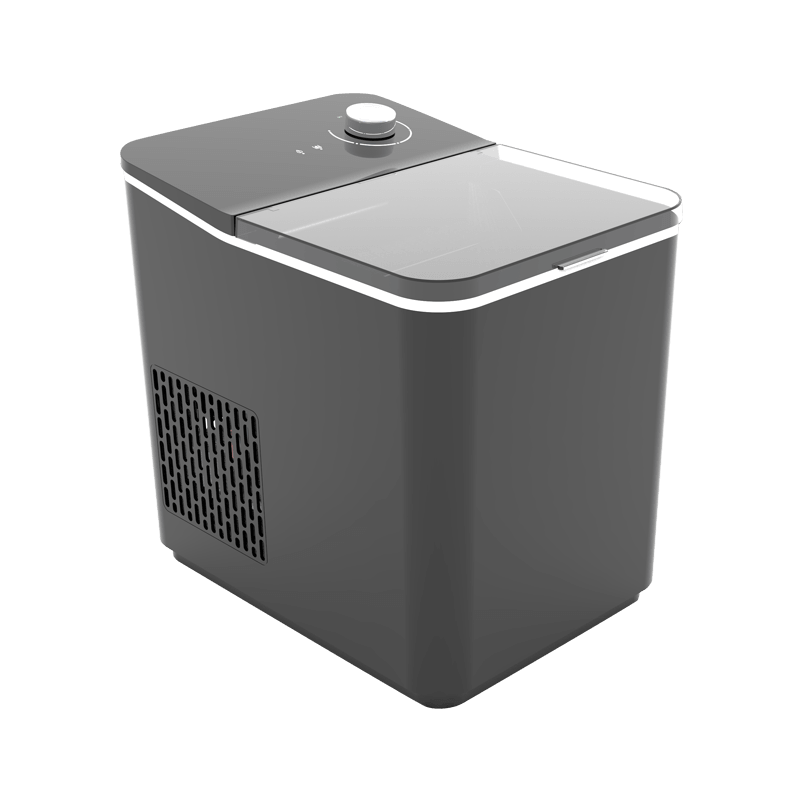
Knob-type ice maker
Understanding Bullet Ice
Bullet ice is recognizable by its rounded or cylindrical appearance and hollow center. This shape gives the ice a distinctive visual appeal while also providing useful performance in drinks. The hollow center reduces the amount of solid ice material in the middle and creates a form that can cool beverages efficiently without looking overly bulky in a glass.
The shape is suitable for water, soft drinks, iced tea, lemonade, fruit beverages, mixed drinks, cocktails, and mocktails. It can also be used in serving containers during family gatherings or informal events. Because the ice has a relatively smooth exterior, it can be comfortable to handle when transferred from a collection basket to a glass or cooler.
One of the product’s highlighted advantages is that the bullet form is less prone to melting quickly than some smaller or thinner ice shapes. The actual melting rate depends on water temperature, room temperature, beverage temperature, airflow, storage conditions, and the quantity of ice being used. Nevertheless, the shape is designed to provide a useful balance between cooling performance and visual appeal.
For coffee drinkers, bullet ice can be useful in iced coffee and cold brew beverages. For home entertainers, it can make a simple drink look more carefully prepared. For families, it provides a convenient way to keep beverages cool without depending entirely on pre-frozen trays. The ice is not limited to one type of drink, which improves the appliance’s overall usefulness.
Compact Design for Flexible Placement
Counter space is one of the most important considerations when selecting a small kitchen appliance. Many homes have limited worktop area, and an appliance that is too large may be difficult to use regularly. The supplied information describes this ice maker as compact and lightweight, making it suitable for kitchen countertops, bar counters, and outdoor areas.
A compact footprint can offer several practical advantages over larger competing machines. It allows the appliance to share space with a coffee machine, air fryer, blender, or water dispenser. It can also be moved when the counter is needed for food preparation. In a home bar, the machine can be placed near drink ingredients and glassware rather than requiring users to travel repeatedly to the freezer.
The appliance is also appropriate for smaller homes, apartments, offices, recreational vehicles, guest rooms, and holiday properties where a built-in ice-making system may not be justified. Its portable countertop concept offers greater flexibility than permanently installed equipment. Users can position it according to the occasion, provided that the chosen location has a suitable electrical supply, a stable surface, sufficient ventilation, and protection from excessive moisture.
For outdoor use, the machine can be useful during gatherings, although it should be placed in a dry, sheltered location and operated according to the manufacturer’s safety instructions. Outdoor environments can expose appliances to dust, rain, heat, and unstable surfaces, so careful placement is important. Compact size makes relocation easier, but portability should not be confused with unrestricted outdoor operation.
The body dimensions provided in the product materials demonstrate that the machine is designed for countertop use rather than commercial floor installation. Users should leave adequate space around the appliance for air circulation and maintenance. They should also ensure that the lid, controls, and collection area can be accessed comfortably after installation.
Fast Ice Making for Everyday Convenience
The central advantage of a dedicated ice maker is convenience. Freezer trays require preparation, storage space, and waiting time. They can also spill when moved, and removing the ice may require twisting or flexing the tray. A countertop ice maker simplifies this routine by combining water storage, refrigeration, and ice collection in one appliance.
The product information describes the machine as using a high-performance refrigeration system intended to produce bullet ice in a short time. The precise production time and daily output may vary according to water temperature, ambient temperature, ventilation, operating conditions, and other factors. Even without relying on a fixed production claim, the appliance is designed around the principle of repeated, convenient ice cycles rather than one occasional tray at a time.
This is valuable during breakfast, when preparing iced coffee or chilled juice. It is useful during lunch and dinner, when several family members may want cold drinks. It is also helpful during gatherings, when demand for ice can increase suddenly. Instead of purchasing bags of ice for ordinary household use, consumers can create ice at the point of use.
Compared with a freezer compartment, the machine also reduces competition for frozen-food storage. Freezer space can be reserved for meat, vegetables, prepared meals, desserts, and other ingredients. This separation between food storage and ice production can make the kitchen easier to organize.
The appliance is not intended to replace every commercial ice system. Restaurants, hotels, bars, and large event venues may require much higher capacity and specialized sanitation procedures. Its strength lies in home and light-duty convenience, where a compact appliance can deliver useful ice without the cost, installation complexity, or physical size of a commercial machine.
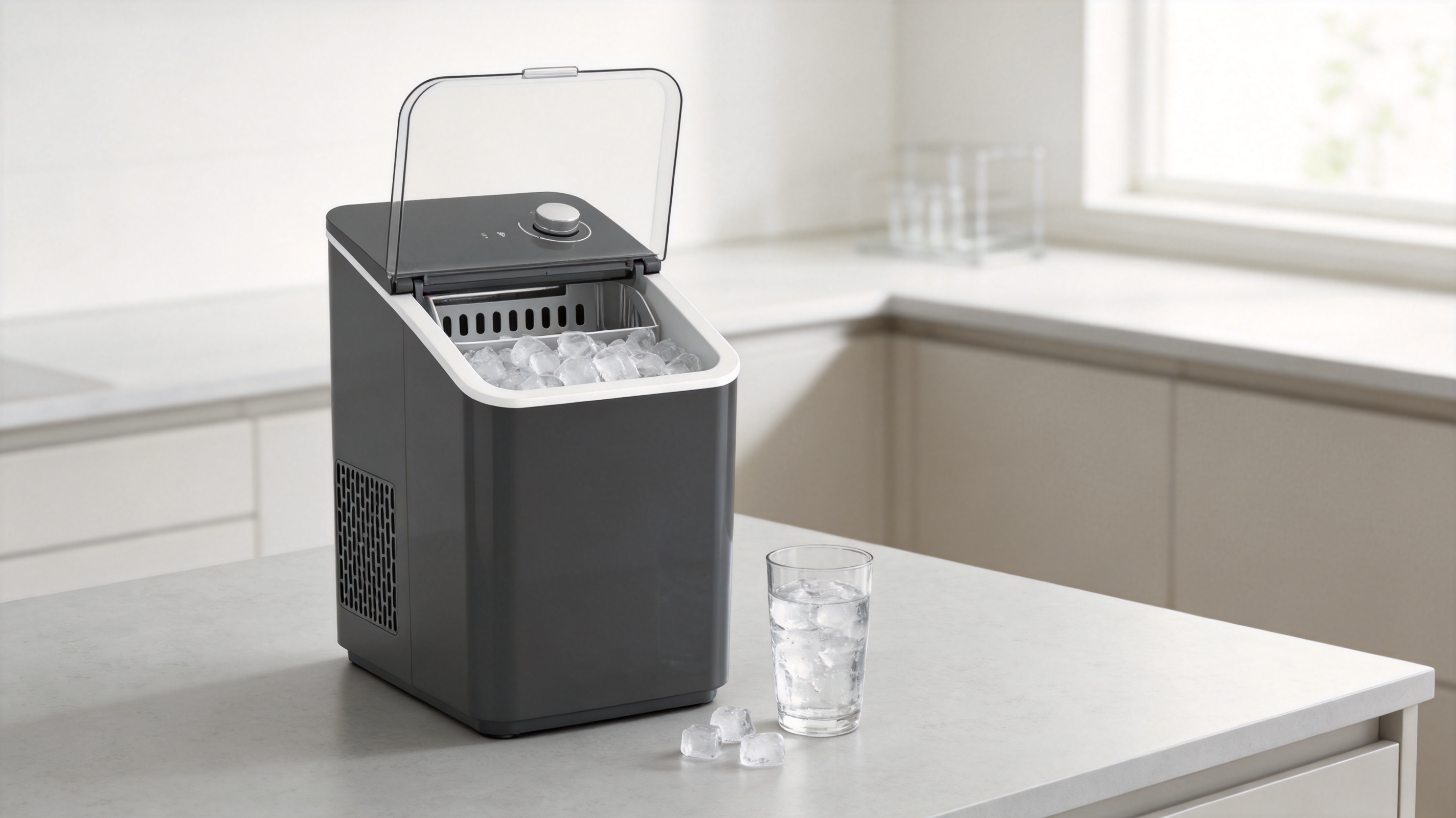
Energy and Refrigerant Considerations
The listed operating specification is 220V–240V at 50Hz, with a rated current of 0.9A and power rating of 150W. These figures identify the intended electrical environment and provide a useful reference for households, distributors, and installation planners. Users should always verify that the local electrical supply matches the product rating before operation.
A 150-watt rating supports the product’s positioning as a compact household appliance rather than a large commercial refrigeration unit. Actual electricity consumption can vary depending on how often the compressor operates, the surrounding temperature, water temperature, ice production demand, and whether the appliance is left running continuously. Nevertheless, the rated power gives consumers a clear starting point for understanding the machine’s operating requirements.
The product uses R600a refrigerant with a listed charge of 19 grams. R600a, also known as isobutane, is widely used in modern refrigeration applications because it offers effective refrigeration performance and a very low global warming potential compared with many older refrigerants. Its use reflects broader industry movement toward more environmentally considerate refrigerant options.
R600a is flammable, so refrigerant-related servicing must be performed by qualified professionals using appropriate procedures and equipment. Consumers should not attempt to open the sealed refrigeration system, refill the refrigerant, or modify the appliance. Safe installation, proper handling, and adherence to the manufacturer’s instructions remain essential.
The use of a lower-impact refrigerant is an advantage when compared with appliances that rely on refrigerants with higher global warming potential. However, environmental performance should be evaluated as a complete system. Efficient production, durable materials, responsible packaging, long service life, repairability, and correct end-of-life disposal also matter. A well-designed appliance that remains useful for many years can reduce the need for frequent replacement.
Simple Operation and User Accessibility
A knob-type interface is one of the most accessible features of this ice maker. Physical controls are easy to recognize and can be operated without navigating multiple digital menus. This simplicity is useful for older users, busy families, hospitality staff, and anyone who prefers direct control.
Simple controls can also reduce the learning curve for first-time users. After filling the water reservoir according to the instructions, the user can select the operating position and monitor the ice-making process. The straightforward design is especially appropriate for an appliance whose primary function is clear and repetitive.
Another benefit of a physical knob is that it can remain practical in environments where touch controls are less convenient. Kitchens may have wet hands, flour, oil, or food residue. Outdoor spaces may have dust or changing light conditions. A tactile control can be easier to locate and operate than a flat touch panel in these situations.
At the same time, users should follow all operating instructions carefully. The water reservoir should be filled with clean, suitable water. The appliance should not be overfilled, tilted unnecessarily, or operated on an unstable surface. Ice should be transferred and stored hygienically, and the internal surfaces should be cleaned according to the recommended schedule.
Ease of operation does not mean that maintenance can be ignored. Any appliance that handles water requires regular attention. Emptying unused water, wiping accessible surfaces, cleaning the collection area, and allowing the machine to dry when appropriate can help maintain a clean operating environment.
Advantages Over Conventional Ice-Making Methods
Compared with Ice Trays
Ice trays are inexpensive and familiar, but they are limited by freezer temperature, available space, and the number of trays on hand. They often require several hours of preparation and may produce only a modest quantity of ice at one time. Tray ice can also absorb freezer odors if it is stored near strongly scented food.
A dedicated countertop ice maker provides a separate process. It can produce ice without occupying tray space in the freezer, and it allows users to make ice closer to the time it is needed. The bullet shape also provides a more consistent appearance than manually filled trays, where water levels and freezing conditions may vary.
Compared with Purchased Bagged Ice
Bagged ice is useful for parties and large gatherings, but regular purchases can become expensive and inconvenient. Bags require transportation, freezer or cooler space, and careful handling. They can also melt during transport and may not be available when stores are closed.
A household ice maker offers a convenient alternative for normal daily demand. It can reduce dependence on emergency ice purchases and provide a steady source of ice for beverages at home. For unusually large events, purchased ice may still be appropriate, but the countertop machine can cover ordinary needs efficiently.
Compared with Larger Built-In Ice Systems
Built-in ice makers can offer substantial production capacity, but they often require more space, installation work, plumbing considerations, and higher investment. They are more appropriate for large kitchens, dedicated bars, or commercial environments.
The compact appliance described here is more flexible. It can be placed on a counter without remodeling the kitchen, and it can be moved or stored when not needed. For users whose demand is moderate, this smaller format avoids paying for capacity that may rarely be used.
Compared with Complex Smart Appliances
Connected appliances can provide notifications and remote control, but they may also involve applications, wireless setup, software updates, and additional points of failure. A knob-type ice maker focuses on the essential task of producing ice. This can be an advantage for consumers who value reliability and simplicity over extensive digital features.
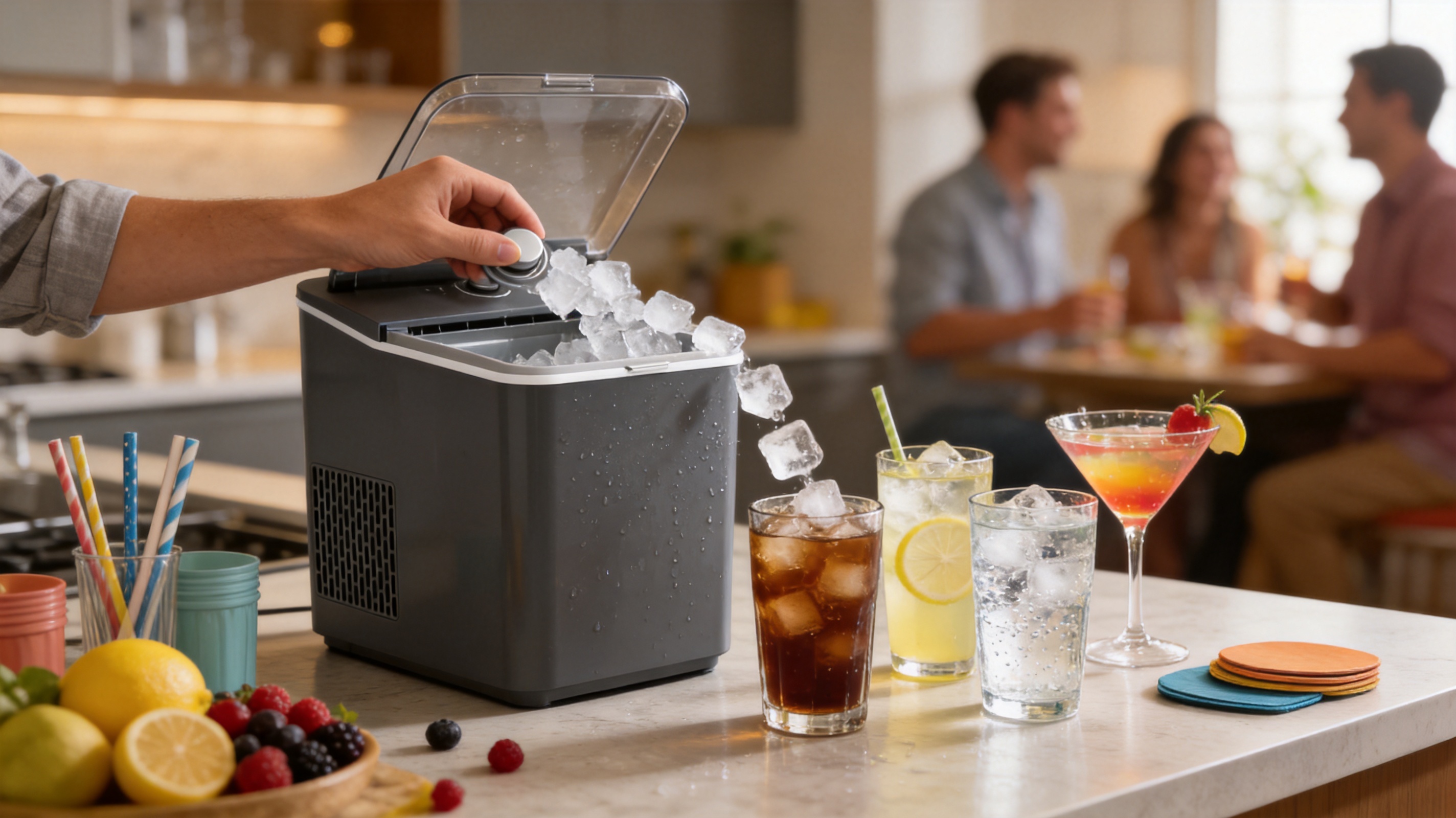
Manufacturing Strengths and Product Development Approach
Alien Technology Co., Ltd. is located in Zhouxiang, Cixi City, Zhejiang Province, an area known for the manufacture of small household appliances and convenient logistics. The company specializes in ice makers, coffee machines, and air fryers. This product focus gives the manufacturer experience in developing appliances that combine heating, cooling, motorized, electronic, and user-interface components within compact household formats.
The company’s stated mission is “Smart Technology, Simplifying Life, Enhancing Happiness.” In the context of this ice maker, that mission can be seen in the emphasis on practical everyday benefits: a compact body, simple control, dedicated refrigeration, bullet-shaped ice, and a refrigerant selected in line with modern environmental considerations.
Manufacturing a small ice maker requires coordination among several technical areas. The refrigeration circuit must be properly designed and sealed. The compressor and heat-exchange components must operate within the intended electrical range. The water-contact parts must be shaped for reliable filling, freezing, and ice release. The outer housing must protect internal components while remaining compact enough for countertop use.
Quality also depends on consistency from unit to unit. A manufacturer must control incoming materials, assembly processes, wiring, sealing, component placement, and functional testing. Small variations in a water pathway, sensor position, fan installation, or refrigeration connection can affect performance. A structured production process helps reduce these variations and supports more dependable appliance operation.
The company’s specialization in several categories of small appliances can encourage cross-category engineering knowledge. Ice makers, coffee machines, and air fryers each require attention to thermal management, electrical safety, compact construction, user convenience, and surface durability. Experience in these areas can support a practical approach to product refinement.
The available information does not specify particular certifications, factory audit results, automation percentages, or testing standards. Therefore, buyers seeking compliance documentation, export approvals, laboratory reports, or customized inspection arrangements should request the relevant documents directly from the manufacturer. The company’s stated commitment to reliable quality and continuous improvement provides a basis for cooperation, but specific claims should always be verified through current documentation.
Design Engineering Behind a Small Ice Maker
Compact appliances require careful internal layout. The manufacturer must fit refrigeration components, electrical elements, water-related structures, air passages, controls, and collection space into a relatively small enclosure. Reducing external dimensions without compromising serviceability or thermal performance is a central design challenge.
Airflow is particularly important. Refrigeration systems release heat while operating, so the appliance needs appropriate ventilation. If it is placed too close to a wall or another heat-producing appliance, the surrounding temperature may rise and affect performance. A well-planned design considers air intake, heat discharge, component spacing, and user access.
Water management is another important engineering area. The reservoir, internal channels, freezing surface, and ice collection area must work together. The design should support regular drainage and cleaning while minimizing unnecessary water retention. Smooth and accessible surfaces can simplify maintenance and help users maintain better hygiene.
The ice-release process also affects the user experience. Ice should separate from the freezing surface in a controlled way and collect in a position that is convenient to access. If the mechanism is inconsistent, ice can jam, clump, or remain attached. Careful component design and production control are therefore essential even in a small appliance.
The knob and control system must also be durable. A physical control is repeatedly handled, so its movement should feel stable and predictable. The surrounding housing should protect the control from accidental impact while making the operating position easy to understand.
Material Selection and Assembly Quality
Household appliances must balance appearance, durability, weight, and manufacturing efficiency. The external housing needs to withstand ordinary countertop use, occasional movement, cleaning, and contact with the surrounding kitchen environment. Internal components must be selected for compatibility with cooling, moisture, vibration, and electrical operation.
Material selection is particularly important for parts that come into contact with water or ice. These components should be appropriate for the intended use and easy to clean. The final suitability of any material depends on the manufacturer’s specifications, applicable regulations, and production controls.
Assembly quality affects both performance and safety. Electrical connections must be secure and properly routed. Refrigeration tubing must be correctly formed and sealed. Fans and moving parts should be installed with suitable clearances. Fasteners should be tightened consistently, and exterior panels should fit securely without creating unnecessary gaps.
For a supplier, these details are important because product reliability is not determined by one component alone. A well-performing compressor cannot compensate for poor sealing. A good control system cannot compensate for inadequate water management. A strong housing cannot compensate for unstable electrical connections. Reliable manufacturing comes from coordinating the complete appliance system.
Testing and Quality Assurance Priorities
A responsible production process should include inspection at multiple stages. Incoming components can be checked for dimensions, appearance, electrical characteristics, and conformity with purchase specifications. During assembly, workers or automated systems can verify wiring, fastening, sealing, and the placement of key parts.
Finished units can be evaluated through visual inspection and functional testing. Relevant checks may include power-on behavior, control operation, refrigeration response, water circulation, ice release, noise, leakage, and electrical safety. The exact testing program depends on the manufacturer’s internal procedures and the requirements of the target market.
Packaging inspection is also important. A compact appliance may be moved through several stages of transport before reaching the consumer. Protective materials should help prevent impact damage, surface scratching, control damage, and deformation. Clear labeling can support correct storage, handling, and installation.
For business customers, quality assurance can be strengthened through agreed inspection standards, sample approval, production monitoring, and pre-shipment checks. These processes are especially useful when products are being sold under a retailer’s own specifications or distributed across multiple countries.
The manufacturer’s stated emphasis on customer satisfaction, continuous improvement, and innovation is relevant to long-term product development. Feedback from users, distributors, repair teams, and quality inspectors can identify opportunities to improve controls, dimensions, packaging, water access, cleaning convenience, and operating instructions.
Where the Ice Maker Fits Best
Home Kitchens
In a home kitchen, the machine can support daily cold drinks without using freezer trays. It can sit beside a coffee machine during the morning routine or be moved near the dining area when entertaining. Its compact form is suitable for users who want dedicated ice without a major installation project.
Home Bars and Entertainment Areas
Bullet ice works well in cocktails, mocktails, sparkling water, and soft drinks. A home bar can benefit from having ice produced close to the mixing area. The machine’s appearance and distinctive ice shape can also contribute to a more organized and professional serving setup.
Offices and Small Workplaces
Shared kitchens and staff rooms often need a convenient source of ice but lack the space or plumbing for commercial equipment. A countertop machine can serve a moderate number of users while keeping the installation relatively simple. Workplace managers should establish cleaning and water-refilling responsibilities to maintain hygienic operation.
Outdoor Gatherings
For picnics, patios, and sheltered outdoor events, the machine can provide useful support when a freezer is not nearby. It must be protected from rain, direct exposure, excessive heat, and unstable surfaces. Users should also ensure that the electrical connection is suitable for the location.
Hospitality and Retail Applications
Small cafés, guesthouses, salons, showrooms, and retail spaces may use a compact ice maker for limited beverage service. However, businesses should evaluate expected demand carefully. If the appliance will operate continuously under heavy commercial use, a larger commercial model may be more appropriate.
Installation and Daily Use Recommendations
Place the appliance on a level, stable, and dry surface. Adequate clearance should be left around ventilation areas, and the machine should not be pushed tightly against a wall unless the operating instructions specifically allow it. Keep it away from ovens, radiators, direct sunlight, and other sources of heat.
Before using the machine, verify the voltage and frequency of the electrical supply. Connect it to a suitable outlet and avoid using damaged cords, loose plugs, or overloaded extension arrangements. Because the appliance contains refrigeration and electrical components, users should not attempt unauthorized modifications.
Use clean water and follow the recommended filling level. Overfilling may cause spillage or interfere with operation. If water remains in the machine for an extended period, it should be drained and replaced according to the cleaning instructions.
Ice should be collected with clean hands or a clean utensil. The storage area should be emptied and cleaned at appropriate intervals. The machine is intended to make ice, not to serve as a long-term freezer. Ice may melt gradually in the collection basket, and the resulting water may return to the water system depending on the appliance design.
When moving the machine, switch it off, unplug it, drain water if necessary, and keep it upright. Refrigeration appliances should generally be allowed to settle after transport before operation, following the supplier’s instructions. These precautions help protect the refrigeration circuit and reduce the chance of water leakage.
Cleaning and Maintenance
Regular cleaning is essential for any appliance that produces ice for consumption. The exterior can be wiped with a soft, damp cloth. Abrasive pads, harsh chemicals, and excessive water should be avoided unless specifically approved by the manufacturer.
The water reservoir, collection area, and accessible internal surfaces should be cleaned according to the recommended schedule. If mineral deposits develop because of hard water, the manufacturer’s approved cleaning method should be used. Unauthorized descaling chemicals may damage components or leave residues.
Users should monitor unusual sounds, odors, leaks, reduced ice production, or control problems. If the appliance does not operate normally, it should be switched off and inspected by an authorized service provider. Refrigerant work and sealed-system repairs require qualified technicians.
Good maintenance can support a longer service life and more consistent performance. It can also help preserve the taste and cleanliness of the ice. For commercial or shared environments, written cleaning procedures and regular maintenance records can improve accountability.
Benefits for Distributors and Business Buyers
For distributors, the product offers a clear retail proposition: a compact appliance that solves a familiar household problem. Its bullet ice format is easy to explain, while the knob-type design appeals to consumers who prefer simple controls. The 150-watt rating and 220V–240V, 50Hz specification make the product suitable for markets using the corresponding electrical standard.
The company’s specialization in several small-appliance categories may also support broader product cooperation. Buyers interested in ice makers, coffee machines, and air fryers can communicate with a manufacturer that already works within these household appliance segments. This can be useful for product line expansion, private-label discussions, or coordinated sourcing programs.
The company is located in Zhejiang, a major manufacturing region with established supply-chain and logistics advantages. Regional access to component suppliers, packaging providers, transportation networks, and appliance production services can support efficient business coordination. Actual lead times, order quantities, customization capabilities, and shipping arrangements should be confirmed directly with the supplier.
Business customers may also benefit from discussing packaging design, user manuals, market-specific labeling, color options, control markings, and inspection requirements. Since the product is compact, packaging efficiency can be an important consideration in warehousing and transportation.
Product Positioning in a Competitive Market
The countertop ice maker market includes basic tray-style alternatives, compact electronic machines, high-capacity household products, and commercial ice systems. This model occupies a practical middle position. It is more convenient than manual tray freezing while remaining smaller and simpler than a built-in or commercial machine.
Its principal competitive strengths are its compact format, bullet ice design, knob-type operation, dedicated refrigeration system, and use of R600a refrigerant. These features address different consumer priorities. Compact size supports flexible placement. Bullet ice supports beverage cooling and presentation. The knob supports accessible operation. Dedicated refrigeration supports on-demand production. R600a reflects consideration for modern refrigerant preferences.
The product is best marketed honestly as a convenient household or light-duty countertop ice maker. It should not be compared directly with commercial machines on the basis of output alone unless verified production data is available. Clear positioning helps set realistic expectations and improves customer satisfaction.
Retailers can present the machine as an everyday convenience appliance for consumers who frequently serve cold beverages. It can also be positioned as a companion product alongside coffee machines, air fryers, drinkware, bar accessories, and outdoor cooking equipment. Its cross-category usefulness may increase its appeal during seasonal promotions and home entertainment campaigns.
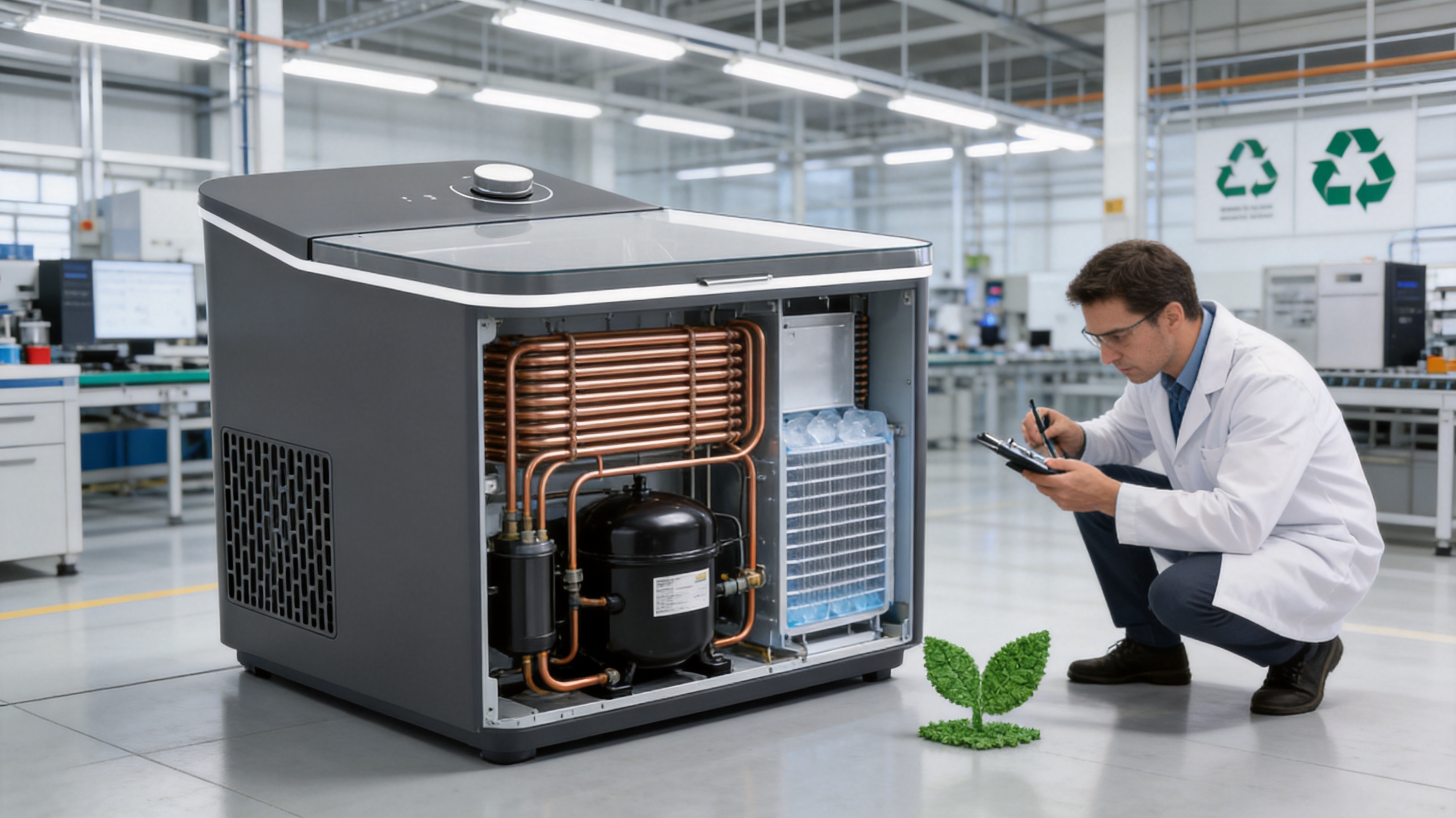
Environmental and Lifestyle Value
The environmental value of a small appliance should be considered in practical terms. The use of R600a is one positive feature because this natural hydrocarbon refrigerant has a very low global warming potential. The compact 150-watt design also reflects an appliance scale intended for moderate household demand rather than high-capacity commercial production.
Users can further reduce waste by making only the amount of ice needed. Instead of buying and discarding large plastic bags of ice for small occasions, households can produce ice in a reusable appliance. This does not eliminate all environmental impacts, since the machine requires electricity, water, materials, transport, and eventual disposal. However, long-term use and responsible operation can support a more efficient household routine.
Durability is another important environmental consideration. An appliance that performs reliably for many years generally avoids the material and transportation impacts associated with frequent replacement. Proper cleaning, correct placement, safe electrical use, and timely professional service can all contribute to a longer useful life.
At the end of its service life, the machine should be handled through appropriate electrical appliance recycling channels. Because it contains a refrigerant circuit, it should not simply be dismantled or discarded with ordinary household waste. Qualified recycling or disposal services can help ensure that materials and refrigerant are handled responsibly.
Practical Buying Checklist
Before purchasing, confirm that the electrical rating matches the intended market. The listed requirement is 220V–240V and 50Hz. Buyers should also verify the final dimensions because the supplied materials contain two different dimensional descriptions. This is particularly important when the appliance will be installed beneath cabinets or beside other equipment.
Check the available counter space, ventilation clearance, water access, drainage expectations, and location of the power outlet. Consider whether the machine will be used occasionally, daily, or during frequent gatherings. Moderate household use is the most natural application for this type of compact appliance.
Ask the supplier about ice production performance under typical room conditions, water capacity, collection capacity, operating noise, cleaning procedures, warranty terms, spare parts, and technical support. Business buyers should also request packaging information, minimum order quantities, production lead time, inspection options, and export documentation.
Confirm what is included with the product. Depending on the sales configuration, accessories such as an ice scoop, instruction manual, drain components, or replacement parts may or may not be included. Clear communication before purchase prevents misunderstandings after delivery.
Frequently Asked Questions
What type of ice does this machine produce?
It produces bullet-shaped ice with a hollow center. This form is suitable for cooling water, juice, iced coffee, cocktails, mocktails, and other cold beverages.
Is the ice maker suitable for a home kitchen?
Yes. Its compact countertop design and household-oriented power specification make it suitable for kitchens, home bars, offices, and other light-duty settings. Users should provide a stable surface, proper ventilation, and a compatible electrical supply.
Does the machine require a permanent water connection?
The supplied information presents it as a compact home appliance, but it does not specify the exact water connection arrangement. Buyers should confirm whether the model uses a manually filled reservoir or another configuration with the supplier before purchase.
What voltage does the appliance use?
The listed power supply is 220V–240V at 50Hz. The appliance should only be used with a compatible electrical supply and in accordance with the product manual.
How much power does it consume?
The listed current and power are 0.9A and 150W. Actual energy use can vary depending on operating conditions, ambient temperature, water temperature, and how frequently the refrigeration system runs.
Why is R600a used as the refrigerant?
R600a, or isobutane, is a natural hydrocarbon refrigerant known for effective refrigeration performance and very low global warming potential. Because it is flammable, the sealed system should only be serviced by qualified professionals.
Can the appliance be used outdoors?
It may be suitable for sheltered outdoor areas, provided that it is protected from rain, direct sunlight, excessive heat, dust, and unstable surfaces. Electrical safety requirements must be followed, and the supplier’s instructions should take priority.
How should the ice maker be cleaned?
Clean the exterior, water-contact areas, collection area, and accessible internal surfaces according to the manufacturer’s instructions. Use only approved cleaning methods, avoid abrasive materials, and drain unused water when appropriate.
Are the listed dimensions consistent?
The technical table lists dimensions of 313 × 226 × 309 millimeters, while the product information gives approximately 325 × 295 × 252 millimeters. These may reflect different measurement methods or configurations. The final dimensions should be confirmed with the supplier before installation.
Is this a commercial ice machine?
It is primarily positioned as a compact household or light-duty countertop ice maker. Businesses with high-volume ice requirements should compare verified production capacity and operating specifications with those of commercial equipment.
What makes the knob-type design useful?
A physical knob offers direct, uncomplicated control. It can be easier to operate than a complex digital interface, especially for users who prefer tactile controls or who use the appliance in busy kitchen and outdoor environments.
What should buyers ask the manufacturer?
Buyers should ask about production capacity, water reservoir details, collection capacity, noise, cleaning, warranty, spare parts, certifications, packaging, lead time, minimum order quantities, customization, and market-specific compliance documents.
Conclusion
The knob-type bullet ice maker is designed to make everyday ice production more convenient without requiring a large installation or sacrificing valuable freezer space. Its compact countertop format supports flexible placement, while its dedicated refrigeration system is intended to produce bullet-shaped ice in a practical household setting.
The product’s strongest advantages over conventional ice trays and larger systems are convenience, portability, simple control, versatile bullet ice, and a manageable 150-watt electrical specification. Its use of R600a refrigerant also aligns with the movement toward lower-global-warming-potential refrigeration technologies, although safe handling and qualified service remain essential.
Behind the product is a manufacturer specializing in small household appliances and operating in Zhejiang, a major appliance production region. Alien Technology Co., Ltd. emphasizes humanized design, reliable quality, continuous improvement, and innovation. These priorities are relevant to a compact appliance that must integrate refrigeration, water management, electrical control, housing design, and user convenience within a limited space.
For households, offices, home bars, and light-duty hospitality applications, the machine offers a practical alternative to freezer trays and frequent purchases of bagged ice. For distributors and business buyers, it represents a focused product with clear consumer benefits and potential for cooperation across multiple household appliance categories. As with any appliance purchase, final dimensions, certifications, production performance, warranty conditions, and technical details should be confirmed directly with the supplier.
References
1. Product technical specification sheet for the knob-type bullet ice maker, including electrical rating, refrigerant, refrigerant charge, and machine dimensions.
2. Product information supplied for the Alien-Z02 compact bullet ice maker, including design features, intended applications, and refrigerant description.
3. Company profile of Alien Technology Co., Ltd., including manufacturing location, product categories, mission, and business philosophy.
4. General refrigeration engineering principles concerning compact appliance ventilation, sealed refrigeration systems, and household ice production.
5. General environmental guidance concerning hydrocarbon refrigerants, responsible appliance maintenance, and end-of-life recycling.