
 English
 한국어
한국어 Español
 Deutsch
Ice is often treated as a minor accessory, yet it has a major influence on the taste, appearance, temperature, and overall experience of a drink. The wrong ice can melt quickly, dilute a carefully prepared beverage, occupy too much freezer space, or create an untidy presentation. A well-designed home ice cube maker addresses these issues by producing regular, solid-looking cubes that are practical for daily use and attractive enough for entertaining.
The Home Ice Cube Maker, identified as model Alien-ZF01, is designed for households that want a dedicated source of ice without relying entirely on freezer trays or irregularly shaped frozen water. Its compact dimensions, 140-watt operating power, R290 refrigerant, and straightforward knob-type design make it suitable for kitchens, home bars, offices, small hospitality settings, and other spaces where convenience matters.
Beyond the basic function of freezing water, the product is built around several useful ideas: predictable cube geometry, slow melting, efficient use of storage space, easy integration into everyday routines, and a compact footprint. These characteristics distinguish it from many improvised ice-making methods and give it practical advantages over basic trays, oversized machines, and ice makers that focus only on speed.
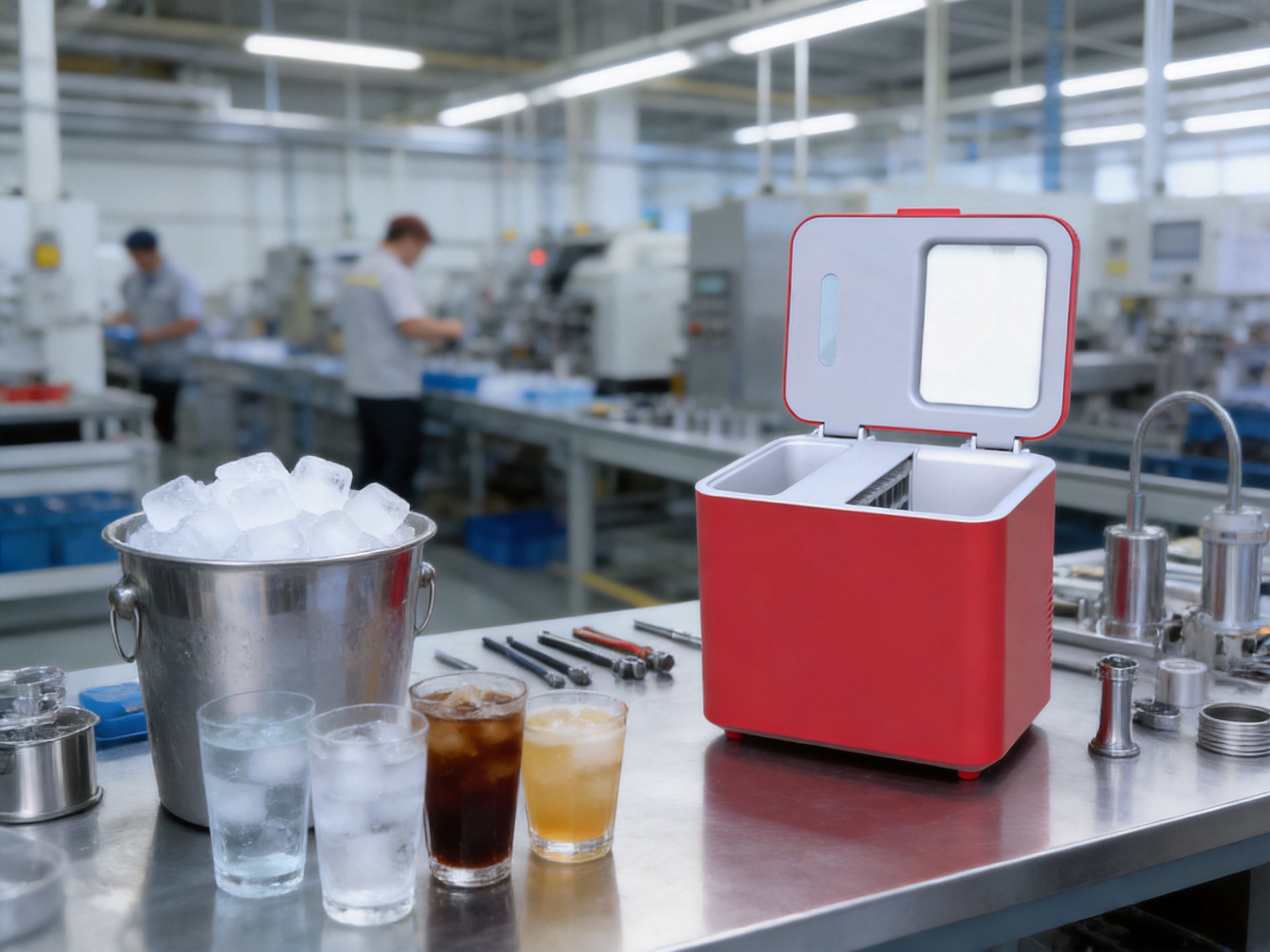
The manufacturer, Alien Technology Co., Ltd., operates in Zhouxiang, Zhejiang Province, an area recognized for its concentration of small household-appliance manufacturing and supporting logistics. The company specializes in ice makers, coffee machines, and air fryers. Its stated mission is to simplify life through smart technology, humanized design, reliable quality, and continuous improvement. These priorities are reflected in a product that concentrates on useful performance rather than unnecessary complexity.
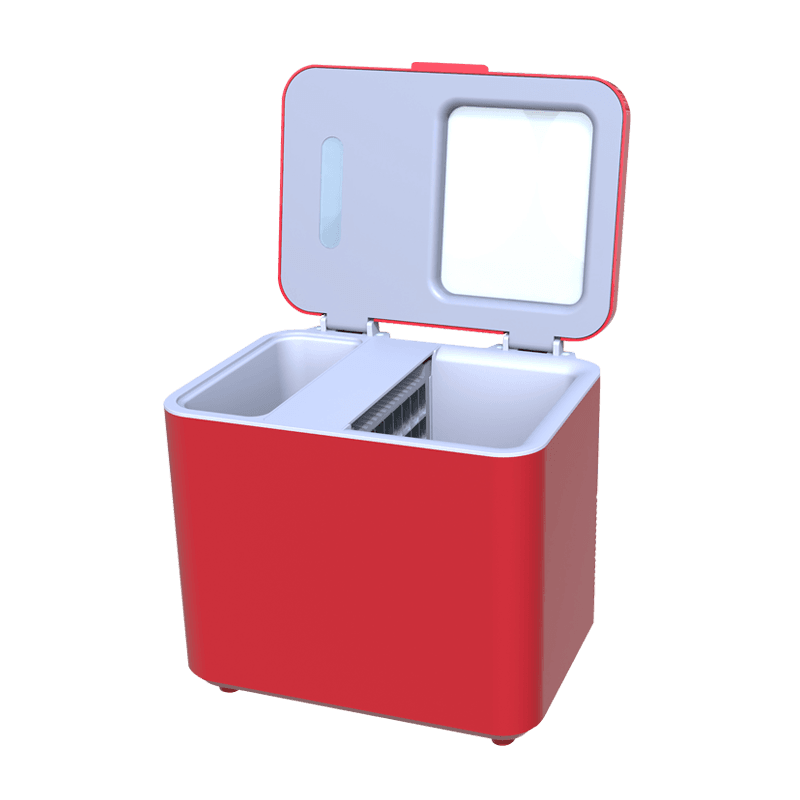
Home ice cube maker
Designed for the Real Needs of Home Ice Production
Home users generally want an ice maker that is easy to understand, compact enough for a normal countertop, economical to operate, and capable of producing ice appropriate for different drinks. A machine that is technically powerful but difficult to control may not be convenient in practice. Likewise, a very small device may be easy to store but fail to produce ice with the solidity and appearance that users expect.
The Alien-ZF01 addresses these everyday requirements through a balanced specification. It operates on a 220-volt, 50-hertz power supply and has a rated current and power specification of 0.65 amperes and 140 watts. This indicates a compact appliance intended for ordinary household electrical environments in compatible markets. Its stated machine dimensions are 325 by 295 by 252 millimeters, giving it a relatively small rectangular footprint for a dedicated ice-making appliance.
The dimensions are especially important for apartments, compact kitchens, offices, guest rooms, recreational areas, and home bars. Countertop space is often limited, and a machine that can fit beneath cabinets or beside other small appliances is easier to incorporate into an existing kitchen arrangement. The product can be positioned as a dedicated ice source without requiring a major renovation or a large appliance installation.
Its knob-type control concept also supports straightforward operation. A physical control is familiar to users of different ages and technical backgrounds, and it avoids the need to learn a complicated interface. In a busy kitchen, simple control can be an advantage because users can begin operation with minimal preparation and without navigating multiple digital menus.
Core Product Specifications
Product |
Home Ice Cube Maker |
Model |
Alien-ZF01 |
Product Category |
Ice Cube Maker |
Power Supply |
220V/50Hz |
Current and Power |
0.65A/140W |
Refrigerant and Charge |
R290/26g |
Machine Dimensions |
325 × 295 × 252 mm |
Control Style |
Knob type |
The specifications show a product focused on practical household use rather than industrial-scale ice production. Buyers should evaluate their local electrical requirements, operating environment, and intended usage before purchase. The appliance should be used according to its instruction manual, particularly regarding ventilation, water handling, electrical safety, cleaning, and refrigerant-related service.
Regular Cubes for Better Beverage Performance
One of the most meaningful advantages of the product is the emphasis on solid, regular ice cubes. Ice shape is not only a visual issue. It affects the amount of surface area exposed to the surrounding liquid, the rate at which the ice melts, and the speed at which a drink becomes diluted.
Irregular chips or thin fragments tend to have a large surface area relative to their volume. They may cool a beverage quickly, but they can also melt rapidly. This is useful in some situations, such as rapidly chilling a soft drink, but it is less desirable when the purpose is to maintain a spirit, cocktail, cold brew, or premium beverage over an extended period.
Regular square-shaped cubes offer a different balance. Their compact geometry reduces the relative surface area exposed to the drink. As a result, solid cubes can remain effective for longer and may melt more slowly than thin, irregular pieces. The ice can provide sustained cooling while reducing the pace at which water enters the beverage.
This slow-melting characteristic is particularly valuable for whiskey, neat spirits, mixed drinks, iced coffee, and beverages whose flavor profile should remain stable. A drink can stay cool without becoming excessively watery too quickly. The result is not merely a colder beverage, but a more controlled drinking experience.
The shape also contributes to visual quality. Neat, clean cubes look professional in a clear glass. They can make a simple drink appear more carefully prepared, which is useful when serving guests or creating a more refined atmosphere at home. In hospitality and food-service environments, presentation can influence how customers perceive the quality of the beverage and the care taken in its preparation.
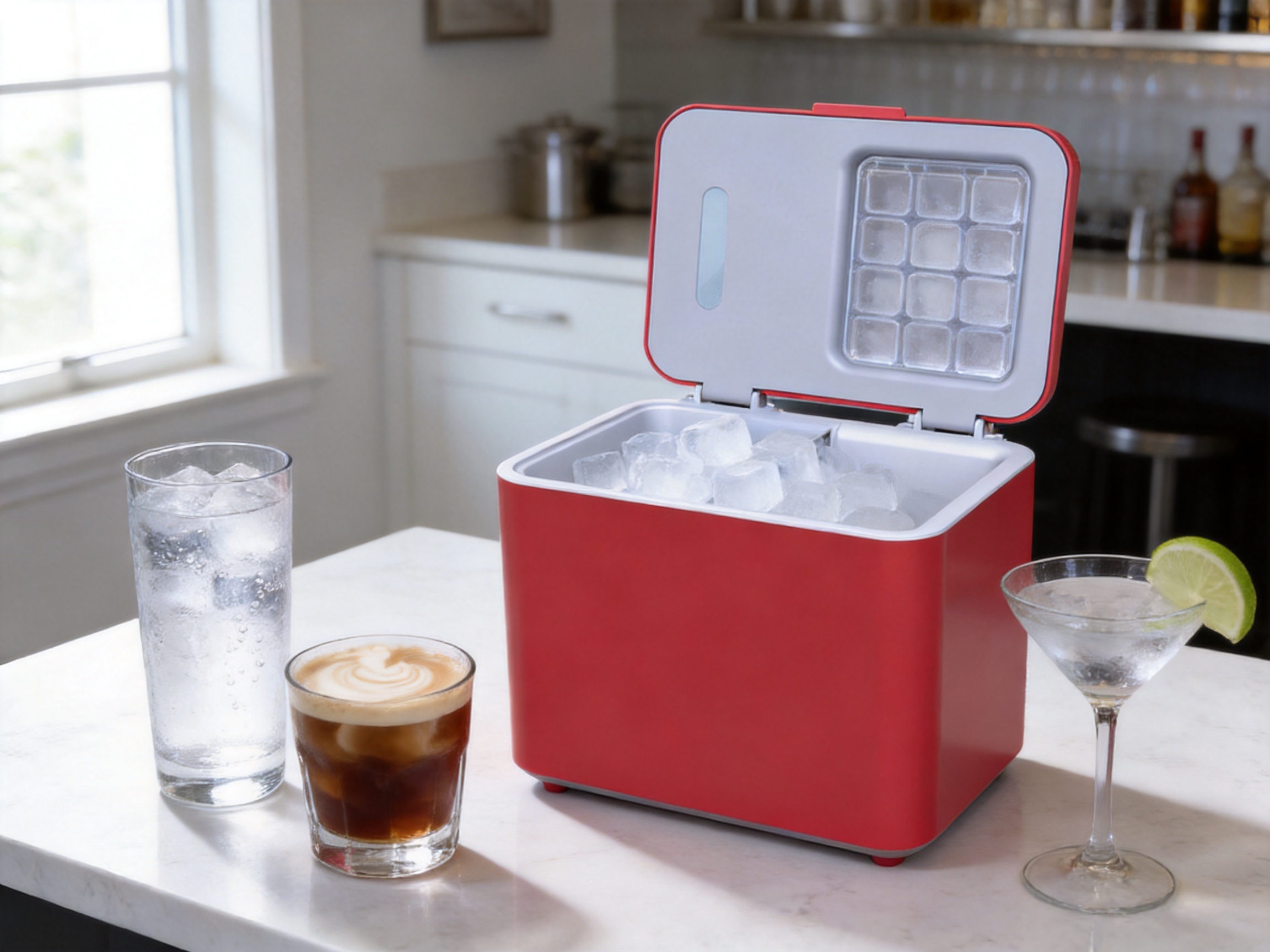
Advantages Over Conventional Ice Trays
Traditional freezer trays remain inexpensive and familiar, but they have several practical limitations. They require freezer space, need time to freeze, may spill during handling, and often produce ice with inconsistent size or shape. Silicone trays can reduce removal difficulty, but they still depend on available freezer capacity and regular manual refilling.
A dedicated ice maker creates a more independent workflow. Instead of filling trays, placing them in a freezer, waiting for them to freeze, and twisting or bending the trays to release the ice, users can operate a purpose-built appliance on the countertop. This reduces the number of steps required to prepare ice for a meal, gathering, or daily drink routine.
The product’s compact dimensions make it more suitable for spaces where a full-size freezer is unavailable or already crowded. In a small apartment, freezer space may be needed for food storage. In an office, the shared freezer may not be large enough for multiple trays. In a home bar, a dedicated ice maker can preserve freezer space for ingredients and bottles.
Regular production also helps maintain more consistent presentation. Homemade tray ice may vary according to how evenly the water was distributed, how the tray was positioned, and whether other frozen items interfered with freezing. A dedicated machine is designed to repeat the same basic process, giving users a more uniform result from one preparation cycle to the next.
Another advantage is accessibility. A countertop appliance can be placed near the area where drinks are prepared and served. This is more convenient than repeatedly walking between the kitchen counter and a freezer located across the room. The machine can support a smoother routine during dinner parties, family events, office breaks, and weekend entertaining.
Comparison with Irregular or Fast-Melting Ice
Evaluation Point |
Regular Home Ice Cube Maker |
Irregular Frozen Ice |
Shape |
Neat and consistent cube form |
Variable pieces, chips, or fragments |
Melting tendency |
Designed for relatively slow melting when solid |
Often melts quickly because of thin sections and high surface area |
Presentation |
Clean and professional appearance |
Less uniform appearance |
Storage efficiency |
Regular shapes can be stacked efficiently |
Irregular shapes leave unused spaces |
Preparation |
Dedicated appliance workflow |
Manual tray filling or improvised freezing |
This comparison does not mean irregular ice has no purpose. Crushed ice and small chips are useful for certain blended drinks, rapid cooling, and specific recipes. However, for users who prioritize longevity, appearance, and versatility, regular cubes provide a stronger all-around option.
Efficient Use of Storage Space
Ice storage is an overlooked part of kitchen organization. Irregular ice pieces can create empty gaps between one another, which means a container fills quickly without holding as much usable ice. Regular square cubes can be arranged more closely, improving the use of a freezer drawer, ice bucket, insulated container, or storage bin.
High stacking efficiency is useful in several settings. A family may want to prepare ice before guests arrive without sacrificing an entire freezer shelf. A small café or office may need to store a reserve of ice in a limited space. A home bar may use an ice bucket or insulated container where uniform cubes can be arranged neatly and accessed easily.
Regular geometry also makes portion planning simpler. Users can estimate how many cubes are needed for a glass, pitcher, ice bucket, or cooler. Although the actual volume of each cube will depend on the machine’s internal design, a consistent shape makes daily use more predictable than a collection of random fragments.
Space efficiency can also improve transport. When cubes are placed in an insulated box or portable cooler, tightly arranged ice leaves fewer voids. This can help users make better use of the available cold-storage volume during picnics, outdoor meals, road trips, and small events. The ice maker itself is not a substitute for a cooler, but its regular output can support more organized cooling arrangements.
Versatility Across Household and Commercial-Inspired Settings
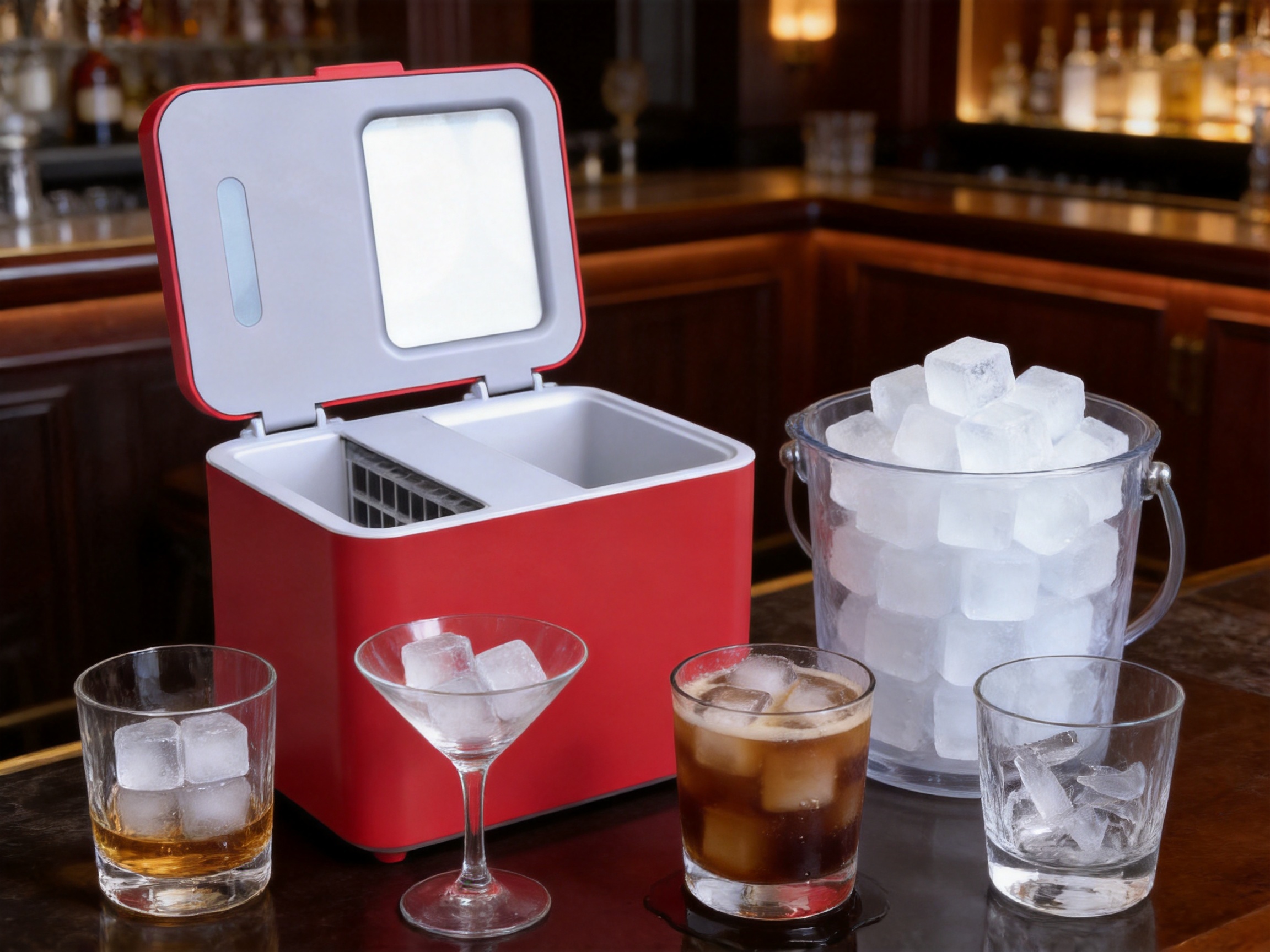
The Home Ice Cube Maker is suitable for more than one type of beverage. Its cubes can be used in water, juice, soda, iced tea, cocktails, mocktails, cold brew coffee, and mixed drinks. The slow-melting concept is especially relevant to beverages that are intended to be enjoyed gradually.
For whiskey and neat spirits, larger or solid cubes are often preferred because they cool the drink while limiting rapid dilution. For cocktails, regular cubes can provide a neat appearance in a glass and create a consistent serving style. For iced coffee, cubes can help maintain a chilled temperature, although users should consider the recipe and strength of the coffee to manage dilution.
The cubes can also support food preparation. They may be used to chill ingredients, cool cooked foods quickly where appropriate, create an ice bath, or maintain a low temperature in a serving container. When using ice around food, cleanliness and safe handling are essential. The water source, internal surfaces, storage container, and serving utensils should all be kept hygienic.
Ice buckets are another practical application. A regular cube is easy to distribute around bottles and containers, and its consistent shape allows the ice to settle efficiently. This is useful for family celebrations, restaurant-style home dining, outdoor entertaining, and small hospitality environments.
Ice can also function as a temporary cold pack when placed in a suitable sealed bag or container. Users should protect skin from prolonged direct contact with very cold materials and should avoid using loose ice in situations where contamination or water leakage could cause problems.
The broad usefulness of the product means that it can serve several household roles instead of being reserved for occasional parties. It can support a daily iced-coffee habit in the morning, chilled water during the day, cocktails in the evening, and event preparation on weekends.
Refrigeration Design and R290 Refrigerant
The product specification identifies R290 as the refrigerant, with a stated charge of 26 grams. R290 is propane used as a refrigerant in appropriately designed systems. It is widely recognized in refrigeration discussions for its low global warming potential compared with many older refrigerant options. Its use requires equipment designed, assembled, labeled, and serviced with suitable safety controls because it is flammable.
For the user, the most important point is responsible operation. The appliance should not be opened, modified, punctured, or repaired by unqualified personnel. Ventilation around the machine should be maintained according to the instruction manual. The product should be placed on a stable surface away from sources of heat, open flames, and conditions that could damage the refrigeration circuit.
From a product-development perspective, selecting a modern refrigerant is part of a wider effort to balance cooling performance, environmental considerations, component compatibility, and safety. A refrigerant specification is not meaningful in isolation; it must work together with the compressor, heat exchangers, tubing, insulation, electrical controls, housing, and assembly procedures.
The 140-watt rating suggests a compact power system intended for countertop operation rather than high-volume industrial production. A modest power requirement can make the machine easier to integrate into ordinary household routines, although actual energy consumption will vary according to ambient temperature, water temperature, usage frequency, ventilation, and duty cycle.
Manufacturing Strengths of the Supplier
Alien Technology Co., Ltd. is based in Zhouxiang, Cixi City, Zhejiang Province, a region with a strong ecosystem for small household appliances. A manufacturing location within such a cluster can provide access to component suppliers, technical labor, tooling services, packaging resources, testing support, and transportation networks.
This regional concentration is valuable because household appliances require coordination across many disciplines. A product such as an ice maker includes a refrigeration system, electrical components, molded or formed housing parts, water-contact components, controls, insulation, fasteners, packaging, and final assembly. Efficient coordination between these areas can support stable production and responsive product improvement.
The company specializes in several related appliance categories, including ice makers, coffee machines, and air fryers. This product range indicates familiarity with compact kitchen appliances and with the design priorities shared by them: manageable countertop dimensions, user-oriented controls, heat or cold management, food-contact considerations, electrical safety, and attractive household styling.
The company’s stated manufacturing philosophy emphasizes reliable quality, customer satisfaction, continuous improvement, and innovation. These principles are relevant to the Alien-ZF01 because an ice maker must perform consistently across repeated cycles. Small issues in sealing, water flow, temperature control, assembly alignment, or control operation can affect the customer experience. A quality-focused production approach therefore needs to address the whole product rather than only its external appearance.
Design-to-Production Coordination
Advanced manufacturing is not limited to robotics or automated machinery. In compact appliances, it also involves disciplined coordination between product design, component selection, assembly, inspection, and feedback from actual use. A good design must be manufacturable, serviceable, safe, and consistent from unit to unit.
For an ice maker, the production process can be understood as a sequence of controlled stages. Product engineers first define the intended functions and physical layout. Mechanical and refrigeration components are then selected to fit the required cooling system and enclosure. Housing parts must be formed with appropriate dimensional accuracy. Water-contact areas must be assembled carefully. Electrical connections and controls must be installed securely. Finally, the completed unit should be inspected for appearance, operation, leakage, and basic electrical performance.
Although the supplied product information does not list specific factory certifications, automation levels, or laboratory equipment, the manufacturer’s specialization provides a practical foundation for developing and producing this type of appliance. Buyers seeking contract manufacturing or business cooperation can request detailed information about quality systems, inspection plans, production capacity, certifications, sample approval, packaging, and after-sales support.
Material and Component Discipline
A reliable appliance depends on appropriate materials and compatible components. The outer housing must protect internal systems while remaining suitable for a kitchen environment. Controls should be durable enough for repeated handling. Water pathways should be designed for regular cleaning and hygienic use. Refrigeration components must be matched to the selected refrigerant and the intended operating conditions.
Component discipline also means using repeatable specifications rather than treating each production batch as an isolated project. Standardized parts can simplify inspection, replacement, inventory management, and after-sales support. In a product family that includes ice makers, coffee machines, and air fryers, experience with shared components and manufacturing methods may also help the company manage development more efficiently.
Inspection and Continuous Improvement
Quality inspection for a compact ice maker should address multiple areas. Visual inspection can identify scratches, gaps, misalignment, or damage. Electrical inspection can confirm safe connections and appropriate operation. Functional testing can evaluate whether the machine starts, cools, controls water, and completes its intended cycle. Refrigeration-related checks can help identify abnormal noise, leakage, or inadequate cooling. Packaging inspection can reduce the risk of damage during transportation.
Continuous improvement begins when information from these checks is recorded and used. If a recurring assembly problem appears, the production method can be reviewed. If users report that a control is difficult to understand, the interface or instructions can be improved. If transport damage occurs, packaging materials and internal protection can be reconsidered. This feedback cycle is a meaningful part of advanced manufacturing because it converts experience into better future products.
Humanized Operation and Everyday Convenience
The company describes its design approach as humanized, and the product’s simple form supports that direction. A home appliance should fit naturally into a user’s routine. It should be easy to place, easy to operate, and easy to understand without requiring specialized knowledge.
A knob-type control can be useful in environments where users prefer tactile feedback. It may also be practical when hands are wet or when the operator is moving quickly between food and drink preparation. The control concept is familiar and can reduce the learning curve for first-time users.
The compact footprint supports flexible placement. Users may keep the machine on a kitchen counter, a beverage station, an office refreshment area, or a home entertainment cabinet, provided that the location is level, dry, properly ventilated, and suitable for the appliance’s electrical requirements.
Convenience also comes from reducing planning. Instead of remembering to fill trays several hours in advance, users can prepare ice closer to the time it is needed. This can make spontaneous entertaining easier. It also helps households that do not want to maintain a large frozen reserve all the time.
Nevertheless, convenience should not be confused with neglect. The machine will perform best when users follow recommended cleaning procedures, use suitable water, maintain ventilation, and allow the appliance to rest or stabilize as instructed. Good user habits protect both hygiene and product life.
Cleaning, Maintenance, and Responsible Use
Because the product handles water and produces ice for consumption, cleanliness is essential. Users should follow the manufacturer’s instructions for cleaning the water reservoir, ice-making surfaces, storage areas, and removable parts. Water should not be left standing for unnecessarily long periods, particularly in warm conditions.
Before cleaning, the appliance should be switched off and disconnected from the power supply when required by the instructions. External surfaces can generally be wiped with a suitable soft cloth, while abrasive tools and harsh chemicals should be avoided unless specifically approved. The refrigeration circuit and electrical sections should not be exposed to water.
Regular cleaning can help prevent unpleasant odors, mineral deposits, residue, and contamination. Water quality influences maintenance needs. Hard water may produce mineral buildup more quickly than filtered or treated water. Users should select water according to local guidance and the product manual.
Ventilation is also important. The machine should not be pushed tightly against a wall if the instructions require clearance. Airflow around the appliance helps the refrigeration system release heat. Blocking vents can reduce performance, increase operating strain, and create unnecessary safety concerns.
R290 equipment requires particular care. The refrigerant circuit should never be punctured or altered. If the appliance is damaged, emits an unusual odor, or shows signs of a refrigeration fault, it should be disconnected and examined by an appropriately qualified service professional. Users should not attempt unauthorized refrigerant repairs.
When moving the machine, it should be handled carefully and kept in the orientation recommended by the instructions. Sudden movement or improper positioning may affect the refrigeration system. After transportation, the appliance may need to stand for a specified period before operation; users should follow the supplied guidance.
Positioning the Product Against Competing Options
The home ice-maker market includes freezer trays, portable ice makers, large under-counter units, commercial machines, and appliances that produce different ice shapes. The Alien-ZF01 occupies a practical position within this range: it is a compact countertop unit focused on regular cubes and straightforward operation.
Compared with freezer trays, it offers greater independence from freezer space and less manual handling. Compared with large commercial machines, it is more appropriate for ordinary homes and smaller spaces. Compared with machines that produce thin or irregular ice, its regular cube concept is more suitable for slow-melting presentation and long drinks.
Its strengths are therefore not necessarily based on producing the greatest possible volume or offering the largest number of digital features. Instead, the product emphasizes balance: compact size, moderate power, useful cube geometry, a simple control approach, and broad household versatility.
Buyers should compare products according to their actual priorities. If a restaurant requires continuous high-volume production, a commercial model may be more appropriate. If a user needs crushed ice for specialized recipes, a different ice form may be preferred. If a household wants regular cubes for drinks, storage, and entertaining in a compact space, this product’s design priorities become more relevant.
Business and Private-Label Potential
The manufacturer welcomes contact from new and existing customers for business cooperation. This may be relevant to importers, distributors, retailers, hospitality suppliers, online appliance sellers, and private-label businesses seeking compact kitchen products.
A product such as the Alien-ZF01 can fit several commercial channels. It may be sold as a countertop ice maker for households, a beverage accessory for home-bar customers, a small-appliance solution for offices, or a supporting product for hospitality and event suppliers. Its related product categories also create opportunities for coordinated offerings involving ice makers, coffee machines, and air fryers.
For business buyers, product evaluation should go beyond the specification sheet. Important areas include sample quality, production consistency, packaging design, shipping protection, minimum order quantities, lead times, spare parts, warranty arrangements, user manuals, regulatory requirements, and market-specific electrical compatibility.
Manufacturing cooperation is strongest when the supplier and buyer establish clear communication from the beginning. Technical drawings, approved samples, inspection standards, labeling requirements, carton specifications, and acceptance criteria should be documented. This reduces ambiguity and helps ensure that the delivered product matches the intended market position.
The company’s location in a household-appliance manufacturing hub can support logistics and supplier coordination. However, each buyer should verify current production capability, quality documentation, delivery terms, and applicable compliance requirements before entering a commercial agreement.
Practical Use Scenarios
Daily Iced Coffee
For people who prepare iced coffee at home, a dedicated ice maker can simplify the morning routine. Regular cubes provide a clean appearance in a transparent glass, while their slower melting tendency can help limit rapid dilution. Users can adjust the coffee recipe according to the amount of ice and the desired strength.
Home Bar Service
A home bar benefits from ice that is uniform and visually appealing. Square cubes suit whiskey, spirits, highballs, mocktails, and many classic mixed drinks. Preparing ice near the serving area can make hosting more efficient and reduce repeated trips to the freezer.
Family Meals and Entertaining
During a family meal or gathering, demand for cold drinks can rise quickly. A countertop machine provides a dedicated source of ice for water, juice, soda, and serving containers. Its compact form allows it to remain available without occupying the space required by a large appliance.
Office Refreshment Areas
In an office, a small ice maker can support cold water, iced tea, and employee refreshments. Its simple control design may be easier for shared use than a highly specialized system. The office should establish a cleaning and water-refilling routine to protect hygiene.
Small Events and Outdoor Preparation
For small gatherings, the machine can assist with advance ice preparation. Once produced, the cubes can be transferred to an insulated container or ice bucket. The appliance should be used indoors or in another environment specifically permitted by the instructions, with protection from rain, excessive heat, and unstable surfaces.
Q&A
What is the main purpose of this product?
The product is a compact home ice cube maker designed to produce regular ice cubes for drinks, food preparation, ice buckets, and other household uses.
What model is the product?
The product model is Alien-ZF01. It is also associated with the alias “Knobtype-ice-maker,” referring to its physical control style.
What power supply does it use?
The stated power supply is 220 volts at 50 hertz. Buyers should confirm that this specification matches the electrical system in their market before operation.
How much power does it use?
The listed current and power specification is 0.65 amperes and 140 watts. Actual energy consumption can vary according to operating conditions, ambient temperature, water temperature, and usage frequency.
What refrigerant does it use?
The specification identifies R290 refrigerant with a charge of 26 grams. Because R290 is flammable, the appliance should be operated, maintained, and repaired only according to the manufacturer’s instructions and by qualified personnel when service is required.
What are the machine dimensions?
The stated dimensions are 325 by 295 by 252 millimeters. Users should also allow any clearance recommended in the instruction manual for ventilation and safe operation.
Why are regular cubes useful?
Regular cubes can provide a cleaner appearance, stack more efficiently, and melt relatively slowly when they are solid and have a compact shape. They are especially suitable for beverages that should remain cool without becoming diluted too quickly.
Can the ice be used for whiskey and other spirits?
Yes. The product information identifies premium whiskeys and neat spirits as suitable applications. Users can select the amount of ice according to their preferred temperature and dilution level.
Can the cubes be used for coffee?
Yes. The cubes can be used for iced coffee and other chilled beverages. Users should consider drink strength and ice quantity to achieve the preferred flavor balance.
Is the machine suitable for commercial use?
It is designed as a home ice cube maker, but it may also be considered for offices, small hospitality environments, and other low-volume applications. Businesses requiring continuous, high-volume production should compare its capacity and operating limits with commercial equipment.
How should the product be cleaned?
Cleaning should follow the supplied instructions. In general, water-contact areas and storage surfaces should be cleaned regularly, external surfaces should be wiped with suitable materials, and electrical and refrigeration components should be protected from water and unauthorized handling.
What makes the manufacturer suitable for cooperation?
Alien Technology Co., Ltd. specializes in small household appliances and is located in a Zhejiang manufacturing area known for appliance production and logistics. The company emphasizes reliable quality, customer satisfaction, continuous improvement, innovation, and humanized design.
Does the supplied information confirm specific certifications?
No specific certifications are listed in the supplied information. Commercial buyers should request current certification, testing, compliance, quality-system, and market-approval documents relevant to their destination country.
Conclusion
The Home Ice Cube Maker is designed around a clear and useful proposition: provide regular, attractive, relatively slow-melting ice in a compact countertop appliance. Its 325 × 295 × 252 millimeter dimensions make it suitable for space-conscious environments, while its 140-watt specification supports a practical household format. The use of R290 refrigerant reflects a modern refrigeration choice that must be paired with responsible design, operation, and servicing.
Its greatest competitive advantages are the quality of the cube concept and the convenience of dedicated production. Regular cubes can improve beverage presentation, reduce rapid dilution, stack efficiently, and serve many applications ranging from whiskey and cocktails to iced coffee, food preparation, ice buckets, and everyday cold drinks.
The manufacturer adds value through specialization in household appliances, access to a strong appliance-production region, and a stated commitment to reliable quality, customer satisfaction, continuous improvement, and innovation. These strengths provide a suitable foundation for product development and manufacturing cooperation, while buyers should still conduct the normal technical, compliance, and quality evaluations required for their markets.
For households and businesses seeking a balanced alternative to freezer trays, irregular frozen pieces, and oversized commercial machines, this compact ice maker offers a focused solution. It brings together practical dimensions, simple operation, useful cube geometry, and broad versatility in a product intended to make everyday beverage preparation more convenient and more refined.
References
1. Alien Technology Co., Ltd. Product specification sheet for the Alien-ZF01 Home Ice Cube Maker.
2. Alien Technology Co., Ltd. Company profile and product-category information for ice makers, coffee machines, and air fryers.
3. General household refrigeration design principles concerning compact cooling appliances, ventilation, cleaning, and safe operation.
4. General beverage-service guidance concerning ice shape, melting rate, dilution control, and presentation.
5. General technical background on R290 hydrocarbon refrigerant, environmental performance, flammability, and qualified servicing requirements.