
 English
 한국어
한국어 Español
 Deutsch
Ice is often treated as a simple accessory, yet the quality, shape, density, and melting behavior of ice can significantly affect the enjoyment of a drink. A well-designed home ice cube maker does more than freeze water. It provides a convenient way to produce consistent ice, supports attractive beverage presentation, reduces dependence on freezer trays, and gives households greater control over the freshness and availability of ice.
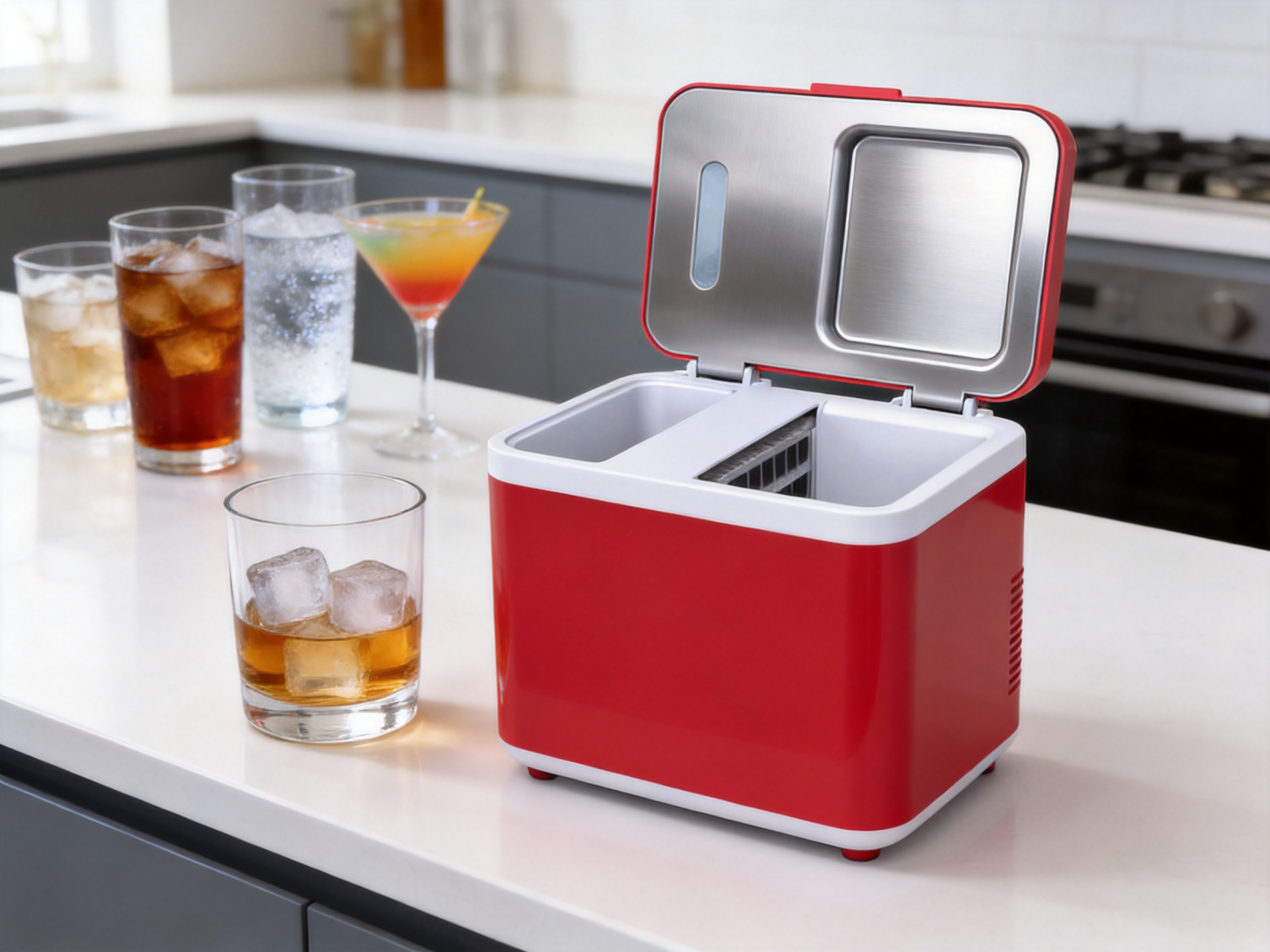
The Home Ice Cube Maker, identified as the Alien-ZF01, is a compact appliance designed for domestic ice production. Its specifications include a 220V/50Hz power supply, a rated current and power of 0.65A/140W, R290 refrigerant with a 26g charge, and machine dimensions of 325 x 295 x 252 millimeters. These characteristics position the appliance as a practical countertop solution for homes, small offices, beverage stations, entertainment areas, and selected light commercial applications.
The product is associated with Alien Technology Co., Ltd., a Zhejiang-based manufacturer specializing in household appliances such as ice makers, coffee machines, and air fryers. The company’s location in Zhouxiang, Cixi City, places it within a region recognized for small household appliance manufacturing, component availability, supply-chain support, and convenient logistics. Its stated mission is to use smart technology to simplify daily life and improve household happiness through humanized design, reliable quality, and practical innovation.
This article examines the product’s design advantages, operating concept, likely user benefits, technical specifications, manufacturing strengths, maintenance considerations, competitive position, and appropriate applications. It also explains why regular square ice can be valuable for beverages and how a compact machine can offer more flexibility than conventional freezer trays or irregular freezer ice.
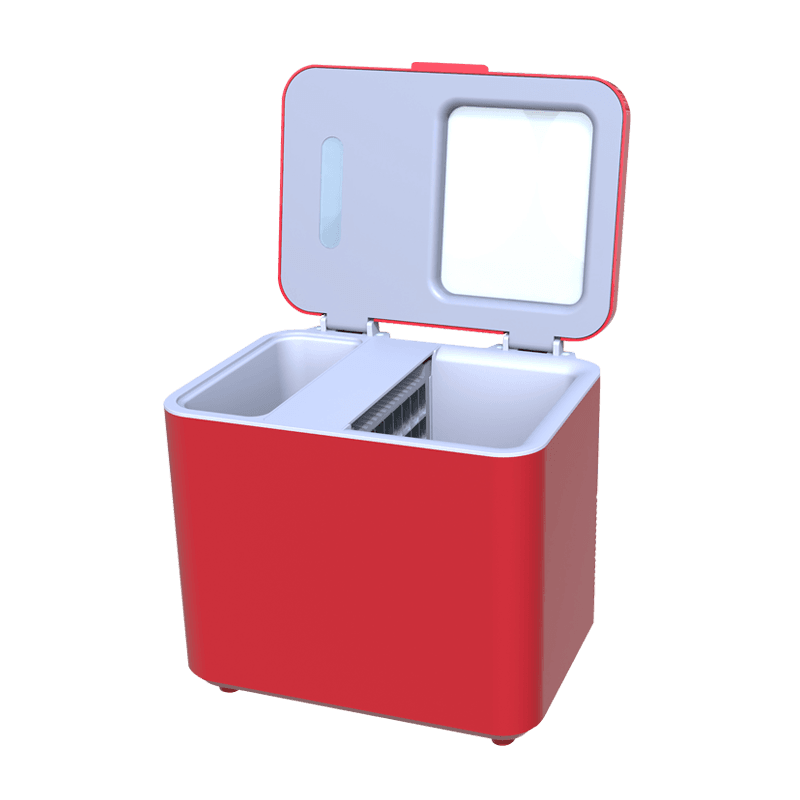
Home ice cube maker
1. Product Overview and Design Purpose
The Home Ice Cube Maker is intended for users who want readily available ice without relying entirely on standard freezer compartments. Traditional ice trays can be slow, inconvenient, and inconsistent. They often require hours of freezing, occupy valuable freezer space, and may produce ice that absorbs food odors. Removing cubes from rigid trays can also be awkward, especially when only a small quantity is needed.
A dedicated countertop ice maker addresses these problems by placing ice production in a separate appliance. Instead of waiting for a tray to freeze, the user can prepare ice through a purpose-built refrigeration system. The compact dimensions of 325 x 295 x 252 millimeters make the product suitable for kitchens, dining areas, home bars, recreational rooms, offices, and guest spaces where a full-size freezer may not be available.
The product description identifies the model as Alien-ZF01 and the alias as Knobtype-ice-maker. This suggests a straightforward control concept centered on a physical knob or rotary interface. A knob can be especially useful for users who prefer simple controls over complex digital menus. It may also be suitable for environments where the appliance is used by different family members, guests, or staff who need to understand the operating function quickly.
The machine is designed around square ice production. Regularly shaped ice has practical and aesthetic benefits. Its uniform appearance can make beverages look more professional, while its predictable geometry helps users portion ice more consistently. Square ice is also easy to place in glasses, pitchers, ice buckets, and serving containers.
Rather than being limited to one type of drink, the machine can support a wide range of daily situations. It may be used for water, soft drinks, iced tea, cocktails, juices, coffee beverages, mocktails, chilled desserts, food preparation, or temporary cooling applications. This versatility increases the value of the appliance because it can serve multiple roles throughout the day.
2. Main Technical Specifications
The technical data supplied for the product provides a concise overview of its electrical and refrigeration requirements. Understanding these figures helps buyers determine whether the appliance is appropriate for their intended environment.
| Specification | Provided Value | Practical Meaning |
|---|---|---|
| Product model | Alien-ZF01 | Identifies the specific home ice cube maker model |
| Product category | Ice Cube Maker | A dedicated appliance for producing ice cubes |
| Power supply | 220V/50Hz | Designed for compatible electrical systems |
| Current and power | 0.65A / 140W | Indicates a relatively modest rated electrical load |
| Refrigerant | R290 | A refrigerant used in compact refrigeration equipment |
| Refrigerant charge | 26g | The stated quantity of refrigerant in the system |
| Machine dimensions | 325 x 295 x 252mm | Compact countertop form factor |
| Control style | Knobtype | Simple physical control concept |
The 140W rating indicates that the appliance is designed around a relatively compact power system rather than the much larger electrical demand associated with full-size commercial refrigeration equipment. This can make it more suitable for normal household circuits, although users should always confirm that the local voltage, frequency, plug configuration, and electrical installation are compatible.
The stated 220V/50Hz specification is important. Customers should not assume that the appliance is suitable for every country or region without checking the local electrical standard. Using a machine with an incompatible voltage or frequency can affect performance, safety, and service life. Importers, distributors, and end users should verify regional requirements before installation or sale.
R290 is the refrigerant listed for the product, with a charge of 26 grams. R290 is propane-based refrigerant commonly used in certain modern compact refrigeration systems. Its use reflects a move toward refrigerant options with a lower global warming impact than many older refrigerants. However, R290 is flammable, so the refrigeration circuit should remain sealed and should be serviced only by qualified professionals using appropriate procedures.
The compact dimensions are one of the product’s strongest practical features. At 325 millimeters wide, 295 millimeters deep, and 252 millimeters high, the machine can fit into many countertop arrangements. Users should still provide appropriate ventilation clearance and keep the appliance away from excessive heat, moisture, and unstable surfaces.
3. Why Regular Square Ice Matters
Ice shape affects more than appearance. It influences the ratio between surface area and volume, the speed at which the ice melts, the amount of dilution added to a beverage, and the way the ice looks in a glass. Square ice is valued because its regular geometry can provide a stable balance between cooling performance and melting behavior.
Dense, solid ice cubes generally melt more slowly than small, hollow, or highly irregular pieces. A larger, compact cube has less exposed surface area relative to its total volume. Because less ice surface is directly exposed to the surrounding liquid, heat transfer can occur more gradually. This helps the cube remain effective for a longer period while reducing rapid dilution.
For premium spirits, slow melting is particularly valuable. Whiskey, bourbon, rum, and other neat spirits are often enjoyed for their aroma and layered flavor. Excessive water can alter the balance of the drink too quickly. A dense cube can cool the beverage while adding water at a slower rate than crushed ice or small irregular pieces.
The same principle can benefit cocktails and non-alcoholic drinks. A drink served over a large, stable cube may remain cold for longer without becoming watery immediately. This is useful for home entertaining, restaurant-style presentation, and anyone who prefers a drink that maintains its original character over an extended serving period.
Regular square ice also has a professional visual quality. In a clear glass, cleanly shaped cubes create straight lines and attractive reflections. They can make a simple beverage appear more carefully prepared. This presentation advantage matters in homes, cafés, hospitality environments, photography, product demonstrations, and social events.
The shape also contributes to storage efficiency. Uniform cubes can be placed together more tightly than irregular fragments. In an ice bucket, insulated container, or freezer compartment, consistent geometry can make it easier to arrange the available volume. Although the machine is designed for convenient production rather than long-term industrial storage, the regular form remains useful whenever ice must be handled or transferred.
4. Advantages Over Conventional Freezer Trays
One of the most direct comparisons is between a countertop ice maker and ordinary freezer trays. Trays are inexpensive and familiar, but they require users to manually fill them, carry them to the freezer, wait for freezing, and remove the ice. The process can be inconvenient when ice is needed frequently or in larger quantities.
A dedicated ice maker is designed around the complete production task. Its refrigeration system, ice-forming area, housing, and control method are integrated into one appliance. This reduces the number of separate steps required from the user and creates a more organized ice-making routine.
Freezer trays also tend to produce ice that varies according to freezer temperature, tray position, door opening frequency, and surrounding food. If the freezer is heavily loaded or opened often, freezing times may be inconsistent. A dedicated machine gives the ice-production function its own operating environment, which can improve predictability.
Another advantage is odor management. Ice stored beside strongly flavored foods can absorb unwanted smells, particularly when it is kept uncovered. A dedicated appliance can separate ice production from the general freezer environment. Users should still keep the water system and ice storage area clean, but the dedicated format can help preserve a fresher sensory experience.
Freezer trays can also be difficult for elderly users or people with limited hand strength. Flexible trays may spill water, while rigid trays require twisting or force to release cubes. A purpose-built machine can reduce the need for manual tray handling and make the overall routine more accessible, depending on the final operating design and ice-release mechanism.
Compared with buying bags of ice, a home ice maker can offer improved convenience and control. Purchased ice requires transport, storage, and regular replacement. It may also be difficult to know how long it has been stored or whether the packaging has been handled properly. Producing ice at home allows users to use fresh water and make ice according to their own schedule.
5. Advantages Over Irregular or Small Ice
Not all ice performs in the same way. Small chips, thin flakes, and irregular fragments have a high surface-area-to-volume ratio. They cool beverages quickly, but they can also melt rapidly. This may be useful for certain blended drinks or food displays, yet it is less suitable for users who want long-lasting cooling with controlled dilution.
Square cubes provide a more stable alternative. Their consistent shape makes it easier to estimate how much ice is being served. A user can add two or three cubes to a glass with a reasonable expectation of the cooling effect and visual appearance. This consistency is valuable for drink preparation, hospitality service, and repeatable recipes.
Irregular ice can also create an uneven appearance. Pieces may vary greatly in size, making a glass look crowded in one instance and underfilled in another. Uniform square cubes produce a cleaner presentation and can be arranged more neatly in glasses, pitchers, and serving vessels.
For ice buckets, consistent cubes can be stacked more efficiently. This does not mean that every storage container will be filled without gaps, but regular geometry generally makes handling easier. It can also reduce the amount of time spent sorting or rearranging ice before a gathering.
The product’s value therefore extends beyond simply making frozen water. It offers a particular ice format associated with slow melting, clean presentation, predictable handling, and broad beverage compatibility.
6. Manufacturing Strengths and Engineering Approach
Alien Technology Co., Ltd. specializes in household appliances including ice makers, coffee machines, and air fryers. This product range suggests experience with compact thermal systems, heating and cooling assemblies, motors, controls, plastic housings, electrical components, and user-oriented appliance design.
Manufacturing a reliable ice maker requires coordination among several technical disciplines. The appliance must manage water, refrigeration, electricity, heat rejection, mechanical structure, and user interaction in a compact enclosure. A weakness in any one of these areas can affect the user experience. For that reason, an effective manufacturing process should treat the appliance as an integrated system rather than as a collection of unrelated parts.
6.1 Product and Mechanical Design
The first manufacturing strength is product architecture. A compact appliance must use its internal space efficiently while preserving airflow, insulation, service access, and structural stability. The 325 x 295 x 252 millimeter enclosure requires careful placement of the refrigeration components, water-related parts, control mechanism, wiring, and ice-forming area.
Good mechanical design also considers daily handling. The exterior should be stable on a countertop, resistant to normal household cleaning, and shaped to reduce unnecessary dirt accumulation. Control placement should be easy to understand. Edges, joints, and access points should be designed for practical assembly and routine maintenance.
The knob-type operating concept can support an uncomplicated user interface. Physical controls are often valued for their tactile feedback and ease of use. They do not require users to navigate multiple digital menus, and they can remain understandable in kitchens where the operator may be wearing gloves or working quickly.
6.2 Refrigeration-System Integration
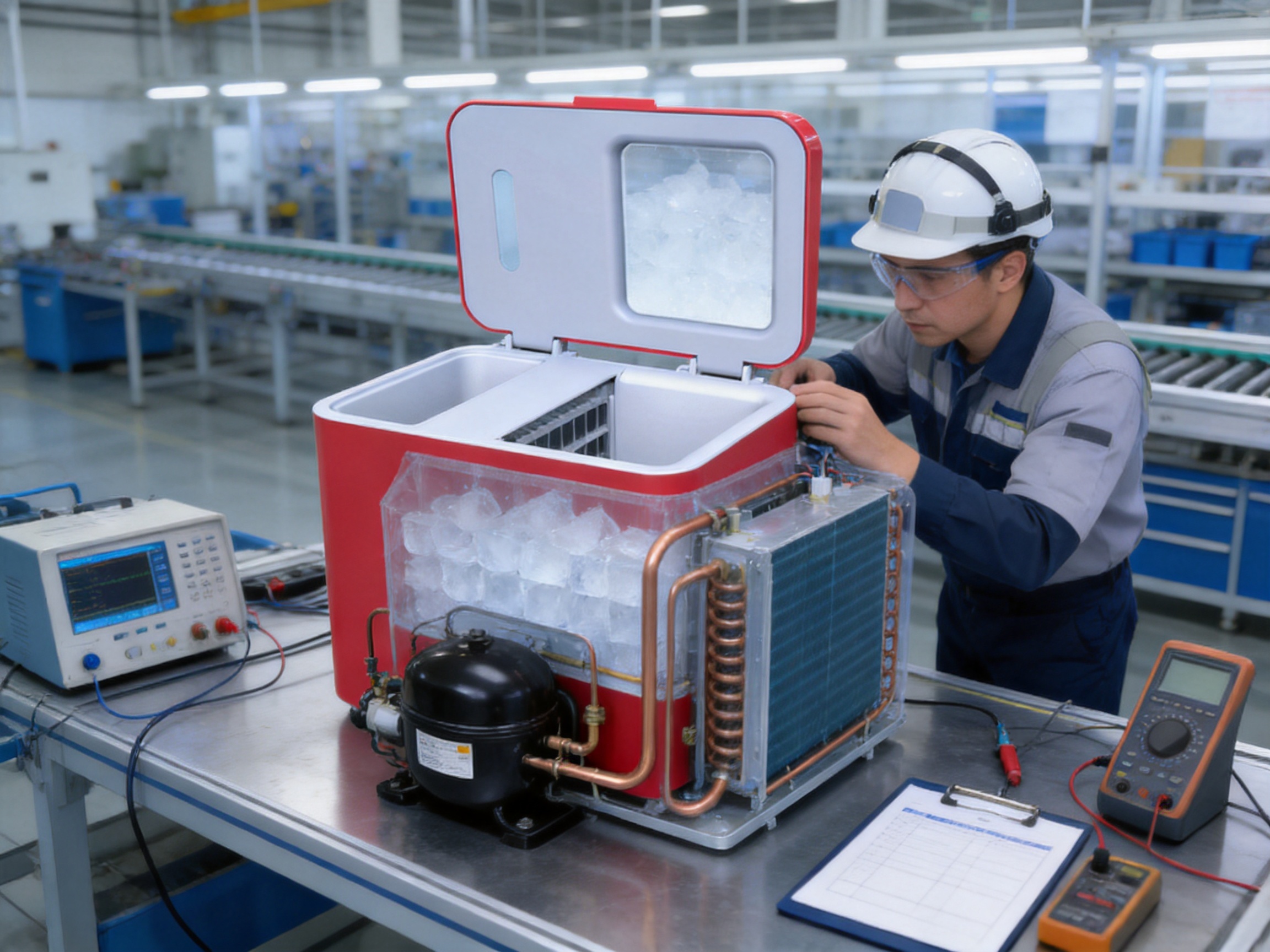
An ice maker depends on a properly balanced refrigeration system. The compressor, condenser, evaporator, refrigerant circuit, insulation, airflow path, and temperature-control strategy must work together. The use of R290 and a 26-gram charge indicates a compact refrigerant circuit designed for the appliance’s scale.
Manufacturing quality is especially important in the refrigeration circuit. Tubing connections must be formed and joined correctly. The circuit must be evacuated, charged accurately, and checked for leakage. Insulation must be applied consistently so that cooling energy is not unnecessarily lost. Components must be positioned to avoid vibration, abrasion, and interference with wiring or structural parts.
Because R290 is flammable, responsible production requires attention to refrigerant handling, electrical protection, component suitability, labeling, and service procedures. A professional manufacturing environment should use controlled charging practices and appropriate inspection methods. These processes help support safe operation and consistent performance when the product is used according to its instructions.
6.3 Electrical and Safety Control
The stated 220V/50Hz, 0.65A/140W electrical specification calls for appropriate wiring, insulation, grounding or protective design, and component selection. Electrical safety is not limited to the power cord. It includes internal terminals, switches, control components, motor protection, compressor starting components, and the separation of electrical parts from water-related areas.
A mature assembly process should include checks for wire routing, terminal security, insulation integrity, polarity where applicable, and abnormal operating conditions. Functional testing can confirm that the machine responds correctly to its control input and that the refrigeration system starts and stops as expected.
Quality assurance should also consider transportation. Household appliances may experience vibration, impact, changes in temperature, and repeated handling before reaching the final customer. Secure internal mounting, suitable packaging, and inspection of external surfaces help reduce the possibility of damage during logistics.
6.4 Water and Hygiene Considerations
Ice is consumed directly or placed into beverages, so cleanliness is essential. The water-contact areas should be designed to support routine cleaning and drying. Smooth surfaces, accessible compartments, and limited areas where stagnant water can remain are valuable design features.
Although the supplied product information does not specify particular food-contact certifications or material grades, responsible buyers should request those details when evaluating the product for commercial distribution. Manufacturing documentation should identify the materials used in water and ice contact, recommended cleaning methods, and any restrictions on detergents or sanitizing agents.
Quality manufacturing does not end when the appliance leaves the assembly line. Clear operating instructions, maintenance guidance, packaging protection, and customer support are also part of product quality. These elements help users preserve hygiene and protect the machine throughout its service life.
6.5 Process Consistency and Continuous Improvement
Alien Technology Co., Ltd. describes its business philosophy as stable, pragmatic, quality-focused, and committed to continuous improvement and innovation. These principles are particularly relevant to small appliances, where customer satisfaction depends on repeatable performance across many individual units.
Process consistency may involve incoming inspection of components, controlled assembly procedures, functional testing, visual inspection, electrical checks, refrigeration verification, and final packaging review. The exact factory procedures should be confirmed with the manufacturer, but these categories represent the type of discipline expected from a professional appliance producer.
Continuous improvement can be driven by customer feedback, service records, production data, and market requirements. Improvements might involve reducing vibration, refining controls, strengthening packaging, simplifying cleaning, improving thermal efficiency, or making the appliance easier to assemble and service.
7. Energy, Refrigerant, and Environmental Considerations
The rated power of 140W provides a useful indication of the appliance’s electrical scale. Actual energy consumption will depend on ambient temperature, water temperature, usage frequency, ventilation, ice-storage conditions, and the length of time the machine remains switched on. A machine that operates in a cool, well-ventilated area may perform differently from one placed beside a stove or in direct sunlight.
Users can support efficient operation by allowing sufficient clearance around the appliance, keeping the condenser area clean, using reasonably cool water when permitted by the instructions, and avoiding unnecessary continuous operation. The machine should not be enclosed tightly inside a cabinet unless the installation instructions specifically allow it.
R290 has become an important refrigerant option in many compact refrigeration applications because of its relatively low global warming potential compared with several legacy refrigerants. Its use can support more environmentally considerate product design when combined with an appropriately engineered system.
At the same time, R290 requires careful handling because it is flammable. The product should never be opened, modified, or repaired by unqualified users. If the refrigeration system is damaged, the appliance should be disconnected from power and inspected by an authorized or properly trained technician. Disposal should follow local rules for appliances containing refrigerant.
Environmental performance also includes product durability. A reliable appliance that remains useful for a long period may reduce the need for frequent replacement. Strong packaging, repair-friendly documentation, component quality, and responsive service can all contribute to a lower lifecycle burden.
8. Installation and Placement Recommendations
The appliance should be placed on a firm, level, and dry surface capable of supporting its weight and resisting ordinary vibration. A stable countertop helps reduce movement and makes the machine easier to operate. Uneven placement can increase noise, affect drainage, or create unnecessary mechanical stress.
Ventilation is important because the refrigeration system must release heat. The machine should not be pushed tightly against a wall or placed immediately beside another heat-producing appliance. Users should follow the clearance requirements in the official manual and maintain a clean airflow path.
The product is specified for 220V/50Hz operation. Before connecting it, the user should verify the local supply and ensure that the outlet is appropriate. Extension cords, overloaded power strips, or damaged plugs should be avoided unless specifically approved for the appliance’s electrical load and environment.
After transportation, refrigeration appliances may need to stand upright before being switched on. This allows internal fluids to settle after movement. The exact waiting time should be confirmed from the manufacturer’s instructions. Users should also inspect the housing, cord, control, and water-related areas before initial operation.
Water quality influences both ice quality and machine cleanliness. Where possible, users should use clean, potable water. Hard water may leave mineral deposits over time, while water with strong odors can affect the taste of the ice. Regular cleaning and descaling should be performed according to the recommended schedule.
9. Cleaning, Maintenance, and Long-Term Use
Regular maintenance is essential for any appliance that handles water and produces consumable ice. Even a well-manufactured machine requires cleaning because moisture, minerals, and environmental dust can accumulate during use.
Before cleaning, the machine should be switched off and disconnected from the power supply. Remaining ice and water should be removed according to the instructions. Exterior surfaces can generally be wiped with a soft, damp cloth, while abrasive pads and harsh chemicals should be avoided unless expressly approved.
Water-contact components should be cleaned at suitable intervals. If the product includes removable parts, they should be washed and dried carefully before reinstallation. Users should not allow standing water to remain in the machine for long periods when it is not in use.
Descaling may be necessary in areas with hard water. Mineral deposits can restrict water flow, affect ice formation, and reduce cleanliness. The appropriate descaling product and procedure should come from the manufacturer because unsuitable chemicals may damage seals, surfaces, or internal components.
If the machine will not be used for an extended period, it should be emptied, cleaned, dried, and stored in a clean, dry location. Keeping the lid or relevant access area slightly open during drying may help prevent unwanted odors, provided that this is safe and consistent with the product instructions.
Unusual noises, water leakage, damaged wiring, a persistent refrigerant odor, or a failure to cool should be treated as service issues. Users should not attempt to puncture the refrigeration circuit or recharge R290 themselves. Professional inspection is the appropriate response.
10. Applications in Different Settings
10.1 Family Kitchens
In a family kitchen, the ice maker can provide convenient ice for daily drinks, weekend meals, celebrations, and summer use. Its compact footprint helps preserve counter space compared with larger appliances. The machine can be operated when required rather than occupying the freezer permanently with trays or bags of ice.
10.2 Home Bars and Beverage Corners
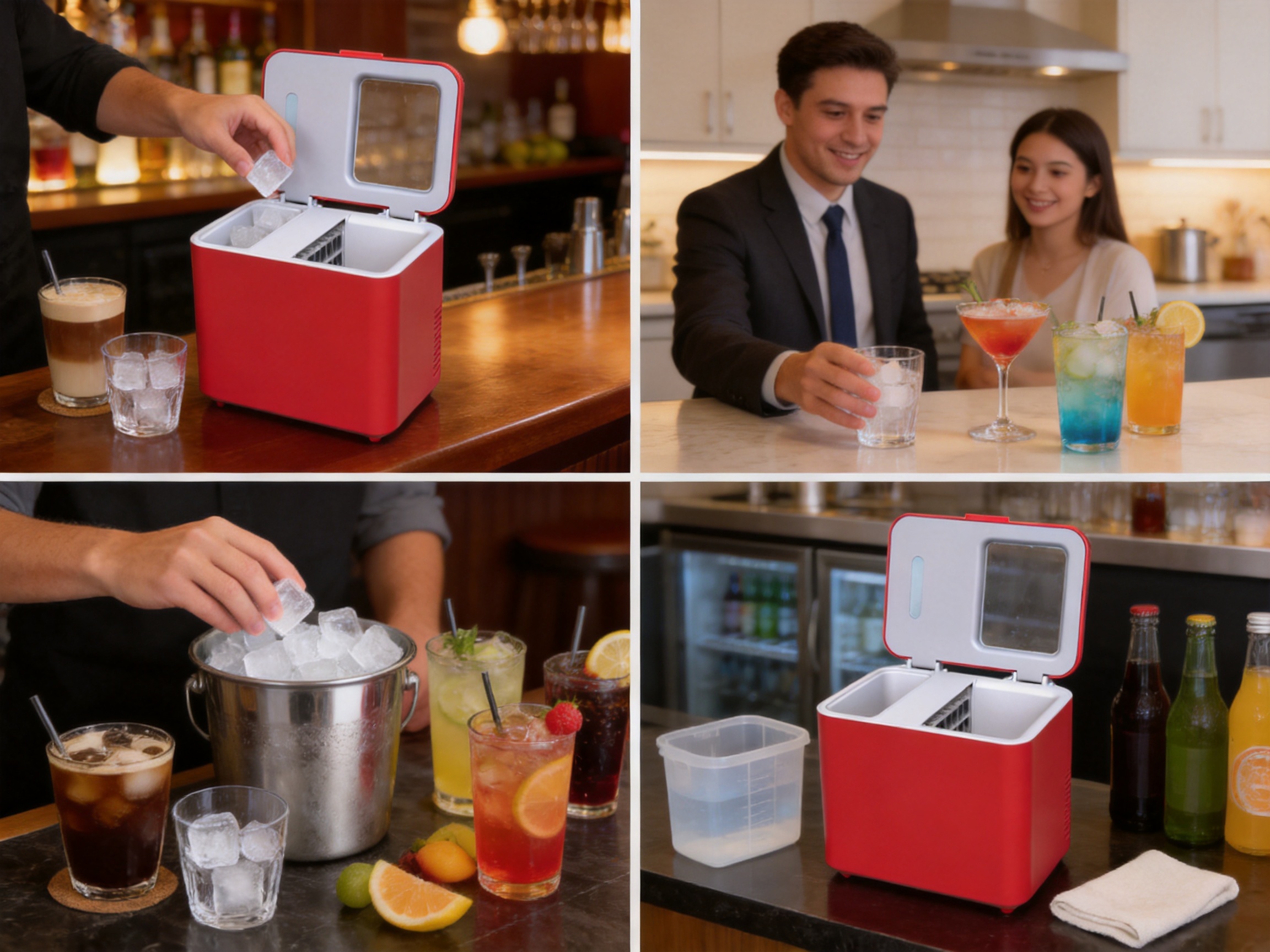
Home bar enthusiasts can benefit from the product’s regular square ice format. Clear glasses, premium spirits, cocktails, and non-alcoholic mixed drinks all benefit from attractive ice presentation. The slower melting characteristics of dense cubes are especially relevant for drinks intended to be consumed gradually.
10.3 Offices and Meeting Areas
Offices may use a countertop ice maker in staff kitchens, meeting rooms, reception areas, or hospitality spaces. Fresh ice can support water, iced coffee, soft drinks, and visiting guests. The simple control concept may help different users operate the appliance without lengthy instructions.
10.4 Small Hospitality Operations
Small cafés, guesthouses, studios, and event venues may consider a compact ice maker where the demand is moderate and space is limited. The product should be evaluated against expected production volume, local electrical requirements, hygiene rules, and commercial-use instructions before being placed in a professional setting.
10.5 Outdoor and Recreational Use
Where a suitable electrical supply is available, the appliance may be useful near recreational areas, private entertainment spaces, or temporary beverage stations. It should be protected from rain, direct water exposure, excessive heat, and unstable surfaces. The product is a countertop appliance rather than an outdoor-rated machine unless the manufacturer specifically states otherwise.
10.6 Food Preparation and Cooling
Ice cubes can also support kitchen preparation. They may be used to cool beverages, chill certain ingredients, create an ice bath, or assist with temporary cooling. In all food-related applications, clean water, clean containers, and proper handling are essential.
11. Competitive Positioning
The Home Ice Cube Maker competes across several categories: freezer trays, portable ice makers, bagged ice, and larger commercial machines. Its strongest position is likely between basic manual ice production and high-capacity professional equipment.
Compared with freezer trays, it offers dedicated operation, improved convenience, and a more organized production method. Compared with bagged ice, it offers on-demand preparation and greater control over water quality and freshness. Compared with large commercial machines, it offers a more compact form and potentially simpler installation for lower-demand environments.
The regular square format is another point of differentiation. Some compact ice machines focus primarily on speed or novelty-shaped ice. A square-cube design appeals to users who prioritize professional presentation, slow melting, and versatility across different beverages.
The 140W rating and compact dimensions may also be attractive to buyers who want a practical appliance without the footprint of commercial equipment. However, buyers should compare actual production capacity, cycle time, storage capacity, noise level, warranty terms, certifications, and service support before making a final purchasing decision. Those details are not included in the supplied specifications and should be confirmed directly.
| Comparison Factor | Home Ice Cube Maker | Freezer Tray | Bagged Ice | Large Commercial Machine |
|---|---|---|---|---|
| On-demand convenience | High for suitable household use | Low to moderate | High until the bag is depleted | High |
| Regular cube presentation | Designed for square ice | Depends on tray design | Varies by supplier | Depends on model |
| Space requirement | Compact countertop footprint | Uses freezer space | Requires storage space | Large or dedicated installation |
| Water control | User selects the water | User selects the water | Controlled by supplier | User or facility controlled |
| Portability of installation | Suitable for compatible countertops | Requires freezer | No appliance needed | Usually less flexible |
| Best fit | Homes, offices, bars, and light use | Occasional low-volume use | Events and immediate bulk needs | High-volume professional use |
This comparison is qualitative rather than a substitute for laboratory testing. The product’s ideal market depends on the customer’s required ice volume, operating environment, budget, and local compliance requirements.
12. Benefits for Distributors and Business Partners
For distributors, the product offers several straightforward selling points. It belongs to a familiar and growing household-appliance category, has a compact form factor, uses a simple control concept, and can be marketed across several consumer applications. Its square ice format creates a clear product story that is easy to explain to retailers and end users.
The manufacturer’s broader product portfolio may also support business cooperation. A company that produces ice makers, coffee machines, and air fryers can potentially offer complementary appliance categories to distributors seeking a broader household range. This may simplify sourcing, product presentation, and category development.
Alien Technology Co., Ltd. emphasizes customer satisfaction, reliable quality, continuous improvement, and innovation. For business partners, these stated values are relevant because long-term cooperation depends on more than the initial product shipment. It also depends on communication, technical documentation, packaging coordination, quality follow-up, and responsiveness to market feedback.
The company’s location in Cixi City, Zhejiang Province, is another practical consideration. A manufacturing base in a small-appliance cluster can provide access to component suppliers, tooling resources, packaging services, logistics networks, and technical labor. These regional advantages may help support efficient production and delivery, although individual order terms, lead times, and quality procedures should be confirmed during commercial discussions.
Potential partners should request complete product documentation before importation or resale. Important documents may include electrical ratings, user manuals, packaging specifications, safety test reports, material information, warranty conditions, spare-part availability, and regional compliance records. These documents help ensure that the product is correctly positioned and legally distributed in each target market.
13. Suggested Quality-Control Framework
A professional quality-control framework for a compact ice maker should cover the entire product lifecycle. Incoming components should be inspected for dimensions, appearance, electrical characteristics, and compatibility with approved specifications. Critical parts such as compressors, controls, wiring, water-contact components, seals, and refrigerant-system materials deserve particular attention.
During assembly, operators should follow standardized work instructions. Wiring should be routed consistently, fasteners should be tightened appropriately, and water-related parts should be protected from contamination. Refrigeration tubing should be positioned to avoid contact with sharp edges or high-vibration components.
End-of-line testing should include visual inspection, power-on testing, control verification, cooling-system operation, water-flow observation, leakage checks, and electrical safety evaluation. Refrigerant charging and circuit integrity should be verified through controlled procedures. The exact testing standards depend on the destination market and the manufacturer’s internal quality system.
Packaging inspection is also important. The appliance should be protected against movement, impact, and moisture during shipping. Packaging should contain sufficient product information, installation guidance, warnings, and handling instructions. Clear labeling is particularly important when a flammable refrigerant such as R290 is used.
Traceability can strengthen the quality process. Production dates, batch information, component records, inspection results, and service feedback can help the manufacturer identify trends and respond efficiently if a recurring issue appears. Continuous improvement is more effective when decisions are supported by reliable production and customer data.
14. How to Select the Right Customer and Use Case
The product is most appropriate for customers who value convenience, compactness, regular square ice, and home-oriented operation. It is a strong candidate for households that entertain guests, prepare chilled beverages regularly, or have limited freezer space.
It may also suit offices and small hospitality environments with moderate ice requirements. Before commercial use, buyers should confirm whether the machine is rated for continuous operation, the expected daily ice output, and the hygiene procedures required by local regulations. A domestic appliance should not automatically be treated as a high-volume commercial machine.
Customers who need very large quantities of ice, continuous high-speed production, or specialized ice formats may require a different product category. Likewise, users in regions with electrical systems other than 220V/50Hz should confirm compatibility before purchase.
Product education should emphasize the difference between ice production and ice preservation. A compact machine may produce ice efficiently, but freshly made cubes can still melt if they remain in a warm environment or if the machine is not designed for long-term frozen storage. Users should transfer ice to an insulated container when appropriate and follow the manufacturer’s guidance.
15. Practical Operating Habits
Users should begin with clean drinking water and avoid overfilling any reservoir. The appliance should be placed on a level surface and allowed to operate with adequate ventilation. The control knob should be used according to the instructions rather than forced beyond its intended range.
Fresh ice should be handled with clean utensils or clean hands. Ice that has fallen onto an unclean surface should not be returned to the storage area. If the machine has been unused for an extended period, cleaning and rinsing should be completed before the next serving cycle.
Performance can vary with room temperature. In a hot environment, the refrigeration system may need to reject more heat, and ice production may take longer. Placing the machine in a cooler, shaded, ventilated position can support more stable operation.
Users should avoid placing hot containers, cooking equipment, or appliances that release steam next to the ice maker. Heat and moisture can affect both external surfaces and refrigeration efficiency. The machine should also be protected from splashing water because it is an electrical appliance.
These simple habits help preserve the advantages of the product and reduce avoidable maintenance problems. They also reinforce the central purpose of the design: convenient ice production with minimal daily effort.
16. Frequently Asked Questions
Q1. What type of appliance is the Home Ice Cube Maker?
It is a compact countertop appliance designed to produce regular ice cubes for household and suitable light-use environments. The model identified in the supplied information is Alien-ZF01, also described as a knob-type ice maker.
Q2. What power supply does the machine use?
The stated power supply is 220V/50Hz. Buyers should confirm that their local electrical system, plug, socket, and installation are compatible before using the appliance.
Q3. How much power does it use?
The supplied specification lists a current of 0.65A and a power rating of 140W. Actual energy consumption can vary according to operating conditions, ambient temperature, usage frequency, and the time the machine remains switched on.
Q4. What refrigerant is used?
The product uses R290 refrigerant with a stated charge of 26 grams. R290 is used in various compact refrigeration systems, but it is flammable. Refrigeration repairs and refrigerant handling should be performed only by qualified personnel.
Q5. Why are square ice cubes useful?
Regular square cubes have a clean appearance, are easy to portion, and can melt more slowly when they are dense and compact. Their shape is suitable for spirits, cocktails, soft drinks, iced coffee, serving buckets, and general kitchen use.
Q6. Is square ice always better than small or irregular ice?
Not necessarily. Different ice types serve different purposes. Small or crushed ice may cool a beverage rapidly, while dense square cubes are generally better for slow melting, controlled dilution, and attractive presentation. The best format depends on the drink and the user’s preference.
Q7. Where can the machine be used?
It can be considered for kitchens, home bars, offices, meeting areas, entertainment rooms, guest spaces, and selected small hospitality settings. It should be used indoors or in locations specifically approved by the manufacturer, with protection from rain, splashing water, and excessive heat.
Q8. Can the machine replace a large commercial ice maker?
It may not be suitable for high-volume commercial production unless the manufacturer confirms that capability. Its compact dimensions and 140W rating suggest a countertop appliance intended for household or moderate-use applications. Buyers with heavy daily demand should verify capacity and duty-cycle information.
Q9. How should the appliance be cleaned?
The machine should be disconnected from power before cleaning. Ice and remaining water should be removed, water-contact areas should be cleaned with approved methods, and the appliance should be dried properly. Descaling may be needed in hard-water areas. The official manual should take priority over general cleaning advice.
Q10. Can users repair the refrigeration system themselves?
No. Users should not open the refrigeration circuit, release refrigerant, or attempt to recharge R290. Any suspected leak, unusual refrigeration problem, or physical damage should be handled by a qualified technician.
Q11. What should distributors confirm before ordering?
Distributors should confirm production capacity, minimum order quantity, lead time, packaging, warranty terms, regional electrical versions, certification documents, user manuals, spare parts, service arrangements, and commercial-use limitations. They should also verify the required documentation for the destination market.
Q12. What makes the manufacturer relevant to household-appliance buyers?
Alien Technology Co., Ltd. specializes in ice makers, coffee machines, and air fryers. Its stated focus on reliable quality, customer satisfaction, continuous improvement, practical innovation, and convenient logistics provides a foundation for business cooperation and product development.
17. Overall Assessment
The Home Ice Cube Maker presents a balanced solution for users who want convenient access to regular square ice without installing large commercial equipment. Its compact 325 x 295 x 252 millimeter form, 140W rated power, 220V/50Hz specification, R290 refrigeration system, and knob-type control concept create a product profile suited to practical everyday use.
Its most meaningful advantage is the combination of convenience and ice quality. The machine is not merely a replacement for a freezer tray. It is designed to produce a more consistent ice format that can support slow melting, controlled beverage dilution, efficient handling, and professional presentation.
The product also benefits from the manufacturer’s specialization in household appliances. Producing ice makers alongside coffee machines and air fryers can provide useful experience in compact appliance architecture, thermal management, electrical integration, plastics, controls, assembly, and user-centered design. The company’s location in Zhejiang’s small-appliance manufacturing environment may further support component sourcing and logistics.
For the strongest market position, the product should be supported by complete technical documentation, clear maintenance instructions, appropriate safety labeling, regional compliance materials, and dependable after-sales service. These supporting elements are essential for converting a technically attractive appliance into a trusted long-term product.
For households, home bars, offices, and selected light-use business environments, the machine offers a practical way to make fresh, neatly shaped ice on demand. For distributors, it provides a clearly defined product story based on compact design, square ice presentation, straightforward operation, and the manufacturing capabilities of an experienced household-appliance supplier.
References
1. Product specification sheet for the Home Ice Cube Maker, model Alien-ZF01.
2. Product information describing the advantages of dense square ice, including slow melting, professional appearance, versatility, and stacking efficiency.
3. Refrigeration engineering guidance concerning compact systems using R290 refrigerant.
4. General household-appliance electrical safety and installation principles for 220V/50Hz equipment.
5. General food-hygiene principles for appliances that produce ice for direct beverage consumption.
6. Manufacturing quality-control principles for compact refrigeration and household appliances.
7. Company profile and business information provided for Alien Technology Co., Ltd.