
 English
 한국어
한국어 Español
 Deutsch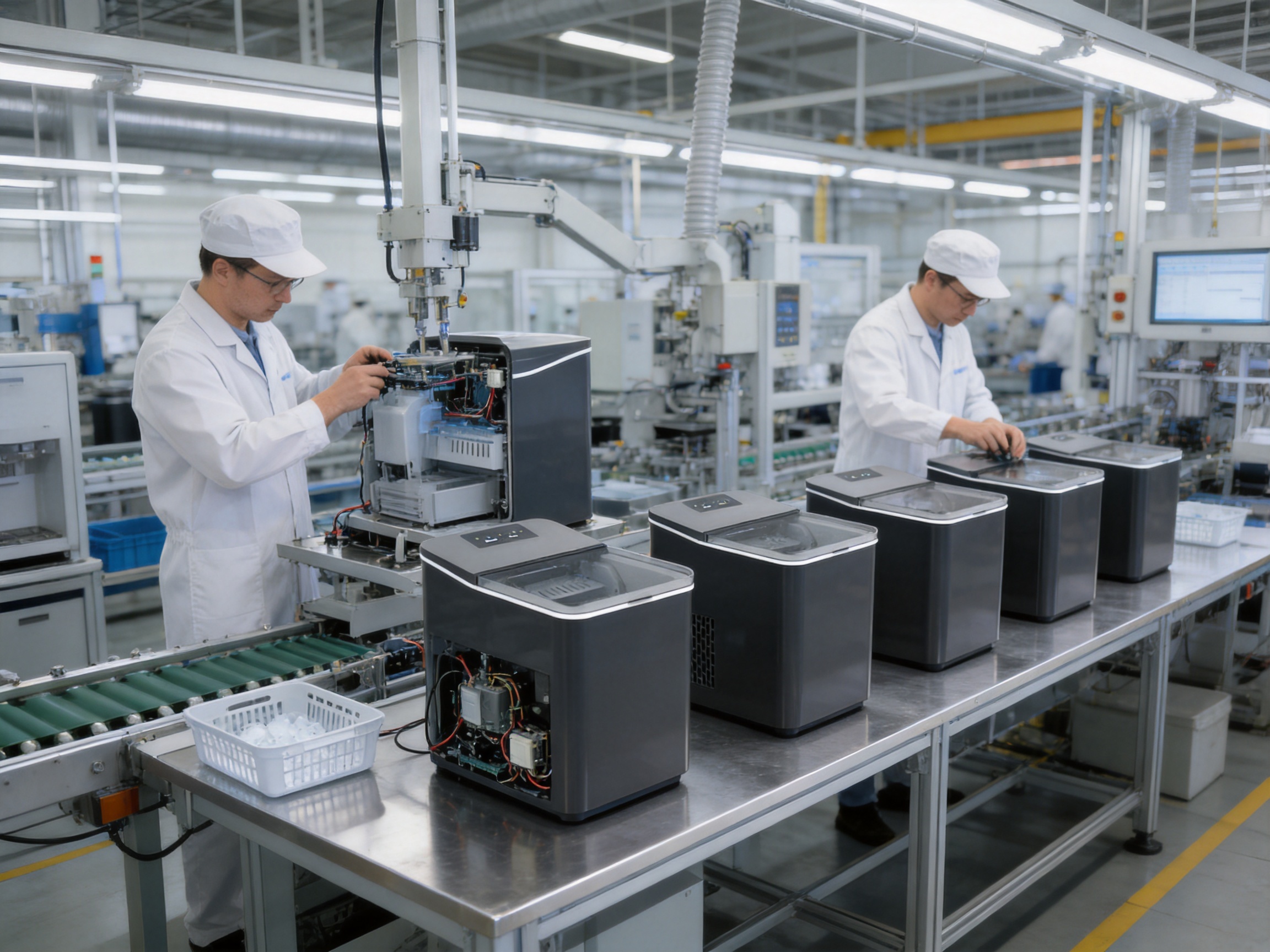
Modern households and workplaces increasingly expect small appliances to deliver speed, convenience, and dependable performance without complicated controls. Ice production is a good example. Traditional freezer trays require long waiting periods, occupy valuable freezer space, and often produce too little ice for gatherings or busy daily routines. Large commercial ice machines can solve the supply problem, but they may be expensive, bulky, noisy, and unnecessarily powerful for homes, offices, recreational vehicles, cafés, bars, and other small spaces.
The Button-Operated Ice Maker is designed to occupy the practical middle ground. It provides fresh ice on demand while remaining compact, straightforward, and relatively efficient. Its one-touch operating method reduces the learning curve, while its compact structure allows it to fit into kitchens, offices, entertainment areas, and mobile environments. The machine is built around a simple idea: users should be able to obtain usable ice quickly without dealing with complex programming, difficult maintenance, or a large installation project.
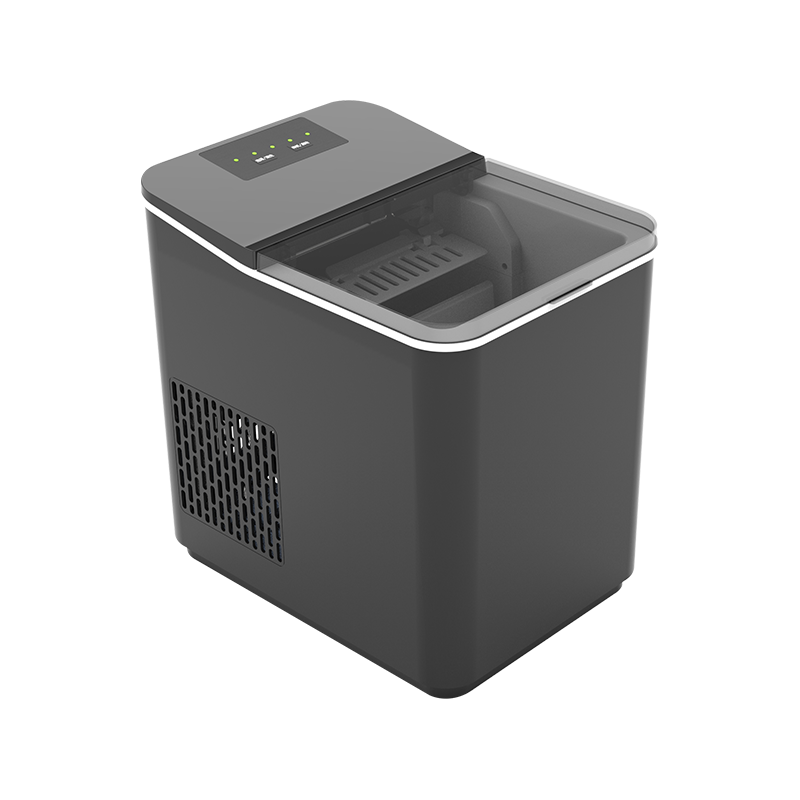
With a rated power supply of 220V–240V at 50Hz, current and power specifications of 0.9A and 150W, R600a refrigerant with a 19g charge, and machine dimensions of 313 × 226 × 309 millimeters, this ice maker offers a practical specification profile for everyday use. It is small enough for countertop placement but capable of supporting regular beverage preparation, family use, small gatherings, and light commercial applications.
A Practical Solution for Everyday Ice Production
Ice is often needed at the exact moment when it is least convenient to make. A family may need cold drinks during dinner, a home office may require ice for beverages throughout the day, or a bar may need an additional supply during a busy period. Freezing trays can be slow and inconvenient, especially when the freezer is already full. Buying bags of ice may also lead to storage issues, unnecessary transportation, and uncertain freshness after the bag has been opened.
The Button-Operated Ice Maker addresses these challenges by creating ice in short production cycles. Under suitable operating conditions, it can produce ice in approximately six to ten minutes per cycle. The precise time may vary according to room temperature, water temperature, ventilation, and the selected ice size, but the short cycle concept is valuable for users who do not want to wait several hours.
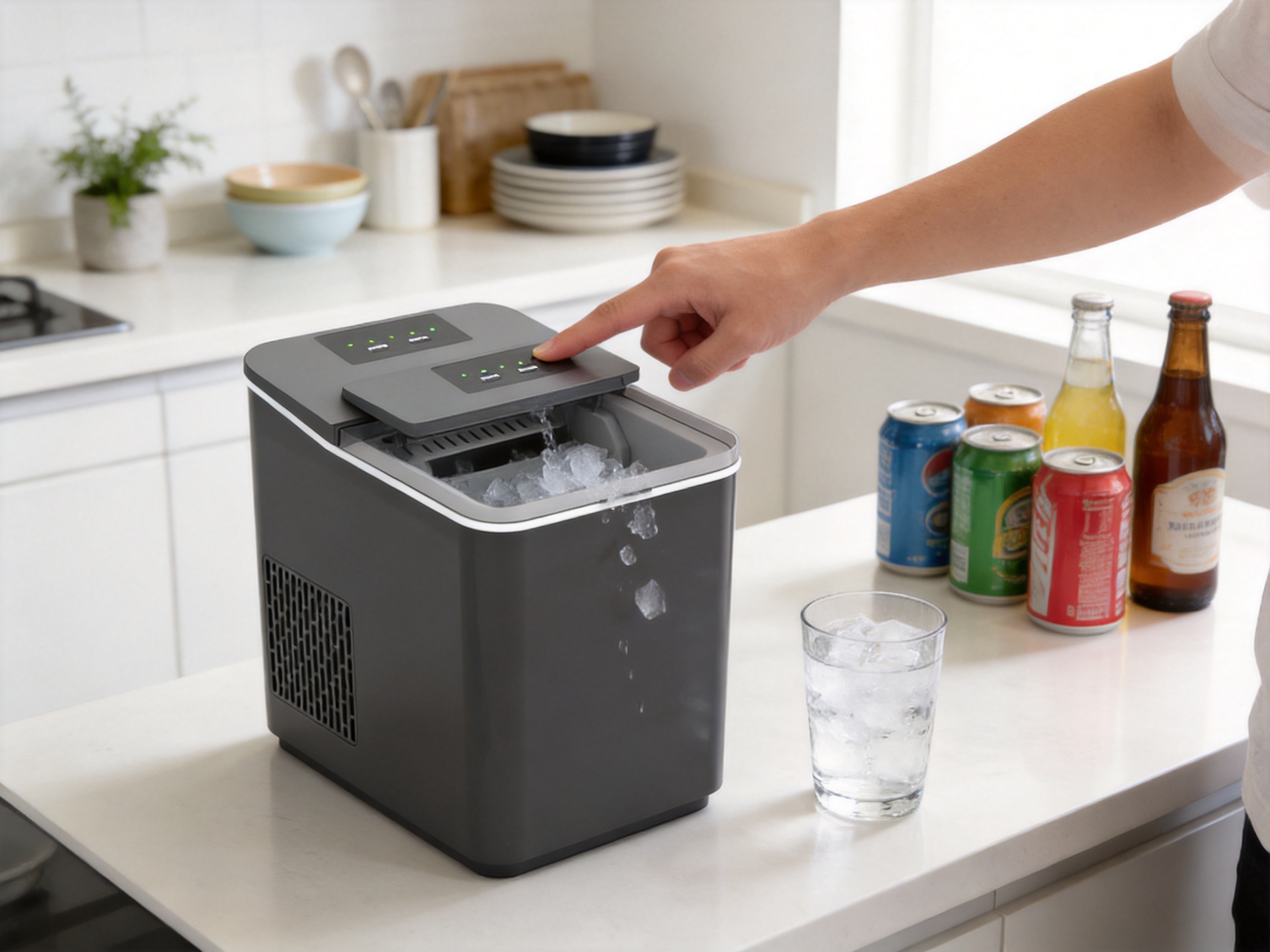
Instead of treating ice production as a major household task, the machine turns it into a simple routine. The user adds water, selects the desired setting when applicable, and presses the operating button. The machine then begins its cooling and ice-forming process. This direct approach is especially useful for people who value convenience over a long list of unnecessary controls.
The unit is also suited to locations where a built-in refrigerator ice dispenser is unavailable. It can serve as an independent source of ice for a kitchen counter, an office refreshment area, a recreational vehicle, a small hospitality setting, or an entertainment space. Because it is a countertop appliance rather than a permanently installed system, it can be moved when the layout or usage needs change.
One-Touch Operation for Broad User Accessibility
The most visible advantage of this model is its button-operated control system. Many modern appliances include touchscreens, multiple menus, wireless applications, or complicated settings. These features can be useful in some situations, but they may also create unnecessary complexity. A one-touch interface provides a more direct relationship between the user and the appliance.
To begin operation, the user can press the designated button rather than navigate through several menus. This simplicity makes the machine suitable for different age groups and levels of technical experience. A first-time user can understand the basic operating principle quickly, while an experienced user can start a cycle without spending time adjusting numerous parameters.
Simple controls can also reduce operating errors. When a machine has fewer steps, there are fewer opportunities to select the wrong program or overlook a necessary setting. This is especially useful in shared environments such as offices, guest rooms, cafés, and family kitchens, where different people may use the appliance during the day.
The design philosophy is not to remove useful functionality, but to place the most important function within easy reach. Producing ice should be the central task, and the control system is organized around that objective. The result is an appliance that feels accessible instead of intimidating.
Convenience for Different Environments
In a home kitchen, one-touch operation allows family members to produce ice without assistance. In an office, employees can operate the machine during breaks without requiring technical instructions. In a recreational vehicle, the straightforward interface is helpful when space is limited and users need equipment that can be operated quickly. In a small bar or hospitality setting, direct controls can support efficient service during periods of moderate demand.
The machine is also appropriate for temporary events. Users can place it near a beverage station during a party or gathering, then move it to storage after the event. This flexibility is different from the fixed installation requirements associated with many large ice-making systems.
Fast Ice Making for Daily Demands
Speed is one of the main reasons people choose a countertop ice maker. The Button-Operated Ice Maker is designed to produce ice in cycles of approximately six to ten minutes. This timing helps users respond to immediate needs instead of planning ice production far in advance.
For a family, a short production cycle can provide additional ice when guests arrive unexpectedly. For an office, it can help maintain a steady supply for cold water, juice, and other drinks. For a small food or beverage business, it can supplement existing ice resources during moderate demand. The machine is not intended to replace every high-capacity commercial system, but it can be a valuable secondary source or a convenient independent unit.
Actual results depend on operating conditions. A warm room, warm water, restricted ventilation, or frequent opening and closing can affect cycle time. Users can support reliable performance by placing the appliance on a stable, level surface, using suitable water, maintaining clear ventilation space, and following a consistent cleaning routine.
Fast ice making is particularly useful because it changes how users manage supply. Instead of storing a large quantity of ice in advance, they can make fresh ice closer to the time of use. This may reduce the need for freezer storage and help keep the serving area organized.
Multiple Ice Sizes for Different Uses
Different beverages and applications require different types of ice. Small pieces may chill drinks quickly, while larger pieces may be preferable for slower melting in cocktails or serving containers. Ice may also be used for smoothies, food presentation, temporary cooling, or routine drinking water.
The Button-Operated Ice Maker supports multiple ice-size choices, allowing users to select a form that better matches the situation. This flexibility gives the appliance broader usefulness than a machine restricted to only one ice format. A household may choose one setting for everyday beverages and another for a weekend gathering. A café or small bar may select a size according to the drink menu and presentation requirements.
Ice size selection also supports personal preference. Some users prefer smaller pieces that cool a drink rapidly, while others prefer a more substantial piece that remains in the glass longer. By offering different options, the appliance can serve a wider range of users without requiring separate equipment.
The selected ice size may influence production time and the amount of ice produced in a cycle. As with all countertop ice makers, the user should refer to the operating instructions and allow the machine to function within its intended conditions. Proper water levels and adequate ventilation remain important regardless of the selected size.
Button-Operated Ice Maker
Compact Dimensions and Flexible Placement
Measuring approximately 313 × 226 × 309 millimeters, the machine has a compact footprint suitable for many countertop environments. Its dimensions make it easier to position near a refrigerator, beverage station, work desk, entertainment area, or service counter. The relatively narrow structure is valuable in apartments, small offices, dormitory-style rooms, recreational vehicles, and other locations where every centimeter matters.
Compactness offers benefits beyond saving space. A smaller appliance is generally easier to relocate, clean around, and store when not in use. Users can adapt the unit to changing needs rather than dedicating a permanent area to a large machine. This is particularly useful for seasonal use, occasional parties, mobile catering, and temporary workspaces.
Placement should still be planned carefully. The appliance should stand on a stable, level surface with enough room around its ventilation areas. It should not be pushed tightly against a wall or placed beside a heat-producing appliance if doing so restricts airflow. Keeping the surrounding area clear helps the cooling system work effectively and supports consistent operation.
The compact format also improves visual integration. Instead of dominating the kitchen or service counter, the machine can fit into an existing appliance arrangement. Its purpose remains clear without creating the appearance of a large industrial installation.
Suitable Locations
The unit can support a range of settings, including residential kitchens, home bars, offices, break rooms, guest areas, small cafés, recreational vehicles, entertainment rooms, and light commercial spaces. Its usefulness comes from the combination of independent operation, compact dimensions, and quick access to fresh ice.
In a recreational vehicle, portability and simplicity are especially important. Users may not have the same freezer space or built-in equipment available in a traditional home. A compact countertop appliance can provide a convenient alternative, provided that the available electrical supply and operating environment match the product requirements.
In an office, the machine can be located near drinking water, coffee equipment, or a shared refrigerator. In a hospitality setting, it may function as a supplemental unit for a small service counter. In each case, the appliance should be used within its intended capacity and maintained according to the instructions.
Energy-Conscious Operation
The machine is rated at 150W with a current specification of 0.9A. This power profile reflects a countertop appliance designed for convenient ice production rather than the continuous output associated with large commercial systems. Its low-power format may help users obtain ice without the energy demands of a much larger installation.
Energy efficiency involves more than a single rated power figure. Water use, cycle frequency, room temperature, ventilation, maintenance, and user habits all influence overall consumption. The product is designed with optimized water usage and low power consumption in mind, helping reduce unnecessary waste during regular operation.
Users can improve efficiency by producing only the amount of ice needed, avoiding unnecessary cycles, and keeping the unit away from direct sunlight or heat sources. Regular cleaning can also help maintain cooling performance. If dust accumulates around ventilation areas, the machine may need to work harder to remove heat, which can affect efficiency and cycle consistency.
A countertop ice maker can also reduce indirect waste associated with purchasing and transporting packaged ice. While the environmental outcome depends on water sources, electricity generation, cleaning practices, and usage patterns, making ice when it is needed can be a practical alternative to repeatedly buying disposable bags.
R600a Refrigerant and Cooling Design
The ice maker uses R600a refrigerant with a listed charge of 19 grams. R600a, also known as isobutane, is commonly used in modern refrigeration equipment because of its low global warming potential compared with many older refrigerants. Its use reflects the broader movement toward more environmentally considerate cooling technologies.
Refrigerant systems must be manufactured, handled, and serviced responsibly. Users should not attempt to open the sealed cooling system or modify refrigerant components. Any technical repair involving the refrigeration circuit should be performed by qualified personnel using appropriate procedures and equipment.
The cooling system works together with the appliance structure, heat dissipation components, water path, controls, and insulation. Reliable ice production is therefore the result of coordinated design rather than refrigerant selection alone. A balanced system can support rapid cooling while maintaining manageable power consumption and acceptable operating noise.
Because the product uses a refrigeration system, ventilation is important. Users should maintain clearance around the machine and avoid blocking air outlets. Correct placement protects performance and supports the long-term reliability of the compressor and other cooling components.
Quiet Operation for Shared Spaces
Noise can determine whether an appliance is comfortable to use. A machine that produces ice but creates excessive sound may be unsuitable for bedrooms, open offices, study areas, or living spaces. The Button-Operated Ice Maker incorporates a noise-reduction approach intended to keep operation more comfortable in everyday environments.
Quiet operation is valuable during work and relaxation. In an office, lower operating noise helps reduce distractions. In a home, it allows the appliance to function near conversation areas without becoming the center of attention. In a guest room or bedroom environment, reduced noise can make occasional use more acceptable.
Some sound is normal during refrigeration. Users may hear the compressor, fan, water movement, or ice-release process. The sound level can also be affected by floor stability and placement. A level surface helps reduce vibration, while sufficient clearance prevents contact noise against walls or nearby objects.
The purpose of noise reduction is not to make the appliance completely silent, but to make its operation less intrusive. This is an important advantage over poorly designed or oversized equipment that may be unnecessarily loud for a small room.
Simple Cleaning and Maintenance
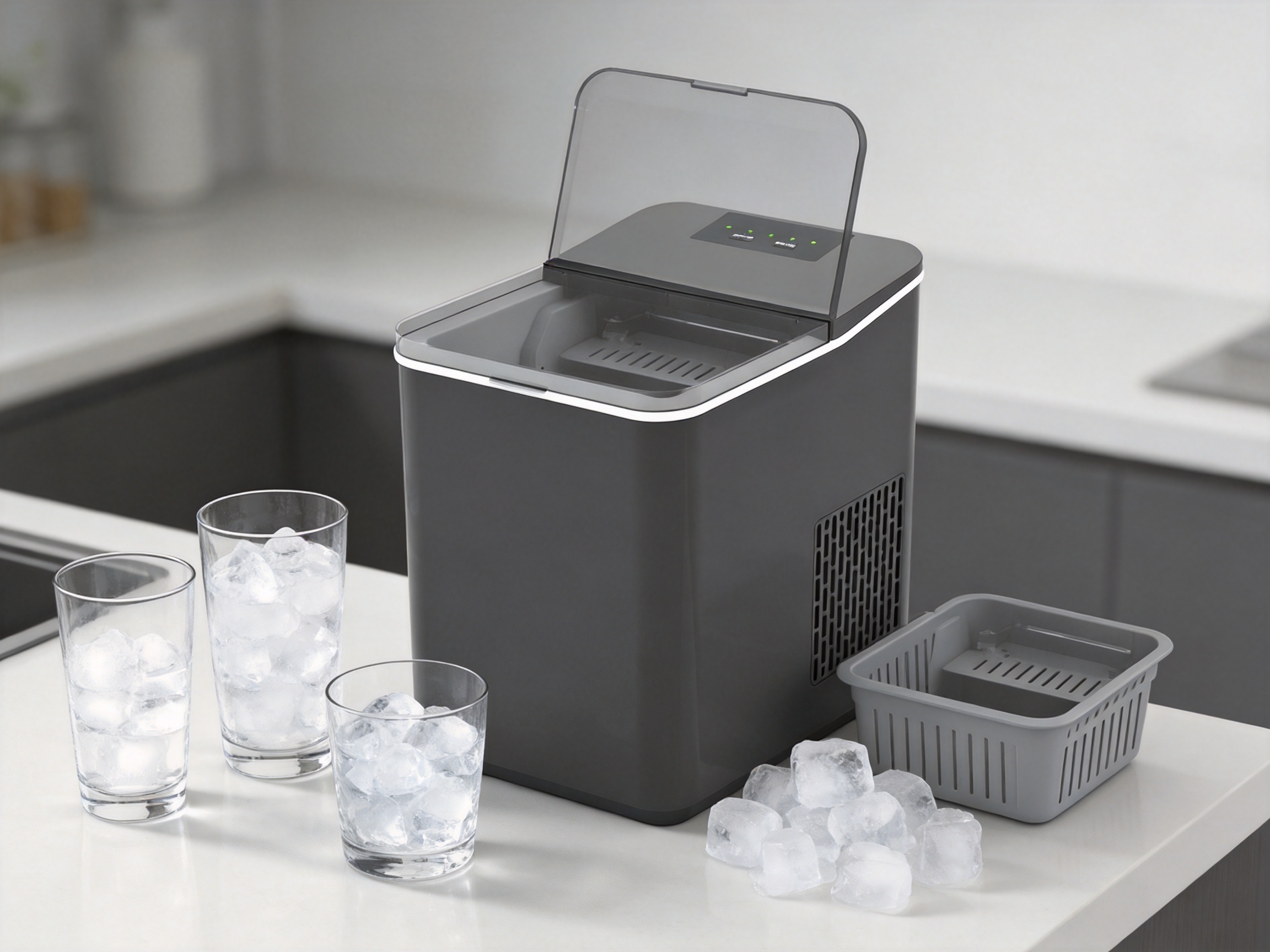
Cleanliness is essential for any appliance that handles water and produces ice for consumption. The Button-Operated Ice Maker is designed with smooth interior surfaces and a removable ice basket to make routine maintenance more manageable. These design features reduce the effort required to access common cleaning areas.
A removable basket allows users to take out stored ice and clean the container separately. Smooth interior surfaces provide fewer places for residue to collect and make wiping more straightforward. Together, these features support a practical maintenance routine rather than a complicated disassembly process.
Before cleaning, users should disconnect the appliance from the power supply and follow the product instructions. The exterior can generally be wiped with a soft, suitable cloth. Water should not be poured over electrical controls or allowed to enter openings. Abrasive cleaners and harsh tools should be avoided if they may damage the surface or leave residue.
The water reservoir and ice-contact areas should be cleaned at suitable intervals, especially when the machine is used frequently. The exact cleaning frequency depends on water quality, room conditions, usage volume, and the manufacturer’s guidance. If the machine will not be used for an extended period, it should be emptied, cleaned, dried, and stored appropriately.
Good maintenance contributes to more than hygiene. It may also help preserve ice quality, reduce odors, support water flow, and maintain dependable operation. A machine that is easier to clean is more likely to be cleaned regularly, which creates a practical advantage over designs with difficult-to-reach internal areas.
Advantages Compared with Common Alternatives
The Button-Operated Ice Maker competes with several common methods of obtaining ice, including freezer trays, refrigerator ice dispensers, purchased bagged ice, and larger commercial machines. Each alternative has a place, but the countertop model combines several advantages in a compact format.
| Ice Supply Method | Main Limitation | Button-Operated Ice Maker Advantage |
|---|---|---|
| Freezer trays | Long freezing time and limited capacity | Produces ice in short cycles and reduces freezer dependence |
| Built-in refrigerator ice maker | Requires a compatible refrigerator and fixed installation | Works as an independent countertop appliance |
| Bagged ice | Requires purchase, transport, and storage | Produces fresh ice when needed at the point of use |
| Large commercial ice machine | Higher cost, larger footprint, and greater capacity than some users need | Offers a compact and accessible solution for homes and light commercial settings |
| Complex smart appliance | May require more setup and technical interaction | Uses direct button operation for fast, simple control |
Compared with freezer trays, the key advantage is speed. Trays may be inexpensive, but they require planning and occupy freezer space. Compared with a built-in refrigerator ice maker, the key advantage is independence. The countertop unit does not depend on a specific refrigerator model or permanent plumbing arrangement.
Compared with bagged ice, the main advantage is convenience at the point of use. Users can make ice in the same location where drinks are prepared. This can be useful during gatherings, in offices, and in mobile environments. Compared with large commercial machines, the advantage is proportionality. Users who need moderate quantities may prefer a smaller machine that is easier to install, operate, and maintain.
These comparisons do not mean that the product replaces every type of ice system. A high-volume restaurant or large hospitality venue may require a larger commercial solution. The strength of this machine is its balance: quick access, simple operation, flexible placement, and moderate energy use in a compact body.
Manufacturing Strengths and Product Development Approach
The product is manufactured by Alien Technology Co., Ltd., a Zhejiang-based appliance company specializing in ice makers, coffee machines, air fryers, and related small household appliances. Its location in Zhouxiang, Zhejiang Province, places the company within a major manufacturing region known for small-appliance production and convenient logistics.
A strong small-appliance manufacturer must coordinate several disciplines at once. Product performance depends on mechanical design, refrigeration engineering, electrical safety, plastics and materials, quality control, assembly accuracy, packaging, and after-sales communication. A reliable ice maker is not created by one component alone. Its value comes from how these elements work together in a finished product.
The company’s stated mission is to use smart technology to simplify life and enhance happiness. In this model, that mission appears through practical rather than excessive technology. The most important functions are made accessible, the footprint is kept compact, and maintenance is considered during the design process. This approach reflects an understanding that useful innovation should remove friction from everyday tasks.
The company also emphasizes reliable quality, customer satisfaction, continuous improvement, and innovation. These priorities are relevant to a product category in which users expect stable performance over repeated cycles. Ice makers handle water, refrigeration, electrical power, and moving components, so quality must be considered at every stage from component selection to final testing.
Process Integration from Design to Assembly
Advanced manufacturing does not necessarily mean adding the most complicated electronics. It can mean integrating the product’s functions carefully so that the final appliance is efficient, durable, and easy to use. For a button-operated ice maker, process integration may include accurate enclosure molding, consistent water-path assembly, secure wiring, reliable control-button placement, refrigeration-system testing, and inspection of the finished unit.
Dimensional consistency is important in a compact product. The listed dimensions of 313 × 226 × 309 millimeters require the external housing, internal water system, cooling components, electrical parts, and insulation to fit together within a limited volume. Good manufacturing control helps maintain proper alignment and reduces the risk of interference between components.
Electrical assembly also requires care. The product is specified for 220V–240V and 50Hz operation, so the power system must be matched to the intended market and tested for secure connections. Proper wiring, insulation, switch operation, and protective design support safe and dependable daily use. Users should always operate the product with a compatible electrical supply and follow local safety requirements.
The refrigeration circuit requires another level of precision. The R600a refrigerant charge is listed at 19 grams, which means the cooling system must be assembled and sealed according to its design specifications. Proper leak control, connection quality, and functional testing are essential for maintaining cooling performance.
Quality-Oriented Production
Quality control for a countertop ice maker should address both visible and hidden characteristics. Exterior surfaces should be checked for fit, finish, and stability. Controls should respond correctly. The ice basket should be removable and properly positioned. Water pathways should function as intended. The refrigeration system should cool effectively, and the final unit should operate without abnormal vibration or noise.
Production testing can also verify power behavior, cycle operation, ice release, water-level response, and shutdown functions. These checks help identify problems before products reach customers. Consistent testing is especially valuable when appliances are distributed internationally, because users expect the same basic experience regardless of location.
The company’s focus on continuous improvement suggests an ongoing effort to examine customer feedback and refine product details. Small improvements in button response, cleaning access, noise control, packaging protection, or internal assembly can produce meaningful benefits in daily use.
Manufacturing strength also includes supply-chain coordination. A company located in an established appliance cluster can benefit from access to component suppliers, technical services, packaging resources, transportation networks, and experienced production workers. Convenient logistics can support more responsive order fulfillment and business cooperation, particularly for overseas customers.
Human-Centered Design and Everyday Reliability
A useful appliance should fit naturally into the user’s routine. The Button-Operated Ice Maker is designed around several common user expectations: the need for quick results, the desire for simple controls, limited counter space, concern about noise, and the importance of easy cleaning. These needs are not separate; they influence whether a machine is used regularly or left in storage.
Human-centered design begins with recognizing the user’s environment. A person may be preparing drinks while cooking, serving guests, answering office messages, or traveling. A complicated interface creates an additional task. A compact unit with direct controls reduces that burden.
Reliability also depends on predictable behavior. Users should know where to add water, how to begin production, how to remove ice, and how to clean the machine. Clear product instructions support this experience, while the physical design should make important operations easy to understand.
The removable ice basket is one example of a small feature with a large practical effect. If ice is difficult to remove, users may spill it or avoid emptying the container. If cleaning requires extensive disassembly, maintenance may be delayed. Accessible components make the correct routine easier to follow.
Recommended Operating Practices
For the best experience, users should place the ice maker on a level, stable countertop near a suitable electrical outlet. The surrounding area should remain dry, clean, and free of objects that could block ventilation. The appliance should not be placed directly beside a stove, oven, radiator, or other heat source.
Use clean water that is suitable for ice production. Water quality affects taste, appearance, and the amount of mineral residue that may accumulate inside the machine. If local water is especially hard, users may need to follow a more frequent cleaning schedule.
Do not overfill the reservoir or force ice into the basket. The machine should be allowed to complete its intended cycle. Ice should be removed when necessary so that the basket does not become unnecessarily crowded. These simple habits can support smoother operation.
After use, inspect the interior and remove remaining water according to the instructions. When the appliance is not needed for a longer period, clean and dry it before storage. Avoid moving the unit immediately after operation if doing so could disturb the refrigeration system; follow the manufacturer’s guidance regarding transport and repositioning.
Users should also pay attention to changes in performance. Unusual noises, water leakage, persistent failure to produce ice, damaged cables, or abnormal odors should not be ignored. The appliance should be disconnected and inspected by qualified service personnel when necessary.
Applications in Home and Business Settings
At home, the ice maker can support everyday drinking water, iced tea, juice, smoothies, cocktails, and family meals. It is useful when the refrigerator’s ice supply is insufficient or when a household wants a dedicated unit for entertaining. Its compact format also makes it suitable for a home bar, outdoor serving area, or secondary kitchen.
In offices, the unit can be placed in a break room or shared kitchen. Employees can make fresh ice for water bottles, soft drinks, coffee beverages, and informal meetings. The one-touch control reduces the need for training, while the compact size allows the machine to share counter space with a kettle, coffee machine, or water dispenser.
In bars and cafés, the product may serve as a supplemental ice source. It can support a small service area, private event, tasting room, or low-volume beverage station. Businesses should evaluate their expected demand carefully. The machine is best suited to moderate requirements and should not be treated as a replacement for a high-capacity commercial system when continuous large-volume production is needed.
In recreational vehicles, the appliance can provide additional convenience when freezer capacity is limited. It can also be helpful in guest houses, dormitory-style accommodations, studios, and compact hospitality spaces. Its mobility allows owners and operators to adapt the appliance to different layouts.
Why the Product Offers Strong Competitive Value
Competitive value is not determined by one specification alone. It comes from the relationship between features, usability, maintenance, footprint, energy requirements, and expected application. The Button-Operated Ice Maker performs well in this balance.
Its first advantage is accessibility. A one-touch control system makes the primary function obvious. Its second advantage is speed, with ice production designed around short cycles. Its third advantage is flexibility, provided by multiple ice-size options and independent countertop operation. Its fourth advantage is practicality, supported by compact dimensions and a removable ice basket.
The product also offers a more comfortable user experience through quiet operation and a design intended to simplify cleaning. Its 150W rating supports a modest power profile for a countertop ice maker, while the use of R600a refrigerant reflects a modern refrigeration direction. Together, these features make the appliance suitable for users who want more convenience than freezer trays provide without committing to a large commercial machine.
Another important point is proportional design. Some products compete by adding features that may not be necessary for the target user. This model focuses on the central purpose of making ice efficiently and conveniently. The result may appeal to customers who prefer dependable operation over complicated connectivity or an oversized control system.
Purchasing Considerations for Distributors and Buyers
Individual buyers should consider available counter space, electrical compatibility, expected ice demand, preferred ice sizes, cleaning habits, and the location where the machine will be used. It is also important to understand that cycle time can change with environmental conditions. A compact ice maker is a convenience appliance, not necessarily a substitute for a large storage freezer or commercial ice plant.
Distributors and business buyers may also evaluate packaging, shipping efficiency, product positioning, replacement support, and target-market requirements. The manufacturer’s experience with ice makers and other small household appliances can be valuable when developing product lines for different regions. A company with a broad appliance focus may also understand how to coordinate design, sourcing, production, and logistics across related categories.
Because the product is intended for 220V–240V and 50Hz markets, distributors should confirm that the specification matches the destination country. They should also provide customers with appropriate operating information and ensure that product labeling and documentation meet applicable requirements.
Company Capabilities and Cooperation Potential
Alien Technology Co., Ltd. is based at No. 138, Huixiang'an Road, Zhouxiang Town, Cixi City, Zhejiang Province. The company specializes in household appliances including ice makers, coffee machines, and air fryers. This product specialization gives the company a foundation for developing appliances that address common household and small-business needs.
Its stated business philosophy combines stable and pragmatic operation with continuous improvement and innovation. This combination is important for buyers seeking a manufacturing partner rather than a single isolated product. Stable production supports consistency, while improvement and innovation help products remain relevant as customer expectations develop.
The company welcomes communication with new and existing customers for business cooperation. Potential partners may seek product supply, distribution opportunities, private-label discussions, product customization, or broader small-appliance cooperation. Any commercial arrangement should be evaluated through normal due diligence, including specifications, samples, production capacity, quality procedures, documentation, packaging, delivery terms, and service support.
The company’s location in Zhejiang also provides logistical advantages. Zhouxiang and the wider Cixi area are associated with small-appliance manufacturing, which can support access to component networks and transportation channels. For international buyers, manufacturing-region connectivity may help simplify sourcing and shipping coordination.
Maintenance as a Competitive Advantage
Many buyers focus on production speed when comparing ice makers, but maintenance can have an equally important effect on long-term satisfaction. A machine that produces ice rapidly but is difficult to clean may become inconvenient over time. The Button-Operated Ice Maker places attention on smooth interior surfaces and a removable basket, helping users maintain the product with less effort.
Easy maintenance can reduce the accumulation of water residue and odors. It can also help preserve the taste and appearance of ice. When cleaning is simple, households and businesses are more likely to follow a consistent schedule, which supports better hygiene and more stable performance.
Maintenance should be viewed as part of the product experience, not as an afterthought. The machine’s design makes routine care more approachable, while the manufacturer’s quality-oriented philosophy supports the expectation that important components should work together reliably.
Q&A
What is the Button-Operated Ice Maker designed for?
It is designed for users who need fresh ice quickly without complicated controls. It can be used in homes, offices, bars, recreational vehicles, and small commercial spaces.
How quickly can it make ice?
It is designed to produce ice in approximately six to ten minutes per cycle under suitable conditions. Room temperature, water temperature, ventilation, and ice-size selection can affect the actual production time.
How is the machine operated?
The main function is controlled through a simple button-operated interface. The user adds water and starts the machine using the designated control. Specific operating steps should be confirmed in the product instructions.
Does it offer different ice sizes?
Yes. The product supports multiple ice-size options, allowing users to select ice for beverages, cocktails, smoothies, food preservation, or personal preference.
What are the electrical specifications?
The listed power supply is 220V–240V at 50Hz. The current and power specifications are 0.9A and 150W. Buyers should confirm electrical compatibility before use.
What refrigerant does the product use?
The machine uses R600a refrigerant with a listed charge of 19 grams. The sealed refrigeration system should not be opened or modified by unqualified users.
Is the ice maker suitable for a small kitchen?
Yes. Its dimensions are approximately 313 × 226 × 309 millimeters, giving it a compact countertop footprint. Adequate ventilation space should still be maintained around the unit.
Is it suitable for commercial use?
It can be suitable for light commercial applications, supplemental ice production, small beverage stations, private events, and similar uses. Businesses with very high or continuous demand should consider a larger commercial system.
How should the appliance be cleaned?
Disconnect the machine before cleaning, remove the ice basket, and follow the product instructions for the water reservoir and interior surfaces. Use suitable cleaning materials and prevent water from entering electrical controls or openings.
Is the machine noisy?
It incorporates a noise-reduction design intended to make operation more comfortable in kitchens, offices, and other shared spaces. Some normal sound from the compressor, fan, water movement, and ice-release process should still be expected.
What makes it different from freezer trays?
It produces ice in short cycles rather than requiring trays to remain in a freezer for several hours. It also reduces dependence on freezer space and provides a more automated experience.
What makes it different from a built-in refrigerator ice maker?
It operates independently and can be placed wherever a suitable countertop and electrical supply are available. It does not require a compatible refrigerator installation.
Who manufactures the product?
The product is manufactured by Alien Technology Co., Ltd., a Zhejiang-based company specializing in ice makers, coffee machines, air fryers, and other household appliances.
Conclusion
The Button-Operated Ice Maker is a practical answer to a common need: having fresh ice available quickly without sacrificing counter space or ease of use. Its one-touch control system reduces complexity, while its six-to-ten-minute production cycles support immediate beverage preparation and everyday convenience. Multiple ice sizes expand its usefulness, and the compact 313 × 226 × 309 millimeter structure allows it to fit into homes, offices, bars, recreational vehicles, and small commercial environments.
The product also combines a 150W power rating, R600a refrigerant, quiet-operation design, optimized water usage, smooth interior surfaces, and a removable ice basket. These characteristics create a balanced appliance for users who want more speed and flexibility than freezer trays can provide, but do not require the size or cost of a large commercial machine.
Its competitive strength is supported by the manufacturing background of Alien Technology Co., Ltd. The company’s specialization in small household appliances, Zhejiang manufacturing base, emphasis on reliable quality, customer satisfaction, continuous improvement, and innovation provide a foundation for product development and business cooperation. By combining practical engineering with user-centered design, the company presents an ice maker focused on simplifying daily life.
For households, the machine can make entertaining and daily drinks more convenient. For offices, it can improve shared refreshment areas. For small businesses, it can provide supplemental ice production in a compact form. With proper placement, cleaning, and operation, it offers an accessible and efficient way to enjoy fresh ice whenever it is needed.
References
1. Product specification sheet for the Button-Operated Ice Maker, including power supply, current, power, refrigerant, charge, and machine dimensions.
2. Product information describing one-touch button control, fast ice making, multiple ice sizes, energy-saving design, quiet operation, and cleaning features.
3. General household appliance design principles concerning ventilation, electrical compatibility, water handling, cleaning, and routine maintenance.
4. General refrigeration engineering references concerning R600a refrigerant and small-appliance cooling systems.
5. General small-appliance manufacturing references concerning product design integration, assembly inspection, quality control, and supply-chain coordination.