
 English
 한국어
 Español
 Deutsch
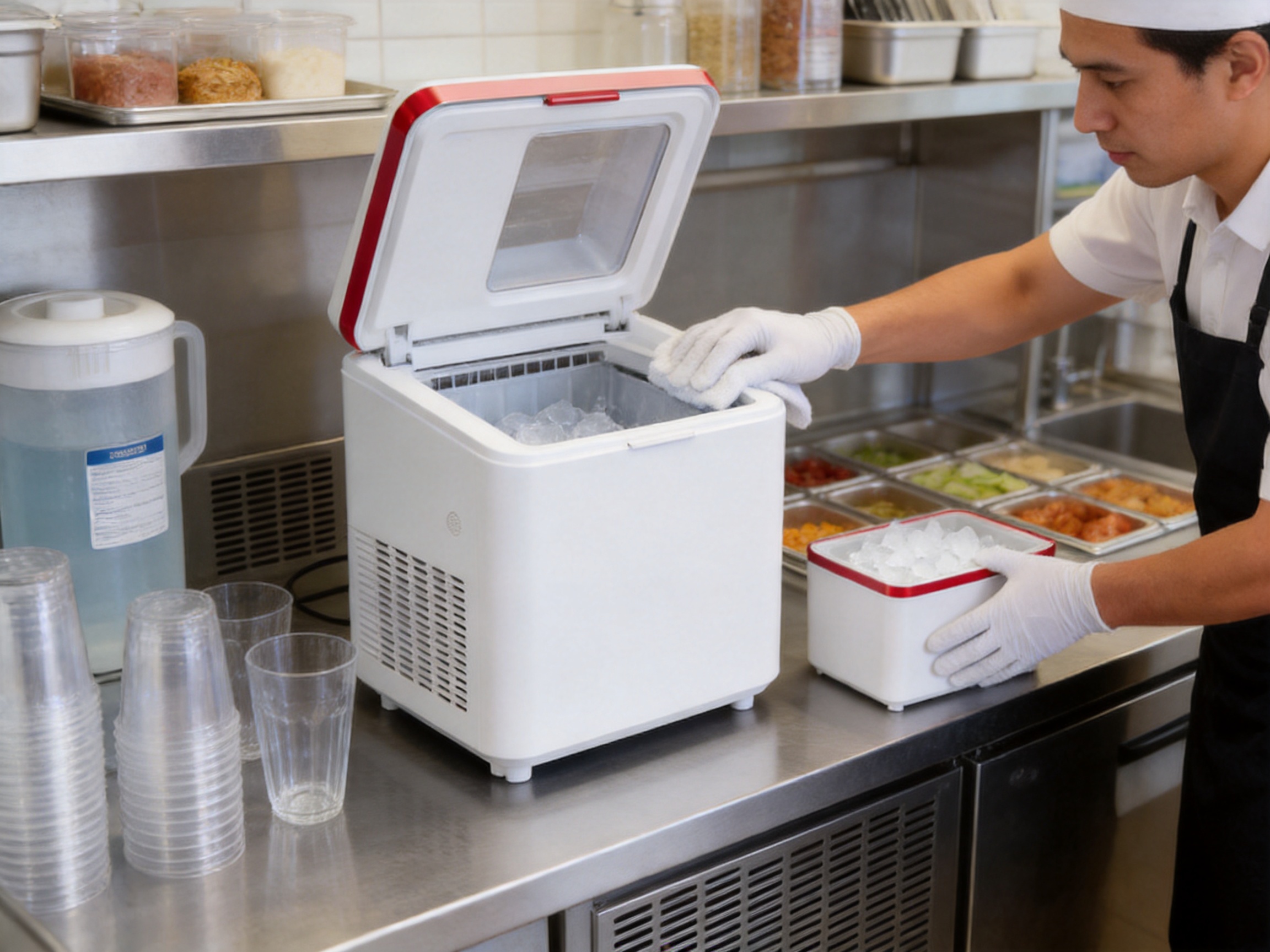
Ice is no longer a simple afterthought in modern food and beverage preparation. In homes, cafés, milk tea shops, fast-food restaurants, offices, and small commercial kitchens, the quality, availability, and handling of ice can directly influence the customer experience. A reliable ice maker must therefore do more than freeze water. It must produce useful ice quickly, store it hygienically, fit comfortably into limited spaces, and remain simple to operate and maintain.
The Touchscreen Ice Maker, identified as the Alien-Z01, is designed around these practical needs. As a compact bullet ice maker, it combines a space-saving structure with a modern control interface and an ice shape intended for quick cooling, easy dispensing, and pleasant consumption. Its 150-watt operating power, compact dimensions, R600a refrigerant, and fully opening top structure make it suitable for users who want convenient ice production without installing a large, complicated system.
Behind the product is Alien Technology Co., Ltd., a Zhejiang-based appliance manufacturer specializing in ice makers, coffee machines, and air fryers. The company’s product development philosophy centers on practical design, dependable quality, intelligent functions, and easier daily living. These principles are reflected in the product’s compact body, accessible cleaning areas, user-oriented operation, and attention to the characteristics of bullet-shaped ice.
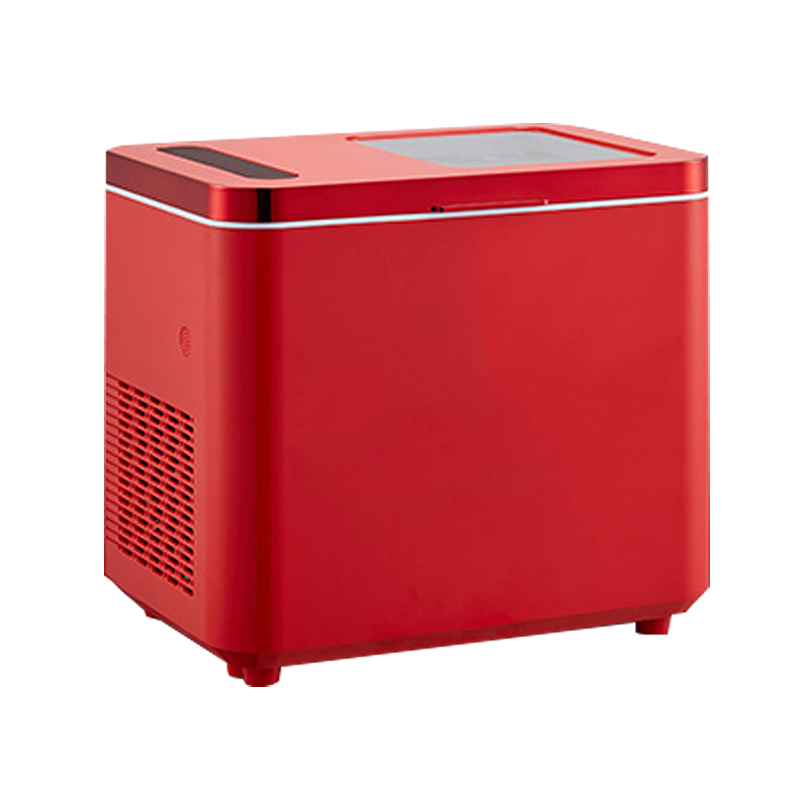
Touchscreen ice maker
Understanding the Touchscreen Bullet Ice Maker
The Alien-Z01 is categorized as a bullet ice maker. Bullet ice is recognizable by its rounded, hollow or perforated shape. Unlike large solid cubes, it is typically lighter and has a larger contact area relative to its mass. This allows it to cool beverages efficiently while offering a texture that many consumers find enjoyable.
The machine is built for users who need a practical supply of ice but do not want the size, installation requirements, or operating complexity associated with a large commercial ice system. Its dimensions are 325 by 295 by 252 millimeters, allowing it to occupy a relatively small footprint on a countertop, service station, beverage preparation area, or household kitchen surface.
A touchscreen-style control experience gives the product a contemporary character. Instead of relying on a collection of complicated mechanical switches, the user can interact with the machine through an intuitive front-facing control area. A modern interface can make everyday functions easier to understand, especially for users who prefer clear visual controls and simple operation.
The appliance operates on a 220V–240V, 50Hz power supply and uses a rated current of 0.9 amperes with power consumption of 150 watts. It uses R600a refrigerant with a stated charge of 19 grams. These specifications position it as a compact appliance designed for efficient countertop ice production rather than as a high-capacity industrial freezing system.
Key Technical Specifications
Product Name | Touchscreen Ice Maker |
Model | Alien-Z01 |
Product Category | Bullet Ice Maker |
Power Supply | 220V–240V / 50Hz |
Current | 0.9A |
Rated Power | 150W |
Refrigerant | R600a |
Refrigerant Charge | 19g |
Machine Dimensions | 325 × 295 × 252mm |
Ice Type | Bullet-shaped ice |
Top Structure | Fully opening design for access and cleaning |
These specifications show how the product balances compactness and useful performance. The machine is small enough for areas where counter space is limited, while the refrigeration system is configured for routine ice-making tasks. For buyers comparing countertop appliances, the combination of a compact footprint and a 150-watt power rating can be especially important because it supports convenient placement without the infrastructure normally associated with a large ice production unit.
Rapid Cooling Through a Functional Ice Shape
One of the main advantages of bullet ice is its ability to cool beverages efficiently. The perforated center increases the surface area that comes into contact with the surrounding liquid. As a result, a drink can cool rapidly without requiring an oversized quantity of ice.
This characteristic is useful in many beverage applications. A customer ordering iced coffee, milk tea, fruit tea, juice, soft drinks, or a mixed beverage generally expects the drink to become cold quickly. In a busy service environment, the ability to cool a beverage promptly helps staff maintain a smooth preparation rhythm.
Compared with dense solid ice, hollow or perforated bullet ice has a different melting and cooling profile. Its structure allows liquid to move around and through the opening, increasing contact between the ice and beverage. This can make it a practical choice for drinks served immediately after preparation.
The shape also supports portion flexibility. Users can add a moderate amount of ice to a glass rather than relying only on large, heavy cubes. This is convenient for households and beverage businesses that prepare different drink sizes throughout the day.
For restaurants and cafés, rapid cooling can contribute to service consistency. A beverage that reaches the desired temperature quickly is easier to prepare according to a standard recipe. For home users, the same feature provides convenience when guests arrive or when a cold drink is needed without waiting for conventional freezer trays to freeze.
Non-Sticky Ice for Easier Handling
Ice storage can become inconvenient when pieces freeze together into a solid mass. Clumped ice is difficult to scoop, difficult to portion, and inconvenient to place into a glass or beverage container. The bullet shape of this product is intended to provide high flowability and reduce the tendency of individual pieces to form an unmanageable block during storage and dispensing.
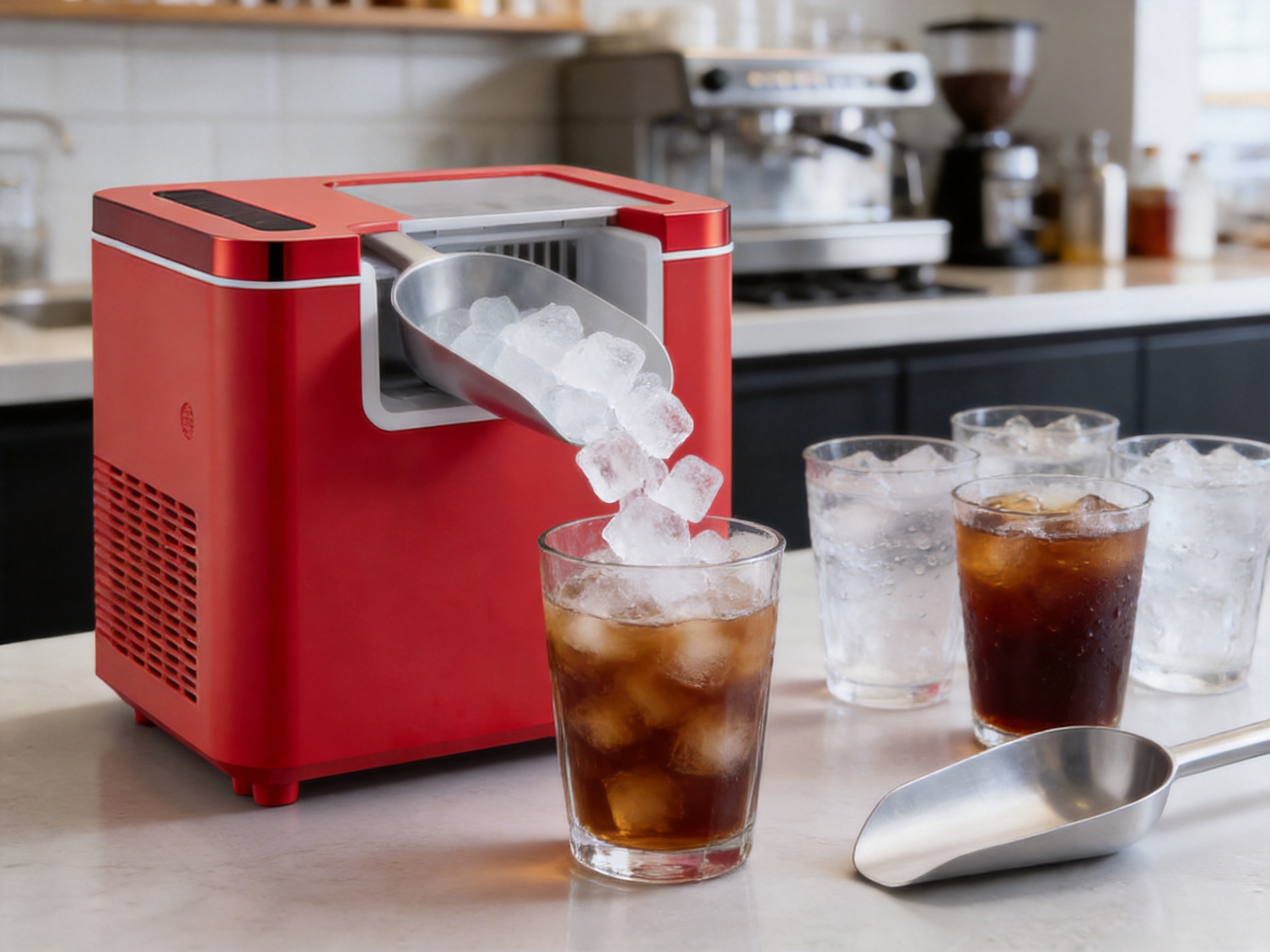
The rounded structure allows pieces to move more freely than irregular fragments or large flat pieces. This is helpful when using an ice scoop, transferring ice into a container, or filling multiple glasses in succession. Staff can collect an appropriate portion quickly without needing to break apart a frozen cluster.
Better flowability also supports organized work areas. When ice can be moved smoothly from the storage section to a drink station, there is less interruption during preparation. This is valuable in milk tea shops, quick-service restaurants, catering operations, and small cafés where every step must be efficient.
The shape may also be compatible with automatic or semi-automatic dispensing arrangements, depending on the wider system in which the ice maker is used. Its consistent form provides a more predictable flow than randomly broken ice, making the product suitable for businesses that value orderly handling.
For residential use, non-sticky ice is equally practical. Home users can scoop only what they need without struggling with a frozen mass. This helps reduce waste and keeps the ice-handling process simple for family members and guests.
A Pleasant Texture for Food and Beverage Service
Ice is part of the sensory experience of a beverage. Consumers notice not only temperature but also how the ice feels as a drink is consumed. Bullet ice offers a texture that is generally less dense and less hard than solid cube ice. Its moderate hardness can create a pleasant crunch when used in suitable drinks.
This texture is especially popular in milk tea shops, fast-food restaurants, casual beverage stores, and other businesses serving chilled drinks. The ice can provide cooling without feeling excessively hard. Its rounded form also makes it visually distinctive, giving beverages a recognizable appearance.
Because the ice is not as dense as a large solid cube, it can be easier for some users to chew once the drink has been consumed. This does not mean that every beverage should contain chewable ice, but it does provide an additional choice for businesses and households seeking a different customer experience.
Texture, appearance, and cooling performance work together. A beverage can appear more attractive when filled with uniform, rounded pieces, while the hollow center adds a visual feature that distinguishes the drink from one prepared with ordinary freezer cubes.
For commercial operators, this can support product differentiation. A shop may use the ice shape as part of its presentation, particularly in transparent cups where customers can see the ice. The result is a practical ingredient that also contributes to branding and perceived product quality.
Continuous Ice-Making Principles and Everyday Efficiency
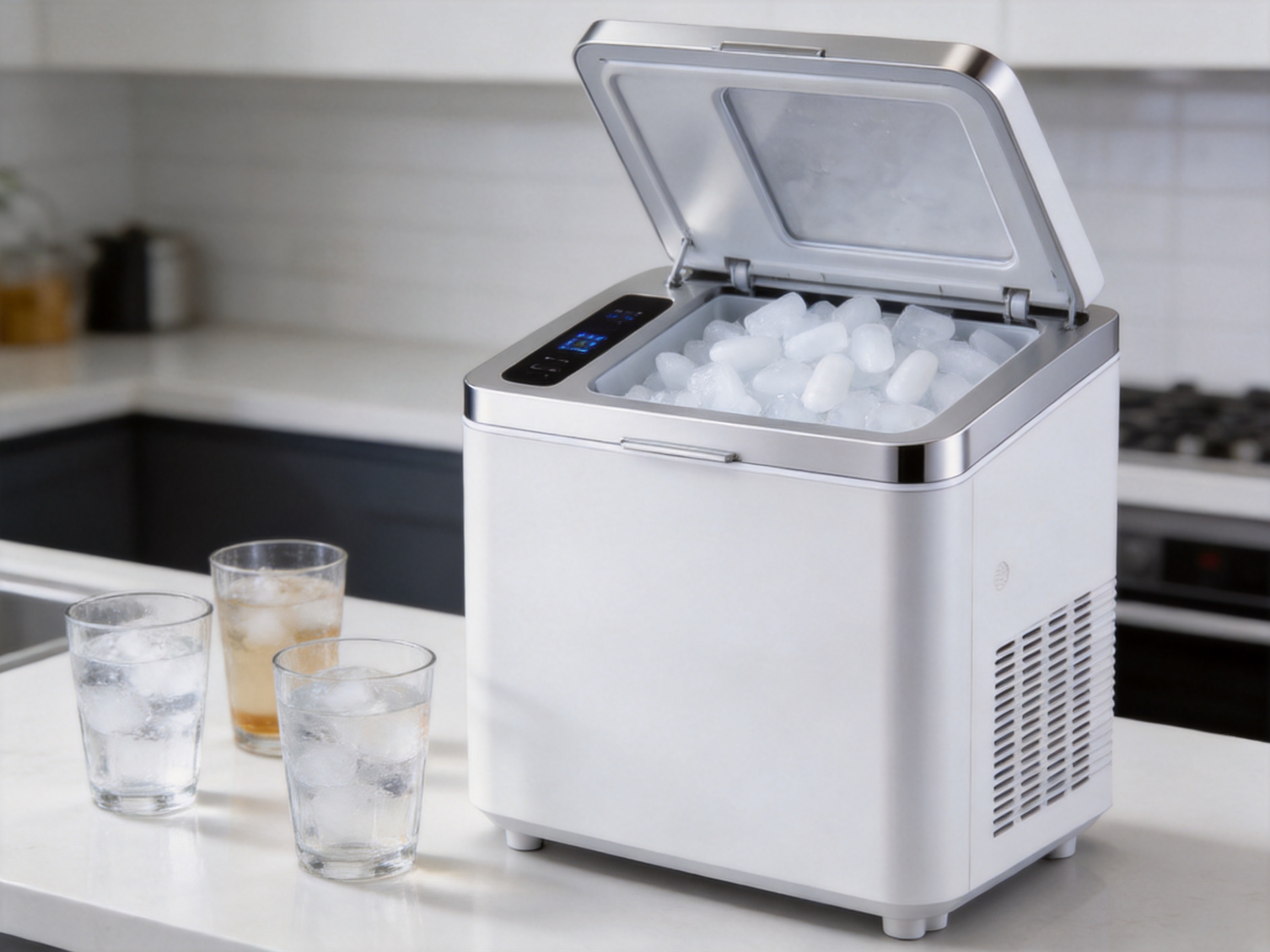
The product information describes a continuous ice-making principle. In practical terms, this means that the machine is designed to produce ice through an ongoing refrigeration and forming cycle rather than relying on a single tray that must be manually refilled and removed after every batch.
This approach is more convenient for users who need ice repeatedly throughout the day. Instead of preparing a limited number of cubes in a freezer tray, the operator can add water, begin the machine’s cycle, and collect ice as it becomes available. The exact production rate may vary according to water temperature, ambient temperature, ventilation, operating conditions, and other factors, but the continuous concept is well suited to regular demand.
In a commercial setting, continuous production can reduce interruptions. Employees do not need to dedicate time to filling multiple trays, waiting for them to freeze, and manually separating each batch. This can make the preparation process more organized, particularly during busy periods.
In a household, the same principle is useful before parties, family gatherings, outdoor meals, or weekend events. The user can prepare ice in advance and replenish the supply as necessary. The appliance provides an alternative to occupying a large amount of freezer space with storage bags or trays.
Efficiency should be considered in relation to the intended application. This is a compact countertop machine, not a substitute for a large-volume ice plant. Its strength lies in providing convenient ice production in a small footprint. Buyers should select the product according to their expected demand, available space, and desired operating pattern.
Compact Design for Space-Limited Environments
Many modern kitchens and beverage counters have limited room. Commercial rents are high, work surfaces are crowded, and household kitchens often need to accommodate several appliances at once. A large ice maker may offer high capacity but can be impractical where every centimeter matters.
With dimensions of 325 by 295 by 252 millimeters, the Alien-Z01 is designed to occupy a compact area. Its size makes it easier to place on a countertop, under an upper cabinet with sufficient clearance, near a beverage preparation area, or in a home kitchen where a full-size machine would be excessive.
A compact body can also simplify transportation and repositioning. A business may move the machine between a front counter, preparation room, event area, or temporary service station as operational needs change. Household users can store or relocate the product more easily than a bulky commercial unit.
Space efficiency does not mean that ventilation can be ignored. Like other refrigeration appliances, the machine should be placed with adequate clearance around the relevant ventilation areas. A stable, level surface is also recommended for safe operation and reliable water handling.
The compact structure is one of the product’s strongest advantages over oversized competitors. Users who require moderate ice production do not necessarily benefit from paying for a large cabinet, extensive installation, or unnecessary capacity. A smaller machine can be more appropriate, easier to integrate, and simpler to maintain.
Fully Opening Top for Better Hygiene
Hygiene is essential whenever an appliance produces ice for human consumption. Water, ice storage areas, internal surfaces, and removable components should be inspected and cleaned regularly. Difficult-to-reach corners can make this task inconvenient and may encourage irregular maintenance.
The Alien-Z01 uses a fully opening top design that allows users to access the ice storage and ice-making areas more completely. This is a significant practical advantage. A lid that opens widely provides better visibility and makes it easier to wipe, rinse, inspect, and dry the interior.
Open access can help eliminate hidden or neglected areas where moisture and residue might remain. While the exact cleaning procedure should follow the product manual, the general design supports a more thorough daily maintenance routine.
For commercial operators, a fully opening top can reduce the time required for cleaning at the end of a shift. Employees can see the relevant surfaces instead of working through a narrow opening. Better visibility can also make it easier to identify unusual buildup, standing water, or foreign material before the next operating period.
For households, easy access makes regular care less burdensome. Users are more likely to maintain an appliance when the cleaning process is straightforward. This supports a fresher ice-making environment and helps preserve the machine’s appearance and performance over time.
Cleaning should include the water-contact areas, ice storage compartment, lid, scoop if supplied, and external surfaces. Users should avoid harsh chemicals or abrasive tools unless they are specifically approved for the appliance. After cleaning, the interior should be rinsed appropriately and allowed to dry according to the manufacturer’s instructions.
Refrigerant and Power Configuration
The machine uses R600a refrigerant with a stated charge of 19 grams. R600a, also known as isobutane, is widely used in modern refrigeration equipment because of its thermodynamic properties and comparatively low global warming potential. Its use reflects the industry’s broader movement toward refrigerant solutions with reduced environmental impact compared with older refrigerant categories.
Because R600a is flammable, all refrigeration systems using it must be handled responsibly. Users should not attempt to open, modify, puncture, or repair the sealed refrigeration circuit. Installation, servicing, and refrigerant-related work should be conducted by qualified professionals following applicable safety requirements.
The product’s 150-watt rating supports its role as a compact appliance. A lower power requirement can be helpful for locations with limited electrical capacity and may contribute to reasonable operating costs when the machine is used according to its intended duty cycle.
Electrical compatibility remains important. The stated power supply is 220V–240V at 50Hz. Buyers should confirm that their local electrical system matches these requirements before purchase and operation. The machine should be connected to a suitable grounded outlet and should not share an overloaded circuit with other high-power appliances.
Power efficiency is not determined by wattage alone. Ambient temperature, ventilation, water temperature, cleaning condition, usage frequency, and the amount of ice stored can all affect performance. Correct placement and regular maintenance help the refrigeration system operate under more favorable conditions.
Designed Around Practical Human Use
A successful appliance is not defined only by its technical components. It must also fit naturally into the user’s routine. The touchscreen control concept, compact body, easy-access lid, and flowing ice shape all address common points of friction in daily ice preparation.
The touchscreen interface can make the machine feel more approachable to users who are familiar with digital household appliances. Clear controls can reduce confusion for first-time operators and make routine actions easier to remember. In a commercial environment, simple controls also help new employees learn the basic operating process more quickly.
The product’s physical form supports a logical workflow. Water can be added, the machine can be activated, ice can be collected, and the interior can be opened for cleaning. A design that keeps these actions accessible is valuable because it reduces the time and effort required for repeated use.
The rounded bullet ice also supports a comfortable handling process. Instead of dealing with sharp fragments or large irregular blocks, the user can scoop relatively uniform pieces. This is convenient for beverage service and reduces the need for manual breaking.
Human-centered design is particularly important for small appliances because users often operate them without specialized training. A product that communicates its functions clearly and makes maintenance easy can deliver more value than a technically complex machine with an inconvenient interface.
Advantages Compared with Traditional Freezer Trays
Traditional freezer trays remain inexpensive and familiar, but they have limitations. They normally produce a fixed number of cubes per cycle, require manual filling, occupy freezer space, and may be difficult to empty when the cubes stick to the tray. They also offer little control over the shape or quantity of ice available at a given time.
The Touchscreen Ice Maker offers a more convenient alternative for users who regularly need ice. It is purpose-built for ice production rather than using freezer space that may already be needed for food. Its continuous operating principle can provide a more dependable supply, and the bullet shape is more suitable for quick cooling and easy scooping.
A dedicated ice maker can also improve organization. Instead of storing bags of ice or stacking trays, users can keep the machine in a designated area and collect ice when necessary. This helps reduce clutter in the freezer and makes the source of the ice more predictable.
For households that only need a few cubes occasionally, a tray may remain sufficient. However, for families who entertain frequently, home beverage enthusiasts, offices, and small food businesses, the convenience of a dedicated machine can justify the investment.
Advantages Compared with Large Commercial Ice Machines
Large commercial ice machines are valuable for hotels, major restaurants, event venues, and operations with very high demand. They can produce and store substantial quantities of ice, but they also require more space, higher investment, more complicated installation, and more involved maintenance.
A compact bullet ice maker is better suited to users whose demand is moderate or variable. It can be placed near the actual beverage preparation area and may not require the same level of plumbing, structural support, or dedicated floor space as a large machine.
The smaller format also makes it easier to add ice production gradually. A small café or new beverage shop may begin with a countertop unit and evaluate demand before investing in larger equipment. This can help control initial costs and avoid purchasing more capacity than the business currently needs.
In addition, a compact machine can function as a supplementary ice source. A restaurant with a larger primary unit may use a smaller appliance at a secondary station, during temporary events, or as a backup for short periods. Its flexibility gives it value beyond the household market.
The appropriate comparison is therefore not simply capacity versus capacity. It is also installation, footprint, maintenance, mobility, operating simplicity, and suitability for the intended work environment. In these areas, a compact countertop design can have a meaningful advantage.
Manufacturing Strengths and Product Development Approach
Alien Technology Co., Ltd. is located in Zhouxiang, Zhejiang Province, an area known for the production and supply of small household appliances. This location provides access to an established appliance manufacturing ecosystem, including component suppliers, logistics services, processing resources, and technical experience.
A concentrated manufacturing environment can support more efficient coordination between product design, component sourcing, assembly, quality inspection, packaging, and shipment. For an appliance manufacturer serving overseas customers, reliable logistics and a mature supply chain are important parts of the overall product offering.
The company specializes in ice makers, coffee machines, and air fryers. Although these products serve different kitchen functions, they share several development requirements: compact mechanical design, electrical safety, heat or refrigeration management, user-friendly controls, material durability, and ease of cleaning.
The company’s stated mission is to use smart technology to simplify life and enhance happiness. In the Alien-Z01, this mission can be seen in the effort to combine modern control, efficient ice formation, compact dimensions, and accessible maintenance. The goal is not to add technology for its own sake, but to apply it to routine tasks that users perform repeatedly.
Advanced manufacturing is not limited to automated machinery. It also includes disciplined design review, accurate component matching, stable assembly procedures, functional testing, electrical safety checks, inspection of refrigeration performance, and consistent packaging. These processes help ensure that the finished appliance performs according to its intended specifications.
Design and Engineering Coordination
Ice makers bring together several systems in a relatively small enclosure. The design must accommodate water pathways, refrigeration components, electrical parts, controls, insulation, the ice-making area, and the storage compartment. Good engineering coordination is necessary to use space effectively without making cleaning or service unnecessarily difficult.
The Alien-Z01’s compact dimensions suggest an emphasis on efficient internal arrangement. A successful compact design must preserve access to important areas while keeping the overall footprint small. The fully opening top is an example of how physical accessibility can be considered during the design stage rather than added as an afterthought.
Product development should also account for the user’s environment. Countertop appliances may be used in warm kitchens, busy service areas, or locations where operators have limited time for maintenance. Materials, seals, controls, and structural parts must therefore be selected with repeated daily use in mind.
Component and Assembly Quality
Consistent assembly is essential for refrigeration appliances. Components must be positioned accurately, electrical connections must be secure, and the refrigeration circuit must be properly sealed. Small errors can affect cooling performance, noise, energy use, or long-term reliability.
A professional manufacturing process normally includes assembly instructions, work-station controls, inspection procedures, and functional tests. These measures help reduce variation between individual units. They also make it easier to identify and correct issues before products are packaged and shipped.
For international customers, manufacturing consistency is particularly important. Products may travel long distances, pass through different distribution environments, and be used under different climate conditions. Stable production and careful packaging help protect the product during this process.
Functional Testing and Quality Control
Quality control for an ice maker should consider more than external appearance. A complete evaluation may include power-on operation, control response, water filling, ice formation, ice release, storage access, temperature behavior, electrical safety, and inspection for leakage or abnormal noise.
Testing should be connected to the product’s stated specifications. The power supply, rated current, power consumption, refrigerant system, dimensions, and operating functions should be verified through appropriate production and inspection procedures. Visual inspection remains useful, but performance testing is essential for a refrigeration appliance.
The company’s commitment to quality, customer satisfaction, continuous improvement, and innovation indicates an approach that values feedback after production as well as inspection before shipment. Customer comments can reveal opportunities to improve controls, cleaning access, packaging, instructions, or future versions of the product.
Continuous improvement is especially relevant for small appliances because users compare not only basic performance but also convenience. A machine that produces ice correctly but is difficult to clean may receive a lower evaluation than a model that offers a similar output with a more practical maintenance design.
Recommended Operating Practices
Before first use, the appliance should be placed on a clean, stable, level surface with adequate ventilation. The exterior and accessible interior areas should be cleaned according to the instructions supplied with the product. Users should confirm the electrical rating and ensure that the power cord and plug are in good condition.
Only clean, potable water should be used for ice intended for consumption. Water quality can influence taste, odor, mineral deposits, and cleaning frequency. If the local water supply is hard or has a strong flavor, filtered water may improve the quality of the finished ice, provided that it is suitable for the machine.
The water reservoir should not be overfilled. Users should follow the indicated water level and avoid placing objects other than water into the reservoir. The ice storage area should also be kept free of foreign material and should not be used for long-term storage of food or other items.
Freshly produced ice should be handled with a clean scoop or clean hands. The scoop should be stored in a hygienic location and washed regularly. Users should avoid touching ice repeatedly with bare hands, particularly in commercial environments where several people may handle the appliance.
The machine should be cleaned regularly, even when it appears clean. Water-contact components and the ice storage area should be inspected for residue or mineral buildup. At the end of a storage period or before extended non-use, the unit should be emptied, cleaned, and dried according to the manufacturer’s guidance.
Because the product uses R600a refrigerant, users should never attempt to drill, cut, or disassemble the refrigeration system. Any refrigerant-related repair should be performed by an appropriately qualified technician.
Applications in Different Settings
Households
At home, the machine can support everyday cold drinks, weekend gatherings, family meals, and special occasions. It is useful for users who enjoy iced coffee, tea, juice, smoothies, mixed drinks, and other chilled beverages but do not want to rely on freezer trays.
The compact size makes it suitable for kitchens where storage is limited. It can also serve as a convenient appliance for entertaining because users can prepare ice close to the serving area rather than repeatedly carrying trays from the freezer.
Milk Tea and Beverage Shops
Milk tea shops often need ice that cools quickly, flows easily, and provides a pleasant texture. Bullet ice is widely associated with this type of service because its shape works well in transparent cups and its moderate hardness is appealing to many customers.
The machine’s practical design can support a smaller beverage outlet, a secondary drink station, or a shop that needs additional ice during peak hours. Operators should evaluate expected demand carefully and use the product within its intended capacity.
Fast-Food Restaurants
Fast-food operations require speed, consistency, and straightforward cleaning. Ice that can be scooped quickly and added to beverages with minimal handling supports an efficient service workflow. The fully opening top also helps staff complete cleaning duties more effectively.
For a small restaurant or food stall, a compact countertop machine can be easier to accommodate than a large floor-standing unit. It may be placed near the drink preparation station, reducing unnecessary movement for employees.
Offices and Shared Spaces
Offices, studios, salons, guesthouses, and shared facilities may need a steady supply of ice without requiring a full commercial kitchen. A compact ice maker can provide a useful amenity for employees, visitors, or customers while occupying limited space.
Events and Temporary Service Areas
The product may also be useful for small events, temporary beverage counters, demonstrations, and catering support, provided that the electrical supply, water access, ventilation, and operating conditions are suitable. Its compact format makes it easier to integrate into a temporary setup than larger fixed equipment.
Why the Product Offers Strong Value
The value of the Alien-Z01 comes from the combination of several features rather than from a single specification. Its bullet ice provides rapid cooling and a distinctive texture. Its rounded form supports easier scooping. Its compact body saves space. Its touchscreen-style operation presents a modern user experience. Its fully opening top supports cleaning and inspection. Its power and refrigerant configuration suit a compact appliance format.
Many competing products may emphasize only speed or production quantity. A practical buyer, however, also considers how easily the machine can be cleaned, where it can be placed, how the ice behaves during handling, and whether the controls are understandable. By addressing these daily concerns, the product can compete effectively in the countertop ice maker category.
The company’s specialization in small household appliances further strengthens its position. Experience across ice makers, coffee machines, and air fryers provides familiarity with compact product architecture, kitchen environments, consumer expectations, and international appliance requirements.
For distributors and business buyers, the product may also offer a clear category fit. It can be marketed to household users, beverage shops, quick-service restaurants, offices, and hospitality applications. Its combination of functional features and compact dimensions allows different sales channels to communicate practical benefits without relying on excessive technical complexity.
Purchasing Considerations
Before purchasing, buyers should verify that the 220V–240V, 50Hz electrical specification is compatible with the intended market. They should also confirm the available counter space and provide sufficient room for ventilation, water filling, ice collection, and lid opening.
Demand planning is equally important. A compact machine is appropriate for moderate ice requirements, but a high-volume restaurant or hotel may require a larger system or multiple units. Buyers should consider peak-hour demand rather than average daily consumption alone.
Water quality, cleaning resources, and staff routines should also be evaluated. The product is designed to make cleaning more accessible, but hygiene still depends on regular human attention. Businesses should establish a cleaning schedule and assign responsibility for inspection and maintenance.
Importers and distributors should review local electrical, safety, labeling, packaging, and appliance regulations. They should also clarify warranty arrangements, technical support, spare parts, user instructions, and after-sales service before placing large orders.
These considerations do not reduce the product’s advantages. Instead, they help ensure that the machine is placed in an environment where its compact design, ice shape, control system, and cleaning structure can provide their full value.
Q&A
What type of ice does the machine produce?
The machine produces bullet-shaped ice. This type of ice has a rounded profile and a perforated or hollow center, which can increase contact with beverages and support rapid cooling.
Is the machine suitable for home use?
Yes. Its compact dimensions and countertop format make it suitable for households, especially those that regularly prepare iced drinks or entertain guests. Users should ensure that the electrical supply and available ventilation are appropriate.
Can it be used in a commercial beverage shop?
It can be suitable for milk tea shops, cafés, fast-food outlets, and other small beverage operations with moderate ice demand. Businesses with very high demand should compare the machine’s practical production capability with their peak requirements and consider supplementary or larger equipment if necessary.
What are the advantages of bullet ice over solid cubes?
Bullet ice can cool beverages quickly because its perforated center increases contact with the surrounding liquid. It is also generally easier to scoop, less likely to form an unmanageable mass, and often provides a softer, more enjoyable texture than dense solid cubes.
Does the ice tend to stick together?
The product information emphasizes the high flowability of its ice shape and its ability to reduce clumping during storage and dispensing. Actual results can vary with operating conditions, storage time, ambient temperature, and water quality.
How does the fully opening top help users?
The fully opening top provides broader access to the ice storage and ice-making areas. This improves visibility and makes routine cleaning, inspection, and maintenance more convenient than designs with narrow or restricted openings.
What power supply does the machine require?
The stated power supply is 220V–240V at 50Hz. The rated current is 0.9 amperes and the rated power is 150 watts. Buyers should confirm compatibility with their local electrical system before operation.
What refrigerant does the machine use?
The machine uses R600a refrigerant with a stated charge of 19 grams. Because R600a is flammable, users must not open or modify the refrigeration circuit. Refrigeration repairs should be completed by qualified professionals.
How often should the ice maker be cleaned?
Cleaning frequency depends on usage, water quality, and the operating environment. The ice storage and water-contact areas should be inspected regularly and cleaned according to the manufacturer’s instructions. Commercial users may need a more frequent schedule than occasional household users.
Can the machine be placed anywhere on a kitchen counter?
It should be placed on a stable, level surface with sufficient ventilation and access for water filling, ice collection, and opening the top. It should not be positioned where heat, moisture, or restricted airflow could interfere with operation.
Is the touchscreen difficult to use?
The touchscreen-style interface is intended to provide a modern and straightforward control experience. Users should follow the supplied instructions for specific functions, indicators, and operating procedures.
What makes the product different from a freezer tray?
Unlike a freezer tray, the machine is dedicated to producing ice and does not require the user to fill and remove individual trays. Its continuous ice-making principle, bullet shape, storage area, and easy-access design provide greater convenience for regular ice demand.
What makes it different from a large commercial ice machine?
The main difference is scale and installation. This model is a compact countertop appliance intended for moderate demand. It uses less space and may be easier to integrate into a home, small shop, office, or secondary beverage station than a large commercial system.
Who manufactures the product?
The product is manufactured by Alien Technology Co., Ltd., a Zhejiang-based company specializing in ice makers, coffee machines, and air fryers. The company emphasizes quality, customer satisfaction, continuous improvement, innovation, and practical smart technology.
Conclusion
The Touchscreen Ice Maker is designed for users who want convenient ice production without the size and complexity of a large commercial machine. Its bullet-shaped ice supports rapid beverage cooling, easy scooping, reduced clumping, and a pleasant texture. Its 325 × 295 × 252-millimeter body is suitable for space-conscious environments, while the 150-watt power rating and R600a refrigerant support its compact appliance design.
The fully opening top is one of the product’s most practical features because it improves access to the ice-making and storage areas. This makes cleaning and inspection more manageable, helping users maintain a hygienic operating environment. The touchscreen-style controls add a contemporary user experience, while the continuous ice-making principle offers greater convenience than conventional freezer trays.
Manufactured by a company specializing in small household appliances, the product reflects an approach that combines functional design, modern technology, practical manufacturing coordination, and attention to customer needs. Its strongest advantage is balance: it provides useful ice performance, compact placement, accessible maintenance, and flexible application in one countertop format.
For households, beverage shops, fast-food restaurants, offices, and small hospitality operations, the machine can be a valuable solution when the priority is convenient, hygienic, and space-efficient bullet ice production. By selecting the product according to actual demand and following correct operating and cleaning practices, users can make the most of its design and manufacturing strengths.
References
Appliance Design Principles for Compact Refrigeration Equipment. Technical reference on space utilization, ventilation, user access, and maintenance considerations.
Food and Beverage Equipment Hygiene Practices. General reference on cleaning schedules, water-contact surfaces, ice handling, and sanitary operation.
Household and Commercial Ice-Making Technologies. Industry reference on bullet ice, solid cubes, continuous ice-making systems, and application selection.
Refrigeration Safety Guidance for Hydrocarbon Refrigerants. Technical reference on R600a handling, sealed systems, service precautions, and qualified repair procedures.
Small Appliance Manufacturing and Quality Control Methods. Industry reference on component inspection, assembly consistency, functional testing, electrical safety, and continuous improvement.
Product specification materials for the Touchscreen Ice Maker, model Alien-Z01.