
 English
 한국어
 Español
 Deutsch
Modern kitchens, home bars, offices, cafés, and outdoor entertaining spaces all benefit from a dependable supply of ice. A compact ice maker can provide that supply without requiring a large freezer, a permanent water line, or the installation space associated with a full-size commercial machine. The Knob-type ice maker, identified as the Alien-Z02, is designed to answer this need with a compact body, a focused 150-watt refrigeration system, and a practical bullet-ice format.
As a bullet ice maker, this appliance is intended for users who want ice produced conveniently and efficiently at home or in small commercial environments. Its hollow-centered bullet cubes are suitable for soft drinks, cocktails, iced coffee, fruit beverages, and everyday chilled water. The product combines straightforward operation with a space-conscious design, making it a useful alternative to relying entirely on freezer ice trays or purchasing bags of ice.
The machine is manufactured by Alien Technology Co., Ltd., a Zhejiang-based household-appliance company specializing in ice makers, coffee machines, and air fryers. The company’s product philosophy centers on practical design, dependable quality, continuous improvement, and the use of technology to simplify daily life. These priorities are reflected in the product’s compact dimensions, stable electrical specifications, environmentally considerate refrigerant, and emphasis on convenient ice production.
This article examines the product’s specifications, operating concept, design advantages, applications, manufacturing strengths, maintenance requirements, and competitive position. It also explains how the appliance can fit into different lifestyles while identifying important points that buyers should confirm before purchase.
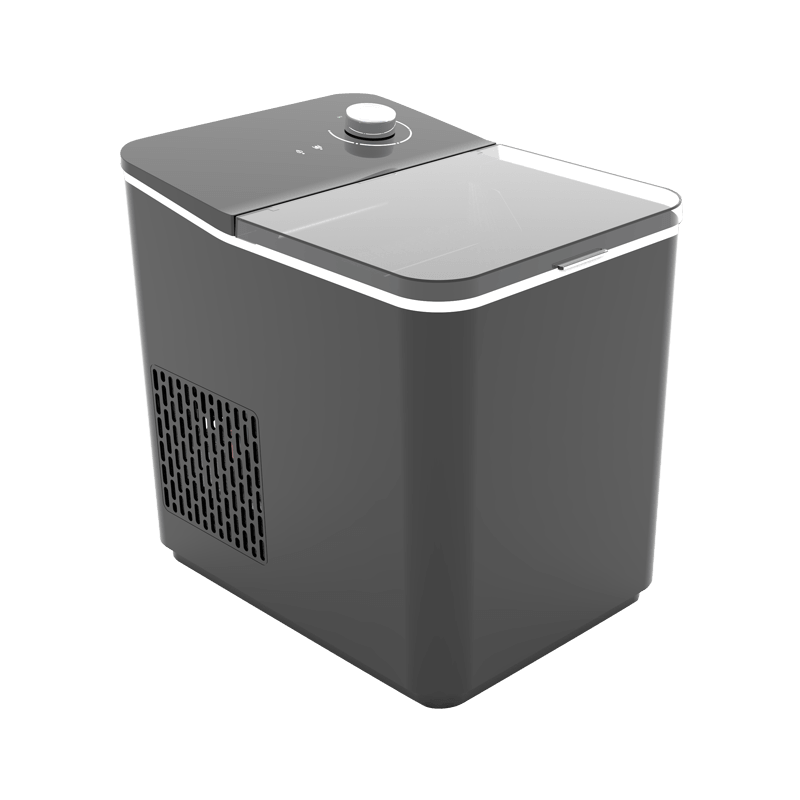
Knob-type ice maker
Product Overview
The Alien-Z02 is a home bullet ice maker with a knob-type control concept. Rather than depending on a complicated installation process, the appliance is designed as a countertop unit that can be placed where ice is needed. Its compact form makes it appropriate for kitchens, bars, entertainment areas, offices, recreational vehicles, and outdoor locations where a suitable power supply is available.
The principal function is the production of bullet-shaped ice. This shape is widely used in domestic ice makers because it can be produced relatively quickly and is convenient for filling glasses, pitchers, shakers, and coolers. The hollow center gives the ice a distinctive appearance and allows it to chill beverages efficiently while remaining practical for routine use.
The listed electrical specification is 220V–240V at 50Hz, with a current and power rating of 0.9A and 150W. These figures indicate a moderate-power appliance designed for household or light-duty operation rather than a large industrial ice-production system. The refrigerant is R600a, also known as isobutane, with a listed charge of 19 grams.
Product Attribute | Specification |
Product Type | Knob-type bullet ice maker |
Model Description | Alien-Z02 |
Power Supply | 220V–240V / 50Hz |
Current and Power | 0.9A / 150W |
Refrigerant | R600a |
Refrigerant Charge | 19g |
Listed Machine Dimensions | 313 × 226 × 309mm |
Additional Dimensions Provided in Product Information | 325 × 295 × 252mm |
Primary Application | Home, countertop, bar, office, and outdoor ice production |
The source material provides two different dimensional descriptions: 313 × 226 × 309mm in the technical table and 325 × 295 × 252mm in the product information. Because countertop clearance is important, buyers, distributors, and retailers should confirm the final external dimensions, including any lid, control, ventilation, or handle clearance, before installation or packaging design.
Fast and Convenient Bullet Ice Production
The central advantage of a countertop ice maker is convenience. Traditional freezer trays require filling, leveling, freezing, and manually removing the ice. They also occupy freezer space and may not provide enough ice when several people are entertaining. Bagged ice requires advance purchasing and additional storage. A dedicated ice maker offers a more direct solution by producing ice at the point of use.
The product information describes the machine as using a high-performance refrigeration system to produce bullet ice in a short time. The precise production cycle and daily output should be confirmed from the final technical documentation, but the intended benefit is clear: users can obtain freshly produced ice without waiting for a freezer tray to solidify.
Bullet ice is especially useful because its shape is adaptable. It can be added to tall glasses, tumblers, pitchers, cocktail shakers, and portable coolers. The hollow center provides an attractive visual feature and creates a practical chilling surface. The ice can help cool beverages quickly while allowing the flavor of the drink to remain recognizable rather than becoming immediately overwhelmed by a large, dense block.
For households, this means greater flexibility during breakfast, family meals, parties, and warm-weather gatherings. For a home bar, bullet ice can support mixed drinks and chilled spirits. For an office, it can provide a convenient option for water and soft drinks. In a small hospitality setting, it can supplement existing ice capacity during periods of moderate demand.
Why Bullet Ice Is Suitable for Everyday Drinks
Bullet-shaped ice is often selected for its balance between usability and production efficiency. The rounded exterior is easy to handle, while the hollow center contributes to fast beverage chilling. Its shape also fits many common drink containers without requiring special tools or large storage bins.
Compared with irregular pieces made by breaking ice trays, bullet ice offers a more consistent appearance. Consistency is valuable when beverages are served to guests or photographed for menus and social media. The uniform format can also make portioning more predictable, although the actual size and weight of each piece should be verified with the supplier’s final product documentation.
The product information states that the shape is less prone to melting than certain alternatives. In practical use, melting depends on room temperature, beverage temperature, ice size, airflow, and serving time. Nevertheless, the bullet format is designed to provide useful chilling performance while maintaining a recognizable shape during normal beverage service.
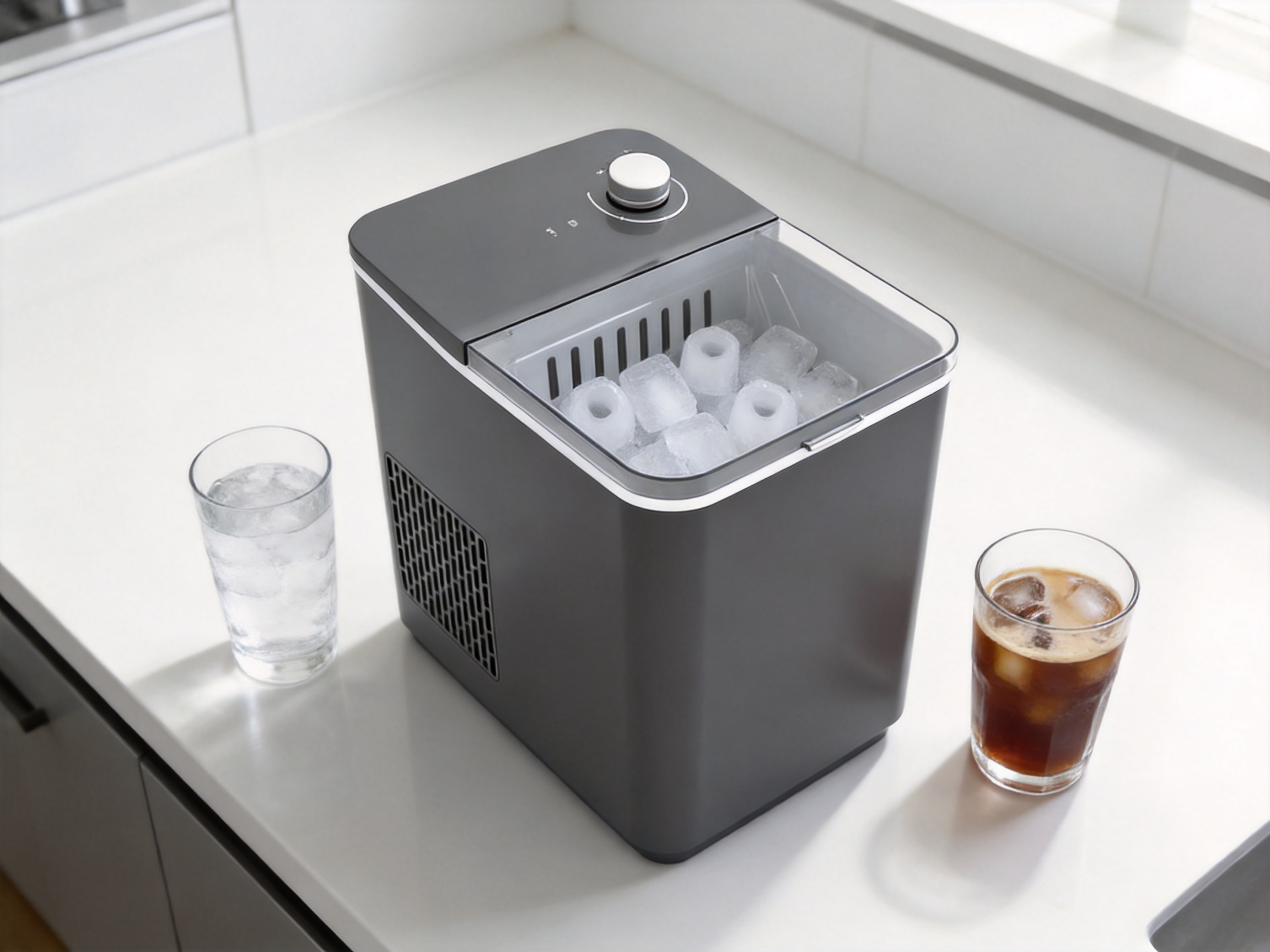
Compact Design for Flexible Placement
Space efficiency is one of the most important differences between a countertop ice maker and a larger freestanding appliance. The product is designed to occupy a limited footprint, allowing it to be placed on a kitchen counter, bar counter, work surface, or suitable outdoor table. This makes it appropriate for apartments, compact homes, recreational areas, and businesses where floor space is limited.
A compact appliance can also be easier to reposition. Users may keep it in the kitchen during the week, move it to a bar or dining area during a gathering, and place it outdoors for a summer event. This flexibility is especially valuable when the need for ice changes from one occasion to another.
The lightweight and compact design described in the product information supports easier handling and storage. Even so, the machine should be placed on a stable, level surface with enough clearance for ventilation, access to the controls, and safe connection to the power supply. It should not be crowded against walls or surrounded by objects that could interfere with heat dissipation.
Integration into Different Environments
In a home kitchen, the ice maker can serve as a dedicated source of drink ice without taking over the freezer. In a home bar, it can be positioned close to mixing tools, glasses, syrups, and chilled ingredients. In an office, it can support shared beverage areas without requiring staff to fill trays repeatedly. In a guest room, event space, or recreational vehicle, it can provide additional convenience when the electrical conditions are suitable.
Outdoor use can be practical for patios, campsites with appropriate power, poolside areas, and garden gatherings. However, the machine should be protected from rain, splashing water, excessive humidity, direct sunlight, and unstable surfaces. Outdoor placement does not remove the need for normal electrical and appliance safety precautions.
The product’s small footprint may also help distributors and retailers. More units can potentially be displayed or stored in a limited showroom area. Its compact packaging profile may support efficient logistics, although shipping dimensions and carton specifications should be obtained separately from the manufacturer.
Energy-Conscious Refrigeration System
The appliance uses R600a refrigerant with a listed charge of 19 grams. R600a is a natural hydrocarbon refrigerant commonly used in modern refrigeration equipment. The product information highlights its comparatively low global warming potential and its alignment with broader environmental trends.
Refrigerant choice is only one part of an appliance’s environmental performance. Actual energy consumption is influenced by ambient temperature, operating frequency, water temperature, ventilation, insulation, component efficiency, and user habits. The listed 150-watt power rating provides an important reference point, but it should not be treated as the same thing as total energy consumed over an entire day.
For users, energy-conscious operation includes placing the ice maker away from heat sources, allowing appropriate ventilation, using clean water, keeping the condenser area free of dust, and avoiding unnecessary operation when sufficient ice has already been produced. These simple practices can support stable performance and reduce avoidable operating losses.
R600a is flammable under certain conditions, as is generally recognized for hydrocarbon refrigerants. Users should not puncture, modify, refill, or repair the sealed refrigeration system themselves. Servicing should be performed by qualified personnel using procedures appropriate for the refrigerant and appliance design. The product should also be transported, installed, and disposed of according to applicable local requirements.
Stable Operation Through Appropriate Power Design
The 220V–240V, 50Hz specification identifies the intended electrical environment for the product. The 0.9A and 150W ratings provide useful information for buyers evaluating household circuits, extension requirements, and commercial display planning. The machine should be connected to a compatible, properly grounded outlet and should not be operated with damaged cords, loose connections, or unsuitable adapters.
Stable operation depends on more than the rated power. Adequate ventilation, a level surface, proper water filling, and regular cleaning all affect the refrigeration cycle and the quality of the finished ice. A well-maintained compact machine can be more convenient and economical than repeatedly buying packaged ice, particularly for users who consume ice regularly.
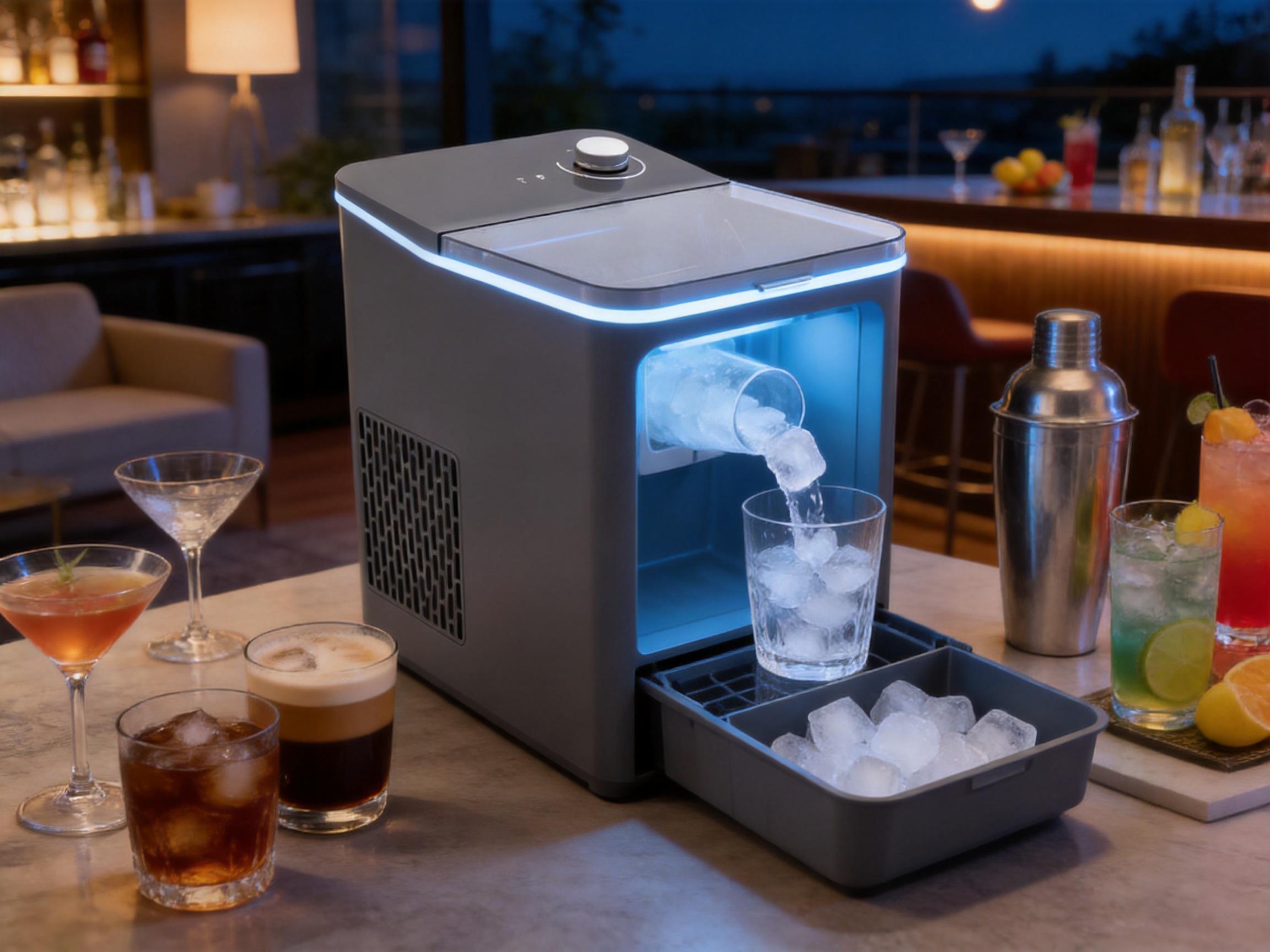
Advantages Compared with Common Alternatives
Compared with Freezer Ice Trays
Ice trays are inexpensive and familiar, but they require freezer space and advance planning. They also involve repeated filling and removal, and their ice may absorb odors if the freezer is crowded. A dedicated bullet ice maker reduces these inconveniences by producing ice in a separate appliance and presenting it in a consistent format.
The countertop machine can be particularly advantageous when freezer capacity is already needed for frozen food. It also avoids the physical effort of twisting multiple trays and reduces the likelihood of spilling water inside the freezer. For households that host guests regularly, the convenience difference can be substantial.
Compared with Bagged Ice
Bagged ice is useful for parties and large events, but it requires shopping, transport, storage, and disposal of packaging. Its availability and quality may vary by location. A countertop ice maker allows users to make ice at home as needed, reducing dependence on retail supply for normal daily consumption.
Bagged ice may still be appropriate for very large gatherings or emergency reserves. The strength of the Alien-Z02 is not necessarily replacing every commercial ice source, but providing a reliable everyday supplement in a compact format.
Compared with Large Commercial Ice Machines
Large commercial machines can deliver high output, but they usually require more floor space, higher investment, greater electrical capacity, and more extensive maintenance. They may be unnecessary for homes, small offices, and low-volume beverage service. A 150-watt countertop design is better aligned with light-duty applications where convenience and space efficiency matter more than industrial production capacity.
The compact machine also offers a simpler path for businesses testing a beverage concept, operating a small office pantry, or adding ice service to a limited menu. A larger commercial system may remain the correct choice for restaurants, hotels, and high-volume catering operations, but the smaller format can be more economical for moderate demand.
Compared with Generic Countertop Ice Makers
Many countertop ice makers appear similar, so meaningful comparison should involve more than appearance. Buyers should evaluate the refrigerant, power rating, dimensions, control method, service support, manufacturing consistency, cleaning guidance, packaging, and supplier responsiveness.
This product distinguishes itself through its clearly listed electrical and refrigerant specifications, compact design intent, bullet-ice format, and connection to a manufacturer focused on several categories of small household appliances. A company that works across ice makers, coffee machines, and air fryers can develop broader experience with compact appliance design, user interfaces, thermal systems, plastic housings, electrical assemblies, and consumer-product quality requirements.
Practical Control and User Experience
The product is identified as a knob-type ice maker, suggesting a straightforward control approach. A physical knob can be easy to understand and operate, particularly for users who prefer direct controls over complex menus. It may also be suitable for environments where several family members or staff need to use the appliance without extensive instructions.
The supplied alias includes the phrase “Touchscreen ice maker,” but the product title and category identify the unit as knob-type. Buyers should therefore confirm the final control interface, display arrangement, and user manual before placing an order. Accurate control information is important for product listings, retail packaging, and customer expectations.
A simple control system can be an advantage when the main task is producing ice rather than managing a large number of programs. Users generally want to add water, start the machine, monitor production, and remove the ice. Clear indicators for power, water level, ice-full status, and operating condition would further improve usability, although the availability of these specific indicators should be confirmed in the final specification.
Water Quality and Ice Quality
Because the ice is intended for beverages, clean water is essential. Users should follow local drinking-water guidance and the manufacturer’s recommendations. Water with strong odors, excessive mineral content, or visible impurities may affect taste, appearance, and internal cleanliness.
Regular cleaning is equally important. Water reservoirs, ice-contact surfaces, collection areas, and drainage components can accumulate residue if they are not maintained. A consistent cleaning routine helps preserve the taste and appearance of the ice and supports reliable operation over time.
Manufacturing Strengths and Product Development Capability
Alien Technology Co., Ltd. is located in Zhouxiang, Zhejiang Province, an area recognized in the supplied company information as a hub for small household-appliance manufacturing with convenient logistics. This location can support access to component suppliers, production services, packaging resources, and transportation networks relevant to consumer appliances.
The company specializes in ice makers, coffee machines, and air fryers. These products share several development requirements: compact structures, electrical safety, heat or refrigeration management, user-friendly controls, consumer-oriented appearance, and repeatable assembly quality. Experience across multiple appliance categories can help a manufacturer understand how to balance performance, cost, reliability, and visual design.
The company states that its mission is “Smart Technology, Simplifying Life, Enhancing Happiness.” In the context of this ice maker, that mission is expressed through a product that reduces the routine work associated with obtaining ice. Instead of treating ice production as a complicated installation project, the appliance presents it as a convenient daily function within reach of ordinary households.
The company also emphasizes excellent quality, customer satisfaction, continuous improvement, and innovation. These principles are important in small-appliance manufacturing because customer experience depends on many details beyond the primary function. Housing fit, control response, noise management, water handling, packaging protection, documentation, and after-sales communication all influence whether a product is perceived as dependable.
Importance of Consistent Assembly
For a compact ice maker, consistent assembly is essential. The refrigeration circuit, electrical system, fan, water pathway, control components, and outer housing must work together within a limited space. Poor alignment or inconsistent connections can affect vibration, cooling performance, leakage protection, and service life.
A professional manufacturing process should include incoming inspection of key components, controlled assembly procedures, electrical checks, refrigeration-system verification, visual inspection, and functional testing. The specific tests used for the Alien-Z02 should be confirmed with the manufacturer, but these are the types of controls that help transform a design specification into a dependable finished appliance.
Production consistency also matters when supplying international customers. Export buyers may require stable dimensions, repeatable electrical ratings, correct labeling, suitable packaging, and documentation in agreed formats. A manufacturer with a quality-oriented and pragmatic business philosophy can be better positioned to manage these requirements over repeated orders.
Design for Logistics and Distribution
Compact appliances must survive multiple stages of handling, from factory packing to warehouse storage, transportation, retail display, and final delivery. Product dimensions, protective materials, carton structure, and internal stabilization all influence the likelihood of damage in transit.
The small form factor of this ice maker can help reduce storage demands and make product placement easier for retailers. It may also offer advantages when distributors consolidate shipments of several household-appliance categories. Nevertheless, shipping weight, carton dimensions, pallet quantity, drop-test performance, and packaging materials should be requested separately for commercial planning.
The company’s location in a region with convenient logistics is a practical advantage for domestic and international cooperation. Efficient logistics can support shorter communication cycles, more predictable component movement, and smoother shipment coordination. These benefits do not replace product quality, but they can strengthen the overall supply relationship.
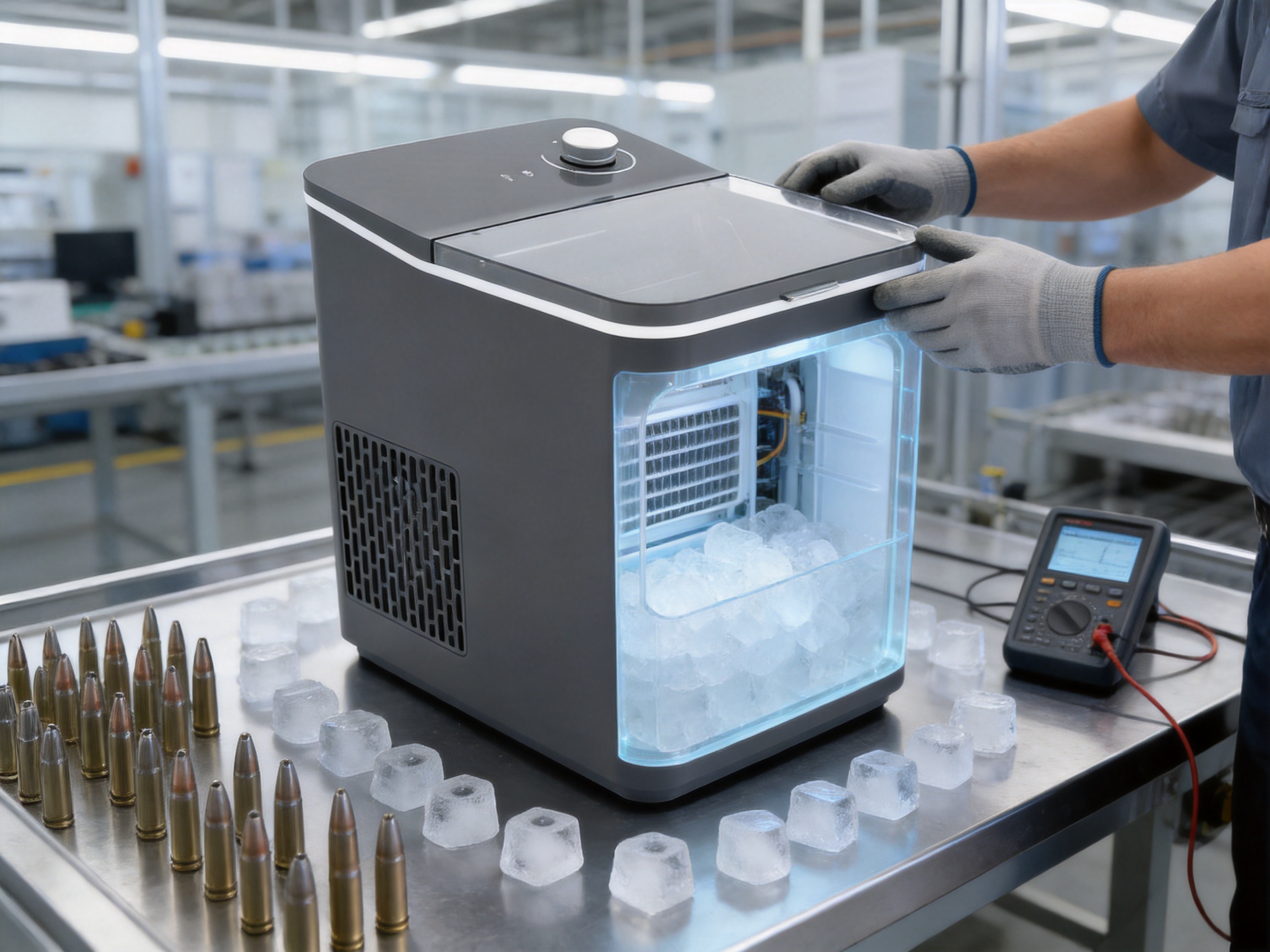
Maintenance and Long-Term Ownership
Regular maintenance is necessary for any appliance that handles water and produces food-contact ice. Before cleaning, the machine should be switched off and disconnected from the power supply. Remaining water and ice should be removed according to the instructions. Surfaces that contact water or ice should be cleaned using approved methods, and the unit should be allowed to dry properly.
Users should avoid abrasive tools, harsh chemicals, and unauthorized internal modifications. The outer housing should be wiped with a suitable soft cloth. Ventilation openings should remain free of dust and obstruction. If the machine develops unusual noise, leakage, a burning smell, electrical instability, or a substantial reduction in cooling performance, it should be stopped and inspected by qualified service personnel.
The refrigeration system should not be opened by untrained users. Since the product uses R600a, service providers must understand the requirements associated with flammable refrigerants. Repairs should use compatible components and follow the manufacturer’s technical procedures.
Placement Recommendations
The ice maker should be installed on a firm, level surface. It should not be placed directly beside a cooker, oven, radiator, or other heat-producing appliance. Adequate clearance should be provided around ventilation areas, and the machine should not be enclosed in a cabinet unless the manufacturer specifically approves that installation.
Before purchase, users should compare the confirmed product dimensions with the available counter space. Because two dimension sets are included in the supplied materials, the final measurement should be obtained from the manufacturer. Buyers should also account for space needed to open the lid, access the water reservoir, remove ice, and route the power cable safely.
Applications for Homes and Small Businesses
The product’s primary market is the home. Families can use it during meals, celebrations, holidays, and warm weather. Individuals who regularly prepare iced coffee, smoothies, soft drinks, cocktails, or chilled tea may appreciate having ice available without using freezer trays.
Home entertainers can position the unit near a serving station. Its bullet ice can support mixed drinks and chilled beverages while contributing to a neat and consistent presentation. Because the unit is compact, it can be stored when not required or moved closer to the area where guests are being served.
Small offices can use the appliance in a staff kitchen or break area. It can provide ice for water bottles and shared drinks without occupying a large amount of space. Guesthouses, studios, beauty businesses, fitness facilities, and small retail environments may also find it useful when their ice demand is moderate.
Restaurants, cafés, and bars should assess expected ice volume before selecting equipment. The Alien-Z02 may be appropriate as a supplemental unit, a backup source, or a solution for limited beverage service. High-volume operations should compare the product’s confirmed production capacity with peak demand and may require a larger commercial machine.
Purchasing Considerations for Distributors and Importers
Business buyers should request a complete technical package before ordering. This should include the final product dimensions, net and gross weight, ice-production capacity, water-reservoir capacity, ice-basket capacity, operating noise information, cycle time, packaging dimensions, warranty terms, and applicable compliance documentation.
The electrical specification should be matched to the destination market. The supplied rating of 220V–240V and 50Hz is suitable only for compatible electrical systems. Importers should also confirm plug type, cord specification, labeling language, user-manual requirements, energy information, and any local certification obligations.
Retail listings should present the product type accurately. Since the supplied materials identify it as a knob-type ice maker while the alias refers to a touchscreen, the final interface should be verified before advertising. Clear product information reduces returns and helps build customer trust.
Commercial buyers may also ask about minimum order quantities, sample procedures, production lead times, color and housing options, private-label services, spare parts, quality-control reports, and after-sales support. These matters are not provided in the current product information and should be discussed directly with the manufacturer.
Balanced Evaluation of the Product
The strongest value of this ice maker is its balance of convenience, compactness, and practical refrigeration performance. It is not presented as a large commercial production system; instead, it is designed for users who want accessible ice in a small footprint. Its 150-watt rating and 220V–240V supply specification give buyers a clear starting point for evaluating compatibility.
The bullet-ice format is another significant advantage. It is familiar, attractive, and suitable for many beverages. The hollow-centered design supports rapid chilling and offers a distinctive appearance compared with ordinary tray ice. The machine’s compact nature also allows it to serve multiple locations without demanding permanent floor space.
The use of R600a reflects attention to modern refrigerant practices and environmental considerations. However, responsible use requires proper servicing, ventilation, and disposal. Buyers should evaluate the full lifecycle of the product, including energy use, maintenance, packaging, and service availability.
The primary areas requiring confirmation are the inconsistent dimensions, the exact user interface, the production capacity, and other operating details not included in the supplied materials. These are normal points for technical due diligence rather than fundamental weaknesses. Once verified, they can help buyers determine whether the product is best suited to household use, supplemental business use, or distribution in a particular market.
Questions and Answers
What type of ice does the machine produce?
The appliance is designed to produce bullet-shaped ice with a hollow center. This format is suitable for water, soft drinks, iced coffee, cocktails, and other chilled beverages.
Is this ice maker intended for home use?
Yes. The product information presents it as a home bullet ice maker. Its compact countertop design may also suit offices, home bars, small hospitality settings, and other locations with moderate ice demand.
What power supply does the product require?
The listed power supply is 220V–240V at 50Hz. Buyers should confirm that their local electrical system, outlet, plug, and safety requirements are compatible before operation.
How much power does it use?
The listed current and power ratings are 0.9A and 150W. Actual energy consumption over time depends on operating conditions, ambient temperature, cycle frequency, ventilation, and usage habits.
What refrigerant is used?
The machine uses R600a refrigerant with a listed charge of 19 grams. Because R600a is a flammable hydrocarbon refrigerant, the sealed refrigeration system should only be serviced by appropriately qualified personnel.
Where can the machine be placed?
It can be placed on a suitable kitchen countertop, bar counter, office surface, or protected outdoor table. The surface should be level and stable, and adequate ventilation clearance should be maintained.
What are the product dimensions?
The technical table lists dimensions of 313 × 226 × 309mm, while the product information lists 325 × 295 × 252mm. These figures should be confirmed with the manufacturer before purchase, installation, packaging design, or retail listing.
Does the product have a knob or a touchscreen?
The product title identifies it as a knob-type ice maker. The supplied alias contains the phrase “Touchscreen ice maker,” so the final control interface should be confirmed through the official product specification or sample before sale.
Can the machine replace a large commercial ice maker?
It is intended primarily for home and moderate-demand applications. Restaurants, bars, hotels, and caterers should compare the confirmed production capacity with their peak requirements. It may work as a supplemental or backup unit in larger operations.
How does it compare with freezer trays?
It can save freezer space, reduce manual tray handling, and provide a more consistent bullet-ice format. It is especially useful when users need ice more frequently than freezer trays can conveniently supply.
How should the ice maker be maintained?
The water reservoir, ice-contact areas, collection surfaces, and exterior should be cleaned according to the manufacturer’s instructions. The appliance should be disconnected before cleaning, kept dry where appropriate, and protected from dust and blocked ventilation.
Who manufactures the product?
The product is manufactured by Alien Technology Co., Ltd., a Zhejiang-based company specializing in ice makers, coffee machines, air fryers, and other household appliances.
Conclusion
The Knob-type ice maker is a practical countertop solution for users who want convenient access to bullet ice without installing a large refrigeration system or relying entirely on freezer trays and packaged ice. Its compact design supports flexible placement, while its 150-watt electrical specification and 220V–240V operating range provide a clear technical foundation for household and light-duty use.
Its bullet-shaped, hollow-centered ice is appropriate for a broad range of beverages and can offer a more consistent presentation than manually broken tray ice. The use of R600a reflects a modern approach to refrigerant selection, while the company’s stated focus on quality, customer satisfaction, innovation, and continuous improvement supports the product’s positioning in the small-appliance market.
Alien Technology Co., Ltd.’s location in Zhejiang’s small-appliance manufacturing environment, together with its experience in ice makers, coffee machines, and air fryers, provides a foundation for product development, assembly coordination, logistics, and business cooperation. For buyers, the next step is to confirm the final dimensions, user interface, production capacity, certification details, warranty arrangements, and service procedures.
When these details align with the intended application, the appliance can deliver a strong combination of convenience, space efficiency, modern refrigeration design, and everyday beverage support. It is best understood as a compact and adaptable ice-making solution for homes and moderate-demand environments where accessible, attractive, and freshly produced ice adds value to daily life.
References
1. Product technical specification supplied for the Alien-Z02 bullet ice maker, including power supply, current, power, refrigerant, charge, and machine dimensions.
2. Product information supplied for the Knob-type ice maker, including bullet-ice applications, compact-design benefits, refrigeration description, and environmental positioning.
3. Company information supplied for Alien Technology Co., Ltd., including manufacturing location, product categories, mission, business philosophy, and cooperation objectives.
4. General appliance-maintenance principles for countertop refrigeration and water-handling equipment.
5. General safety principles for appliances using R600a hydrocarbon refrigerant.