
 English
 한국어
 Español
 Deutsch
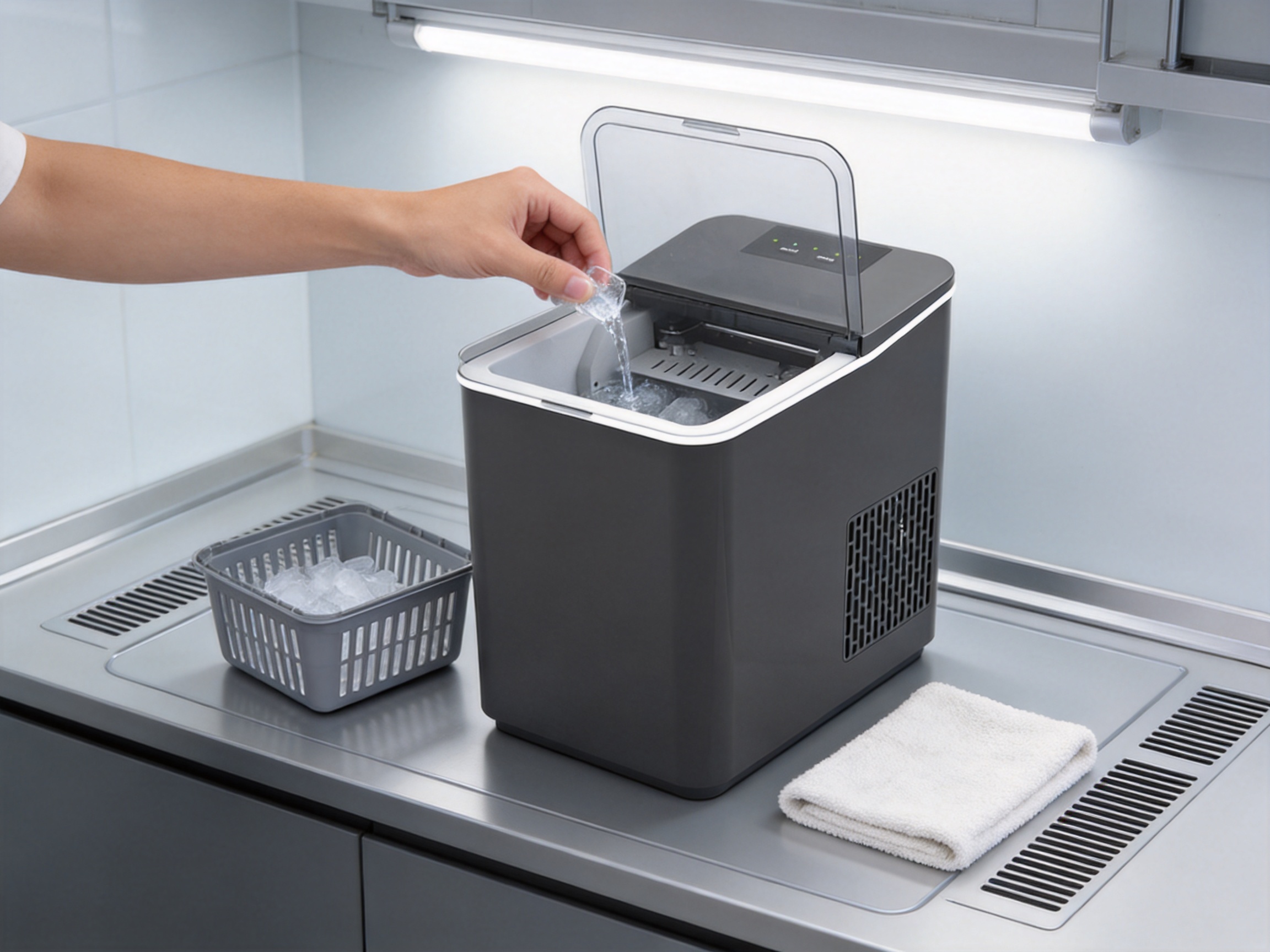
Reliable access to fresh ice can make everyday life more comfortable and entertaining. Whether it is needed for chilled water at home, cocktails at a small bar, cold beverages in an office, or refreshments during an RV journey, an independent ice maker offers convenience that a standard freezer often cannot match. The Button-Operated Ice Maker is designed around this need. It combines straightforward controls, compact dimensions, efficient operation, and practical maintenance features in a countertop appliance intended for households and small commercial environments.
Unlike a traditional freezer ice tray, this product is designed to produce ice on demand rather than requiring users to fill trays, wait for freezing, and manually remove individual cubes. Its one-touch operation reduces the number of steps required to begin production. Users can press the operating button, select an appropriate ice size when applicable, and allow the machine to complete its cycle. This simple workflow makes the appliance accessible to families, offices, hospitality areas, and users who prefer uncomplicated technology.
The machine is categorized as a bullet ice maker and uses a compact construction measuring approximately 313 by 226 by 309 millimeters. Its relatively small footprint allows it to fit on a kitchen counter, office cabinet, bar workstation, mobile recreational vehicle surface, or other stable platform. At the same time, the 150-watt electrical rating provides the operating power necessary for rapid ice production without the higher energy demand commonly associated with large commercial equipment.
The product is manufactured by Alien Technology Co., Ltd., a Zhejiang-based household appliance company specializing in ice makers, coffee machines, and air fryers. The company’s product development approach emphasizes humanized design, dependable quality, practical operation, and continuous improvement. These priorities are reflected in the ice maker’s simple button control, compact body, energy-conscious specifications, smooth interior surfaces, removable ice basket, and focus on everyday usability.
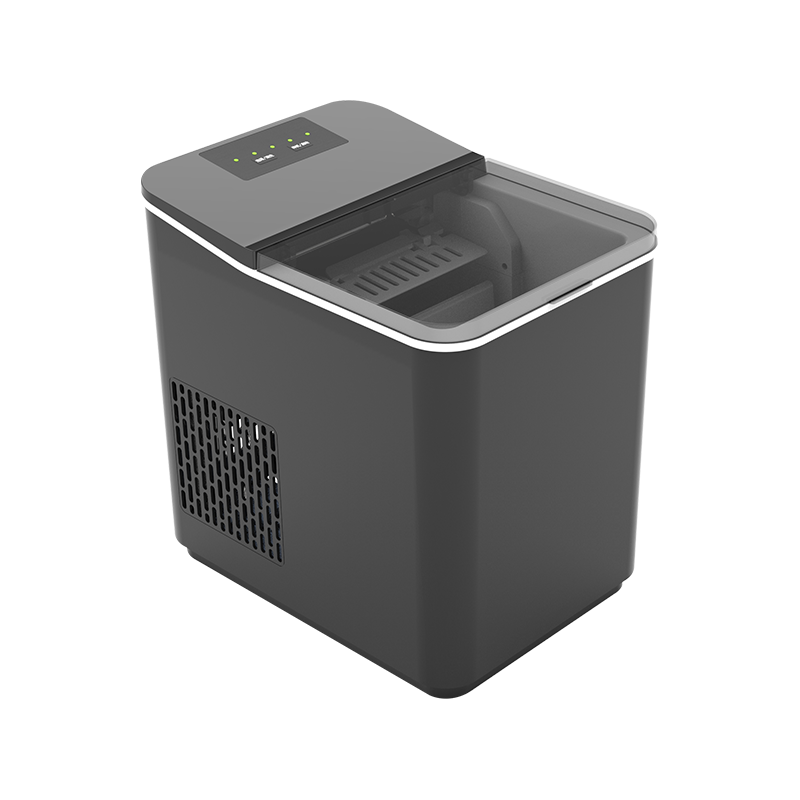
Button-Operated Ice Maker
Designed for Immediate, Convenient Ice
The main advantage of a dedicated countertop ice maker is immediacy. Conventional freezer ice production can be slow and inconvenient, especially when a household is hosting guests or when a large amount of ice is needed for a short period. Ice trays also require users to handle water carefully, place them in a freezer, wait for the contents to solidify, and remove the ice without spilling. A compact automatic ice maker streamlines this entire process.
The Button-Operated Ice Maker is intended to begin working after a simple button press. This one-touch concept is especially useful for people who do not want to navigate complicated menus or digital interfaces. A clear physical control can be easier to understand than a screen filled with icons, particularly for older users, first-time users, or shared environments where several people may operate the appliance.
The operating concept is also useful in situations where speed matters. The product is designed to produce ice in approximately 6 to 10 minutes per cycle, depending on factors such as water temperature, room temperature, selected ice size, and operating conditions. This means users can begin preparing chilled drinks shortly after starting the machine instead of waiting for a freezer compartment to complete a long freezing process.
Fast production does not mean the appliance has to occupy a large amount of space. The machine dimensions of 313 by 226 by 309 millimeters provide a balance between working capacity and countertop practicality. Its footprint is suitable for kitchens with limited storage, compact offices, guest rooms, mobile living spaces, and small service counters. Because it is not designed as a permanently installed appliance, users can reposition it when necessary, provided that the machine is placed on a stable, level surface with sufficient ventilation.
One-Touch Operation for a Broad Range of Users
Ease of use is one of the product’s strongest design characteristics. A button-operated system minimizes the learning curve. Users do not need specialized training to understand the basic procedure: add suitable water, connect the appliance to an appropriate power supply, press the control, and allow the machine to operate. This simplicity makes the product practical for homes, workplaces, vacation properties, recreational vehicles, cafés, bars, and temporary event locations.
A physical button can also support quick operation during busy moments. When preparing several drinks, users can begin ice production without interrupting other tasks for long. In a small office, different employees can operate the appliance without needing to read an extensive manual. In a hospitality setting, simple controls help reduce the risk of incorrect operation caused by unfamiliar software or complicated settings.
Although the control system is simple, the appliance is not limited to a single use case. Its versatility comes from the combination of fast production, selectable ice sizes, compact form, and removable components. Different ice sizes can serve different purposes. Smaller pieces may be useful for quickly chilling soft drinks or filling narrow glasses, while larger pieces may be suitable for cocktails, smoothies, food presentation, or longer-lasting cooling.
Multiple ice sizes also allow households to adapt the product to changing needs. On an ordinary day, a family may use a smaller quantity of ice for water and juices. During a gathering, the same appliance can support a broader beverage menu. In a small food-service environment, different sizes can be matched to drink recipes and presentation requirements. This flexibility gives the product an advantage over basic ice trays, which generally provide only one shape and size.
Practical Benefits of Physical Controls
Physical operation offers several practical benefits. It is immediately visible, requires little explanation, and can be used even when a person is wearing gloves or handling other kitchen equipment. A clearly designed control surface also avoids unnecessary visual complexity. For an appliance whose main purpose is to produce ice, a focused interface keeps attention on the task rather than on features that may rarely be used.
Simple controls can contribute to long-term satisfaction because they reduce operational frustration. Consumers often expect small household appliances to work quickly and predictably. A product that starts with a direct command meets that expectation. This is particularly valuable in shared spaces, where the appliance may be used by people with different levels of technical confidence.
Rapid Production for Home and Small Commercial Settings
The advertised production cycle of approximately 6 to 10 minutes is one of the product’s most important competitive advantages. Many users do not need the capacity or complexity of a large commercial ice system. They need a compact appliance that can provide a useful quantity of fresh ice at short intervals. This product is positioned for that middle ground between freezer trays and large built-in machines.
For household use, rapid production can support breakfast drinks, afternoon refreshments, parties, outdoor meals, and evening beverages. It can also provide a convenient source of ice when the freezer is full or when a family has unexpectedly used its stored supply. Because production occurs in cycles, users can operate the machine according to immediate demand rather than storing a large quantity of ice in advance.
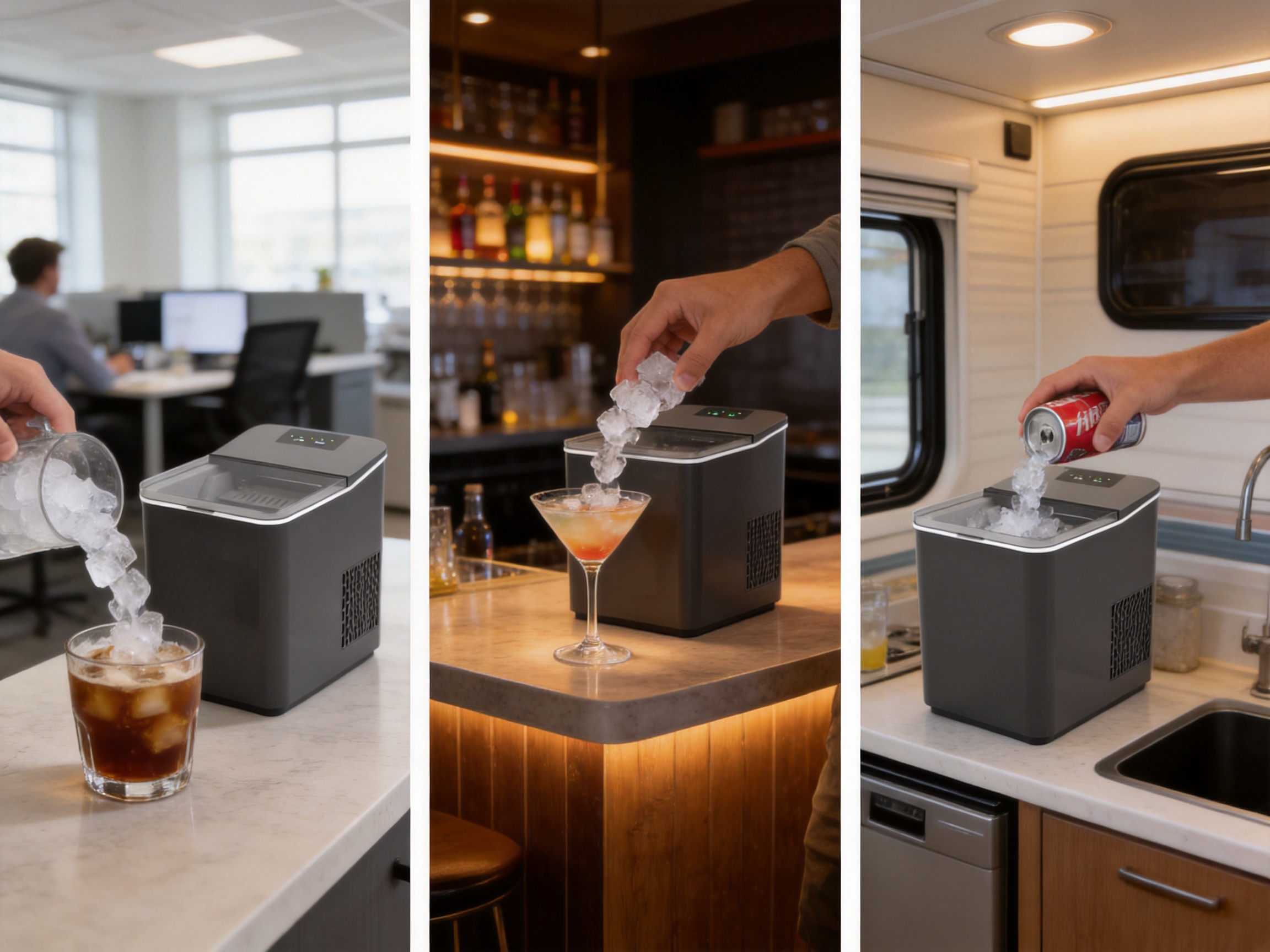
For offices, a countertop ice maker can improve the shared beverage area without requiring a major renovation. Employees can prepare cold water, iced coffee, fruit drinks, and other refreshments throughout the workday. The compact body helps preserve valuable workspace, while the relatively low power rating is appropriate for a small appliance operating in a staff kitchen or break room.
In bars, cafés, and small hospitality locations, the machine can serve as a supplementary ice source. It may be useful for lower-volume service periods, private events, tasting areas, or locations where installing a large ice-making system is impractical. Its role is not to replace every high-capacity commercial machine, but to provide a flexible and accessible source of additional ice for targeted applications.
RVs and mobile living spaces represent another important use case. Storage and counter space are limited in recreational vehicles, and travelers often value appliances that can be moved or stored as needed. The product’s compact dimensions allow it to fit into a carefully planned mobile kitchen environment, subject to the vehicle’s electrical capacity and safe operating requirements.
Energy-Conscious Engineering
The appliance has a rated power of 150 watts and a current specification of 0.9 amperes. These figures indicate an energy-conscious design intended for countertop use rather than the high continuous demand associated with large industrial equipment. Lower power consumption can help users manage everyday operating costs, particularly when the ice maker is used regularly in a home or office.
Energy efficiency involves more than electrical consumption alone. The product information also emphasizes optimized water usage. Efficient water management can reduce waste and help users produce ice without repeatedly adding excessive quantities of water. A properly designed water system supports consistent operation while making the appliance easier to manage during daily use.
Actual energy and water consumption will depend on the surrounding environment, usage frequency, selected ice size, water temperature, and the length of each operating session. Even so, the combination of a 150-watt rating, compact construction, and targeted production cycles gives the appliance a practical advantage over oversized equipment when the required output is moderate.
The product uses R600a refrigerant with a stated charge of 19 grams. R600a is commonly used in compact refrigeration appliances because it can support efficient cooling performance with a relatively small refrigerant charge. The refrigerant system must always be handled according to applicable safety standards and by qualified personnel when service is required. Users should not attempt to open or modify the refrigeration circuit.
Specification |
Product Information |
Practical Significance |
Product type |
Button-operated bullet ice maker |
Provides an accessible countertop source of ice |
Power supply |
220V–240V, 50Hz |
Designed for compatible electrical systems within this range |
Current and power |
0.9A / 150W |
Supports energy-conscious countertop operation |
Refrigerant and charge |
R600a / 19g |
Compact refrigeration system specification |
Machine dimensions |
313 × 226 × 309mm |
Suitable for kitchens, offices, bars, and mobile spaces |
Ice production cycle |
Approximately 6–10 minutes |
Provides fresh ice quickly for immediate needs |
Ice options |
Multiple ice sizes |
Adapts ice production to drinks, food, and entertaining |
Compact Construction Without Unnecessary Complexity
Compact appliances must use space carefully. Every internal component, water channel, cooling element, and control must be arranged within a relatively small enclosure. The dimensions of this model demonstrate an effort to deliver useful ice-making performance without creating an oversized countertop presence. Its rectangular footprint is narrow enough for many kitchen worktops and office cabinets, while its height remains manageable beneath common shelves or overhead storage.
A compact design can also improve portability. Users may move the appliance between a kitchen and a dining area, take it to a holiday property, or store it when it is not needed. This flexibility distinguishes a countertop ice maker from a permanently installed appliance. Nevertheless, movement should be carried out carefully, and the machine should be allowed to stand in the manufacturer’s recommended position for the appropriate amount of time before operation if it has been transported or tilted.
The internal design must balance cooling efficiency, water circulation, ice formation, and heat dissipation. A well-organized appliance body helps maintain predictable performance while minimizing wasted space. Compact engineering is therefore not merely a matter of making the exterior smaller. It requires coordination among mechanical, electrical, thermal, and structural elements.
For consumers, this coordination is visible through practical results: the machine occupies less counter space, starts with minimal effort, produces ice quickly, and can be cleaned without complicated disassembly. These characteristics give it a meaningful advantage over improvised alternatives and over larger machines whose capacity may exceed the needs of ordinary users.
Quiet Operation for Shared Environments
Noise is a major consideration for small refrigeration appliances. A machine that operates loudly may be unsuitable for an office, bedroom-adjacent kitchen, guest room, or quiet home. The Button-Operated Ice Maker incorporates a noise-reduction design intended to keep operation quieter and more comfortable for people nearby.
Quiet operation is useful during many parts of the day. In an office, it helps preserve a professional atmosphere. In a home, it reduces disruption while family members are working, studying, watching television, or sleeping. In a bar or café, lower operating noise allows customers and staff to communicate more comfortably. For RV users, reduced noise is especially valuable because living areas are close together.
All refrigeration equipment produces some sound from cooling components, water movement, and mechanical operation. The practical goal is not absolute silence but a controlled sound level that is less intrusive in normal environments. Noise-reduction engineering can involve careful component selection, vibration management, structural support, and airflow planning. These design considerations demonstrate how a small appliance can prioritize the user’s overall experience rather than focusing only on its primary output.
Easy Cleaning and Maintenance
Ice comes into direct contact with water, so cleanliness is essential. The product is designed with smooth interior surfaces and a removable ice basket to make routine cleaning more straightforward. Smooth surfaces reduce areas where residue may collect, while a removable basket allows users to access the storage area without complicated tools or procedures.
Regular maintenance helps preserve ice quality, prevent unpleasant odors, and support reliable operation. Users should empty unused ice when appropriate, remove standing water according to the operating instructions, wipe accessible surfaces with a clean suitable cloth, and follow the recommended cleaning schedule. The machine should be disconnected from the power supply before cleaning, and water should not be poured into electrical openings or external controls.
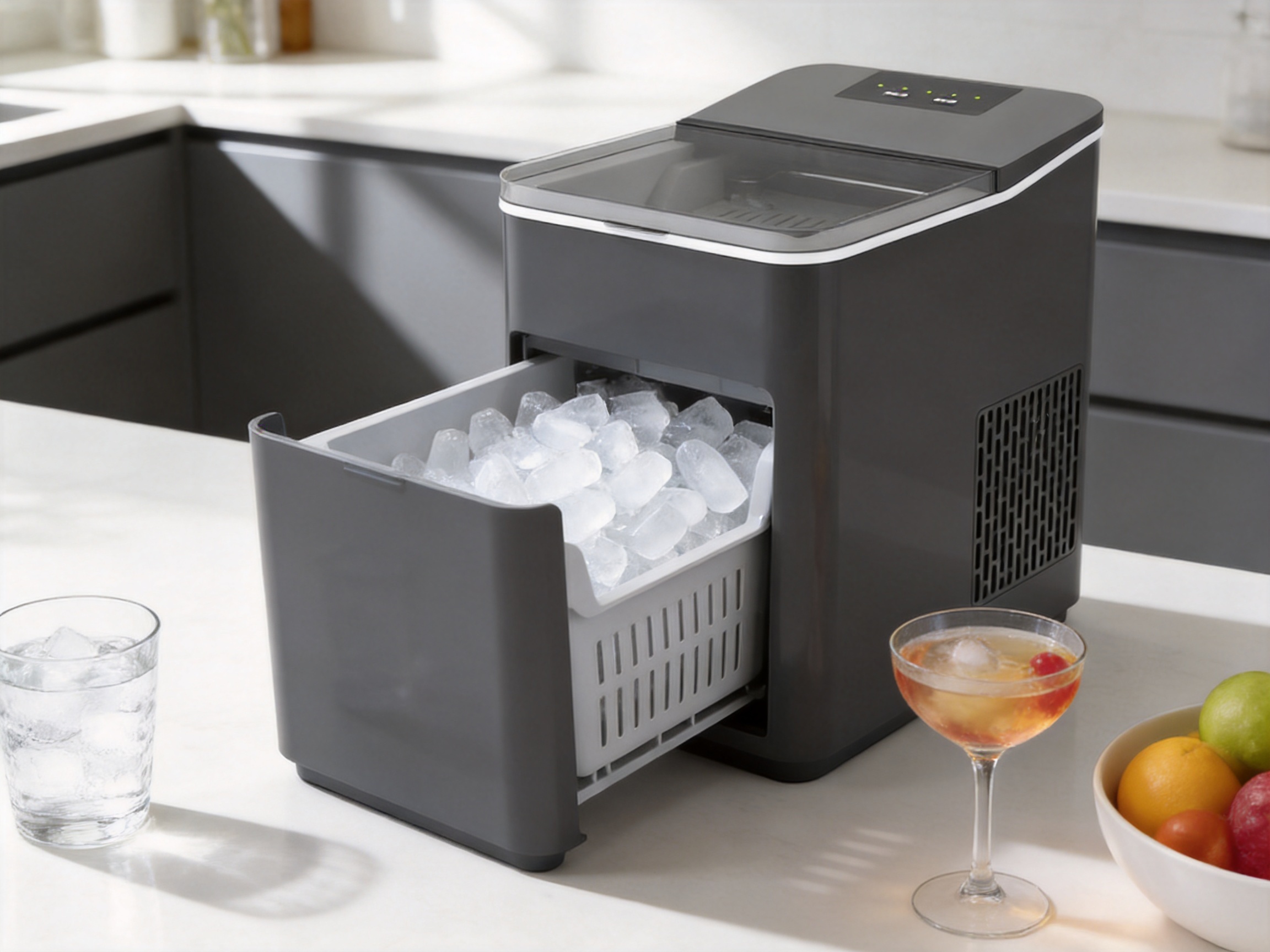
A removable ice basket is particularly valuable because it separates the handling of finished ice from the main body of the appliance. Users can lift out the basket, transfer ice to a serving container, and clean the component independently. This is more convenient than reaching into a fixed compartment or attempting to clean around permanently installed structures.
Maintenance simplicity is also a competitive advantage. Appliances that are difficult to clean may be used less often or may develop avoidable hygiene problems. By keeping the interior accessible and minimizing unnecessary complexity, the design encourages users to care for the product regularly. This supports long-term usability and contributes to a more satisfying ownership experience.
Recommended Everyday Care
Before each operating session, users should ensure that the machine is placed on a stable, level surface and that the water reservoir contains suitable clean water. The surrounding area should remain dry, and the ventilation openings should not be blocked. After use, the ice basket and accessible interior areas should be checked for remaining water or ice.
Cleaning frequency should reflect usage. A machine used daily may require more frequent attention than one operated occasionally. In areas with hard water, mineral deposits may accumulate more quickly, so users should follow the applicable cleaning instructions and use only appropriate cleaning materials. Abrasive cleaners, sharp tools, and unauthorized chemicals may damage internal surfaces or affect future ice quality.
Any refrigeration, electrical, or sealed-system service should be performed by qualified professionals. The use of R600a requires particular attention to safe handling procedures because refrigerant systems must not be punctured, altered, or serviced casually. Proper maintenance protects the user, the appliance, and the surrounding environment.
Manufacturing Strengths and Product Development Approach
The product is made by Alien Technology Co., Ltd., located in Zhouxiang, Cixi City, Zhejiang Province. The area is recognized as a hub for small household appliance manufacturing and benefits from established logistics and supporting industrial resources. This location provides a practical foundation for product development, component coordination, production organization, and distribution to customers in domestic and international markets.
The company specializes in several household appliance categories, including ice makers, coffee machines, and air fryers. Experience across related categories can support useful knowledge in thermal management, heating and cooling systems, plastic and metal enclosure design, electrical safety, user-interface development, and consumer-oriented product planning. Although each appliance requires specialized engineering, shared manufacturing experience can help the company improve its overall design and quality processes.
The company’s stated mission is to use smart technology to simplify life and enhance happiness. In the ice maker, this mission appears not through excessive digital features but through purposeful convenience. The one-touch control, rapid operating cycle, compact body, multiple ice sizes, low power rating, quiet operation, and easy-clean construction all serve the goal of making an everyday task simpler.
Advanced manufacturing does not necessarily mean adding the greatest number of functions. For a countertop ice maker, advanced manufacturing can mean producing consistent components, controlling assembly tolerances, organizing the refrigeration system effectively, managing water pathways, testing electrical performance, and maintaining dependable operation across repeated cycles. Product quality is built through many coordinated processes rather than through a single visible feature.
Humanized Design as a Manufacturing Objective
A humanized appliance begins with an understanding of how people actually use it. Consumers want fresh ice quickly, but they also want simple controls, manageable cleaning, reasonable noise levels, and a body that fits their available space. Addressing these expectations requires collaboration between product designers, engineers, manufacturing personnel, and quality teams.
The Button-Operated Ice Maker demonstrates this type of design thinking. The button control responds to the need for immediate operation. The multiple ice sizes address different beverage and food applications. The smooth interior surfaces respond to cleaning concerns. The removable ice basket responds to handling convenience. The compact dimensions respond to space limitations. The noise-reduction approach responds to the realities of shared living and working environments.
Each feature may appear simple on its own, but combining them in one compact appliance requires careful planning. The water system must work with the ice-forming mechanism. The cooling system must fit within the enclosure while allowing heat to dissipate. The control interface must be easy to use without compromising reliability. The removable basket must be convenient while remaining stable during normal operation. Manufacturing strength is demonstrated by the ability to bring these requirements together in a coherent product.
Quality-Oriented Production
The company describes its business philosophy as stable and pragmatic, with a focus on excellent quality, customer satisfaction, continuous improvement, and innovation. These principles are relevant to a product that may operate repeatedly over many cycles. A dependable ice maker must be built for consistent electrical performance, controlled cooling, secure component assembly, and reliable user interaction.
Quality-oriented production typically includes inspection of incoming materials, control of assembly procedures, evaluation of finished appliances, and attention to packaging and logistics. Specific testing procedures may vary according to the production model and applicable market requirements, but the underlying objective remains the same: ensure that the appliance reaches customers in suitable working condition and continues to meet its functional expectations during normal use.
Manufacturing quality also affects the appearance and usability of the product. Smoothly finished surfaces, properly fitted panels, dependable buttons, secure baskets, and consistent dimensions contribute to customer confidence. These details may not be visible in a specification sheet, but they strongly influence the ownership experience.
Advantages Over Common Alternatives
The Button-Operated Ice Maker offers several advantages compared with ordinary freezer trays. Trays require manual filling, occupy freezer space, and may spill during handling. They also provide limited control over the production schedule and generally create only one ice size. By contrast, a dedicated ice maker is designed specifically for repeated ice production and can offer multiple sizes with much less manual effort.
Compared with large commercial ice machines, this model offers a more approachable scale. A restaurant with high-volume demand may require specialized equipment with a much larger output, but many homes, offices, and small businesses do not need that level of capacity. A compact countertop model can reduce the space commitment, installation requirements, and operational complexity associated with oversized machinery.
Compared with basic low-cost ice makers, the product’s focus on one-touch operation, quiet performance, multiple ice sizes, energy-conscious operation, and easy maintenance creates a more complete user experience. Price is not the only measure of value. Consumers also consider how quickly the appliance works, how easy it is to clean, how much space it occupies, and whether it can adapt to different occasions.
The machine’s 220V–240V, 50Hz power specification also gives it a clear target market. It is suitable for electrical systems that match this range, making it appropriate for many regions where these standards are used. Buyers should always confirm compatibility before purchase and use the appliance only with a properly grounded and suitable electrical connection.
Alternative |
Common Limitation |
Countertop Ice Maker Advantage |
Freezer ice trays |
Manual filling, slow freezing, one standard size |
Automated production, faster access, and multiple ice options |
Large commercial systems |
Greater space, installation, and capacity requirements |
Compact dimensions and practical output for smaller locations |
Complex smart appliances |
More controls and a longer learning curve |
Direct one-touch operation for quick use |
Unmanaged portable cooling methods |
Inconsistent temperature and limited ice availability |
Purpose-built refrigeration and repeatable ice production |
Use in Different Environments
Home Kitchens
In a home kitchen, the appliance can support regular drinking water, iced tea, juice, smoothies, and family meals. It can remain on the counter when frequently used or be stored when additional counter space is needed. The compact dimensions make it easier to integrate into a kitchen without redesigning cabinets or adding a dedicated water line.
Parties and Entertaining
During gatherings, ice demand can increase rapidly. Guests may use ice for soft drinks, cocktails, fruit beverages, chilled serving bowls, and temporary food presentation. The machine’s short cycle time allows hosts to replenish ice during the event rather than relying entirely on pre-purchased bags or freezer storage. Multiple sizes can also support different types of drinks.
Offices and Break Rooms
In a workplace, an ice maker can improve the shared refreshment area. Staff members can prepare cold beverages without leaving the office to purchase ice. Quiet operation helps limit disturbance, while the one-touch control reduces the need for training. The product’s energy-conscious rating is also appropriate for organizations that monitor routine electricity usage.
Bars and Small Hospitality Businesses
Small bars, cafés, guesthouses, and event spaces may use the appliance as a supplementary source of ice. It can help support service during peak periods, provide ice for a private room, or serve locations where installing a large machine is not practical. Business owners should match expected demand with the machine’s actual production capability and use it as part of a broader ice-management plan where necessary.
RVs and Vacation Properties
Mobile and temporary living spaces often require compact equipment. The machine can provide fresh ice at a campsite, holiday home, or recreational vehicle when a compatible power supply is available. Users should consider ventilation, surface stability, water availability, and the vehicle’s electrical capacity before operating the appliance.
Responsible Operation and Safety Considerations
Safe operation begins with checking the electrical requirements. This model is specified for 220V–240V at 50Hz and should be connected only to a compatible supply. The plug, cord, outlet, and surrounding area should be kept dry. Extension cords or adapters should not be used unless they are appropriate for the appliance and permitted by local safety guidance.
The appliance should be placed on a stable, level surface with sufficient clearance around ventilation areas. Blocking airflow can reduce cooling performance and may place unnecessary stress on the refrigeration system. The machine should not be positioned near direct heat sources, exposed flames, or locations where it may be splashed with water.
Only suitable clean water should be added. Users should not place beverages, syrups, food, or foreign objects in the water reservoir unless the official operating instructions specifically permit them. Ice intended for consumption should be handled with clean utensils or clean hands, and the basket should be maintained regularly.
Children should use the appliance only with suitable supervision. The machine is not a toy, and users should not insert fingers or tools into openings. If the appliance develops unusual odors, smoke, electrical damage, refrigerant concerns, or abnormal operating behavior, it should be disconnected and inspected by a qualified service professional.
Why the Product Represents Practical Innovation
Innovation in household appliances is most valuable when it solves real problems. This ice maker does not rely on unnecessary complexity to appear advanced. Its innovation is practical: produce ice quickly, use a simple control, fit into a small area, reduce operating inconvenience, support different ice sizes, and make cleaning easier.
The appliance also reflects a broader movement toward right-sized equipment. Consumers increasingly seek products that deliver the necessary function without occupying excessive space or consuming more resources than required. A compact 150-watt ice maker can be a sensible option for users who want on-demand ice but do not need a large permanently installed system.
The company’s experience in household appliances provides a foundation for this type of product development. Ice makers, coffee machines, and air fryers all require attention to user routines, thermal performance, component safety, cleaning, and everyday durability. By working across these categories, the manufacturer can apply a broad understanding of how people interact with compact appliances in real homes and businesses.
The result is a product aimed at convenience without sacrificing useful functionality. One-touch operation reduces effort. Rapid cycles reduce waiting. Multiple sizes increase flexibility. Quiet operation improves comfort. Smooth surfaces and a removable basket reduce cleaning difficulty. Compact dimensions make placement easier. Together, these features create a balanced appliance for modern daily life.
Q&A
What type of appliance is this product?
It is a countertop bullet ice maker with button-operated controls. It is intended to produce fresh ice for homes, offices, bars, RVs, vacation properties, and small commercial environments.
How quickly can it make ice?
The product information states that it can produce ice in approximately 6 to 10 minutes per cycle. Actual timing may vary according to water temperature, room temperature, selected ice size, and operating conditions.
Is the machine difficult to operate?
No. It is designed around one-touch button operation. Users can begin production with a simple press rather than navigating a complicated control system.
Can users choose different ice sizes?
Yes. The product is designed to provide multiple ice-size options. The available selection can be matched to beverages, cocktails, smoothies, food preservation, or general chilling needs.
Where can the ice maker be used?
It can be used in homes, offices, bars, small hospitality spaces, RVs, and other suitable locations with a compatible electrical supply and adequate ventilation.
How much space does it require?
The stated machine dimensions are approximately 313 by 226 by 309 millimeters. This compact size is intended for countertop placement and is suitable for locations where space is limited.
What is the electrical specification?
The product is specified for a 220V–240V, 50Hz power supply. Its stated current and power rating are 0.9 amperes and 150 watts. Buyers should confirm that their local electrical system is compatible before use.
Is the machine energy efficient?
Its 150-watt rating and optimized water-usage design support energy-conscious countertop operation. Actual consumption depends on how often the machine is used, the ambient environment, the selected ice size, and the length of each operating session.
What refrigerant does it use?
The product specification lists R600a refrigerant with a 19-gram charge. Any work involving the refrigeration circuit should be performed by a qualified professional using appropriate safety procedures.
Is it noisy?
The appliance incorporates a noise-reduction design intended to support quieter operation. Some sound is normal for a refrigeration appliance, but the design is intended to make it suitable for kitchens, offices, and other shared environments.
How should the machine be cleaned?
The smooth interior surfaces and removable ice basket are designed to make routine cleaning easier. Users should disconnect the appliance before cleaning, follow the official instructions, keep the water system hygienic, and avoid abrasive materials or unauthorized chemicals.
Can it replace a large commercial ice machine?
It is designed for homes, offices, bars, RVs, and small commercial spaces rather than every high-volume commercial application. Businesses should compare expected ice demand with the machine’s production capability before relying on it as a primary source.
What makes it different from freezer trays?
It provides automated ice production, faster access, multiple ice-size choices, and less manual handling. Freezer trays generally require repeated filling and long freezing periods, while this product is purpose-built for on-demand ice production.
What type of company manufactures the product?
Alien Technology Co., Ltd. is a Zhejiang-based household appliance manufacturer specializing in ice makers, coffee machines, and air fryers. Its stated priorities include quality, customer satisfaction, continuous improvement, innovation, and humanized product design.
What should buyers confirm before purchase?
Buyers should confirm power compatibility, available counter space, ventilation requirements, expected ice demand, cleaning needs, and any local requirements for appliances using R600a refrigerant. They should also review the product’s operating and safety instructions.
Conclusion
The Button-Operated Ice Maker is a practical solution for users who want fresh ice without the inconvenience of freezer trays or the excessive scale of large commercial equipment. Its compact 313 by 226 by 309-millimeter body, 150-watt operating rating, rapid 6-to-10-minute cycle, multiple ice sizes, quiet-operation design, and removable ice basket make it suitable for a broad range of everyday environments.
Its strongest advantage is balance. The product combines simple operation with useful flexibility, efficient specifications with dependable functionality, and compact construction with fast ice production. It is designed to fit into real kitchens, offices, bars, RVs, and small businesses where users value convenience, manageable maintenance, and efficient use of space.
The manufacturing background of Alien Technology Co., Ltd. further supports the product’s positioning. Located in a region known for small household appliance production and specializing in several related appliance categories, the company applies a practical approach centered on quality, customer needs, innovation, and continuous improvement. Its focus on humanized design is reflected in an appliance that prioritizes the user’s daily experience.
For customers seeking a straightforward and adaptable source of ice, this product offers a compelling combination of speed, simplicity, compactness, and operational efficiency. It demonstrates that thoughtful manufacturing and practical technology can make a routine household task considerably easier.
References
1. Product specification sheet for the Button-Operated Ice Maker, including electrical rating, refrigerant information, machine dimensions, and product category.
2. Product information supplied for the Button-Operated Ice Maker, including operating concept, ice-production cycle, multiple ice sizes, noise-reduction design, and cleaning features.
3. Manufacturer information for Alien Technology Co., Ltd., including company location, product categories, mission, quality principles, and business philosophy.
4. General household appliance safety principles concerning electrical compatibility, ventilation, water handling, cleaning, and qualified refrigeration-system service.
5. General product-design principles for compact refrigeration appliances, including user-centered operation, maintenance accessibility, energy-conscious engineering, and space-efficient construction.