
 English
 한국어
한국어 Español
 Deutsch
Modern homes, offices, bars, recreational vehicles, and small refreshment spaces increasingly need one appliance that can deliver convenience without adding complexity. A button-operated ice maker answers that need by transforming a simple daily requirement into an effortless experience: press a button, wait a short cycle, and enjoy fresh bullet-shaped ice for drinks, food cooling, entertaining, and everyday comfort. The Button-Operated Ice Maker, model Alien-Z03, is designed around this exact idea. It combines straightforward operation, compact dimensions, efficient power use, quiet performance, and easy maintenance in one practical countertop machine.
Unlike traditional ice trays that require hours of freezing time and constant refilling, this ice maker produces ice in rapid cycles, typically in as little as 6 to 10 minutes depending on ambient conditions and water temperature. Compared with many competing countertop ice makers, its value lies not only in speed but also in simplicity. Many users do not want complicated digital menus, confusing settings, or unnecessary learning steps. They want fresh ice with minimum effort. This machine is built for that user: the control experience is intuitive, the physical footprint is space-conscious, and the internal structure supports consistent ice output for daily use.
The product also reflects the manufacturing strengths of Alien Technology Co., Ltd., a household appliance manufacturer based in Zhouxiang Town, Cixi City, Zhejiang Province, an area known for small household appliance production and convenient logistics. With a product scope covering ice makers, coffee machines, and air fryers, the company focuses on practical domestic appliances that simplify daily routines. Its philosophy emphasizes humanized design, reliable quality, continuous improvement, and intelligent technology. In the Button-Operated Ice Maker, these principles appear in the details: one-touch operation, fast cycle performance, optimized energy use, quiet running, removable components, and a form factor that fits many living and working environments.
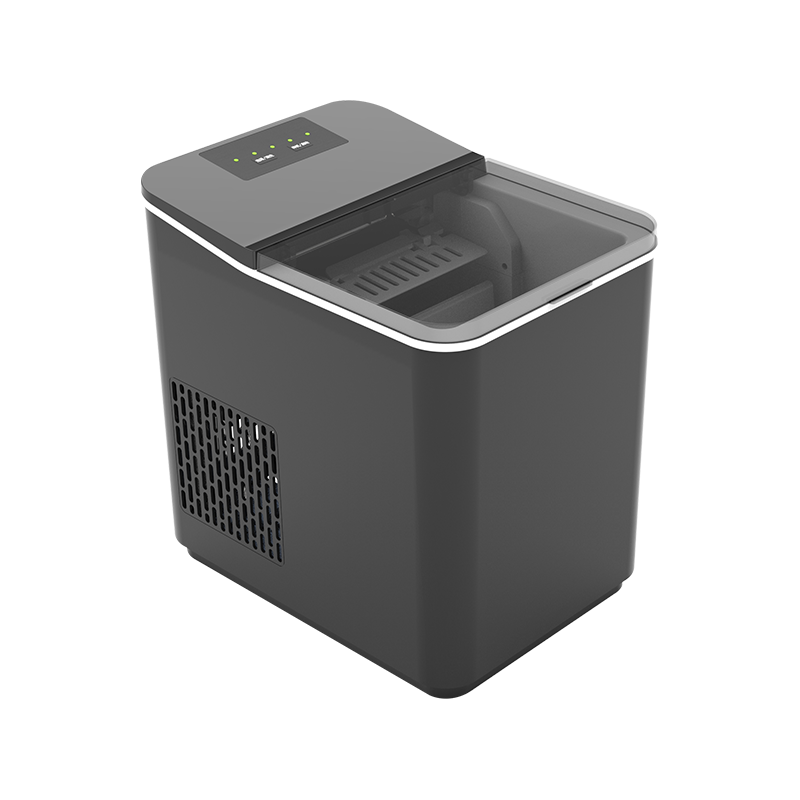
Button-Operated Ice Maker
A Practical Appliance for the Everyday Need for Ice
Ice is no longer just a seasonal convenience. It is part of daily beverage preparation, home entertaining, office refreshment, food preservation, personal cooling, and hospitality service. In many households, freezer space is already limited by frozen foods, meal-prep containers, and packaged ingredients. Ice trays take up space, spill easily, absorb freezer odors, and require planning long before the ice is needed. In offices and small business spaces, relying on refrigerator ice compartments can be inconvenient, inconsistent, and unhygienic when many users share the same supply.
A countertop bullet ice maker solves these common problems by producing ice independently and quickly. It does not require a permanent water line, and it can be positioned wherever a suitable power supply and stable surface are available. For parties, meetings, evening drinks, home coffee stations, outdoor gatherings, or recreational vehicles, the machine provides a flexible ice source without requiring built-in installation. This flexibility is one of the strongest advantages of a button-operated design. Users can move the machine, refill it manually, clean it easily, and operate it without technical knowledge.
The Button-Operated Ice Maker is especially suitable for users who value reliability and direct control. Its one-touch operation lowers the learning barrier for elderly users, first-time appliance buyers, small office teams, and busy families. The result is a product that feels accessible rather than intimidating. In a market where some appliances become more complex than necessary, this ice maker takes the opposite approach: it makes the core function easy, fast, and dependable.
Core Product Specifications
The technical foundation of any ice maker matters because it determines compatibility, energy use, cooling performance, and installation convenience. The Button-Operated Ice Maker is designed with household and light commercial environments in mind, using a compact body and efficient refrigerant system. Its specifications show a balance between practical power, manageable size, and reliable cooling performance.
Product Item |
Button-Operated Ice Maker |
Category |
Bullet Ice Maker |
Model |
Alien-Z03 |
Product Power Supply |
220V-240V / 50Hz |
Current / Power |
0.9A / 150W |
Refrigerant / Charge |
R600a / 19g |
Machine Dimensions |
313 x 226 x 309 mm |
Operation Type |
Button-operated control |
Typical Ice-Making Cycle |
Approximately 6-10 minutes per cycle, depending on conditions |
Main Use Scenarios |
Homes, offices, bars, recreational vehicles, and small commercial spaces |
The dimensions of 313 x 226 x 309 mm make the appliance suitable for countertops, pantry corners, office refreshment areas, and small bar counters. Its 150W power rating supports efficient operation without demanding the power profile of larger commercial ice machines. The use of R600a refrigerant reflects a modern approach to compact refrigeration, offering effective cooling performance with a relatively small charge amount.
One-Touch Button Control: A Clear Advantage in Daily Use
One of the product’s defining advantages is its button-operated control system. Many appliances are promoted with advanced interfaces, but more controls do not always mean a better user experience. In daily life, especially for appliances used repeatedly by different people, simplicity often creates more value than complexity. A single clear control approach reduces mistakes, saves time, and makes the product easier to share among family members, colleagues, or guests.
Compared with competing ice makers that may use multi-step selection panels, touch interfaces that respond inconsistently to wet fingers, or confusing icons, a button-operated ice maker provides direct physical confidence. The user presses the button and understands immediately that the machine has started. This tactile operation is especially useful in kitchens and bars, where hands may be wet, lighting may vary, or users may be in a hurry. The control experience is predictable and friendly.
For elderly users, the benefit is even clearer. Appliances with complicated displays can create hesitation and reduce confidence. A one-touch button gives the user a simple relationship with the machine: add water, place the basket properly, close the lid, press the button, and wait for fresh ice. For offices, the same simplicity reduces the need for training or instructions. Anyone can use the machine without interrupting others or reading a manual repeatedly.
This advantage is not merely aesthetic. A simple control design can also contribute to long-term reliability because it reduces unnecessary operational complexity. Fewer confusing functions mean fewer incorrect settings and less frustration. The machine’s purpose remains focused: produce ice efficiently and conveniently.
Fast Ice Making for Real-Life Timing
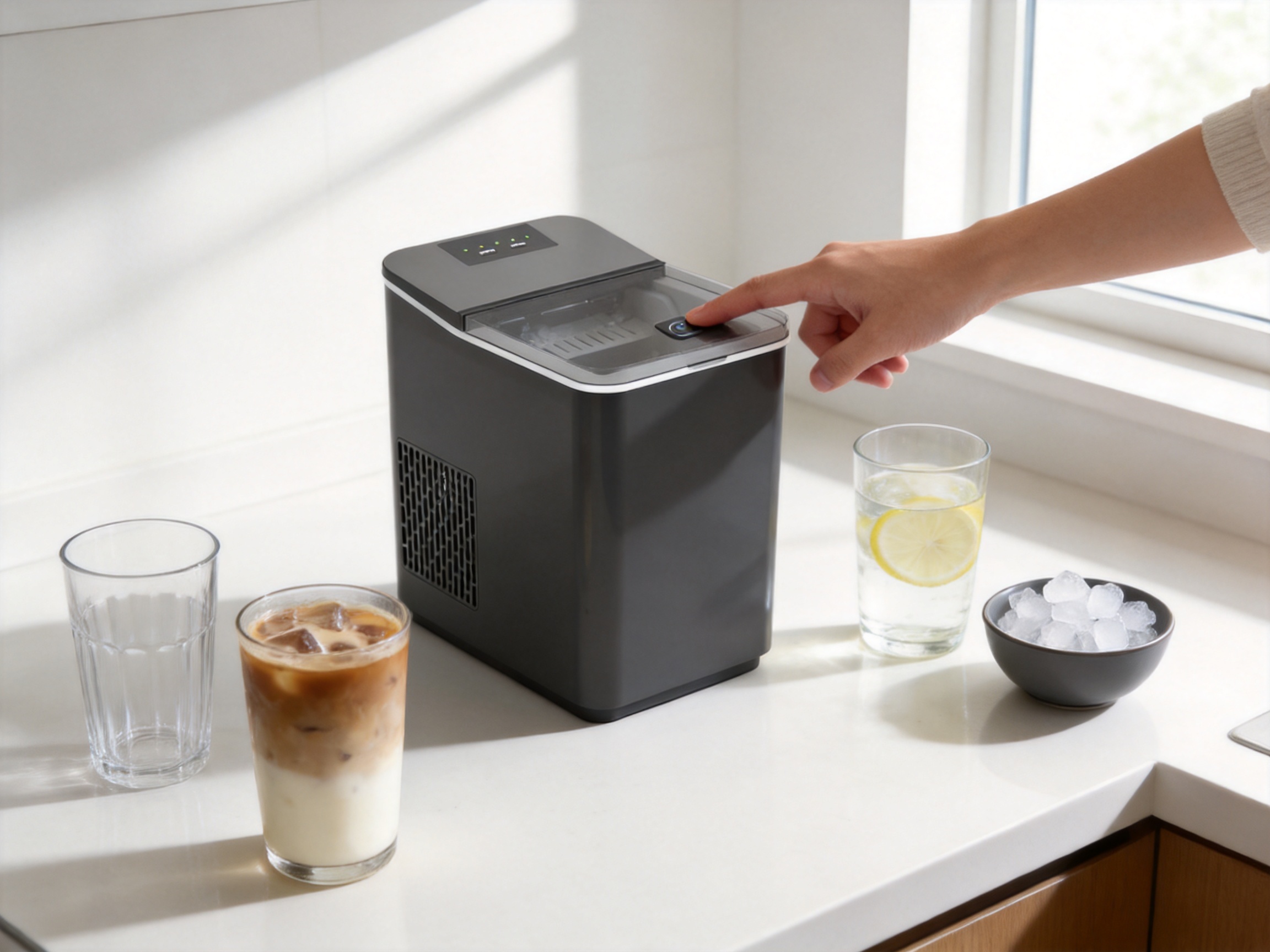
Speed is one of the most important buying factors for a countertop ice maker. The Button-Operated Ice Maker can produce ice in approximately 6 to 10 minutes per cycle, which is significantly faster than conventional freezer trays. This speed changes how users plan their daily routines. Instead of preparing ice hours in advance, users can begin making ice shortly before guests arrive, before preparing iced coffee, or during a meeting break.
In a home setting, this is helpful for families that use ice at different times of day. Morning smoothies, afternoon iced tea, evening cocktails, and chilled water all require a steady supply. A fast-cycle machine supports these changing needs without making the user depend on freezer storage. In an office, a quick ice cycle helps maintain refreshment availability during busy hours. In a small bar or service corner, the machine can supplement existing refrigeration by producing fresh ice close to the point of use.
Compared with many competing products, the practical advantage is not only the first-batch speed but also the consistency of repeated cycles. A useful ice maker must do more than create a few pieces quickly; it must keep working steadily as long as water and operating conditions allow. The Button-Operated Ice Maker is designed for consistent production, allowing users to accumulate ice over time for gatherings, beverage stations, or daily hydration habits.
The bullet ice shape also supports quick formation. Bullet ice is widely used in countertop machines because it can be produced efficiently around evaporator fingers and released into the basket in regular cycles. Its hollow or rounded structure chills beverages effectively and is easier to scoop than many irregular ice shapes. For common drinks such as soda, juice, iced coffee, cocktails, lemonade, and water, bullet ice offers a practical balance of cooling performance and production speed.
Multiple Ice Sizes for Different Applications
The machine supports the selection of different ice sizes, allowing users to adapt ice production to different needs. This flexibility is valuable because not every beverage or cooling task benefits from the same ice size. Smaller ice pieces may be preferred for quick chilling, smoothies, or narrow cups, while larger pieces may be preferred for cocktails, pitchers, or slower melting in cold drinks.
Some competing low-cost ice makers limit users to a single output size, which can reduce convenience. A user may find the ice too small for slow sipping or too large for certain cups. By offering multiple ice size options, the Button-Operated Ice Maker gives the user more control over the final experience without making the machine complicated. This aligns with the product’s broader philosophy: flexibility should be useful, not overwhelming.
For homes, multiple ice sizes help different family members enjoy beverages the way they prefer. For an office, it helps serve a wider range of drink types, from chilled water to cold brew coffee. For recreational vehicles or compact hospitality settings, it provides versatility in a limited space. The ability to adjust ice size is a small feature that creates noticeable everyday value.
Energy Efficiency and Optimized Resource Use
Energy efficiency is increasingly important in household appliances. Users want convenience, but they do not want high electricity consumption or wasteful operation. With a rated power of 150W, this ice maker is designed for efficient ice production in compact environments. Its operation focuses on converting water into usable ice quickly without the energy burden of larger, permanently installed commercial machines.
Compared with using a full freezer for frequent ice tray production, a countertop machine can be more convenient and targeted. Freezers must maintain an entire compartment at low temperatures, while a compact ice maker focuses its cooling cycle on producing ice batches as needed. For users who need fresh ice frequently but not in industrial quantities, this type of appliance offers a sensible middle ground.
Optimized water usage also matters. Water is added to the reservoir and circulated through the ice-making process, helping reduce unnecessary waste. Any water not frozen during a cycle can continue to be used in subsequent cycles, depending on the machine’s operating design and cleanliness practices. This is more practical than ice trays that may spill during transport or be discarded when they absorb odors.
R600a refrigerant is commonly used in compact refrigeration products because it provides effective cooling characteristics with a small refrigerant charge. In this model, the refrigerant charge is 19g, supporting cooling performance while keeping the system compact. Responsible refrigerant handling during manufacturing is essential, and this is where production process quality becomes especially important. Accurate charging, leak testing, and sealed system inspection directly affect safety, performance, and durability.
Quiet Operation for Comfortable Environments
An appliance may be fast and functional, but if it is noisy, users may avoid placing it where they actually need it. Quiet operation is therefore a major advantage for kitchens, offices, bedrooms, small meeting areas, and guest spaces. The Button-Operated Ice Maker is designed with noise reduction in mind, helping it operate without becoming an intrusive background presence.
Competing products sometimes focus on ice output while neglecting acoustic comfort. A loud compressor, harsh fan noise, or clattering ice drop can make an ice maker unsuitable for shared environments. While any refrigeration appliance produces some operating sound, thoughtful design can reduce vibration, airflow noise, and unnecessary mechanical harshness. A quieter machine is easier to live with, especially when it is used early in the morning, late at night, or during work hours.
Quiet performance also supports flexible placement. Users can keep the machine near a coffee station, on a kitchen counter, in a small office pantry, or in an entertainment room without worrying that it will dominate the atmosphere. In hospitality or small commercial spaces, lower noise helps preserve a pleasant customer experience.
Compact Design Without Sacrificing Usefulness
The machine’s dimensions, 313 x 226 x 309 mm, indicate a compact appliance designed for real countertops. Space is one of the most important limitations in modern homes and small business environments. A product can have excellent performance, but if it is too large or awkward, users may store it away and stop using it. This ice maker is sized to remain accessible, which increases its practical value.
Its footprint allows it to fit beside coffee machines, air fryers, water dispensers, or other compact appliances. For users who are building a home beverage station, this is particularly useful. A coffee machine can prepare iced coffee, while the ice maker supplies fresh bullet ice nearby. In a small office, the machine can fit on a refreshment counter without requiring dedicated plumbing. In an RV, vacation cabin, or small apartment, its compactness allows users to enjoy fresh ice even where a large refrigerator ice system is unavailable.
Compared with larger built-in ice machines, the advantage is mobility. The user can relocate the appliance when needed, store it during periods of low use, or bring it to event spaces. Compared with very small, low-output devices, it offers a more capable balance of size and performance. This balance is one reason countertop bullet ice makers have become popular among modern appliance users.
Easy Cleaning and Maintenance
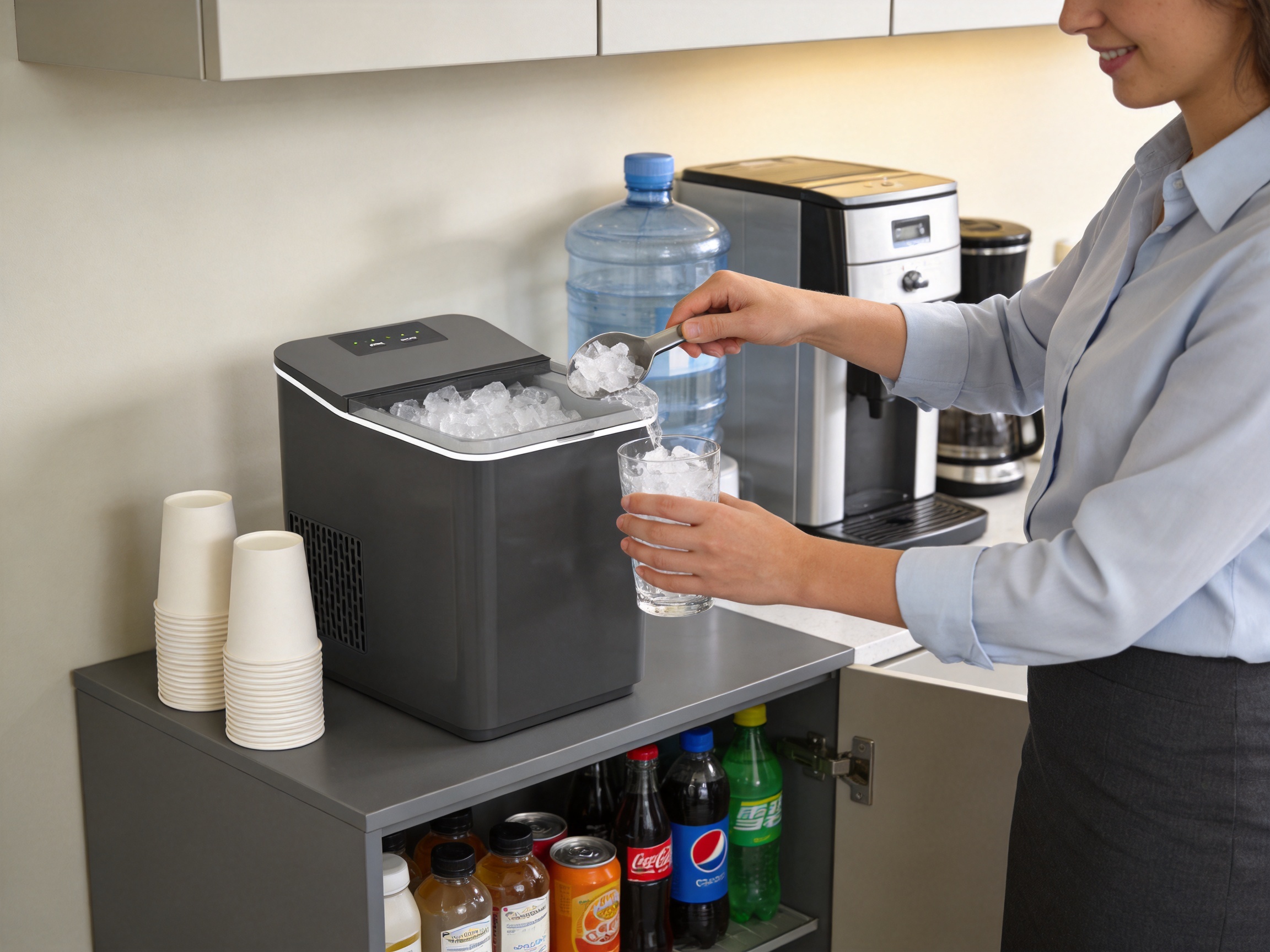
Ice is consumed directly, so cleanliness is essential. The Button-Operated Ice Maker is designed with smooth interior surfaces and a removable ice basket, making regular cleaning more convenient. Easy maintenance is a major advantage over products with difficult-to-reach corners, fixed baskets, or complicated internal structures that discourage users from cleaning frequently.
A removable ice basket allows users to empty ice, rinse components, and keep the storage area fresh. Smooth surfaces reduce the places where residue can accumulate. For best results, users should empty unused water regularly, clean the reservoir according to the manual, and allow the machine to dry when it will not be used for a period of time. These simple habits help maintain ice taste, appearance, and machine performance.
Maintenance convenience is also important in offices and shared spaces. If cleaning requires too much effort, it may be neglected. A design that supports quick cleaning encourages better hygiene and longer product satisfaction. This is an area where practical engineering directly affects user behavior. The easier a product is to maintain, the more likely it is to perform well over time.
Advantages Over Competing Ice Makers
The countertop ice maker market contains many products with similar claims, but the best choice depends on how well the machine balances usability, speed, size, efficiency, and reliability. The Button-Operated Ice Maker stands out because it focuses on the features that matter most in daily use rather than relying on unnecessary complexity.
Advantage 1: Simpler Operation
The one-touch button design provides a clearer user experience than multi-control interfaces. This is valuable for families, offices, elderly users, and shared spaces. A competing model may advertise many controls, but if users only need ice quickly, those controls can become distractions. Simplicity reduces misuse and increases satisfaction.
Advantage 2: Quick Ice Availability
With ice production in approximately 6 to 10 minutes per cycle, the machine supports real-time needs. Compared with freezer trays that require hours, the time savings are substantial. Compared with slower countertop units, fast cycle performance makes the appliance more useful for parties, meetings, and daily beverage preparation.
Advantage 3: Compact and Portable Form
The dimensions make the machine suitable for many locations. It does not require permanent installation, which gives it an advantage over built-in systems. Users can place it in the kitchen, office, RV, bar area, or small commercial counter according to need.
Advantage 4: Efficient Power Profile
The 150W rating supports practical household and light commercial use. Efficient operation helps users enjoy the benefits of fresh ice without feeling that the appliance is excessive for daily life. This makes it suitable for regular use rather than occasional novelty use.
Advantage 5: Flexible Ice Size Options
Multiple ice sizes improve versatility. Users can select ice according to the drink or cooling application. This gives the machine an advantage over single-size models that force every use case into one format.
Advantage 6: Maintenance-Friendly Design
Smooth interior surfaces and a removable basket make cleaning more manageable. Competing products that are difficult to clean can lose appeal over time, especially if ice taste or hygiene becomes a concern. Maintenance-friendly construction supports long-term satisfaction.
Advantage 7: Balanced Performance for Multiple Environments
Some ice makers are designed only for occasional home use, while others are too large or specialized for ordinary users. This machine occupies a useful middle position. It is simple enough for home users, capable enough for frequent refreshment needs, and compact enough for small spaces.
Manufacturing Strengths Behind the Product
A reliable ice maker depends on much more than exterior design. Behind every successful unit is a manufacturing process that controls component quality, assembly accuracy, refrigeration performance, electrical safety, and final inspection. Alien Technology Co., Ltd. operates in a region with a strong foundation in small household appliance manufacturing, which supports supply chain coordination, skilled production resources, and efficient logistics.
The company’s focus on ice makers, coffee machines, and air fryers gives it experience across several appliance categories that share important engineering concerns: heating or cooling control, housing design, electrical assembly, user safety, airflow management, and consumer-friendly operation. This cross-category experience supports practical product development. Lessons learned from one appliance type can improve another. For example, airflow optimization, noise reduction, control simplicity, and easy-clean structures are relevant across many household appliances.
Material and Component Preparation
Manufacturing begins with the selection and preparation of components. For an ice maker, important parts include the housing, water reservoir, ice basket, evaporator assembly, compressor system, fan, pump, control board, wiring, buttons, insulation elements, and refrigeration circuit components. Quality at this stage affects every later step. Dimensional accuracy helps parts fit correctly. Material consistency supports durability. Proper component inspection reduces assembly defects.
For a compact ice maker, the internal layout must be efficient. The machine needs space for water circulation, ice formation, ice storage, airflow, and electrical separation, all within a countertop body. This requires careful design and manufacturing discipline. If parts are poorly aligned, the machine may become noisy, inefficient, or difficult to assemble. A well-controlled production process helps ensure that each unit meets the intended structure and performance standard.
Refrigeration System Assembly
The refrigeration system is the heart of the ice maker. It must cool effectively, cycle reliably, and remain sealed. The use of R600a refrigerant requires careful handling and accurate charging. During manufacturing, the refrigeration circuit must be assembled with attention to connection integrity, cleanliness, and leak prevention. Even a small defect in the sealed system can reduce performance or shorten service life.
Accurate refrigerant charging is especially important. Too little refrigerant can reduce cooling capacity, while too much can affect efficiency and operating stability. The specified 19g charge indicates the system is designed for a precise amount. Manufacturing controls help ensure each unit receives the correct charge. Leak testing and performance checks are key steps in confirming that the refrigeration system is ready for long-term use.
Electrical Assembly and Control Reliability
The button-operated control system may appear simple to the user, but it still requires reliable electrical assembly. The button must communicate correctly with the control board, the pump and compressor must operate in the intended sequence, and protective functions must respond properly. Wiring must be organized to avoid interference with moving parts, heat sources, or water exposure areas.
Good manufacturing practice includes checking electrical continuity, insulation, grounding where applicable, and functional response. Since the product operates with water and electricity in close proximity, careful design separation and quality inspection are essential. A user-friendly appliance must also be a safe appliance. The strength of manufacturing lies in making the internal system dependable while keeping the user experience simple.
Noise and Vibration Control
Quiet operation depends partly on design and partly on assembly precision. Compressors, fans, pumps, and housing panels can generate vibration if they are not mounted properly. During production, stable fastening, correct positioning, and component balance help reduce operating sound. A compact machine is especially sensitive to vibration because the housing is smaller and sound can transfer quickly through the structure.
Manufacturing attention to these details helps the final appliance perform comfortably in homes and offices. This is a meaningful competitive strength. Many users do not evaluate noise until after purchase, but once the appliance is in daily use, quietness becomes one of the most appreciated qualities.
Water Path and Ice Release Testing
The water path must deliver water consistently to the ice-making area, and formed ice must release properly into the basket. If water flow is uneven, ice size and shape may become inconsistent. If ice release is poor, the machine may slow down or require user intervention. Manufacturing tests can help confirm that pumps, sensors, evaporator surfaces, and release timing are functioning as intended.
Consistent bullet ice production is a result of coordinated engineering. Cooling, water circulation, timing, and release must work together. The user sees only the final ice pieces, but the machine’s internal process is carefully sequenced. A reliable manufacturer pays attention to these hidden details because they determine whether the product remains convenient after weeks and months of use.
Final Inspection and Packaging
Before shipment, finished units should undergo appearance checks, functional checks, and packaging inspection. Appearance quality matters because countertop appliances are visible in kitchens and offices. Functional testing matters because customers expect the machine to work immediately. Packaging matters because appliances must withstand transportation from factory to warehouse, distributor, retailer, or end user.
Alien Technology Co., Ltd. benefits from its location in a convenient logistics region, supporting efficient movement of products and components. Logistics strength helps reduce lead times and supports cooperation with customers in different markets. For buyers, stable manufacturing and logistics are important because they influence supply reliability, replacement planning, and business cooperation.
Humanized Design for Modern Living
The company’s mission emphasizes smart technology, simplifying life, and enhancing happiness. In the Button-Operated Ice Maker, this mission appears through humanized design rather than unnecessary decoration. The machine is designed to solve a real problem: people want fresh ice quickly without complicated preparation. Every major feature supports that purpose.
The one-touch button reduces mental effort. Fast cycles reduce waiting. Multiple ice sizes improve beverage enjoyment. Quiet operation protects comfort. Efficient power use supports responsible daily operation. Smooth surfaces and a removable basket make cleaning less burdensome. Compact dimensions respect modern living spaces. These qualities combine into an appliance that fits naturally into everyday routines.
Humanized design also means considering different users. A young professional may use the machine for iced coffee. A family may use it for dinner drinks and weekend gatherings. Office staff may use it to improve workplace refreshment. RV travelers may use it where freezer space is limited. A small bar may use it as a supplemental ice source. The same appliance serves these different people because it focuses on universal needs: ease, speed, reliability, and cleanliness.
Use Cases Across Homes, Offices, Bars, RVs, and Small Commercial Spaces
Home Kitchens
In home kitchens, the machine supports daily hydration, cold drinks, smoothies, and entertaining. It reduces dependence on freezer trays and helps families respond quickly when guests arrive. Since it is compact, it can remain on the counter during warm seasons or be stored when not needed.
Home Beverage Stations
Many users now create dedicated beverage corners with coffee machines, syrups, tea supplies, and water dispensers. A compact ice maker is a natural addition. It makes iced coffee, cold brew, lemonade, sparkling drinks, and cocktails easier to prepare. The fast cycle time supports spontaneous drink preparation.
Offices
In offices, the machine improves employee comfort and visitor hospitality. A shared ice supply supports water, tea, coffee, and soft drinks. Button operation is particularly useful because many people can use the appliance without instruction. Quiet operation helps it fit into pantry areas or break rooms.
Bars and Entertainment Areas
For small bars, home bars, and entertainment rooms, the machine provides convenient supplemental ice. It may not replace a large commercial ice system for high-volume service, but it is highly useful for light service, private events, tasting rooms, and backup supply. Multiple ice sizes support different beverage styles.
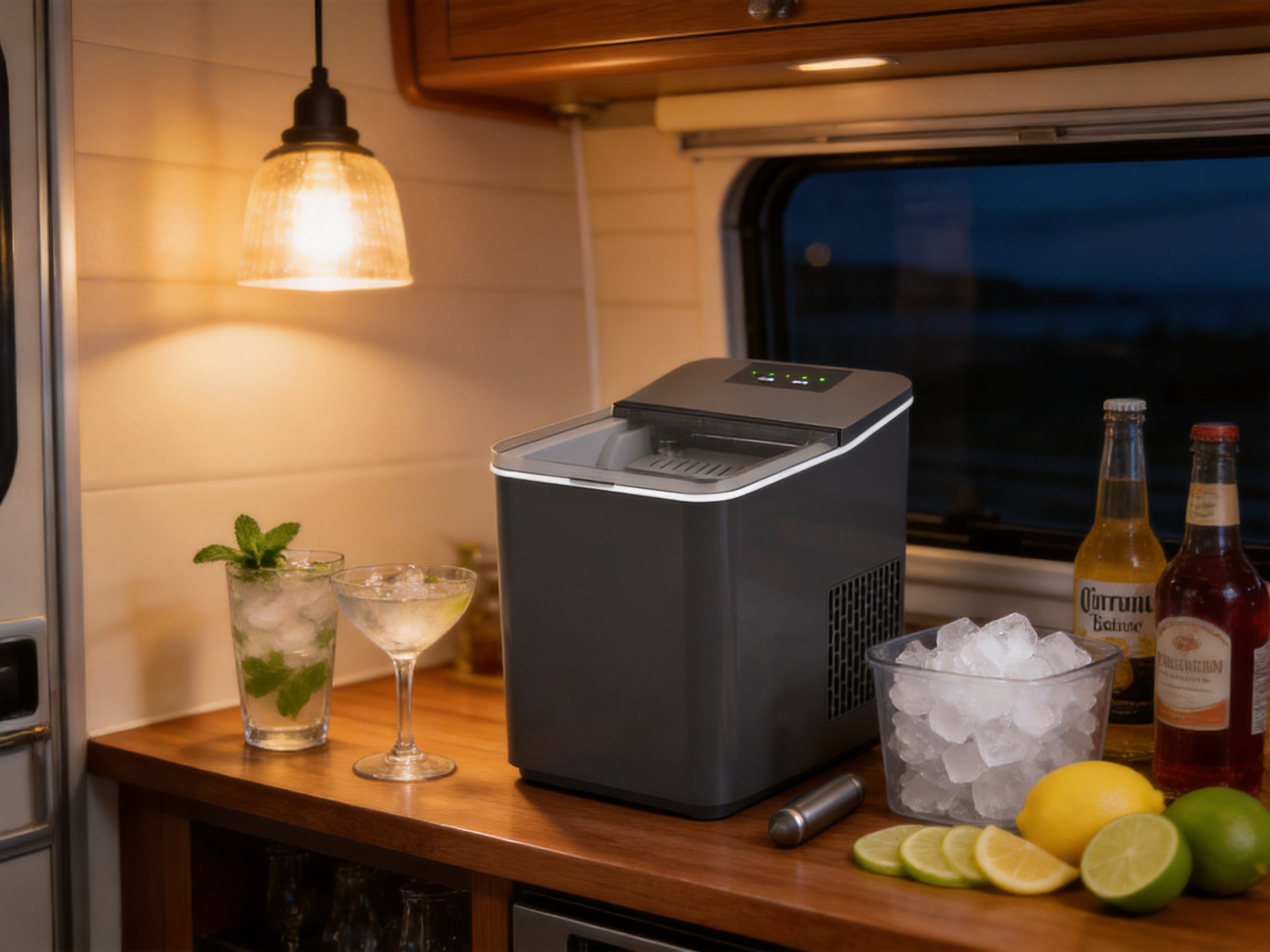
Recreational Vehicles and Vacation Spaces
In RVs, cabins, and vacation homes, freezer space is often limited. A portable countertop ice maker provides comfort without built-in installation. Users can enjoy fresh ice during travel, camping stays, or seasonal living. The compact body and simple operation are particularly valuable in these environments.
Small Commercial Spaces
Small shops, studios, salons, and reception areas can use the machine to offer chilled drinks to customers. It adds a hospitality touch without requiring a major equipment investment. The simple interface makes it easy for staff to operate during busy hours.
Performance Tips for Best Results
To get the best performance from the Button-Operated Ice Maker, users should place the machine on a stable, level surface with adequate ventilation around it. Like all refrigeration appliances, it performs best when airflow is not blocked. Users should avoid placing it near high heat sources, direct sunlight, or enclosed spaces without ventilation.
Water temperature and room temperature can affect ice-making speed. Cooler water and a moderate ambient environment generally support faster ice formation. If the machine is used in a very warm room, the first cycle may take longer, and ice may be softer at first. This is normal for compact ice makers. Allowing the machine to run through several cycles can improve consistency.
Clean water is recommended for better ice taste and machine cleanliness. If local tap water has strong mineral content or odor, filtered water may improve the user experience. Regular cleaning is important, especially when the machine is used frequently. Emptying old water, rinsing the basket, and wiping interior surfaces help keep ice fresh.
Users should transfer ice to a freezer if they want to store it for a long time. Countertop ice makers are designed to make ice quickly, but many are not intended to function as deep freezers. Ice left in the basket may gradually melt and return to the water reservoir, where it can be used for future cycles. This circulation is practical, but long-term storage is best handled by a freezer.
Why Manufacturing Location and Company Focus Matter
Alien Technology Co., Ltd. is located at No. 138, Huixiang'an Road, Zhouxiang Town, Cixi City, Zhejiang Province. This location matters because the surrounding region has a strong industrial foundation for small household appliances. A developed appliance manufacturing environment supports access to component suppliers, technical workers, production equipment, packaging resources, and transportation networks.
For international buyers, distributors, and business partners, manufacturing stability is as important as product design. A company that specializes in household appliances can better understand market expectations, product safety, usability, and quality consistency. The company’s product categories, including ice makers, coffee machines, and air fryers, show a focus on appliances that improve daily convenience. This focus supports ongoing improvement in design, assembly, and customer cooperation.
The company’s business philosophy emphasizes excellent quality, customer satisfaction, continuous improvement, innovation, and pragmatic development. These values are important in appliance manufacturing because consumer expectations continue to rise. Buyers want products that are not only attractive at first glance but also reliable after repeated use. Continuous improvement helps manufacturers respond to customer feedback, refine production methods, and strengthen product competitiveness.
Design Philosophy: Smart Technology Without Unnecessary Complexity
Smart technology does not always mean adding screens, apps, or complicated settings. In a practical household appliance, smart design often means making the product easier to use, more reliable, and better adapted to real human behavior. The Button-Operated Ice Maker demonstrates this form of intelligence. It simplifies the process of making ice while preserving important functions such as fast production, size selection, efficient operation, and easy maintenance.
This approach gives the product a strong competitive identity. In a crowded market, some products try to stand out by adding features that users rarely need. However, an appliance used every day must succeed in ordinary moments: when someone wants a cold drink quickly, when an office visitor asks for water, when a family dinner needs more ice, or when an RV traveler wants comfort away from home. In these moments, clear operation and dependable output matter more than decorative complexity.
Quality as a Complete User Experience
Quality is often discussed as if it only means durability, but in a household appliance, quality includes the whole user experience. A quality ice maker should be easy to understand, fast enough to be useful, compact enough to place conveniently, quiet enough to live with, efficient enough for regular use, and easy enough to clean. It should also be manufactured consistently so that customers receive the performance they expect.
The Button-Operated Ice Maker addresses these quality dimensions in a balanced way. Its one-touch operation improves usability. Its 6-10 minute cycle improves convenience. Its 150W power rating supports efficiency. Its compact dimensions improve placement flexibility. Its removable basket and smooth interior improve maintenance. Its refrigerant system supports ice production in a small body. Together, these characteristics create a product that is not merely a machine but a practical daily assistant.
Q&A Section
Q1: What type of ice does this machine make?
It is a bullet ice maker. Bullet ice is a popular shape for countertop ice machines because it forms quickly, chills drinks effectively, and is easy to scoop and use in common cups and beverage containers.
Q2: How quickly can it produce ice?
The machine can produce ice in approximately 6 to 10 minutes per cycle, depending on water temperature, room temperature, ventilation, and operating conditions.
Q3: Is the machine difficult to operate?
No. The product is designed for button-operated control. Users can start ice production with a simple button action, making it suitable for families, offices, elderly users, and first-time users.
Q4: Where can this ice maker be used?
It is suitable for homes, offices, bars, recreational vehicles, vacation spaces, beverage stations, and small commercial areas where convenient fresh ice is needed.
Q5: Does it require a permanent water connection?
The product is designed as a compact countertop ice maker, so it is intended for convenient placement and manual use rather than permanent built-in installation. Users should follow the product manual for water filling and operation.
Q6: What are the machine dimensions?
The machine dimensions are 313 x 226 x 309 mm, making it compact enough for many countertops and small spaces.
Q7: What power supply does it use?
The product power supply is 220V-240V / 50Hz, with a current and power rating of 0.9A / 150W.
Q8: What refrigerant is used?
The machine uses R600a refrigerant with a charge amount of 19g. This supports compact refrigeration performance when handled and charged correctly during manufacturing.
Q9: Is it easy to clean?
Yes. The machine is designed with smooth interior surfaces and a removable ice basket, making routine cleaning and maintenance more convenient.
Q10: What makes it competitive compared with other countertop ice makers?
Its key advantages include one-touch button operation, fast ice-making cycles, multiple ice size options, efficient power use, quiet operation, compact dimensions, and easy cleaning. These features create a strong balance of convenience, performance, and practicality.
Conclusion
The Button-Operated Ice Maker is designed for users who want fresh ice without delay, complication, or permanent installation. It responds to a common modern need with a focused and practical solution: simple button control, rapid bullet ice production, flexible ice sizes, efficient operation, quiet performance, compact placement, and easy maintenance. These qualities make it suitable for a wide range of environments, from home kitchens and office pantries to bars, RVs, vacation homes, and small commercial spaces.
Its advantages over competing products come from balance. It does not depend on unnecessary complexity to appear advanced. Instead, it delivers meaningful improvements in the areas users notice every day: how easy it is to start, how quickly ice appears, how comfortably it fits into a room, how simple it is to clean, and how reliably it supports daily refreshment. This user-centered approach is supported by the manufacturing experience and appliance-focused development philosophy of Alien Technology Co., Ltd.
In an appliance market where convenience, reliability, and space efficiency are increasingly important, this button-operated bullet ice maker offers a compelling solution. It is a small machine with a clear purpose: to make fresh ice quickly and easily, helping people enjoy colder drinks, smoother gatherings, better hospitality, and more comfortable daily living.
References
ASHRAE Handbook: Refrigeration, American Society of Heating, Refrigerating and Air-Conditioning Engineers.
Principles of Refrigeration, Roy J. Dossat and Thomas J. Horan.
Household and Similar Electrical Appliances Safety Standards, International Electrotechnical Commission.
Small Appliance Design and Manufacturing Practices, industry technical literature on compact household appliances.
Food Equipment Hygiene and Cleaning Guidelines, general references for appliances involving potable water and ice contact surfaces.