
 English
 한국어
한국어 Español
 Deutsch
Ice is a small household necessity that can make a significant difference to daily comfort. A cold drink, a chilled dessert, an iced coffee, or a well-prepared cocktail all depend on a dependable supply of ice. However, traditional ice-making methods often require planning, freezer space, and considerable waiting time. Filling trays, placing them in a freezer, and removing frozen cubes later may be acceptable for occasional use, but this method becomes inconvenient during family gatherings, office events, outdoor activities, or commercial service.
The Button-Operated Ice Maker is designed to provide a simpler alternative. Built for direct, easy-to-understand operation, it allows users to begin making ice with a single button. Its compact structure, efficient 150W operating power, and fast ice-making cycle make it suitable for homes, offices, bars, recreational vehicles, and small commercial spaces. The machine is engineered around a practical idea: users should be able to obtain fresh ice without complicated controls or a large permanent installation.
Manufactured by Alien Technology Co., Ltd., a Zhejiang-based household-appliance producer, the machine reflects the company’s focus on humanized design, reliable quality, intelligent technology, and practical manufacturing. The manufacturer specializes in ice makers, air fryers, coffee machines, and other small appliances. This product combines a straightforward control system with a compact cooling structure, removable ice storage, multiple ice-size options, and features intended to reduce daily maintenance.
This article examines the product’s operating concept, specifications, advantages over conventional and competing ice-making solutions, user applications, maintenance requirements, and the manufacturing strengths that support its performance.
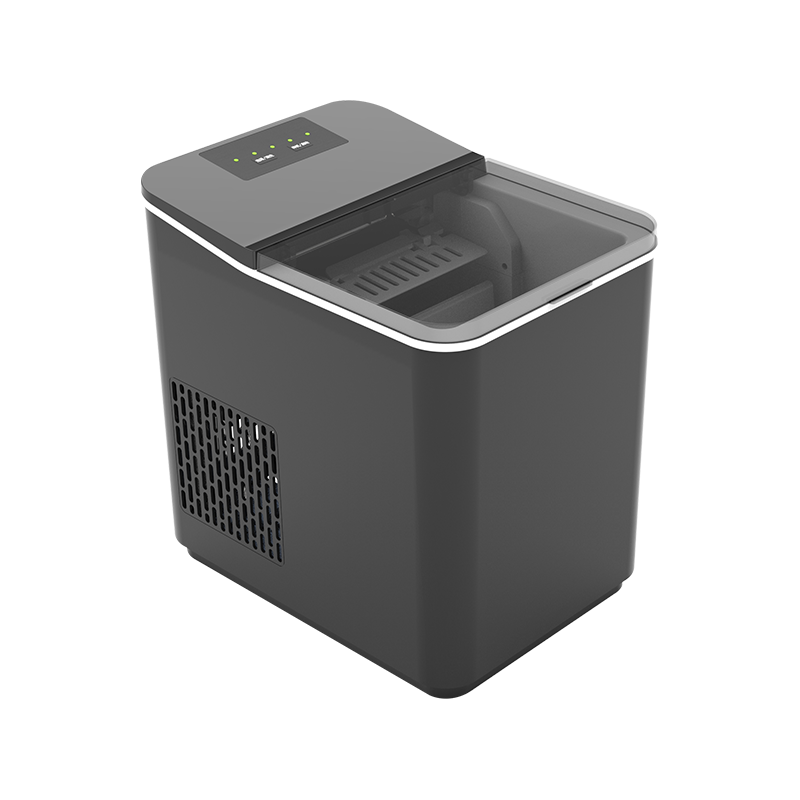
Button-Operated Ice Maker
1. Product Overview
The Button-Operated Ice Maker is a countertop ice-making appliance with the model description Alien-Z03. It belongs to the bullet ice maker category, a product class known for producing small, rounded or bullet-shaped pieces that are convenient for beverages and general cooling applications. Its compact dimensions measure 313 × 226 × 309 millimeters, allowing it to fit on many kitchen counters, office tables, bar workstations, and mobile living surfaces.
The operating concept is intentionally simple. Instead of requiring a complicated digital menu, the machine uses button-operated control. A user can place the appliance in a suitable location, add water according to the operating instructions, select the desired ice setting where applicable, and press the control button to start production. This straightforward interaction reduces the learning curve and makes the appliance accessible to a wide range of users.
The product is designed for users who need ice quickly but do not necessarily want a full-size freezer or a permanently installed ice-making system. It can be used as a supplementary ice source in a family kitchen, a convenient beverage accessory in an office, a practical service tool behind a small bar, or a portable cooling solution for recreational environments where a suitable electrical supply is available.
Core Product Specifications
Product Type |
Button-operated countertop ice maker |
Category |
Bullet Ice Maker |
Model Description |
Alien-Z03 |
Power Supply |
220V–240V / 50Hz |
Current and Power |
0.9A / 150W |
Refrigerant and Charge |
R600a / 19g |
Machine Dimensions |
313 × 226 × 309 mm |
Control Method |
Button operation |
Ice Options |
Multiple ice sizes, subject to the selected operating configuration |
Recommended Environments |
Homes, offices, bars, RVs, and small commercial spaces |
The listed electrical specifications indicate that the appliance is intended for regions using a 220V–240V, 50Hz power supply. Users should always confirm electrical compatibility before operation and follow the applicable safety instructions. The 150W power rating supports the product’s positioning as a compact appliance rather than a large, high-capacity commercial ice plant.
2. The Advantage of One-Touch Operation
One of the clearest advantages of the Button-Operated Ice Maker is its simple control system. Many modern appliances contain numerous menus, icons, modes, and settings that may be useful in complex applications but unnecessary for routine ice production. For a user who simply wants to make ice, excessive controls can add confusion rather than value.
The button-operated design focuses on the most important function: starting and managing the ice-making process with minimal effort. A user does not need extensive technical knowledge to understand the basic operating sequence. This makes the appliance particularly suitable for households with multiple users, shared offices, hospitality environments, and locations where guests may need to operate the machine without staff assistance.
A simple control interface can also help reduce operational errors. When the purpose of the main control is clear, users are less likely to select an unsuitable setting or interrupt a cycle unintentionally. The design is therefore not merely a matter of convenience; it supports predictable daily use.
The one-touch approach is also useful for older users and first-time appliance owners. A machine that can be understood quickly is more likely to be used correctly and consistently. In busy kitchens or service areas, operators can begin a cycle without diverting attention to a complicated programming procedure.
Compared with manually filling ice trays, button operation offers a faster transition from demand to production. Compared with more complex machines, it offers a more approachable user experience. This balance between automation and simplicity is one of the product’s strongest competitive advantages.
3. Fast Ice Making for Daily Demand
The product is designed to produce ice in approximately 6 to 10 minutes per cycle, depending on operating conditions such as ambient temperature, water temperature, ventilation, and the selected ice size. This rapid cycle is valuable because it reduces the need to prepare ice far in advance.
For a home user, fast production means that ice can be made when guests arrive rather than being stored in large quantities days earlier. For an office, it supports cold drinks during meetings or warm afternoons. In a bar or small food-service environment, it can help supplement the existing ice supply during periods of moderate demand. For an RV or recreational setting, it offers a convenient source of fresh ice without relying entirely on a freezer compartment.
The value of speed is not only measured by the duration of one cycle. It also depends on how easily the machine can repeat the process. A compact ice maker that produces successive batches can provide a practical flow of ice for routine use, provided that the water supply, storage capacity, ventilation, and operating instructions are properly managed.
Compared with conventional freezer trays, the machine significantly reduces waiting time. A tray may require several hours to freeze, while this appliance is designed around short production cycles. Compared with a large built-in system, it offers a more accessible solution for locations that do not need continuous high-volume production or permanent installation.
Users should understand that real-world production performance can vary. Ice-making appliances generally operate more efficiently in a cool, well-ventilated environment than in a hot or enclosed location. The advertised cycle range should therefore be viewed as an operating reference rather than an absolute guarantee under every condition.
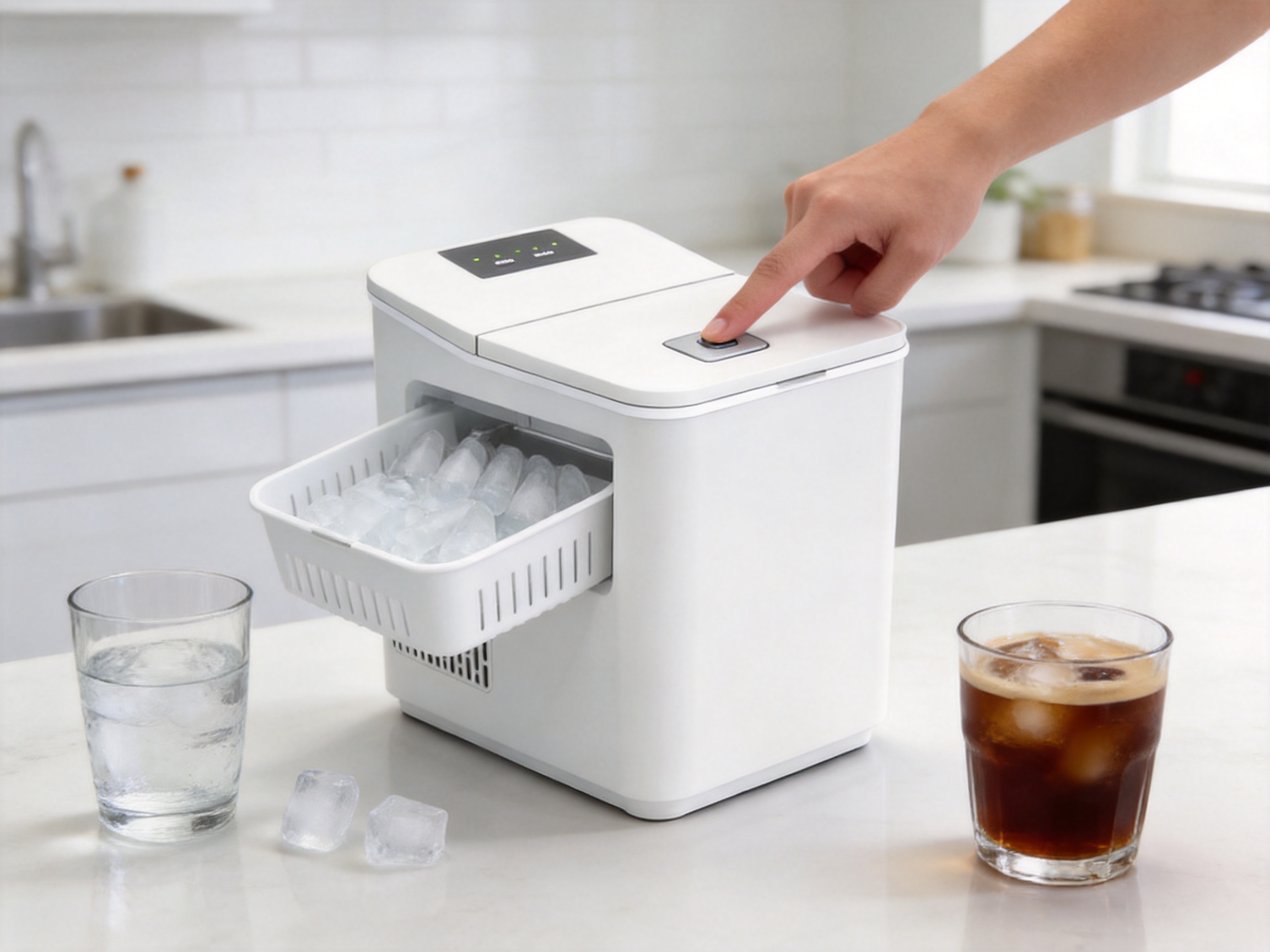
4. Multiple Ice Sizes for Different Uses
Different drinks and cooling tasks benefit from different ice dimensions. A small beverage may require compact pieces that chill quickly, while a cocktail or serving container may benefit from larger pieces that melt more slowly. Smoothies, cold juices, soft drinks, and food-preservation applications can also have different ice requirements.
The Button-Operated Ice Maker provides multiple ice-size options, allowing users to select a format that suits the situation. This flexibility gives the appliance an advantage over basic ice trays, which generally produce only one fixed shape and size. It also makes the machine more adaptable than a single-setting ice maker intended for only one type of beverage.
For domestic use, multiple sizes allow one appliance to support different members of a family. Children may prefer smaller pieces for cold drinks, while adults may select another size for coffee-based beverages or entertaining. In an office, the same machine can serve water, juice, iced tea, and other refreshments without requiring separate equipment.
In hospitality environments, ice shape contributes to presentation as well as cooling performance. Bullet-shaped ice can provide a distinctive appearance in clear glasses and beverage dispensers. Its smooth form is also convenient for handling and pouring. The exact result will depend on the selected setting and the machine’s operating conditions, but the availability of choice gives users greater control over the final serving experience.
5. Compact Dimensions and Flexible Placement
Measuring 313 × 226 × 309 millimeters, the machine is designed to occupy a relatively small countertop footprint. Space efficiency is important because many users want additional ice-making capacity without sacrificing valuable kitchen or service-area workspace.
The compact structure can be beneficial in apartments, small offices, dormitory-style environments, mobile homes, and recreational vehicles. It may also be useful in cafés, bars, and small restaurants that need supplementary ice close to a preparation or serving station. Since the appliance is not described as a permanently installed unit, it can be positioned where it is most useful, provided that the surface is stable and the required electrical and ventilation conditions are met.
Small dimensions also simplify storage when the machine is not needed continuously. Seasonal users may bring it out for summer events, parties, or outdoor entertaining and store it afterward. This is more flexible than installing a dedicated ice system that occupies space year-round.
However, compact size should not be interpreted as permission to place the machine in any confined location. Like other refrigeration appliances, it requires appropriate ventilation around the housing. It should not be pushed tightly against a wall, placed beside a strong heat source, or operated on an unstable surface. Correct placement helps protect performance and supports the service life of internal components.
6. Energy-Conscious Operation
The machine has a rated power of 150W and a current rating of 0.9A under the specified 220V–240V, 50Hz electrical supply. These specifications support a compact and energy-conscious operating profile for a countertop appliance. The product is designed to provide on-demand ice without the continuous electrical demand associated with some larger systems.
On-demand production can help users avoid making more ice than they need. Instead of filling a large freezer compartment with trays or operating a large ice system for light demand, users can produce smaller quantities when required. This approach may reduce unnecessary storage and support more efficient use of kitchen resources.
The product information also emphasizes optimized water usage. Efficient water management is valuable because it can reduce waste during repeated operation. Users should still follow the recommended fill level and avoid overfilling the reservoir, as excessive water may affect production or create spillage.
Energy performance depends on usage conditions. Ambient temperature, cycle frequency, ventilation, water temperature, and cleaning condition all influence appliance efficiency. A clean machine with adequate airflow can generally operate more effectively than one covered in dust or placed in a hot, enclosed space.
Compared with freezing trays inside a large refrigerator, a dedicated countertop unit may offer a more direct approach to producing ice. Compared with a high-capacity commercial system, its lower power rating may be more appropriate for light and moderate demand. This positioning makes it a practical choice for users who value efficiency and convenience over industrial-scale output.
7. Quiet Operation for Shared Spaces
Noise is an important consideration for appliances used in homes, offices, bedrooms, and customer-facing environments. The Button-Operated Ice Maker incorporates a noise-reduction design intended to keep operation quiet. This feature helps the appliance fit into spaces where a loud compressor or fan could be distracting.
In a residential kitchen, quieter operation allows ice production to continue without overwhelming conversation or entertainment. In an office, it reduces disruption during meetings and focused work. In a bar, café, or small hotel environment, moderate sound levels contribute to a more comfortable atmosphere for customers and employees.
Noise levels may vary depending on the operating cycle and surrounding surface. Cooling systems can produce different sounds during startup, refrigeration, water circulation, and ice release. A stable, level surface can help reduce vibration. Users should also maintain clear ventilation and avoid placing the appliance against objects that may amplify sound.
Compared with improvised ice production in a busy freezer, a purpose-built appliance provides a more controlled process. The quiet-operation objective further strengthens its advantage in shared spaces where convenience must be balanced with comfort.
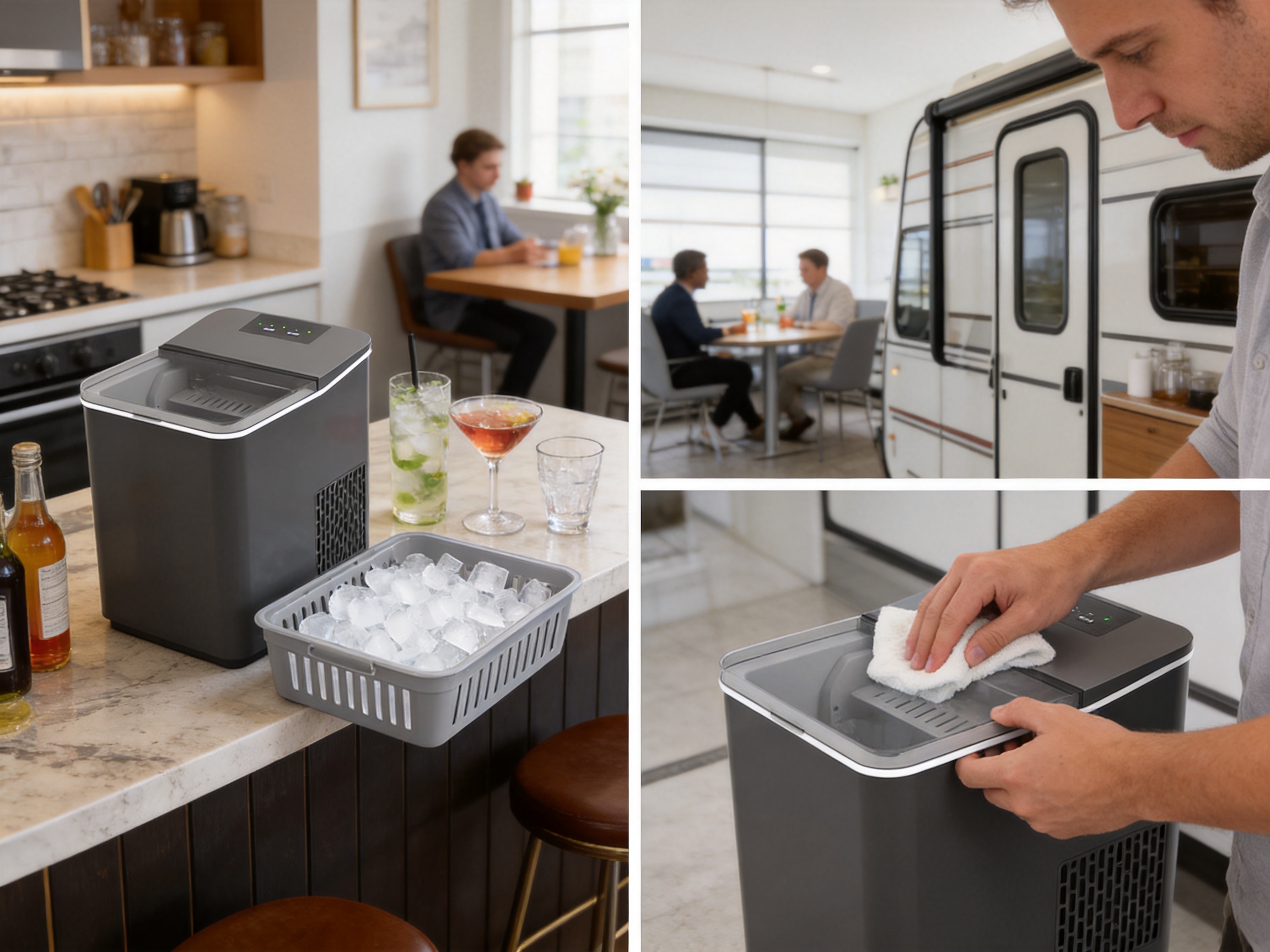
8. Easy Cleaning and Maintenance
Regular cleaning is essential for any appliance that handles water and produces ice for consumption. The Button-Operated Ice Maker is designed with smooth interior surfaces and a removable ice basket to make routine maintenance easier.
Smooth internal surfaces reduce the number of places where water residue or particles can collect. A removable basket allows users to take out the finished ice, clean the storage area, and access the interior more conveniently. These design details can save time and encourage more consistent maintenance.
A sensible cleaning routine should begin with disconnecting the machine from the electrical supply and removing remaining ice and water. The basket and accessible surfaces can then be cleaned according to the manufacturer’s instructions. Users should avoid harsh chemicals, abrasive tools, or unsuitable cleaning materials that could damage internal surfaces or leave unwanted residues.
Water quality also affects maintenance. If local water contains a high level of minerals, scale may accumulate over time. Using appropriate water and following the recommended descaling procedure can help maintain water flow and cooling performance. The appliance should be dried properly when it will not be used for an extended period.
Easy maintenance is a competitive advantage because cleaning difficulty often determines whether users continue to care for an appliance properly. A machine that is inconvenient to clean may gradually experience reduced hygiene and performance. By contrast, removable and smooth components support a more practical ownership experience.
9. R600a Refrigerant and Cooling Design
The machine uses R600a refrigerant with a listed charge of 19 grams. R600a, also known as isobutane, is widely used in various modern refrigeration appliances. Its inclusion reflects the product’s compact refrigeration architecture and the manufacturer’s selection of a refrigerant suited to small cooling systems.
Because R600a is flammable, users should not attempt to open, puncture, modify, or repair the sealed refrigeration circuit. Any service involving refrigerant or the compressor system should be performed by qualified personnel using appropriate procedures and equipment. The appliance should also be kept away from flames and other ignition sources during installation, operation, and disposal.
The refrigeration system works together with the water circuit, ice-forming surfaces, control components, and heat-dissipation structure. Reliable ice production depends on the coordinated performance of these parts. A compact appliance must manage cooling, airflow, water delivery, ice release, and storage within a limited housing, which places importance on careful component arrangement and assembly accuracy.
The use of a small refrigerant charge is consistent with a countertop format. It allows the product to provide localized cooling in a compact body rather than requiring the large systems associated with industrial equipment. The result is an appliance that prioritizes accessibility, portability, and space efficiency.
10. Advantages Over Conventional Ice Trays
Traditional ice trays remain inexpensive and familiar, but they require substantial waiting time. Users must fill the trays, place them in a freezer, wait for freezing, remove the ice, and refill the trays. The process is simple but not immediate.
The Button-Operated Ice Maker improves on this method in several ways. First, it produces ice in short cycles rather than requiring many hours of freezer time. Second, it reduces the need to handle individual trays. Third, it can make repeated batches without occupying freezer shelves. Fourth, it offers different ice sizes instead of one fixed mold shape.
The appliance also provides more predictable access to fresh ice. Freezer trays can be difficult to remove, may spill water, and can become mixed with frozen food. A dedicated unit creates a separate ice-making area, supporting better organization and convenience.
For households that entertain frequently, the difference can be especially noticeable. Rather than reserving freezer space for trays before every event, users can operate the machine as needed. This allows the freezer to remain available for food storage and other frozen products.
Nevertheless, trays may remain suitable for very occasional users who have ample freezer space and no need for rapid production. The Button-Operated Ice Maker is most valuable when convenience, speed, repeatability, and space flexibility justify the use of a dedicated appliance.
11. Advantages Over Large Built-In Ice Systems
Large built-in ice systems can provide high output, but they typically require more space, a greater installation commitment, and potentially more complex plumbing or electrical arrangements. They are often intended for restaurants, hotels, or other high-volume operations.
The Button-Operated Ice Maker offers a different value proposition. It is designed for users who need convenient ice production without the cost and complexity of a full commercial installation. Its compact dimensions make it easier to place, relocate, and store. Its button control also makes daily operation more approachable.
For small businesses, this distinction can be important. A café, office pantry, boutique hotel, or small bar may not need the capacity of a large ice plant. A countertop unit can serve as a supplementary source during normal service or as a primary source for limited demand.
The product is not intended to replace every industrial ice-making system. Its competitive advantage lies in right-sizing the solution. Users receive dedicated ice production without investing in equipment designed for a much larger workload.
12. Advantages Over More Complicated Countertop Machines
Some countertop appliances emphasize large displays, numerous automatic programs, and extensive digital menus. These features can be useful, but they may also increase the learning curve and create more points of user confusion.
The Button-Operated Ice Maker takes a more focused approach. Its primary control is easy to identify, and its operating concept is direct. This can be advantageous in family homes, shared offices, and hospitality spaces where different people may use the appliance throughout the day.
Simplicity can also support reliability. A design with fewer unnecessary user-interface functions may be easier to understand and maintain. The appliance still provides useful flexibility through multiple ice sizes, but it does not make the user navigate an overly complicated control environment.
This balance is particularly appealing to buyers who want practical technology rather than technology for its own sake. The machine’s intelligent features are directed toward a clear daily need: producing ice quickly, consistently, and with minimal effort.
13. Manufacturing Strengths of the Manufacturer
Alien Technology Co., Ltd. is located in Zhouxiang, Zhejiang Province, an area known for small household-appliance production and convenient logistics. The company specializes in ice makers, coffee machines, air fryers, and related household appliances. This specialization gives the manufacturer experience across several product categories that require compact mechanical structures, heating or cooling control, electrical integration, user-focused housing design, and routine quality management.
The company’s stated mission is “Smart Technology, Simplifying Life, Enhancing Happiness.” This mission is reflected in the product’s practical design language. The Button-Operated Ice Maker does not rely on unnecessary complexity. Instead, it applies technology to a common household task and makes that task faster and easier.
A manufacturer experienced in several appliance categories can also benefit from shared knowledge. Lessons learned in airflow management for air fryers, compact fluid and heat control for coffee machines, and refrigeration integration for ice makers can support broader engineering awareness. While each product requires its own development process, cross-category experience can encourage practical and efficient design decisions.
Product Development and Component Integration
Compact ice makers require accurate coordination between the refrigeration system, water path, ice-forming area, sensors, control interface, storage basket, and outer housing. The machine’s small dimensions leave limited room for misplaced wiring, inefficient airflow, or poorly arranged components. A capable production process must therefore begin with careful product engineering and component planning.
The Button-Operated Ice Maker’s design demonstrates attention to this integration. The electrical system is matched to a 220V–240V, 50Hz environment. The 150W power rating is aligned with a compact appliance format. The refrigerant charge is specified for the small cooling circuit, while the removable basket and smooth interior support user maintenance.
Assembly Accuracy
Refrigeration appliances depend on assembly accuracy. Sealed cooling systems, water channels, insulation, electrical connections, and moving components must be installed consistently. Proper assembly helps reduce the risk of leaks, vibration, poor heat dissipation, and inconsistent ice production.
A professional household-appliance manufacturer typically relies on organized assembly procedures, defined workstations, component checks, and process supervision. These practices are especially important when producing multiple units for domestic and international markets. Consistent assembly helps ensure that the user experience remains stable from one product to the next.
Inspection and Quality Management
Quality management is not limited to examining the finished exterior. A reliable process should also consider incoming components, electrical safety, control response, cooling operation, water handling, noise, ice release, and packaging protection. Each stage offers an opportunity to identify issues before the product reaches the customer.
The company’s stated commitment to excellent quality, customer satisfaction, continuous improvement, and innovation indicates an organizational focus on long-term product performance. For a small appliance, this approach is important because users expect the machine to be ready for operation with minimal adjustment after unpacking.
Appropriate inspection procedures can also support export readiness. Products shipped across regions must be protected against transportation vibration, humidity, and handling stress. Careful packaging and final inspection help reduce avoidable damage during logistics.
Humanized Design as a Manufacturing Strength
Manufacturing strength is not only measured by factory equipment or production volume. It also includes the ability to translate user needs into practical design choices. A removable basket, smooth interior, simple button control, compact housing, and multiple ice-size options all represent decisions made around user behavior.
This humanized approach can distinguish the product from appliances that focus only on technical output. The best household appliances are not merely functional; they are understandable, maintainable, and suitable for the environments in which people actually live and work.
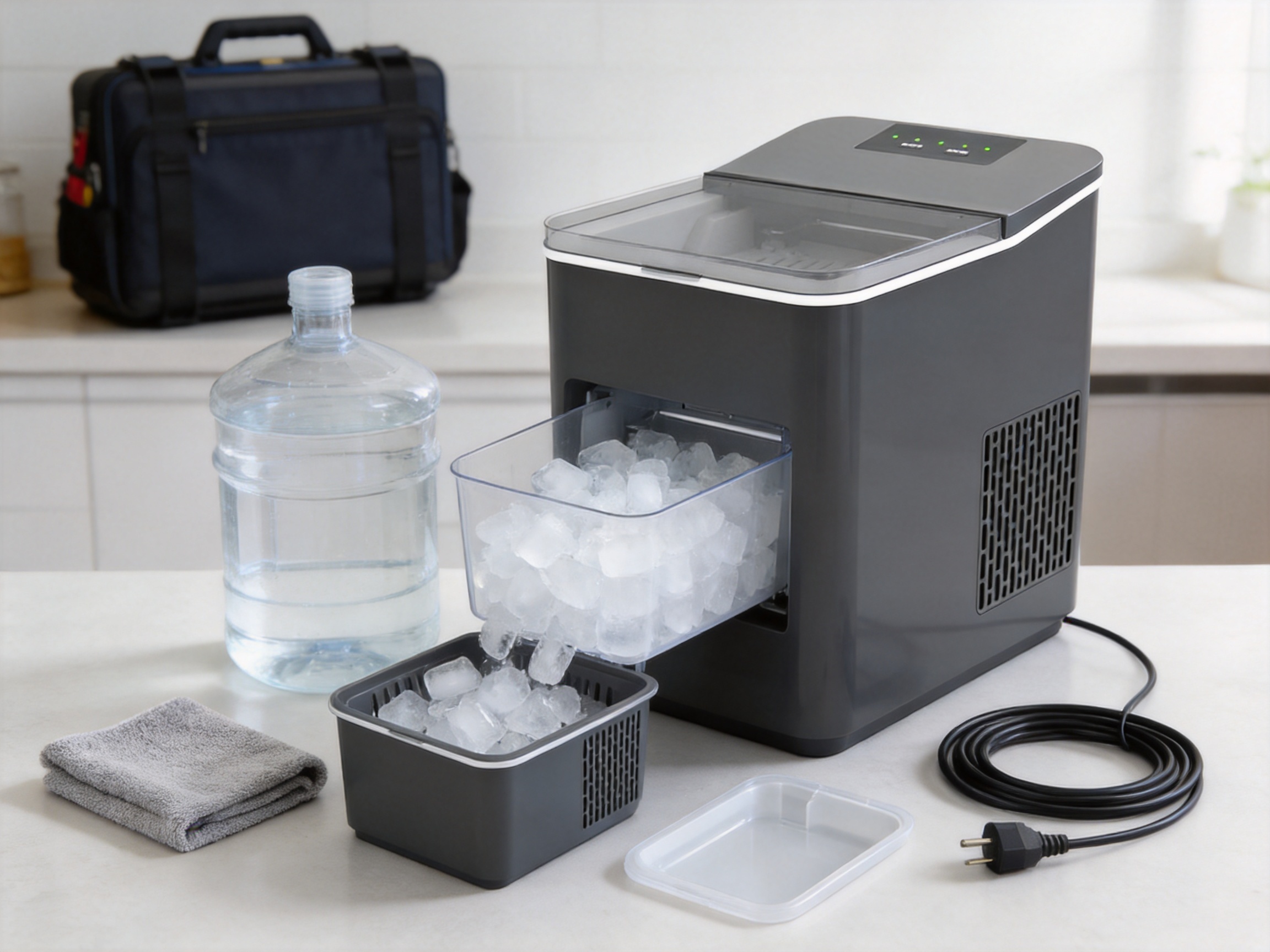
14. Applications in Homes
In the home, the Button-Operated Ice Maker can serve ordinary daily needs as well as special occasions. It can provide ice for water, soft drinks, iced tea, coffee beverages, fruit drinks, and desserts. During warm weather, the ability to produce fresh ice on demand can make the kitchen more comfortable and convenient.
Families may also find the appliance useful when freezer space is limited. Instead of filling shelves with trays, they can reserve freezer capacity for food. The machine’s countertop format makes it accessible without requiring a remodeling project or permanent installation.
For parties, the fast cycle time can help users respond to changing demand. It is still sensible to prepare some ice in advance for large gatherings, but the appliance can provide additional batches during the event. Its multiple-size capability further supports different drink styles and serving preferences.
15. Applications in Offices and Workplaces
Office kitchens and staff lounges often need a modest supply of ice but lack the space or budget for commercial equipment. The compact appliance can support cold water, iced coffee, juice, and refreshments during meetings or shared breaks.
Its button control is suitable for shared use because employees do not need extensive instructions. The removable basket and easy-clean interior can also help establish a simple maintenance routine among staff members.
Quiet operation is particularly valuable in workplaces. A machine that operates with reduced noise is less likely to interrupt conversations, telephone calls, or focused work. Its compact footprint also allows it to fit into a pantry or break area without dominating the available counter.
16. Applications in Bars and Small Commercial Spaces
Small bars, cafés, event counters, and boutique hospitality businesses may require flexible ice production without needing a high-capacity industrial system. The Button-Operated Ice Maker can provide supplementary ice near a service point, preparation area, or private event station.
Bullet-shaped ice can be suitable for soft drinks, mixed beverages, iced coffee, and general chilling. Multiple ice sizes allow operators to select a format that works with different glasses and serving styles. Fast cycles can help staff respond to moderate demand during busy periods.
Commercial users should evaluate expected volume carefully. A countertop unit is best matched to light or moderate workloads and should be operated within the manufacturer’s recommendations. For continuous high-volume service, a larger commercial ice maker may be more appropriate. The competitive strength of this product is flexibility and accessibility, not industrial-scale output.
17. Applications in RVs and Recreational Settings
Recreational vehicles, holiday homes, outdoor entertainment areas, and temporary event spaces often benefit from compact appliances. The machine can offer a convenient ice source where a freezer is small or already occupied.
Before using the appliance in an RV or mobile environment, users should confirm that the available electrical system matches the required 220V–240V, 50Hz supply. The machine should be placed on a stable, level surface with adequate ventilation. Movement during transport should be managed carefully, and the appliance should be allowed to stand as recommended before operation if it has been tilted or moved extensively.
For recreational use, the machine’s simplicity is a significant advantage. Users can obtain fresh ice without carrying large quantities from home or purchasing ice repeatedly during a trip. The removable basket also makes it easier to transfer ice to a cooler or serving container.
18. Recommended Operating Practices
Correct operation supports performance, hygiene, and service life. The appliance should be placed on a firm, level surface away from direct heat, excessive moisture, and restricted airflow. Ventilation openings should remain clear, and objects should not be placed on top of the unit unless permitted by the operating instructions.
Use clean water and do not exceed the recommended fill level. Overfilling can result in spills and may interfere with internal operation. The ice basket should not be overloaded, and produced ice should be transferred or used as appropriate rather than left indefinitely inside the machine.
Users should inspect the power cord and plug before operation. The appliance should be connected to a suitable outlet, and extension cords should be used only when permitted and rated appropriately. Electrical components should never be exposed to standing water.
When the machine is not in use, it should be emptied, cleaned, and dried according to the manufacturer’s instructions. Long-term storage should take place in a dry, clean environment. These practices help reduce odor, mineral buildup, and contamination.
19. Maintenance and Service Considerations
Routine maintenance should include cleaning the water-contact surfaces, washing the removable ice basket, wiping the exterior, and checking for visible residue or obstruction. If mineral deposits appear, a suitable descaling procedure should be followed. The frequency of descaling depends on water hardness and how often the appliance is used.
Users should not attempt to repair the compressor, refrigerant circuit, sealed tubing, or other specialized components. R600a is flammable, and improper service can create safety risks. Qualified technicians should handle refrigeration repairs, refrigerant recovery, and sealed-system work.
If ice production slows, users should first check basic conditions: adequate water, clean internal surfaces, sufficient room ventilation, suitable ambient temperature, and unobstructed airflow. If a problem continues, professional service or manufacturer support should be considered rather than repeated unauthorized adjustment.
A clear maintenance routine is one of the easiest ways to protect the investment. Cleaning also supports the quality of the ice, which is especially important when the product is used for beverages or food-related applications.
20. Purchasing and Ownership Value
The value of an ice maker is determined by more than its purchase price. Buyers should consider how often they need ice, how much freezer space is available, whether rapid production matters, and how simple the appliance is to operate and clean.
The Button-Operated Ice Maker offers value through a combination of speed, compactness, accessible operation, multiple ice sizes, low rated power, and flexible placement. Its design is suitable for users who need more convenience than freezer trays provide but do not require a large permanent ice system.
Ownership value is also supported by the product’s maintainable design. A removable basket and smooth interior can reduce cleaning effort. The straightforward button interface can make daily use easier for different household members or workplace operators. Quiet operation adds value in spaces where comfort matters.
For business buyers, the machine may be useful as a backup or supplementary appliance. It can provide additional ice during small events, seasonal demand, or service periods when the primary supply is temporarily insufficient. Because it is compact, the business can position it near the area of greatest need.
21. Why the Product Stands Out
The Button-Operated Ice Maker stands out because it concentrates on the practical requirements of everyday ice production. It does not attempt to be an oversized commercial plant or an unnecessarily complicated smart appliance. Instead, it offers an approachable solution built around a clear user experience.
Its main advantages include one-touch operation, 6–10 minute ice-making cycles, multiple ice sizes, a compact 313 × 226 × 309 millimeter body, a 150W power rating, quiet operation, and easy cleaning. The use of R600a refrigerant and a 19-gram charge supports its compact refrigeration design, while the removable basket and smooth surfaces address everyday maintenance.
Compared with freezer trays, it is faster and more convenient. Compared with large installed systems, it is smaller and easier to position. Compared with complicated countertop appliances, it is easier to understand. These advantages make it a well-balanced option for homes, offices, hospitality environments, recreational vehicles, and small commercial locations.
22. Questions and Answers
Q1: What type of ice maker is this product?
It is a countertop button-operated ice maker in the bullet ice maker category. It is designed to produce small bullet-style pieces for drinks, food cooling, and general household use.
Q2: How is the machine operated?
The appliance uses simple button control. After placing it correctly, adding water, and selecting the appropriate setting where available, the user can press the button to begin production.
Q3: How quickly can it make ice?
The product is designed to produce ice in approximately 6 to 10 minutes per cycle. Actual production time may vary according to ambient temperature, water temperature, ventilation, ice size, and other operating conditions.
Q4: Does it offer different ice sizes?
Yes. The product information identifies multiple ice-size options. Users can select a suitable size for beverages, cocktails, smoothies, or other cooling needs.
Q5: What are the machine’s dimensions?
The dimensions are 313 × 226 × 309 millimeters. Its compact size is intended for countertop use in kitchens, offices, bars, RVs, and small commercial spaces.
Q6: What power supply does it require?
The specified power supply is 220V–240V at 50Hz. The listed current and power are 0.9A and 150W. Buyers should confirm that their local electrical supply is compatible before use.
Q7: What refrigerant does it use?
The appliance uses R600a refrigerant with a listed charge of 19 grams. Because R600a is flammable, the sealed refrigeration system should be serviced only by qualified personnel.
Q8: Is it suitable for a small bar or café?
It can be suitable as a primary ice source for light demand or as a supplementary machine for moderate demand. Businesses requiring continuous, high-volume production should evaluate larger commercial equipment.
Q9: Is the machine difficult to clean?
The product is designed for easier maintenance through smooth interior surfaces and a removable ice basket. Users should clean it regularly and follow the manufacturer’s recommended cleaning procedures.
Q10: Can it be used in an RV?
It can be considered for RV use when the vehicle provides the required 220V–240V, 50Hz electrical supply and a stable, adequately ventilated operating location. The machine should be secured appropriately during transportation.
Q11: What makes it different from using freezer trays?
It provides faster production, repeated short cycles, multiple ice-size options, and dedicated ice storage. It also avoids occupying freezer shelves with water-filled trays.
Q12: Does compact size mean it can be placed anywhere?
No. The appliance requires a stable surface, suitable electrical access, and adequate ventilation. It should be kept away from heat sources, excessive moisture, and restricted spaces.
Q13: Who manufactures the product?
The product is manufactured by Alien Technology Co., Ltd., a Zhejiang-based company specializing in household appliances including ice makers, air fryers, and coffee machines.
Q14: What is the manufacturer’s business strength?
The company emphasizes humanized design, reliable quality, customer satisfaction, continuous improvement, innovation, and practical household-appliance manufacturing. Its location in Zhejiang also provides access to an established small-appliance production and logistics environment.
Q15: Is this an industrial ice maker?
No. It is a compact countertop appliance intended for homes, offices, bars, RVs, and small commercial spaces. Its value is flexibility and convenience rather than industrial-scale production.
23. Final Assessment
The Button-Operated Ice Maker is a practical solution for users who want fresh ice without the delay and inconvenience of traditional freezer trays. Its compact footprint, simple button operation, rapid 6–10 minute production cycle, multiple ice sizes, quiet operation, and easy-clean structure address the most common needs of household and light commercial users.
The product also benefits from a sensible balance between performance and simplicity. Its 150W rated power supports a compact operating profile, while the R600a refrigeration system is suited to the appliance’s small format. The 313 × 226 × 309 millimeter dimensions allow flexible placement in kitchens, offices, bars, RVs, and other locations where space is limited.
Its advantages over competitors are strongest when the comparison is based on ease of use, footprint, speed, and everyday flexibility. It is faster and more convenient than freezer trays, less demanding than a built-in commercial system, and more approachable than countertop appliances with unnecessarily complicated controls.
Behind the product is a manufacturer focused on household-appliance development and practical innovation. Alien Technology Co., Ltd. combines experience in ice makers, air fryers, coffee machines, and related products with a stated commitment to reliable quality, customer satisfaction, continuous improvement, and humanized design. These strengths support a product philosophy centered on making everyday tasks simpler.
For households, offices, small hospitality businesses, recreational users, and other buyers with light to moderate ice demand, the Button-Operated Ice Maker offers a convenient and space-conscious way to maintain a fresh supply. With correct installation, suitable operating conditions, regular cleaning, and responsible maintenance, it can become a dependable addition to daily beverage and food-service routines.
References
1. Product specification sheet for the Button-Operated Ice Maker, model description Alien-Z03.
2. Manufacturer-provided product information concerning one-touch control, ice-making cycles, ice-size selection, energy-conscious operation, quiet performance, and cleaning design.
3. Manufacturer-provided company profile for Alien Technology Co., Ltd., including product categories, business philosophy, quality objectives, and location information.
4. General household refrigeration safety guidance concerning R600a refrigerant, electrical compatibility, ventilation, and qualified servicing.
5. General appliance-maintenance principles for water-contact surfaces, removable storage components, mineral-scale control, and hygienic ice production.