
 English
 한국어
한국어 Español
 Deutsch
In modern homes, beverage stations, small restaurants, milk tea shops, offices, hospitality counters, and convenience-oriented food service settings, reliable ice production is no longer a minor detail. Ice influences the temperature, appearance, taste, service speed, and overall customer experience of many drinks and prepared foods. A compact ice maker that can produce user-friendly bullet ice quickly and hygienically is therefore a practical investment for operators who want consistent performance without sacrificing space or ease of use.
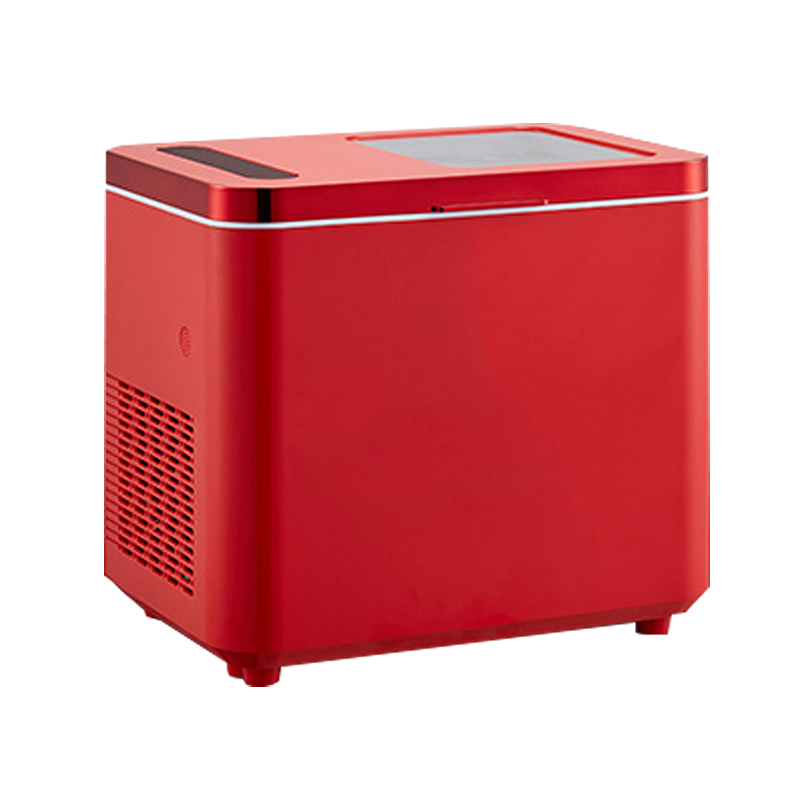
The touchscreen bullet ice maker described in this article is designed for efficient daily ice production in environments where convenience, cleanliness, compact structure, and beverage cooling speed matter. Its bullet-style ice, compact machine dimensions of 325 x 295 x 252 mm, 220V-240V/50Hz power supply, 150W rated power, R600a refrigerant, and fully flip-top cleaning-friendly design make it suitable for a wide range of household and light commercial applications. It is especially relevant for businesses that require fast ice availability while maintaining simple operation and low-maintenance routines.
Unlike many traditional ice-making solutions that focus only on production volume, this product emphasizes the complete user experience: how the ice cools drinks, how easily it can be scooped, how hygienically the machine can be maintained, how little counter space it occupies, and how smoothly it fits into fast-paced service operations. These practical advantages make it a competitive choice in the category of compact bullet ice makers.
Product Overview
This touchscreen ice maker belongs to the bullet ice maker category. Bullet ice is recognized by its rounded external shape and hollow or perforated center. This structure gives the ice a larger surface area in contact with beverages compared with some solid ice formats. As a result, bullet ice can cool drinks quickly, making it valuable for restaurants, tea shops, coffee corners, office pantries, and home entertainment settings where fast chilling is expected.
The product is developed for users who want simple operation and dependable ice availability. The touchscreen interface helps modernize the user experience by replacing complicated mechanical controls with a more direct and intuitive control surface. For operators and household users, this means the ice maker can be used without extensive training. In a food and beverage environment where multiple employees may operate the equipment, a clear control design reduces confusion and helps maintain service efficiency.
The machine’s compact structure is also an important advantage. With dimensions of 325 x 295 x 252 mm, it can fit on many countertops, pantry surfaces, back counters, bar stations, and small preparation areas. This is significant because many small food service businesses and household kitchens have limited available space. A space-saving ice maker can provide practical ice-making capability without requiring major layout changes.
The product uses R600a refrigerant with a 19g charge. R600a is commonly used in compact refrigeration appliances because it offers efficient cooling performance when applied correctly in sealed refrigeration systems. Combined with a rated power of 150W, the system is designed to support rapid ice-making in a compact format while remaining suitable for everyday countertop operation.
Core Technical Specifications
Product Type |
Touchscreen Bullet Ice Maker |
Power Supply |
220V-240V/50Hz |
Current/Power |
0.9A/150W |
Refrigerant/Charge |
R600a/19g |
Machine Dimensions |
325 x 295 x 252 mm |
Ice Type |
Bullet Ice |
Key Structural Feature |
Fully flip-top design for easier cleaning and maintenance |
Ideal Use Scenarios |
Homes, offices, beverage shops, milk tea shops, fast food counters, small restaurants, and hospitality areas |
Why Bullet Ice Matters
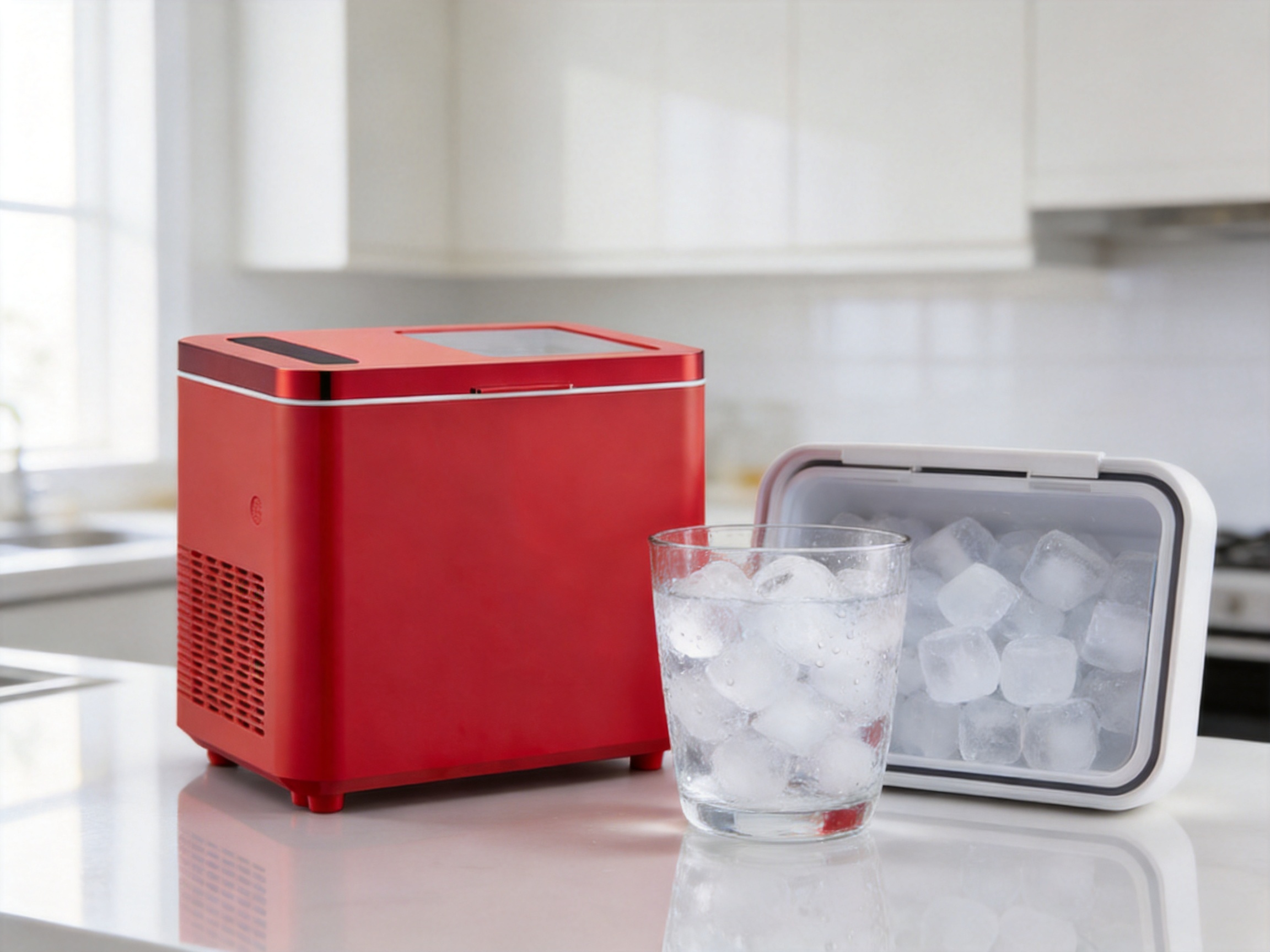
The quality of ice is not defined only by whether it is frozen. Shape, hardness, surface area, melt behavior, and handling characteristics all affect the end user’s experience. Bullet ice has become popular because it strikes a useful balance between cooling speed, texture, and convenience. Its rounded profile makes it easy to scoop, and the hollow center helps increase contact with liquid, accelerating cooling performance.
In a beverage business, rapid cooling can improve service quality. Drinks that reach the desired temperature quickly are more refreshing and more consistent. Customers often judge a cold beverage immediately by its first sip. If a drink is not cold enough, the customer may perceive it as poorly prepared, even if the ingredients are good. Bullet ice helps reduce this risk because it can transfer cold to the beverage efficiently.
For milk tea shops and fast food restaurants, bullet ice is especially attractive because it provides a pleasant crunchy texture. It is not as hard as many solid ice cubes, which can be important for customers who enjoy chewing ice. This moderate hardness can improve the sensory enjoyment of drinks such as iced tea, fruit tea, soda, coffee beverages, and blended refreshments.
Another advantage of bullet ice is its flowability. Some ice shapes clump easily in storage, especially when they melt slightly and refreeze. Clumped ice can slow down service, create waste, and make dispensing inconvenient. Bullet ice tends to remain easier to scoop and dispense because of its shape and reduced tendency to stick together. This is a practical advantage for busy service settings where employees need to prepare drinks quickly and consistently.
Rapid Cooling for Efficient Beverage Service
One of the product’s most important advantages is the rapid cooling performance of its bullet ice. The perforated or hollow center increases the contact area between the ice and the beverage. More contact area allows heat to transfer from the beverage into the ice more quickly. In practical terms, this means drinks can become cold faster after ice is added.
For businesses, faster cooling can reduce waiting time and improve operational flow. During busy hours, every second counts. A beverage shop may need to prepare dozens or hundreds of drinks in a short period. If ice performs efficiently, staff can maintain better drink quality without adding unnecessary preparation steps. Customers receive cold beverages quickly, and the business can maintain a smoother service rhythm.
For homes and offices, rapid cooling is equally useful. Users may want to cool juice, water, coffee, soda, cocktails, or tea without waiting for a refrigerator to chill the drink. A compact ice maker provides immediate ice availability and makes entertaining guests easier. Instead of purchasing bagged ice or waiting for freezer trays, users can prepare cold drinks on demand.
Compared with some conventional ice formats, bullet ice offers a balanced cooling experience. Very large solid cubes may melt slowly but cool beverages more gradually. Crushed ice cools very quickly but may dilute beverages faster and can be messy to handle. Bullet ice sits between these extremes, offering quick chilling with better structure and easier handling than crushed ice.
Non-Sticky Ice with High Flowability
In real-world use, the ease of handling ice is just as important as the speed of making it. Ice that sticks together can reduce efficiency and create frustration. Employees may need to break up clumps manually, which wastes time and can compromise hygiene. Home users may also dislike ice that freezes into a solid mass in the storage area.
The bullet shape produced by this ice maker helps reduce clumping during storage and dispensing. The curved form and hollow center support better separation between pieces. This improves flowability, allowing users to scoop ice more easily and move it into cups, pitchers, buckets, or beverage containers with less effort.
High flowability is particularly important for automatic or semi-automatic dispensing systems, drink counters, and environments where ice is handled repeatedly throughout the day. Smooth dispensing reduces delays and helps maintain a clean work surface. When ice pieces separate easily, staff can use a scoop more effectively and portion ice more consistently.
Compared with irregular ice or ice that forms in larger blocks, bullet ice is more convenient for everyday beverage preparation. It has enough structure to remain recognizable and easy to handle, but it does not have sharp edges or awkward shapes that make scooping difficult. This makes the product suitable for high-frequency use.
Moderate Hardness and Enjoyable Texture
Ice texture can influence beverage enjoyment. Some ice is extremely hard and uncomfortable to chew. Some ice is too soft and melts too quickly. Bullet ice is valued because it often provides moderate hardness, creating a crunchy texture that many consumers enjoy. In beverage shops, this can become part of the customer experience.
For milk tea, fruit tea, iced coffee, lemonade, soda, and similar drinks, texture matters. Customers may sip the drink and then chew the remaining ice. If the ice is pleasantly crunchy, it can make the beverage feel more refreshing and satisfying. This is one reason bullet ice is widely appreciated in casual dining and beverage service.
The moderate hardness also supports practical use. Ice that is not excessively hard can be easier to blend or crush if needed. While this machine is primarily intended to make bullet ice, the resulting ice may be more flexible for different beverage styles than very dense cubes. Operators can use it for direct service or as an ingredient in chilled drink preparation.
In comparison with some competitor products that produce only standard cube ice, this bullet ice maker offers a more customer-friendly ice format for fast-moving beverage environments. Cube ice can be suitable for some applications, but bullet ice provides a combination of cooling speed, scoopability, and chewable texture that is highly attractive for many drink categories.
High Ice-Making Efficiency in a Compact Format
The continuous ice-making principle used in bullet ice makers supports efficient production over time. Instead of relying on a traditional freezer tray process, the machine can repeatedly produce batches of ice through a dedicated refrigeration system. This is much faster and more convenient than manual freezing methods.
For businesses, high ice-making efficiency helps reduce dependence on purchased ice. Buying bagged ice may seem simple, but it introduces storage challenges, transportation costs, hygiene concerns, and potential inconsistency. A compact ice maker allows operators to produce ice on site, improving control and convenience.
For households, efficiency means users can prepare ice for family meals, parties, outdoor drink service, or daily hydration without planning far in advance. Freezer trays often require several hours to produce a limited amount of ice. A countertop ice maker can deliver ice much more quickly and repeatedly, improving everyday convenience.
The compact structure of this model is a major advantage. At 325 x 295 x 252 mm, it is designed to occupy a relatively small footprint while still providing useful ice-making capacity. In many kitchens or commercial counters, space is already occupied by coffee machines, air fryers, blenders, storage bins, display equipment, or preparation tools. A smaller ice maker allows users to add ice-making capability without redesigning the workspace.
Compared with larger machines, this product is easier to place, move, and integrate. Compared with very small or low-powered alternatives, it offers a stronger combination of functionality, touchscreen control, and cleaning convenience. This balance gives it a competitive position for users who need practical ice output without industrial-scale equipment.
Space-Saving Design for Modern Kitchens and Counters
Space efficiency is increasingly important in both home and commercial appliance design. Many consumers live in apartments or houses where countertop space is limited. Many small businesses operate from compact shopfronts where every centimeter must be used carefully. A bulky appliance can disrupt workflow and reduce the flexibility of the service area.
This touchscreen bullet ice maker addresses that challenge with a compact body. Its dimensions allow it to fit into locations where larger ice machines would be impractical. It can be placed near a beverage station, beside a coffee machine, in an office pantry, on a bar counter, or in a small restaurant service area. The compact size makes it easier to keep ice production close to where ice is actually used.
Keeping the ice maker near the point of service improves efficiency. Staff do not need to walk to a back freezer or storage room for ice. Home users do not need to open a freezer repeatedly. This reduces movement, saves time, and supports a cleaner workflow.
The space-saving design also benefits seasonal or flexible operations. For example, a small café may need more ice during summer, while an office may need more ice during meetings or events. A compact machine can be deployed when needed and stored more easily when demand changes. This flexibility is difficult to achieve with large built-in machines.
Competitor machines sometimes sacrifice compactness for capacity, resulting in equipment that is too large for small users. Others are compact but inconvenient to clean or operate. This product’s advantage lies in combining a small footprint with useful features such as touchscreen control, bullet ice production, and a fully flip-top cleaning design.
Fully Flip-Top Design for Easier Cleaning
Hygiene is essential in any appliance that comes into contact with water and ice. Ice is consumed directly or added to beverages, so cleanliness cannot be treated as optional. Poorly cleaned ice makers can develop mineral buildup, residue, odors, or unsanitary corners. A design that supports easy cleaning is therefore a major advantage.
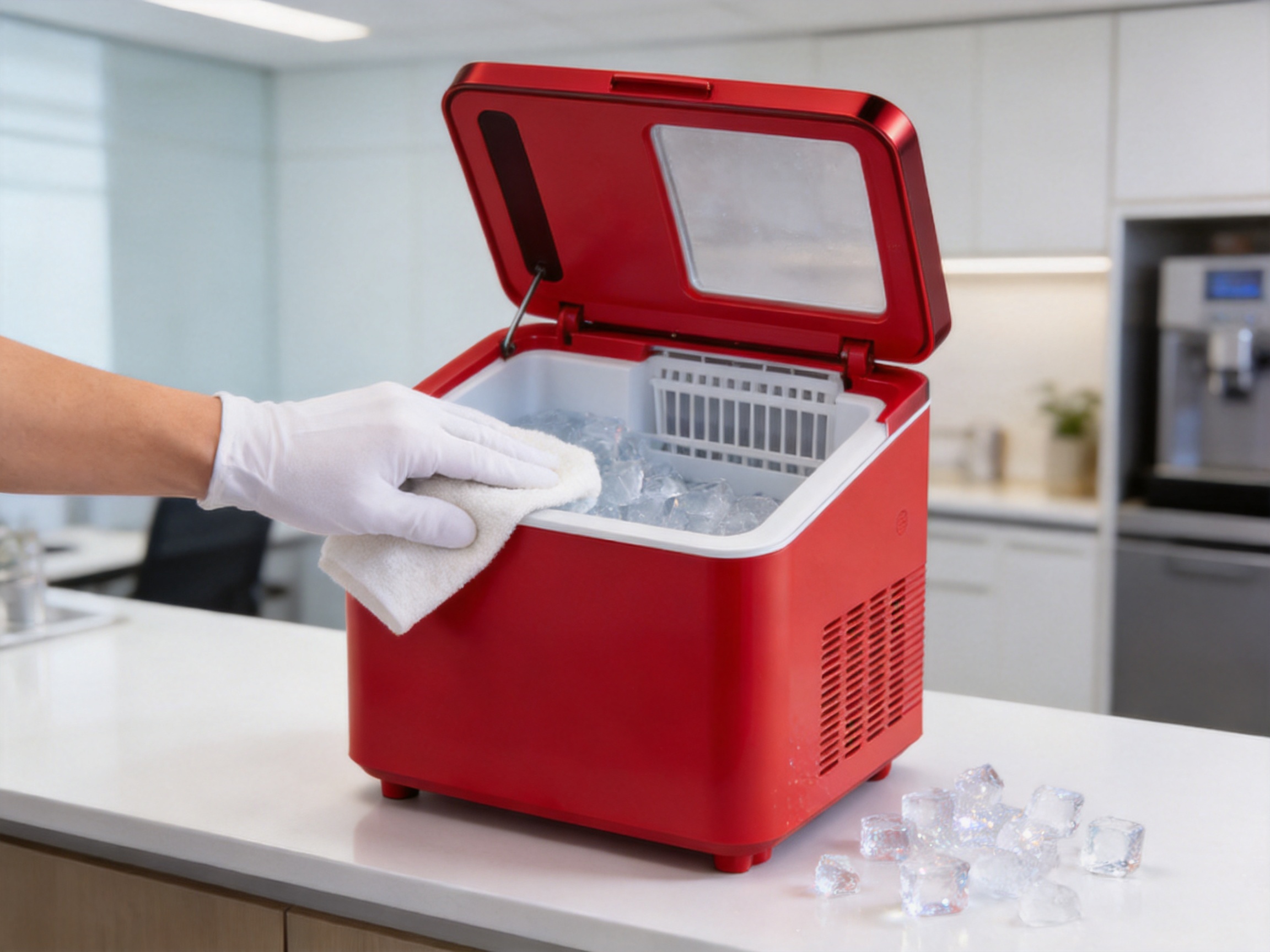
This product includes a fully flip-top design that allows users to open the ice storage and ice-making areas more completely. This improves visibility and access during cleaning. When users can reach the internal areas more easily, routine maintenance becomes less difficult and more likely to be performed properly.
Many competing compact ice makers have narrow openings or internal corners that are difficult to inspect. Even if the machine works well mechanically, cleaning inconvenience can reduce long-term satisfaction. Users may delay cleaning because it is awkward or time-consuming. Over time, that can affect hygiene and performance.
The flip-top structure helps reduce these problems. Users can access the ice storage area, remove visible residue, wipe surfaces, and maintain the machine with greater confidence. In commercial settings, this supports better daily sanitation routines. In homes and offices, it gives users peace of mind that the ice they consume is produced in a cleaner environment.
Easy cleaning also supports durability. Mineral deposits and residue can affect water flow, cooling efficiency, and overall performance if ignored. By making maintenance more convenient, the machine helps users protect their investment and maintain consistent operation over time.
Touchscreen Operation and User Experience
A touchscreen interface gives the ice maker a modern and intuitive operating feel. In appliance design, controls are not merely decorative; they influence how quickly users understand the product and how confidently they use it. A clear touchscreen can reduce uncertainty, simplify operation, and support a more refined appearance.
For commercial locations, simple operation reduces training needs. Staff turnover can be high in food and beverage businesses, and equipment must be easy for new employees to learn. If a machine requires complicated steps, mistakes may occur during busy periods. A touchscreen interface helps streamline basic operation and makes the product more approachable.
For household users, the touchscreen enhances convenience. Users may not operate the ice maker every day, so the interface should remain easy to understand even after periods of non-use. A clean control surface also makes the appliance look more modern on the countertop.
Compared with older button-based designs, touchscreen controls are often easier to clean because there are fewer gaps around mechanical buttons. In a kitchen or beverage environment, splashes and residue are common. A smoother control area can be wiped more easily, supporting the overall hygienic design philosophy of the machine.
Energy and Refrigeration Considerations
The machine operates on a 220V-240V/50Hz power supply and has a current/power rating of 0.9A/150W. These specifications position it as a compact appliance suitable for common electrical environments in many markets that use this voltage range. Users should always confirm local electrical compatibility before installation and operation.
The refrigeration system uses R600a with a charge of 19g. R600a is widely used in modern refrigeration appliances because it can support efficient cooling in suitable systems. It is important that any refrigeration appliance using this refrigerant is manufactured, sealed, transported, and serviced according to proper safety standards.
From a user perspective, the combination of compact design and dedicated refrigeration allows ice production without occupying freezer space. This is more convenient than storing large bags of ice or relying solely on refrigerator freezer compartments. It also helps reduce the risk of ice absorbing freezer odors from stored food.
Competitor products may use different refrigeration designs, some of which may be less efficient, louder, larger, or less convenient to maintain. While exact performance depends on model and operating conditions, this product’s specification package is practical for users who want a countertop ice maker with a balance of performance, size, and usability.
Applications in Beverage Businesses
For beverage shops, ice is a daily necessity. Milk tea, fruit tea, iced coffee, smoothies, lemon drinks, soda-based beverages, and specialty refreshments all rely on ice for temperature and presentation. A compact bullet ice maker can support these operations by providing a steady source of easy-to-handle ice near the preparation area.
Milk tea shops can benefit from the bullet ice texture because customers often enjoy ice that is chewable without being overly hard. The rapid cooling effect helps freshly prepared drinks reach a refreshing temperature quickly. The non-sticky flowability supports fast scooping during peak hours.
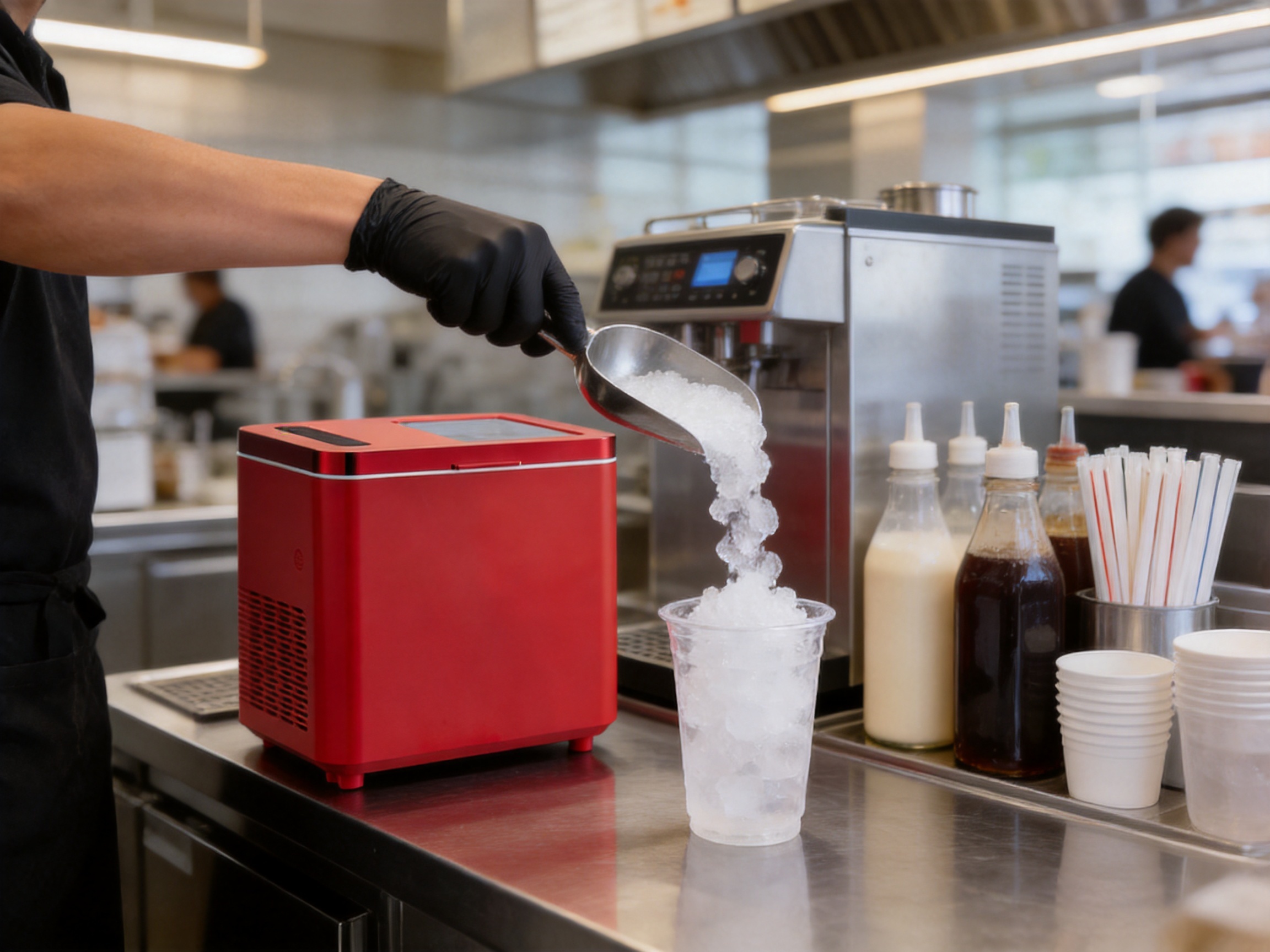
Fast food restaurants can use bullet ice for soft drinks, iced tea, and customer self-service beverage stations. The ice’s shape makes it easy to portion and dispense. A compact unit can also serve as a backup or auxiliary ice source when demand rises unexpectedly.
Coffee shops can use the ice maker for iced Americanos, iced lattes, cold brew service, frappé-style preparation, and chilled seasonal beverages. Since coffee shops often already use multiple countertop appliances, the compact footprint is especially valuable. The machine can fit into a preparation workflow without demanding excessive space.
Small restaurants and snack bars can use the machine for table beverages, kitchen chilling tasks, and customer drinks. By producing ice on site, they reduce reliance on external ice delivery and improve control over daily supply.
Applications in Homes and Offices
In homes, the ice maker offers convenience for daily living and entertainment. Families can prepare iced water, juice, tea, coffee, cocktails, sports drinks, and party beverages without waiting for freezer trays. During gatherings, a countertop ice maker can help maintain beverage service more easily.
Office environments can also benefit. Employees often appreciate access to cold drinks, especially during warm seasons. An ice maker in a pantry, break room, or meeting area improves workplace comfort. For client visits and internal events, readily available ice helps create a more hospitable environment.
Compared with refrigerator ice makers, a dedicated countertop unit can be more flexible. It can be placed where needed, used during high-demand periods, and cleaned directly. It also avoids overloading the freezer or relying on a refrigerator that may not produce enough ice for group events.
For household users who value appliance aesthetics, the touchscreen design and compact proportions can integrate well into modern kitchens. Instead of a purely industrial appearance, the product offers a cleaner and more contemporary user experience.
Competitive Advantages Over Conventional Ice Solutions
The product’s advantages become clearer when compared with common alternatives. The first alternative is the freezer tray. Freezer trays are inexpensive, but they are slow, limited in output, and inconvenient for frequent use. They require planning, occupy freezer space, and often produce ice that is difficult to remove or inconsistent in size.
The second alternative is bagged ice. Bagged ice can provide large quantities quickly, but it requires purchase, transportation, and storage. It may melt during transport, take up freezer space, and introduce questions about handling history. Businesses that rely on bagged ice may face supply disruptions or recurring costs.
The third alternative is a large commercial ice machine. Commercial units can provide high capacity, but they may be too large, expensive, or complex for small shops, offices, and homes. They may require dedicated installation, drainage, and more space. For light commercial and countertop needs, a compact bullet ice maker may be more practical.
The fourth alternative is a basic compact ice maker without convenient cleaning access or modern controls. Such machines may produce ice, but daily satisfaction can decline if they are difficult to clean, awkward to operate, or poor at preventing ice clumping. This touchscreen bullet ice maker differentiates itself through its combination of rapid cooling bullet ice, high flowability, compact size, touchscreen operation, and fully flip-top cleaning access.
Manufacturing Strengths Behind the Product
The product is manufactured by Alien Technology Co., Ltd., a company located in Zhouxiang Town, Cixi City, Zhejiang Province. This region is known as a hub for small household appliances and benefits from convenient logistics and an established manufacturing ecosystem. Such a location can support efficient sourcing, production coordination, and delivery planning for appliance products.
The company specializes in household appliances including ice makers, coffee machines, and air fryers. This product range is important because it reflects experience in heating, cooling, airflow, water handling, user interface design, assembly control, and consumer appliance safety. Expertise across multiple appliance categories can strengthen product development by encouraging cross-functional engineering and manufacturing knowledge.
The company’s mission emphasizes smart technology, simplifying life, and enhancing happiness. In the context of this ice maker, that mission is reflected in practical design choices: a touchscreen interface for simpler operation, compact dimensions for easier placement, bullet ice for better beverage enjoyment, and a flip-top structure for easier cleaning. Rather than focusing only on technical specifications, the product addresses everyday user problems.
Manufacturing strength also depends on quality awareness. The company states that it pursues excellent quality, customer satisfaction, continuous improvement, and innovation while following a stable and pragmatic business philosophy. These values are highly relevant in appliance manufacturing because reliability and consistency are essential. Users expect an ice maker to perform repeatedly under daily conditions, not only during initial testing.
Advanced Manufacturing Process Considerations
A high-quality compact ice maker requires more than assembling visible parts. It involves coordinated processes across design, material selection, refrigeration system production, water-contact component control, electrical assembly, user interface integration, and final inspection. Each stage influences performance, safety, cleanliness, and user satisfaction.
The product’s compact body requires precise internal layout. Components such as the refrigeration system, water reservoir, ice-making mechanism, storage area, control board, and outer housing must be arranged in a limited space without compromising service access or airflow. This requires disciplined product engineering and manufacturing process control.
Refrigeration system manufacturing is especially important. The use of R600a requires careful handling and sealed-system integrity. Proper charging, leak prevention, and system cleanliness are essential for stable cooling performance. A manufacturer with experience in appliance production can implement process checks to help maintain consistent refrigeration performance.
Electrical assembly is another key area. The touchscreen interface, power supply, sensors, and control logic must work together reliably. In a humid appliance environment, appropriate insulation, wiring organization, and component protection are important. Good manufacturing practice reduces the risk of loose connections, operational errors, or premature failures.
Plastic and metal component production also matters. The outer housing must fit accurately, resist everyday handling, and support easy cleaning. Internal surfaces that contact water or ice should be designed for cleanliness and durability. The flip-top mechanism should open conveniently while maintaining structural stability.
Final inspection is critical for any appliance. A responsible manufacturing process may include power-on checks, cooling performance checks, operational inspection, appearance inspection, packaging inspection, and safety-related verification according to applicable requirements. These steps help ensure that each unit delivered to customers meets functional expectations.
Quality Control and Continuous Improvement
Quality in ice makers must be measured over repeated cycles, not only one-time operation. The machine must freeze water, release ice, store ice, respond to user controls, and repeat the process reliably. Even small inconsistencies can affect user satisfaction. For example, poor water circulation may reduce ice formation; weak refrigeration performance may slow production; difficult cleaning access may cause hygiene complaints.
The company’s emphasis on continuous improvement is therefore meaningful. Continuous improvement encourages feedback collection, process refinement, design optimization, and supplier management. In competitive appliance markets, products must evolve based on real customer needs. A company that treats quality as an ongoing practice can better respond to market expectations.
Customer satisfaction also depends on practical details. Is the machine easy to place? Is the ice easy to scoop? Can the user clean the storage area without frustration? Does the control interface feel intuitive? Does the product fit common usage scenarios? The touchscreen bullet ice maker answers these concerns through its user-centered design.
Compared with competitors that may emphasize low cost at the expense of usability, this product provides a broader value package. It is not merely a freezing device; it is a compact beverage-support appliance designed around operation, hygiene, texture, and space efficiency.
Design Philosophy: Smart Technology That Simplifies Daily Life
The product reflects a design philosophy centered on making daily tasks easier. Ice making may seem simple, but in practice it affects many routines: preparing drinks, hosting guests, serving customers, maintaining cleanliness, and organizing kitchen space. A well-designed ice maker reduces effort in all these areas.
The touchscreen supports intelligent simplicity. Users do not need to manage trays, monitor freezing times, or purchase ice externally. They can operate the machine directly and receive bullet ice for immediate use. The compact design simplifies placement. The flip-top design simplifies cleaning. The bullet ice shape simplifies scooping and drink cooling.
This is the meaning of practical smart technology. Smart design does not always require excessive complexity. Sometimes the smartest appliance is the one that solves common problems with direct, dependable, and user-friendly features. This product follows that principle by focusing on the complete ice-making experience.
Hygiene, Maintenance, and Daily Care
To maintain good performance and ice quality, users should follow regular cleaning practices. The fully flip-top design makes this easier by allowing better access to internal areas. Users should empty unused ice, clean water-contact surfaces, wipe the storage area, and avoid leaving stagnant water for long periods. Cleaning frequency should match usage intensity.
In commercial environments, daily cleaning routines are recommended because the machine may be used frequently and exposed to beverage splashes, dust, and handling. In offices and homes, cleaning should still be performed regularly, especially if the machine is not used every day. Fresh water should be used, and the machine should be kept in a clean, ventilated location.
Proper maintenance supports better taste. Ice can absorb odors or reflect water quality. Using clean water and maintaining the internal surfaces helps preserve the freshness of beverages. For users in areas with hard water, periodic descaling or mineral deposit management may be necessary depending on water conditions.
Good maintenance also protects performance. Dirt, scale, or blocked water flow can affect ice formation. By making cleaning more convenient, the product reduces the barriers that often prevent users from maintaining appliances properly.
Operational Efficiency for Small Businesses
Small businesses often operate under tight constraints. They must control costs, manage limited space, train staff quickly, and deliver consistent customer experiences. An ice maker that is compact, easy to use, and easy to clean can contribute directly to operational efficiency.
For a milk tea shop, the machine supports fast beverage preparation. Staff can scoop bullet ice quickly because it is less prone to sticking. The ice cools drinks rapidly, helping maintain taste and customer satisfaction. The compact size leaves more room for ingredients, sealing machines, cups, and preparation tools.
For a small café, the ice maker can support iced coffee menus without requiring a large commercial installation. Seasonal demand for iced drinks can increase quickly, and a countertop ice maker provides flexible capacity. It can serve as a main ice source for smaller operations or a supplementary source for larger ones.
For fast food counters and snack bars, the machine provides practical ice availability for soft drinks, tea, and customer beverages. The touchscreen operation helps staff use the equipment with minimal instruction. The flip-top cleaning design supports hygiene routines at closing time.
Over time, the product can help reduce dependence on outside ice purchases, improve service consistency, and make beverage preparation more self-sufficient. These advantages can be especially valuable for independent operators and growing businesses.
Value for Distributors and Appliance Buyers
For distributors, retailers, and appliance buyers, a product’s marketability depends on both features and usability. This touchscreen bullet ice maker has several selling points that are easy to communicate: rapid cooling bullet ice, non-sticky flowability, pleasant crunchy texture, compact dimensions, touchscreen interface, and easy-clean flip-top access.
These features correspond to real customer needs. Consumers want convenience and clean design. Businesses want efficiency and reliability. Offices want simple shared appliances. Beverage shops want ice that improves drink quality and workflow. Because the product addresses multiple segments, it offers broad market potential.
The manufacturer’s background in small household appliances also supports distributor confidence. A company that produces ice makers, coffee machines, and air fryers understands appliance market expectations and can develop products suited to daily consumer use. Its location in an established appliance manufacturing region supports logistics and production coordination.
For buyers comparing suppliers, the combination of product function and manufacturing stability matters. A strong supplier should be able to provide consistent production quality, practical product design, and responsive cooperation. The company’s stated focus on customer satisfaction and stable business philosophy supports long-term partnership potential.
Environmental and Practical Use Considerations
Efficient ice production can reduce waste associated with repeatedly buying bagged ice. Bagged ice often involves plastic packaging, transportation, freezer storage, and potential melt loss. Producing ice at the point of use can be more convenient and may reduce unnecessary trips or packaging consumption, depending on user behavior.
The use of R600a refrigerant reflects a common direction in compact refrigeration appliances. As with any refrigerant-based product, safe design, responsible manufacturing, and proper handling are essential. Users should follow product instructions and avoid damaging the refrigeration system.
Practical sustainability also includes durability and maintainability. A product that is easy to clean and maintain can remain useful for longer. The flip-top design contributes to this by encouraging better care. When appliances last longer and perform consistently, users can reduce replacement frequency and improve overall value.
Installation and Placement Guidance
To achieve good performance, users should place the ice maker on a stable, level surface. The location should be clean, dry, and well ventilated. Adequate space around the machine helps heat dissipate from the refrigeration system. The machine should be connected to a suitable 220V-240V/50Hz electrical supply, and users should avoid overloaded outlets or unsafe extension practices.
The machine should be positioned near the area where ice is used, but away from direct heat sources such as ovens, fryers, or strong sunlight. Excess heat can make refrigeration work harder and may affect ice-making efficiency. In beverage businesses, placing the unit near the drink preparation station can improve workflow.
Users should fill the machine with clean water according to the operating instructions. If the local water quality is poor, filtered water may improve ice taste and reduce mineral deposits. The ice storage area should be emptied and cleaned regularly, especially after periods of non-use.
Long-Term User Benefits
The long-term value of this ice maker lies in convenience, consistency, and usability. Users gain an on-demand ice source that does not require freezer trays or constant ice purchases. Businesses gain better control over ice availability and beverage service. Offices and homes gain a compact appliance that supports daily comfort.
The bullet ice shape continues to provide value throughout the machine’s life. Rapid cooling improves drink quality. Flowability simplifies handling. Moderate hardness enhances the customer or user experience. These are not occasional benefits; they apply every time ice is made and served.
The cleaning-friendly structure also has long-term importance. Appliances that are difficult to clean often become neglected. A design that encourages maintenance helps preserve hygiene and performance. Over months and years of use, this can be one of the most important differences between a satisfying product and a frustrating one.
Finally, the product’s compact footprint means it can remain useful even if the user’s environment changes. It can move from a kitchen to a bar counter, from an office pantry to a meeting area, or from one shop layout to another. This flexibility strengthens its overall value.
Frequently Asked Questions
What type of ice does this machine produce?
It produces bullet ice, which has a rounded shape and a hollow or perforated center. This shape supports fast beverage cooling, easy scooping, and a pleasant crunchy texture.
Why is bullet ice useful for drinks?
Bullet ice offers a larger contact area with liquid than some solid ice shapes, helping beverages cool quickly. It is also easier to scoop and less likely to clump than certain irregular or block-style ice forms.
Is the machine suitable for commercial use?
It is suitable for many light commercial environments such as milk tea shops, coffee shops, fast food counters, small restaurants, offices, and hospitality beverage stations. Users with very high-volume industrial needs should evaluate capacity requirements carefully.
What are the machine dimensions?
The machine measures 325 x 295 x 252 mm, making it compact enough for many countertops and small service spaces.
What power supply does it require?
The product is designed for 220V-240V/50Hz power supply, with a current/power rating of 0.9A/150W. Users should confirm local electrical compatibility before use.
What refrigerant does the machine use?
It uses R600a refrigerant with a 19g charge. The refrigeration system should be handled according to proper appliance safety guidance.
How does the fully flip-top design help?
The fully flip-top design allows users to open the ice storage and ice-making areas more completely. This improves access for daily cleaning, helps reduce hidden dirt, and supports better hygiene.
Is the ice easy to scoop?
Yes. Bullet ice is designed with good flowability and is less prone to sticking together. This makes it easier to scoop, portion, and dispense during beverage preparation.
Can it be used at home?
Yes. The compact size, touchscreen operation, and convenient ice production make it suitable for home kitchens, parties, family drinks, and daily use.
What makes this product different from basic compact ice makers?
Its advantages include touchscreen operation, rapid-cooling bullet ice, non-sticky ice flowability, moderate hardness, compact dimensions, and a fully flip-top structure for easier cleaning. These features improve both user experience and maintenance convenience.
Conclusion
This touchscreen bullet ice maker is designed for users who need fast, convenient, hygienic, and space-saving ice production. Its bullet ice format supports rapid beverage cooling, pleasant texture, and easy handling. Its compact 325 x 295 x 252 mm body makes it suitable for kitchens, offices, beverage shops, fast food counters, and small restaurants. Its touchscreen interface improves usability, while the fully flip-top design makes cleaning more accessible and practical.
Compared with freezer trays, bagged ice, oversized commercial machines, and basic compact ice makers, this product offers a strong balance of performance and convenience. It helps users produce ice on demand, reduce dependence on external ice sources, improve beverage service speed, and maintain better hygiene routines.
Behind the product is Alien Technology Co., Ltd., a manufacturer located in a strong small-appliance production region and focused on household appliances such as ice makers, coffee machines, and air fryers. The company’s commitment to smart technology, quality, customer satisfaction, continuous improvement, and pragmatic manufacturing supports the product’s practical value. For buyers seeking a compact ice maker that combines modern operation, efficient bullet ice production, and easy maintenance, this model provides a compelling solution.
References
ASHRAE Handbook: Refrigeration. American Society of Heating, Refrigerating and Air-Conditioning Engineers.
International Electrotechnical Commission. Safety Standards for Household and Similar Electrical Appliances.
Food and Beverage Service Principles: Beverage Temperature, Ice Handling, and Customer Experience. Hospitality Training Literature.
Refrigeration and Air Conditioning Technology. Modern Appliance Engineering Reference Text.
Small Household Appliance Manufacturing and Quality Control Practices. Consumer Appliance Industry Reference Manual.