
 English
 한국어
한국어 Español
 Deutsch
Modern households expect more from small appliances than simple convenience. A well-designed home ice cube maker must be compact enough for daily use, efficient enough for repeated operation, reliable enough for long service, and refined enough to improve the experience of enjoying drinks, preparing food, or entertaining guests. The Home Ice Cube Maker ZF01 is designed for precisely this kind of everyday performance. It combines a practical countertop footprint, stable refrigeration technology, and a focus on producing neat, square ice cubes that are suitable for a wide range of household and hospitality scenarios.
Ice may seem simple, but good ice changes the quality of a drink. Poorly formed ice can melt too quickly, dilute beverages, and look unappealing in a glass. By contrast, well-shaped ice cubes with a solid structure melt more slowly, maintain a clean appearance, and help preserve the original taste of whiskey, cocktails, iced coffee, juice, tea, soft drinks, and chilled water. The value of a home ice cube maker is therefore not only measured by how fast it produces ice, but also by the consistency, usability, and storage efficiency of the ice it creates.
The ZF01 home ice cube maker is developed for users who want a practical solution for daily cooling needs without relying entirely on freezer trays or commercial ice. It is suitable for families, apartment kitchens, home bars, small offices, guest rooms, outdoor gatherings, and light commercial settings where a compact and dependable ice-making solution is preferred. With a machine dimension of 325 x 295 x 252 mm, it can fit conveniently on many countertops while still offering meaningful performance for routine household use.
Beyond the product itself, the manufacturing strength behind the appliance plays an important role. The producer is located in Cixi, Zhejiang Province, an area known for small household appliance manufacturing, supply-chain integration, skilled production labor, and convenient logistics. This regional advantage supports efficient component sourcing, quality control, production coordination, and export-oriented service. The company focuses on household appliances including ice makers, coffee machines, and air fryers, giving it experience in temperature control, electrical assembly, plastic parts processing, metal components, user-friendly design, and mass production management.
The purpose of this article is to introduce the product in depth, explain the value of square ice cubes, compare the appliance with common alternatives, and describe the manufacturing strengths that support product reliability. It also includes a technical specification table, usage guidance, a Q&A section, and references for readers who want a broader understanding of ice-making technology and household appliance design.
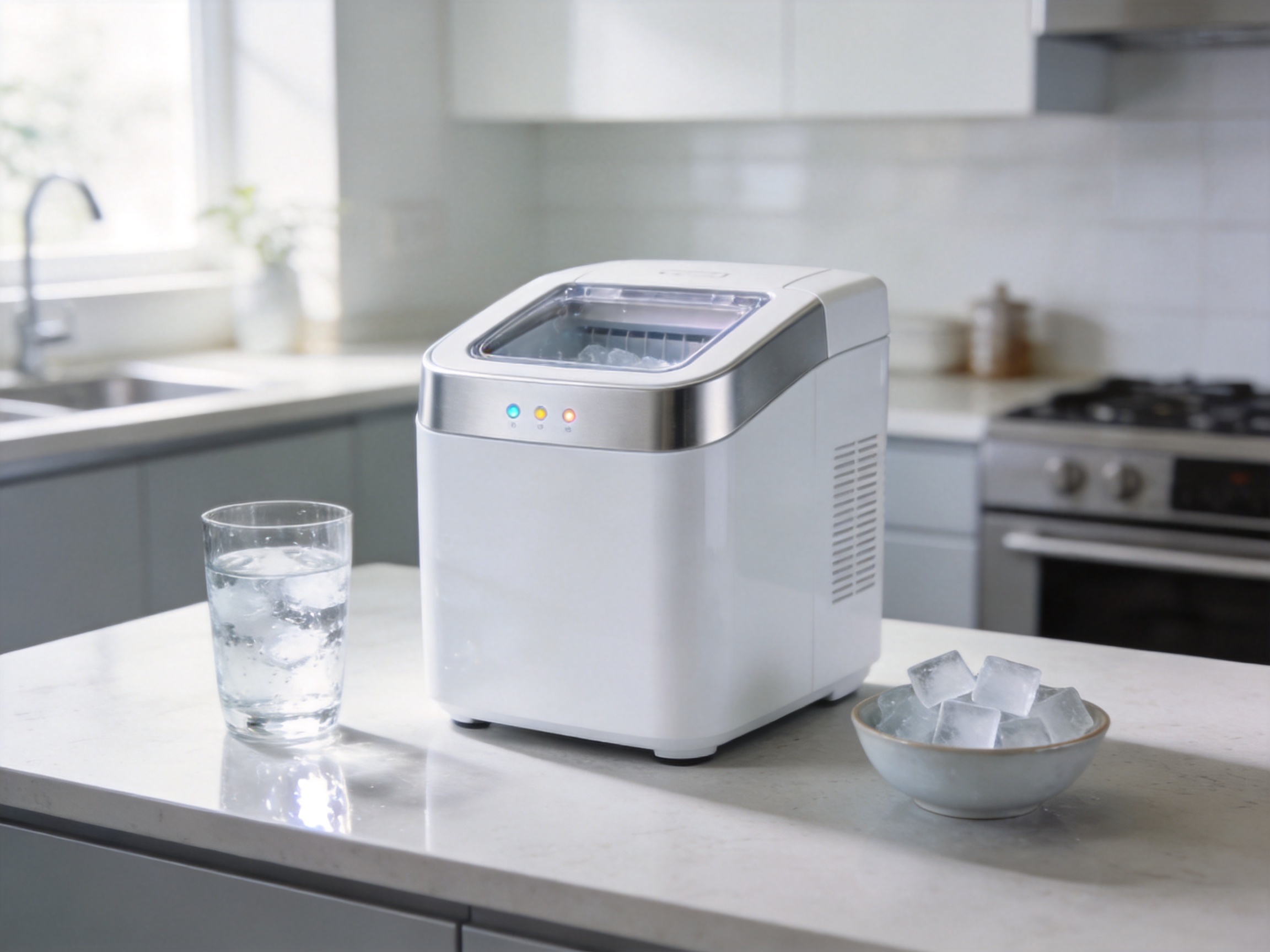
Product Overview
The Home Ice Cube Maker ZF01 is a compact appliance designed to produce regular ice cubes for home and lifestyle use. Its overall design is centered on practicality: a manageable size, stable electrical requirements, refrigerant-based cooling, and an output style that creates visually appealing square ice cubes. The product is especially suitable for users who value slow-melting ice, neat presentation, and efficient storage.
Many people rely on traditional freezer trays, but trays are slow, occupy freezer space, and often produce ice that absorbs odors from stored food. Commercial bagged ice can be convenient, but it may be irregular in shape, difficult to store cleanly, and less satisfying for users who prefer fresh ice on demand. A dedicated home ice cube maker solves these issues by placing ice production where it is needed most: directly in the kitchen, bar area, refreshment corner, or office pantry.
The ZF01 model uses a 220V/50Hz power supply and operates with a current and power rating of 0.65A/140W. It uses R290 refrigerant with a charge of 26g. R290, also known as propane refrigerant, is widely recognized in refrigeration engineering for its low global warming potential when properly applied in compliant systems. In compact refrigeration appliances, careful design, secure sealing, and standardized manufacturing processes are important for safe and effective performance.
The machine’s size, 325 x 295 x 252 mm, gives it an appealing balance between countertop convenience and functional internal capacity. It is large enough to house the necessary refrigeration components, water handling structure, and ice-forming zone, yet compact enough to remain accessible in everyday environments. This size is particularly useful for users who want a machine that does not dominate the kitchen but still feels like a dedicated appliance rather than a novelty product.
Product Item |
Specification |
Product Type |
Home Ice Cube Maker |
Model |
ZF01 |
Product Power Supply |
220V/50Hz |
Current/Power |
0.65A/140W |
Refrigerant/Charge |
R290/26g |
Machine Dimensions |
325 x 295 x 252 mm |
Ice Shape |
Square Ice Cubes |
Recommended Use |
Home kitchens, home bars, offices, guest areas, gatherings, and beverage service |
The Practical Value of Square Ice Cubes
The defining feature of this product is its focus on ice cubes with a neat square shape. Square ice cubes are valued because they provide a practical combination of cooling performance, visual refinement, storage convenience, and versatility. Unlike irregular crushed ice or thin hollow ice, a solid cube has a compact form and a relatively low surface-area-to-volume ratio. This helps slow the melting process when the cube is placed in a drink.
A slow melting rate is particularly important for beverages that should remain flavorful. Premium whiskey, neat spirits, carefully mixed cocktails, cold brew coffee, iced tea, fruit infusions, and fresh juice can lose character when diluted too quickly. When ice melts rapidly, it releases more water into the drink in a shorter time, reducing strength, aroma, sweetness, acidity, and mouthfeel. Square ice cubes help address this problem by chilling the beverage gradually and steadily.
The shape also matters visually. In a clear glass, neat square ice cubes look clean, professional, and deliberate. They communicate care and attention. A drink served with regular cubes appears more refined than one filled with fractured, cloudy, or uneven pieces. This is one reason square ice is often associated with premium beverage service, even in home environments. It helps elevate simple daily drinks into a more enjoyable ritual.
Versatility is another advantage. Square ice cubes are suitable for water, soda, cocktails, juice, coffee, tea, wine buckets, food preparation, cooling bowls, picnic containers, and temporary cold compresses. They can be used in ordinary tumblers, wide glasses, pitchers, ice buckets, shaker tins, and food storage containers. Because their form is predictable, users can portion them easily and arrange them neatly.
The regular shape also improves storage efficiency. Irregular ice pieces create empty spaces between pieces, while square cubes can stack more tightly. This makes them easier to store in freezer bags, ice bins, trays, and insulated containers. For households that prepare ice before parties or gatherings, efficient stacking can be a meaningful benefit. More usable ice can be stored in less space, reducing clutter in the freezer.
In addition, square cubes are easy to handle. They are less messy than crushed ice and less awkward than oversized novelty ice. Their predictable size and shape allow users to add the right amount to each drink. This contributes to consistent serving quality, especially when preparing multiple beverages for guests.

Advantages Over Common Ice-Making Alternatives
Compared with Traditional Freezer Trays
Traditional freezer trays are inexpensive, but they have several limitations. They require hours to freeze water, occupy freezer space, and depend on the freezer’s overall cleanliness and airflow. Ice made in open trays can absorb food odors, especially from fish, meat, sauces, or frozen leftovers. The final cubes may crack, stick, or become uneven because household freezers are not optimized for controlled ice formation.
A dedicated home ice cube maker offers a more convenient workflow. Users can prepare ice without clearing freezer shelf space or waiting overnight. The appliance is positioned where ice is needed, allowing the user to produce and collect ice more conveniently. This is valuable during summer, family meals, parties, or daily beverage preparation.
The ZF01 also improves the sense of control. Instead of relying on a few trays that may or may not be ready, users can operate the machine as part of their routine. For example, a household may run the ice maker before dinner, before guests arrive, or during weekend gatherings. The availability of fresh ice can become predictable rather than accidental.
Compared with Bagged Commercial Ice
Bagged ice can be useful for large events, but it has disadvantages for everyday use. It must be purchased, transported, stored, and handled. Once opened, the bag can become messy, and ice pieces may fuse together in the freezer. Bagged ice may also include irregular pieces that are less attractive for refined drinks.
A home ice cube maker reduces dependence on outside purchases. It supports on-demand freshness and eliminates the inconvenience of last-minute trips to buy ice. For users who regularly drink iced coffee, cold tea, sparkling water, cocktails, or smoothies, this can save time and improve daily convenience.
Compared with Low-Quality Compact Ice Makers
Not all compact ice makers are equal. Some models focus only on quick production and ignore the quality of the ice shape, the stability of the cooling system, or the durability of internal components. A poorly built unit may produce inconsistent ice, generate unnecessary noise, leak water, or fail prematurely due to weak assembly practices.
The ZF01 benefits from a manufacturer with experience in household appliance categories that require heating, cooling, airflow, temperature regulation, and electrical safety. Ice makers, coffee machines, and air fryers may serve different functions, but they share core manufacturing disciplines: precise assembly, electrical reliability, user-safe design, thermal management, and quality inspection. This broader appliance background supports more professional production management.
Compared with Oversized Commercial Machines
Commercial ice machines are powerful, but they are usually too large, costly, and maintenance-heavy for ordinary homes. They may require dedicated plumbing, drainage, professional installation, or significant counter and floor space. For many households, that level of capacity is unnecessary.
The ZF01 is designed for the practical middle ground. It provides a dedicated ice-making solution without the footprint and infrastructure requirements of commercial systems. It is suitable for daily domestic use, personal entertainment spaces, and smaller service areas where flexibility matters more than industrial scale.
Cooling Performance and Refrigeration Design
At the heart of an ice maker is its refrigeration system. The ZF01 uses R290 refrigerant with a 26g charge. Refrigeration performance depends on a coordinated system of compressor operation, evaporator design, thermal transfer, water contact, insulation, and control logic. For a compact appliance, the goal is to deliver stable cooling within a limited space while maintaining safe operation and manageable energy use.
The listed power rating of 140W indicates that the appliance is designed for household-level operation rather than heavy industrial duty. This balance is important. Excessive power would be inefficient and inconvenient for domestic environments, while insufficient power would compromise ice formation. A 140W design can support practical ice-making performance while remaining appropriate for everyday home use.
The use of R290 also reflects the trend toward refrigerants with lower environmental impact when compared with many older refrigerant types. In modern appliance engineering, the refrigerant is only one part of the equation. Safe application requires controlled charging, leak prevention, component compatibility, electrical protection, and manufacturing discipline. These details are especially important in compact systems, where internal space is limited and component placement must be carefully arranged.
Thermal efficiency is influenced by the quality of materials, the precision of assembly, and the consistency of production. If a cooling component is poorly fitted, if insulation is insufficient, or if water flow is uneven, ice quality can suffer. That is why manufacturing process control matters. A well-made ice maker is not simply a collection of parts; it is an integrated system where each component must support the others.
The compact dimensions of the ZF01 suggest an emphasis on household usability. A machine that is too large may be stored away and rarely used. A machine that fits naturally into the kitchen is more likely to become part of daily life. Good appliance design is therefore not only about technical specifications but also about human behavior: where the product sits, how often it is used, how easy it is to clean, and whether it improves the user’s routine.
Manufacturing Strengths Behind the Product
Alien Technology Co., Ltd. is based in Zhouxiang Town, Cixi City, Zhejiang Province, a region known for its strong small household appliance industry. This location provides meaningful manufacturing advantages. Mature local supply chains make it easier to source plastic housings, electrical components, refrigeration parts, metal accessories, packaging materials, and testing equipment. The presence of related suppliers and experienced workers can shorten production cycles and improve coordination.
The company’s product scope includes ice makers, coffee machines, and air fryers. This range demonstrates familiarity with both cooling and heating appliances. Coffee machines require water handling, temperature control, pumps or flow systems, electrical safety, and user interface design. Air fryers require heat resistance, airflow management, motor systems, plastics capable of withstanding thermal stress, and food-contact awareness. Ice makers require refrigeration, condensation control, water circulation, and insulation. The overlap among these categories strengthens the manufacturer’s engineering and production knowledge.
Advanced manufacturing is not defined only by automated equipment. It is also defined by repeatable process control. For an ice maker, key production steps may include incoming material inspection, refrigeration component assembly, refrigerant charging, sealing checks, electrical wiring, functional testing, water system inspection, housing assembly, appearance review, packaging verification, and final quality control. Each step helps reduce defects and improve user satisfaction.
A strong manufacturer also pays attention to design for assembly. When parts fit cleanly, workers can assemble them with consistent quality. When internal layout is logical, serviceability improves and production errors decrease. When the housing is designed for both strength and appearance, the finished appliance feels more reliable. These details are often invisible to the user, but they influence long-term performance.
The company’s stated mission emphasizes smart technology, simplified living, and enhanced happiness. In appliance terms, this means products should solve real household problems without unnecessary complexity. The ZF01 follows that philosophy by addressing a common need: fresh, attractive ice at home. Instead of turning ice-making into a complicated process, the appliance is meant to make refreshment more convenient.
Quality philosophy is also important. The company emphasizes excellent quality, customer satisfaction, continuous improvement, innovation, and pragmatic business development. These values are relevant in a competitive small-appliance market where customers expect consistent performance, safe operation, attractive design, and responsive cooperation. For buyers, distributors, and end users, a manufacturer with a stable and improvement-oriented approach is more trustworthy than one focused only on short-term output.
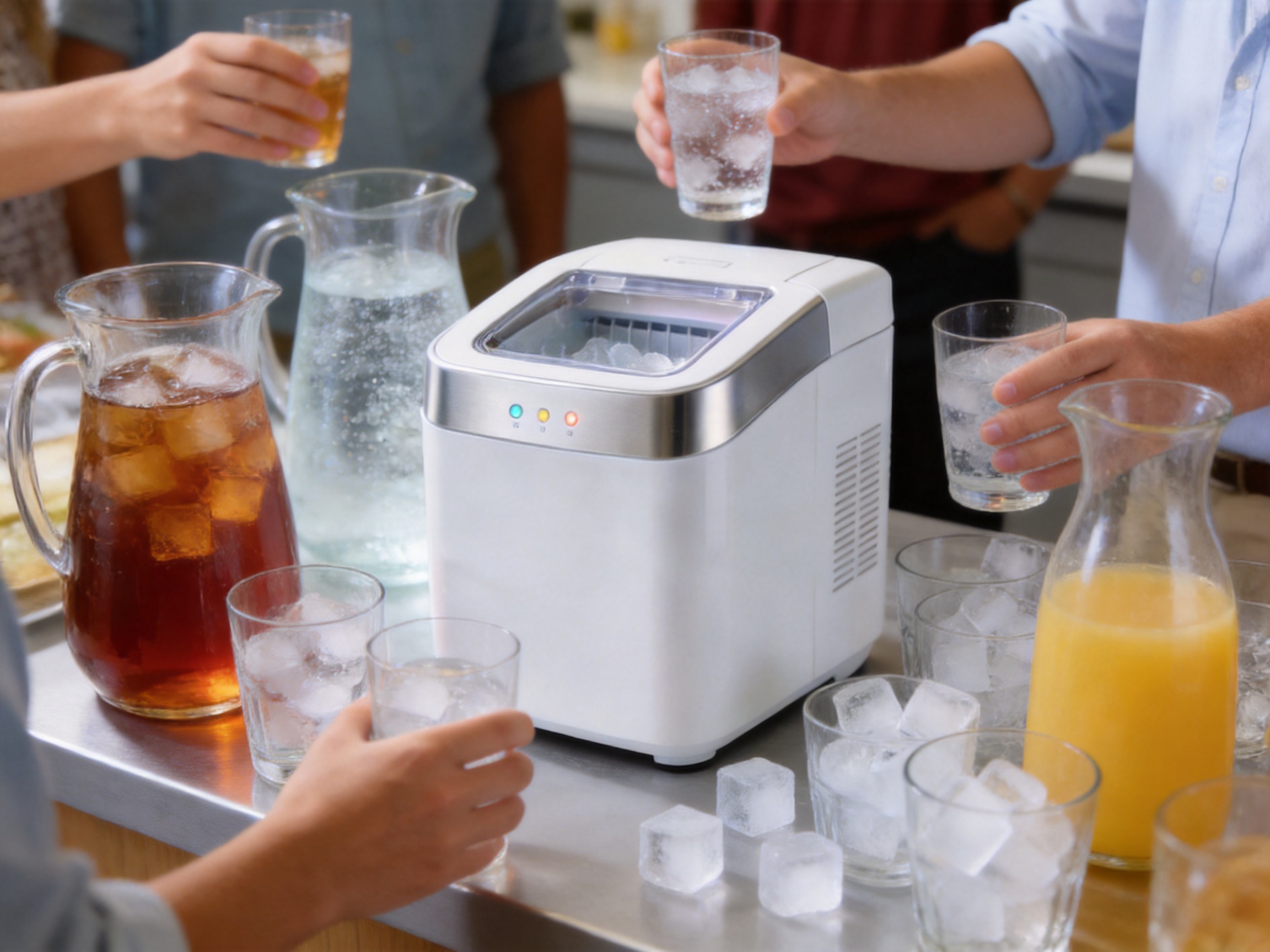
Design for Everyday Convenience
A home appliance succeeds when it is easy to integrate into daily life. The ZF01’s compact footprint helps it fit on kitchen counters, beverage stations, office sideboards, and small hospitality counters. The size of 325 x 295 x 252 mm allows it to be placed in areas where a larger commercial machine would not be practical. This makes the product suitable for apartments, family homes, rental spaces, meeting rooms, and small entertainment areas.
The product’s square ice cube output supports many everyday routines. In the morning, users can add cubes to iced coffee, cold milk tea, smoothies, or breakfast juice. During the afternoon, the cubes can chill water, sports drinks, lemonade, or sparkling beverages. In the evening, they can serve whiskey, cocktails, mocktails, or chilled tea. For weekend gatherings, the same machine can support pitchers, ice buckets, and food display needs.
The regular cube shape also simplifies serving. When preparing drinks for guests, the host can use similar amounts of ice in each glass, improving consistency. When storing ice for later, the cubes fit more cleanly into containers. When adding ice to a shaker or pitcher, the user can estimate quantity more easily than with irregular chunks.
Another important convenience is psychological: users no longer have to wonder whether there is enough ice in the freezer. A dedicated machine changes ice from a scarce item into a manageable resource. This is especially valuable in warm weather or in households that frequently serve cold drinks.
Professional Appearance for Home Beverage Service
Presentation has become increasingly important in home dining and entertaining. People invest in better glasses, coffee equipment, cocktail tools, tableware, and beverage ingredients. Ice is part of that experience. Even a simple glass of water can look more inviting with clean, well-shaped cubes. A cocktail can look more balanced and premium when the ice is visually neat.
Square ice cubes provide a professional appearance because they signal order and intentionality. The straight edges and uniform shape create a clean visual effect. In transparent glasses, the cubes catch light and enhance the look of the beverage. For social gatherings, this small detail can make drinks feel more carefully prepared.
The product therefore offers more than function. It supports lifestyle value. It helps users enjoy the feeling of a home bar, café, or guest service area without requiring specialized commercial equipment. For people who enjoy hosting, this can be a meaningful advantage.
Storage Efficiency and Space Management
Freezer space is often limited. Families may store meat, vegetables, frozen meals, desserts, bread, and leftovers. Traditional ice trays occupy flat shelf space and can spill if moved. Irregular ice pieces in bags can take up more room than expected. Square ice cubes help improve storage efficiency because their regular shape allows tighter stacking.
When cubes are produced and then transferred to a clean storage container, they can be arranged more neatly than crushed or irregular ice. This makes it easier to prepare for parties or hot days. Users can create batches in advance and store them with less wasted space.
The efficiency of cube storage also supports transport. For picnics, short trips, or outdoor dining, square cubes can be placed into insulated containers with drinks or food. Their form makes them easier to pack around bottles and containers. They can also be used in ice buckets for wine, beer, soda, or sparkling water.
Applications in Different Scenarios
Home Kitchens
In the kitchen, the ZF01 supports daily hydration, cooking preparation, and beverage enjoyment. Ice can be used to cool boiled eggs, blanch vegetables, chill sauces, prepare cold noodles, or rapidly cool homemade drinks. Families with children may use ice for juice, milk drinks, or summer refreshments. Adults may use it for coffee, tea, or evening drinks.
Home Bars
For home bars, the value of square ice is especially clear. Spirits and cocktails benefit from slow, controlled cooling. A glass containing neat cubes looks intentional and refined. The user can prepare whiskey, gin and tonic, rum drinks, highballs, spritzes, and nonalcoholic cocktails with better presentation.
Small Offices
In an office environment, a compact ice maker can improve employee refreshment. It supports iced coffee, cold water, tea, and soft drinks without requiring a large commercial ice system. It can also make meeting rooms and reception areas feel more welcoming.
Guest Rooms and Hospitality Corners
Small hospitality spaces, serviced apartments, guesthouses, and lounges may benefit from a compact appliance that provides fresh ice without major installation demands. The machine can support guest comfort while maintaining a manageable size and operation style.
Gatherings and Seasonal Use
During summer gatherings, barbecue meals, birthday parties, and family celebrations, ice demand increases quickly. A home ice cube maker provides additional support beyond refrigerator ice trays. Users can prepare ice before guests arrive and continue producing more as needed.
Reliability Through Practical Engineering
Reliability is one of the most important factors in an ice maker. Because the appliance involves electricity, water, refrigeration, and repeated thermal cycling, its design must be practical and robust. Every component must work within expected operating conditions. The housing must protect internal parts. The refrigeration system must remain sealed. Electrical connections must be secure. Water-contact areas must be designed for regular use and cleaning.
The ZF01’s specification reflects a practical household refrigeration appliance. The 220V/50Hz supply is suitable for markets using that electrical standard. The 0.65A/140W rating indicates moderate power operation. The R290 refrigerant charge of 26g reflects compact refrigeration design. The dimensions support convenient placement while leaving room for internal system integration.
Good engineering also considers user habits. A home appliance should be simple enough that users operate it correctly. It should not require excessive technical knowledge. It should encourage regular cleaning and safe placement. It should fit into normal household routines. Products that are too complicated often fail not because of poor technology, but because they do not match real user behavior.
Quality Control and Production Discipline
Manufacturing quality is essential for household appliances. In ice maker production, quality control may include visual inspections, electrical safety checks, water leakage tests, refrigeration performance tests, noise observation, packaging checks, and operational sampling. These procedures help ensure that each unit delivered to customers performs as expected.
The company’s manufacturing environment in Zhejiang supports process efficiency. Local access to appliance parts and skilled production teams helps maintain stable output. Experience across multiple appliance categories can also improve internal standards. For example, air fryer production reinforces knowledge of heat-resistant materials and safety testing. Coffee machine production strengthens water system experience. Ice maker production deepens refrigeration and condensation management. Together, these capabilities create a stronger manufacturing foundation.
Continuous improvement is particularly important. In competitive appliance markets, product details must evolve. Improvements may involve quieter operation, better internal layout, improved water flow, stronger packaging, more durable plastics, more intuitive controls, or enhanced production testing. A manufacturer that values improvement can adapt more effectively to customer feedback and market expectations.
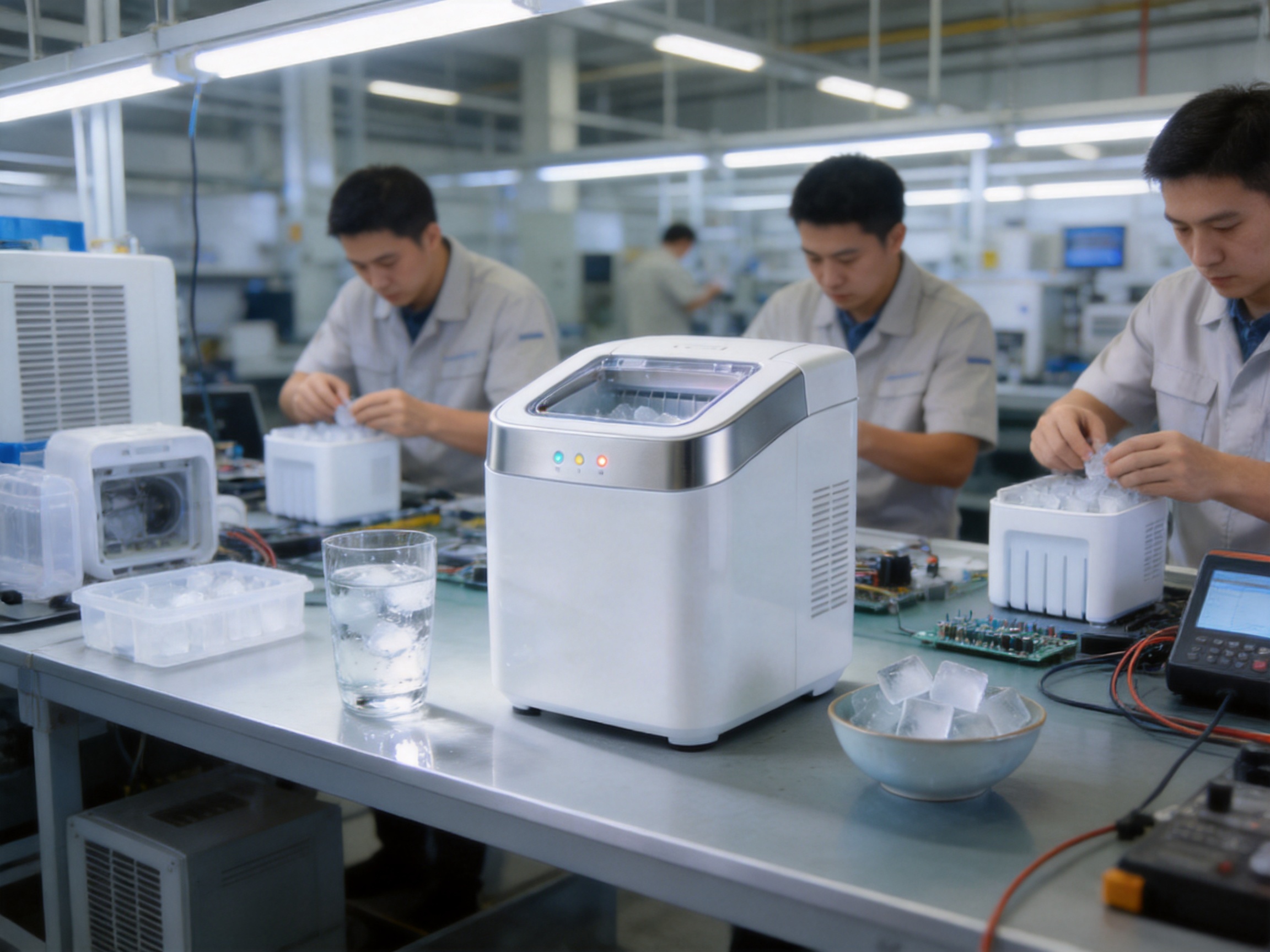
Why This Ice Maker Stands Out
The ZF01 stands out because it addresses multiple needs at once. It is compact, but not merely decorative. It produces useful square ice cubes, not random frozen fragments. It supports daily beverage enjoyment, not only occasional party use. It comes from a manufacturer with experience in several household appliance categories, not from an isolated single-product operation.
Its advantages can be summarized in five main areas. First, the square ice form offers slow melting and attractive presentation. Second, the compact machine size supports countertop convenience. Third, the refrigeration specification is appropriate for household use. Fourth, the product fits a wide range of scenarios, from kitchens to offices. Fifth, the manufacturing background provides confidence in production capability and quality control.
Compared with freezer trays, the product improves convenience and freshness. Compared with bagged ice, it reduces dependency on outside purchases. Compared with low-quality compact machines, it benefits from disciplined appliance manufacturing. Compared with commercial machines, it is more suitable for ordinary household spaces. These combined advantages make it a practical choice for users who want better ice without unnecessary complexity.
Care, Cleaning, and Responsible Use
Proper use and cleaning help maintain ice quality. Users should place the machine on a stable, level surface with adequate ventilation. It should be kept away from excessive heat sources, direct sunlight, and confined spaces that prevent heat dissipation. Since ice quality depends on water quality, clean drinking water is recommended. If the local water has strong mineral content or odor, filtered water may improve the final result.
Regular cleaning is important because water systems can accumulate mineral scale or residue over time. Users should follow the product manual for cleaning intervals and procedures. In general, draining old water, wiping accessible surfaces, and keeping the ice storage area clean can help preserve freshness. The machine should be dried before long-term storage.
Users should also handle ice hygienically. Ice should be collected with clean tools or clean hands, and storage containers should be washed regularly. If cubes are stored in a freezer, they should be kept away from strong-smelling foods. Clean storage protects the taste and appearance of the ice.
Responsible use also includes respecting electrical safety. The appliance should be connected to a suitable power source, and damaged cords or plugs should not be used. Water should not be allowed to enter electrical areas. If unusual noise, odor, leakage, or malfunction occurs, users should stop operation and seek appropriate service guidance.
Business Value for Distributors and Buyers
For distributors, retailers, and appliance buyers, the ZF01 offers a product category with strong consumer relevance. Demand for home ice makers is supported by lifestyle trends including home entertaining, iced coffee culture, cocktail preparation, health-focused hydration, and compact kitchen convenience. Consumers increasingly want appliances that make daily routines more enjoyable, and ice makers fit naturally into that trend.
The product’s compact size can support efficient warehousing and display. Its practical specification makes it suitable for many home users. The square ice feature provides a clear selling point, while the manufacturer’s broader appliance expertise supports confidence in supply and production.
The company’s location in a mature appliance manufacturing area is also valuable for business cooperation. Convenient logistics, supplier access, and manufacturing concentration can support production scheduling and shipment coordination. For customers seeking long-term cooperation, these factors matter as much as the product itself.
Q&A Section
Q1: What type of ice does this home ice cube maker produce?
It is designed to produce neat square ice cubes. This shape is valued for its professional appearance, efficient storage, and slower melting behavior compared with many irregular or thin ice forms.
Q2: Why are square ice cubes better for drinks?
Square ice cubes have a compact and regular form. When the cubes are solid and well formed, they tend to melt more slowly than smaller or irregular pieces. This helps keep drinks cold without diluting them too quickly.
Q3: Is this machine suitable for whiskey and cocktails?
Yes. Square ice cubes are well suited for whiskey, spirits, highballs, cocktails, mocktails, iced coffee, and other drinks where appearance and controlled dilution are important.
Q4: What are the main technical specifications?
The machine uses a 220V/50Hz power supply, has a current and power rating of 0.65A/140W, uses R290 refrigerant with a 26g charge, and has dimensions of 325 x 295 x 252 mm.
Q5: How does this product compare with freezer trays?
Freezer trays require long freezing times and occupy freezer space. They can also absorb odors from frozen food. A dedicated home ice cube maker provides more convenient access to fresh ice and reduces reliance on freezer trays.
Q6: How does it compare with bagged ice?
Bagged ice must be purchased, transported, stored, and handled. It may contain irregular pieces and can become messy after opening. A home ice cube maker allows users to make ice when needed and enjoy fresher, cleaner presentation.
Q7: Where can the machine be used?
It can be used in home kitchens, home bars, small offices, guest rooms, lounges, beverage stations, and gathering spaces. Its compact size makes it suitable for many countertop environments.
Q8: What kind of water should be used?
Clean drinking water is recommended. If local tap water has a strong taste, odor, or high mineral content, filtered water may improve ice quality and help reduce mineral buildup.
Q9: Does the machine require professional installation?
The provided information describes it as a home ice cube maker with compact dimensions and household electrical specifications. Users should follow the manual for setup and operation. In typical household use, such compact units are intended to be more convenient than large commercial systems.
Q10: Why is manufacturing background important?
An ice maker combines water handling, refrigeration, electrical systems, housing design, and repeated operation. A manufacturer with experience in household appliances is better positioned to manage quality control, component sourcing, assembly consistency, and product improvement.
Q11: What makes the product attractive for distributors?
It offers a clear consumer benefit, a compact form, a desirable square ice feature, and a practical technical specification. It is also produced by a company located in a mature small-appliance manufacturing region, which can support supply-chain efficiency and business cooperation.
Q12: How should users maintain the appliance?
Users should keep the machine clean, use clean water, place it on a level surface, allow proper ventilation, and follow the manual for cleaning and storage. Regular care helps maintain ice freshness and product performance.
Conclusion
The Home Ice Cube Maker ZF01 is a practical and attractive appliance for users who want fresh, neat, and slow-melting ice cubes at home or in small service environments. Its compact dimensions, household power specification, R290 refrigeration system, and square cube output make it a useful solution for daily refreshment, entertaining, office drinks, and hospitality settings.
The product’s value is not limited to convenience. It enhances drink quality by reducing rapid dilution, improves presentation through clean cube geometry, supports efficient freezer storage, and reduces dependence on traditional trays or bagged ice. For people who care about iced beverages, cocktails, coffee, and guest service, these benefits are meaningful in everyday life.
Behind the product is a manufacturer located in a strong small-appliance production region, with experience in ice makers, coffee machines, and air fryers. This background supports component coordination, production discipline, quality control, and continuous improvement. In a competitive market, these strengths help the product stand apart from ordinary compact ice makers that may focus only on low cost or basic function.
For households, the appliance offers convenience and refinement. For distributors and buyers, it offers a category with growing lifestyle appeal and clear selling points. For anyone who wants better ice without the scale and complexity of commercial equipment, the ZF01 home ice cube maker provides a balanced and compelling solution.
References
ASHRAE Handbook: Refrigeration. American Society of Heating, Refrigerating and Air-Conditioning Engineers.
International Electrotechnical Commission. Household and Similar Electrical Appliances Safety Standards.
Stoecker, W. F. Industrial Refrigeration Handbook. McGraw-Hill Education.
Gosney, W. B. Principles of Refrigeration. Cambridge University Press.
Food and beverage service training materials on ice handling, beverage dilution, and presentation standards.