
 English
 한국어
 Español
 Deutsch
Ice is no longer simply a frozen way to lower the temperature of a drink. For many households, cafés, offices, hospitality venues, and food display areas, the type of ice matters just as much as the beverage itself. Shape, texture, cooling speed, moisture content, and ease of use can all influence the drinking experience. The Home Chewing Ice Maker is designed around this broader understanding of ice. Rather than producing only hard, conventional cubes, it creates a softer, smaller, and more chewable form of ice intended for drinks, food presentation, cold compresses, smoothies, shaved ice, and other daily applications.
This product, identified as the Alien-ZJ01, combines a compact household format with a focused 130-watt operating capacity. Its design is particularly suitable for people who enjoy chewable ice in iced coffee, soda, fruit drinks, and other beverages. The resulting ice can be scooped, mixed, and consumed more comfortably than many hard cubes. It can also cool a drink quickly because its small particles provide a relatively large contact area with the surrounding liquid.
The product is manufactured by Alien Technology Co., Ltd., a Zhejiang-based household appliance company specializing in ice makers, coffee machines, and air fryers. The company’s product philosophy centers on smart technology, simplified daily life, user-oriented design, reliable quality, and continuous improvement. These priorities are reflected in the compact dimensions, focused power consumption, refrigerant selection, and multi-purpose design of the Home Chewing Ice Maker.
Understanding the Chewable Ice Concept
Traditional ice cubes are usually valued for durability. They remain solid for a relatively long time and are suitable when a beverage needs gradual cooling. However, their hardness can make them unpleasant or difficult to chew. Large cubes may also be inconvenient to scoop, blend, or distribute evenly through a drink. When the cubes melt, they can create larger pieces of water that do not always mix smoothly with the beverage.
Chewable ice is designed to offer a different balance. Its softer texture is gentler on the teeth and more enjoyable to bite. The particles are smaller and more irregular than standard large cubes, allowing them to blend naturally with drinks and other ingredients. This texture is the central advantage of a chewable ice maker. It does not merely produce frozen water; it produces a form of ice intended to become part of the complete consumption experience.
The texture also makes the ice practical for people who prefer to consume ice after finishing a drink. Instead of leaving behind hard pieces that are difficult to bite, soft chewable ice can provide a pleasant final portion of the beverage experience. It is especially attractive for iced coffee, carbonated drinks, fruit beverages, milk-based drinks, mocktails, and smoothies.
For households, texture can be an important factor in choosing a countertop appliance. A family may want cooling performance, but it may also want ice that children and adults can handle more comfortably. In an office, chewable ice can make water, juice, and soft drinks more appealing. In a hospitality setting, the same texture can add a recognizable feature to the serving experience.
Product Overview and Technical Profile
The Home Chewing Ice Maker is a compact appliance intended for convenient indoor use. Its dimensions are 224 by 333 by 325 millimeters, giving it a relatively small footprint for a dedicated ice-making appliance. This format can help it fit on a kitchen counter, beverage station, office pantry surface, or service area where space is limited.
Item |
Specification |
Product type |
Home chewing ice maker |
Model description |
Alien-ZJ01 |
Power supply |
220V/60Hz |
Current and power |
0.55A/130W |
Refrigerant and charge |
R600a/19g |
Machine dimensions |
224 x 333 x 325 mm |
Primary application |
Soft, chewable ice for beverages and food-related uses |
The listed 220V/60Hz electrical specification should be checked against the intended installation location before purchase or deployment. Electrical standards vary by market, and users should always operate the appliance with a compatible power supply. The 130-watt rating indicates a focused household design rather than an oversized commercial system. This can be advantageous for users who want specialized ice production without installing a large machine.
The use of R600a refrigerant with a 19-gram charge reflects a compact refrigeration approach. R600a is commonly used in small refrigeration appliances because it can support efficient cooling in appropriately designed systems. As with all appliances using flammable refrigerants, the unit should be handled, transported, installed, and serviced according to applicable safety requirements. Consumers should not attempt unauthorized refrigeration repairs.
Dimensions are also an important part of the product’s usability. Countertop appliances often compete for limited space with coffee machines, air fryers, water kettles, blenders, and food preparation equipment. A compact body makes it easier to position the ice maker close to the refrigerator, beverage preparation area, or dining space. The dimensions also support more flexible storage when the appliance is not in regular use.
Rapid Cooling Through Small Ice Particles
One of the most practical advantages of small ice particles is their contact area. A large ice cube touches a drink on a limited number of surfaces. Smaller pieces expose more surface area to the surrounding liquid, which can help draw heat from the beverage more quickly. This is particularly valuable when a drink needs to be cooled immediately rather than gradually.
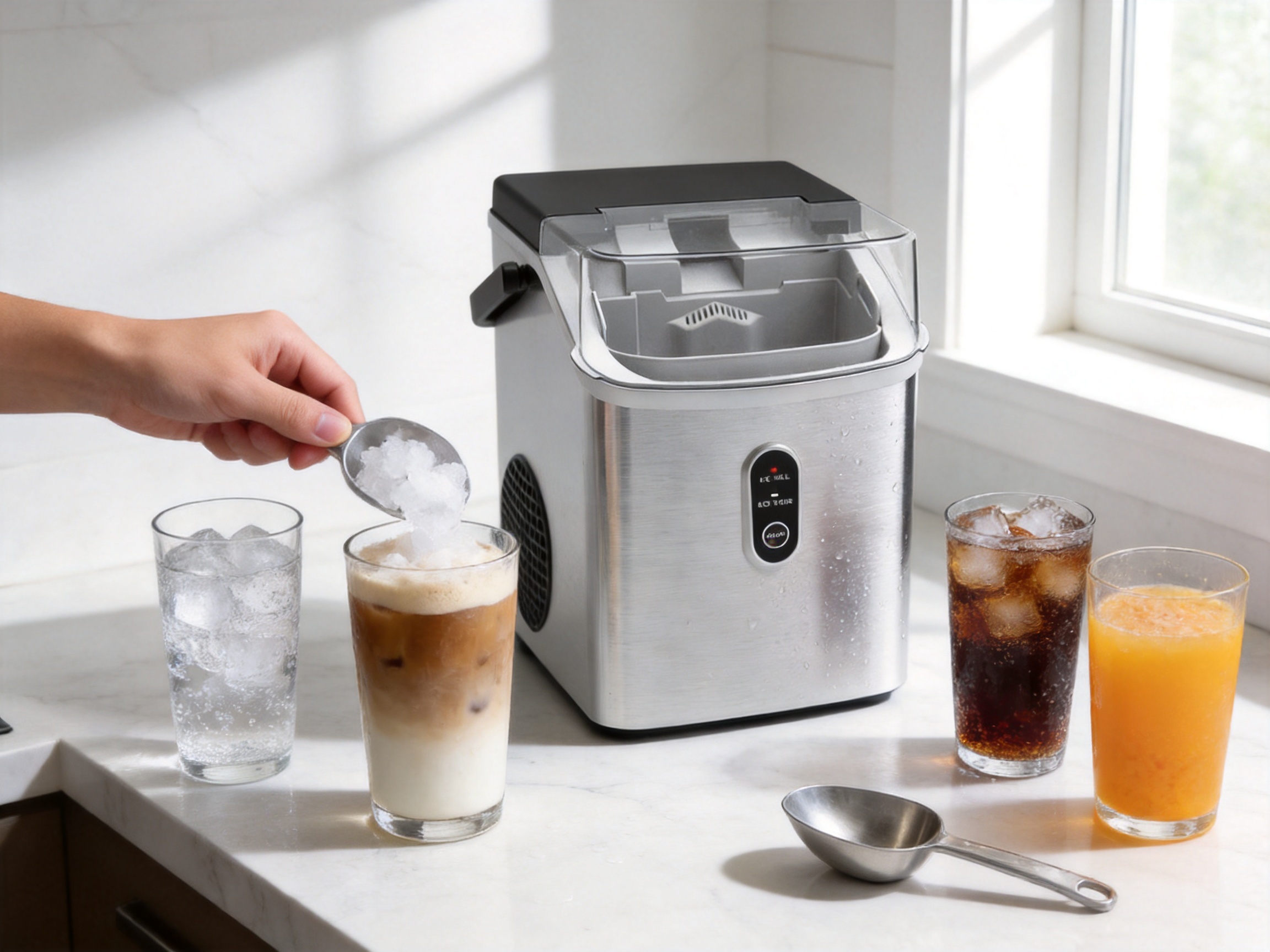
Iced coffee is a strong example. Coffee prepared warm can lose its intended flavor balance if it is cooled too slowly or diluted by excessive melting. Soft chewable ice can help lower the temperature while dispersing throughout the cup. The user can also mix the ice more easily, allowing the cooling effect to spread through the entire drink.
Carbonated drinks, fruit punches, iced tea, sports beverages, and flavored water can also benefit from rapid contact with small ice. When the ice is distributed across the beverage, the drink may feel cold more consistently from the first sip to the last. The softer texture can make the remaining ice more enjoyable to consume instead of simply leaving it in the glass.
Cooling performance depends on many conditions, including the starting temperature of the water, the ambient temperature, the volume of the drink, the amount of ice used, and the serving container. The product’s advantage is therefore best understood as a functional design benefit rather than a promise of identical results in every situation. Smaller particles are inherently well suited to rapid cooling because they interact with more of the beverage at once.
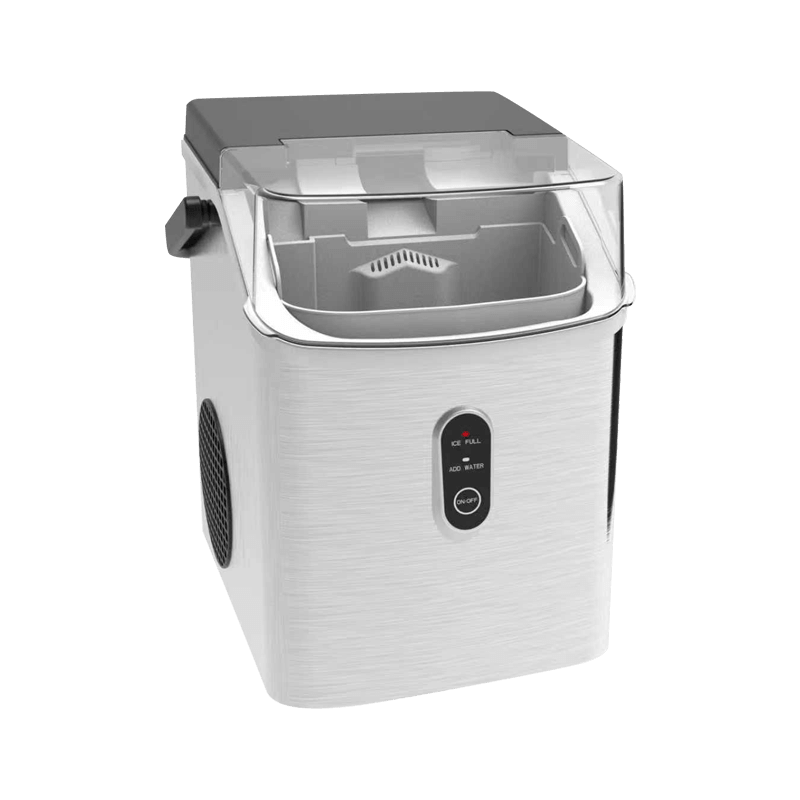
Home chewing ice maker
A More Comfortable and Enjoyable Texture
The central difference between chewable ice and conventional hard ice is the user experience. Hard cubes can be difficult to bite and may be uncomfortable for people with sensitive teeth. They can also create loud impacts against glassware and may be inconvenient for children. The softer texture of chewable ice addresses these concerns by providing a gentler, more flexible bite.
A pleasant texture can influence how often an appliance is used. If ice is hard to consume, people may use it only when necessary for cooling. If the ice is soft and satisfying, it becomes part of the beverage itself. This can encourage more creative drink preparation at home, from simple iced water to blended fruit beverages and dessert-style drinks.
The sound and texture of chewing ice are also part of its appeal. Many consumers enjoy the light crunch and soft bite associated with this type of ice. It gives a drink a distinct sensory identity and can make an ordinary refreshment feel more special. For hospitality operators, that sensory feature can become a small but memorable detail in a customer’s experience.
Texture may also affect how the ice interacts with other ingredients. Soft pieces can be more easily stirred into a drink, pressed into a cup, or scooped onto a serving tray. They do not necessarily remain as isolated blocks. Instead, they can become an integrated component of smoothies, shaved ice, cold desserts, and other preparations.
Versatility Beyond Ordinary Drinks
The Home Chewing Ice Maker is not limited to serving ice in a glass. Its soft, scoopable output supports a variety of household and professional applications. The ice can be used directly in beverages, but its small-particle form also makes it suitable as a base ingredient for smoothies and shaved ice.
Use in Smoothies
Smoothies require ingredients that can be blended efficiently. Large, hard cubes can increase blending time and place additional stress on a blender. Smaller, softer ice particles can be easier to combine with fruit, yogurt, milk, juice, or plant-based beverages. They can help create a cold, thick texture while distributing more evenly through the mixture.
The exact result depends on the blender, recipe, and quantity of ice. Users should follow the operating instructions of their blender and avoid overloading it. Nevertheless, the general format of chewable ice is well suited to recipes where the ice needs to become part of the finished texture rather than remain as large pieces.
Use in Shaved-Ice-Style Desserts
Chewable ice can also serve as a convenient starting point for cold desserts. Its smaller size may make it easier to scoop, portion, and combine with syrups, fruit, condensed milk, chocolate, or other toppings. At home, this offers a simple way to create refreshing desserts without relying exclusively on large blocks of ice.
Food preparation should always be performed with clean utensils and safe handling practices. If the ice will be eaten directly, users should begin with clean, potable water and keep the production and serving areas hygienic.
Cold Food Displays
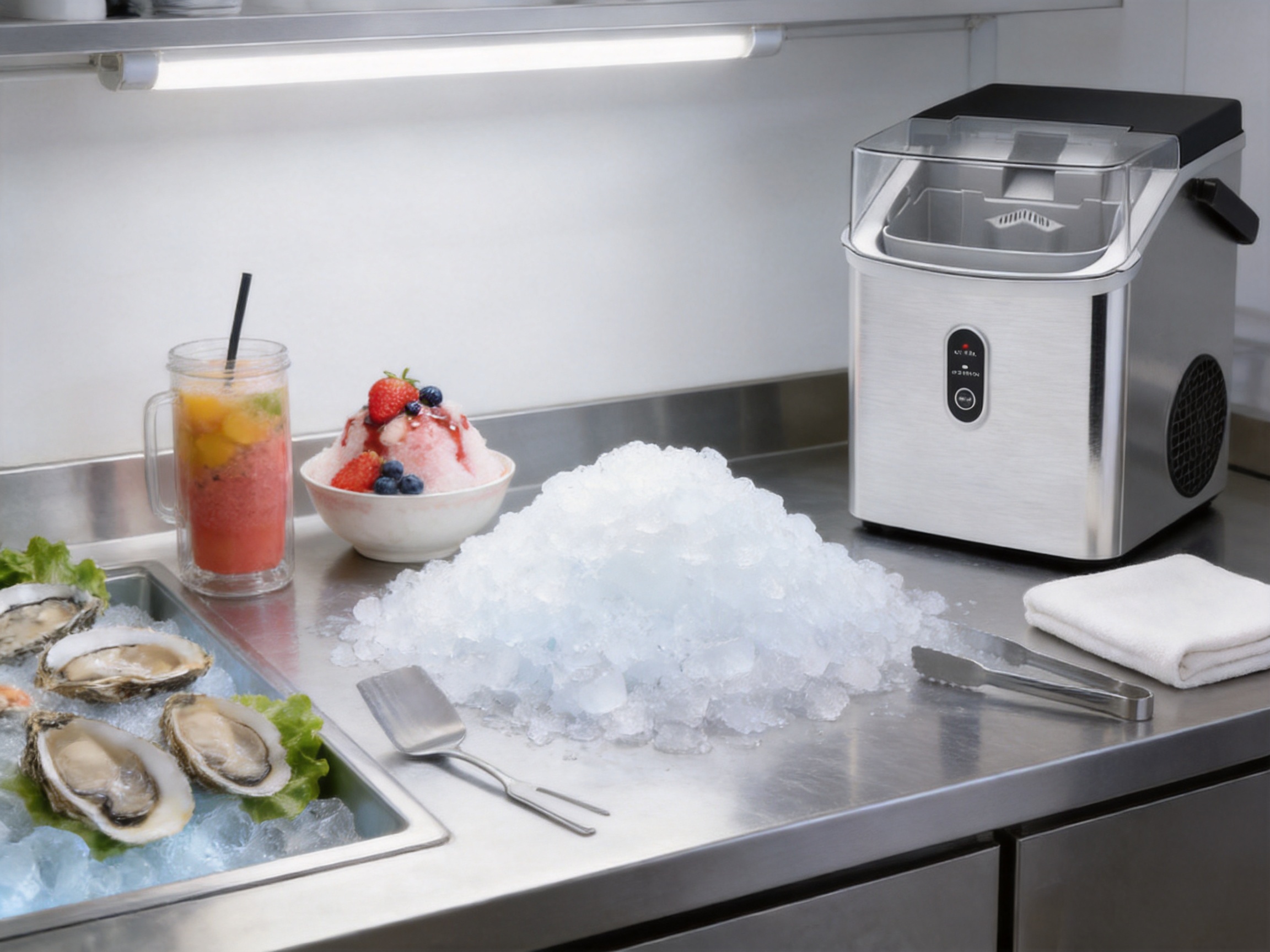
The product information highlights the ability of this ice to coat food closely. This may be useful for salad bars, seafood displays, oysters, sashimi, vegetables, and other chilled presentation settings. Small particles can fill spaces around food more effectively than a few large cubes, producing a more uniform visual arrangement and helping maintain a cold environment around displayed items.
In a food service setting, the ice must be managed carefully. It should be produced from suitable water, placed in clean display equipment, and replaced according to the operator’s food safety procedures. Ice used around raw seafood or other sensitive foods should never be treated casually. The product’s coating advantage is valuable only when combined with responsible hygiene and temperature control.
Cold Compress Applications
Another possible application is use in cold compresses. Small, soft ice particles can conform more closely to the shape of a body part than rigid cubes. This may make them useful for general household cold-pack preparation when appropriate. A cloth barrier should be used to protect the skin, and cold should be applied according to medical guidance.
The appliance is not a medical device, and its ice should not be presented as a treatment for injuries or medical conditions. The benefit is primarily one of shape and conformity. Anyone with a significant injury or medical concern should consult a qualified healthcare professional.
Advantages Compared with Conventional Ice Makers
Conventional ice makers remain useful, especially when users prefer hard cubes, large pieces, or slow melting. However, the Home Chewing Ice Maker is differentiated by the specific texture and applications of its output. Its value becomes clear when the user’s priorities include chewability, rapid cooling, easy mixing, and food coverage.
First, the soft texture offers a more comfortable bite than standard hard cubes. This is a major distinction rather than a minor variation. Consumers who enjoy eating ice may find conventional cubes too hard, while chewable ice is designed around a gentler mouthfeel.
Second, small particles can cool beverages rapidly. A conventional cube may remain intact while the drink around it changes temperature gradually. Smaller pieces can spread through the drink and create more points of contact. This is useful when serving iced coffee, soda, or other drinks immediately after preparation.
Third, chewable ice is easier to scoop and mix. A spoon can move the particles through a drink without the clattering and resistance associated with large cubes. This can be helpful for children, older adults, people with sensitive teeth, and anyone preparing blended or layered beverages.
Fourth, the same ice format can serve several purposes. A conventional ice maker may be optimized mainly for drinking beverages. A chewable ice maker can also support smoothies, shaved ice, cold food displays, and cold compress preparation. This broader utility can improve the value of the appliance for homes and small businesses.
Fifth, the compact design makes specialized ice production more accessible. Users do not necessarily need a large commercial machine or a dedicated floor area. The 224 x 333 x 325 millimeter body is suited to countertop installation, subject to adequate ventilation, clearance, and safe operating conditions.
Engineering Priorities in a Compact Appliance
Producing soft chewable ice requires more than simply freezing water. The appliance must manage cooling, freezing behavior, ice formation, and output texture in a coordinated way. Although detailed internal manufacturing diagrams are not provided, the product’s specifications indicate a design focused on compact refrigeration and specialized ice production.
The 130-watt power rating suggests that the machine is engineered for household-scale operation. A practical appliance must balance ice formation with electrical demand, physical size, heat dissipation, and user expectations. Efficient use of space is particularly important because the unit must contain refrigeration components, water-contact areas, controls, structural housing, and output mechanisms within a compact body.
The R600a refrigerant system is another element of the refrigeration design. A small charge supports the compact format, while the sealed cooling system provides the thermal function required for ice formation. Proper assembly, leak prevention, and quality inspection are essential in any refrigeration appliance. These areas are central to responsible manufacturing and long-term product reliability.
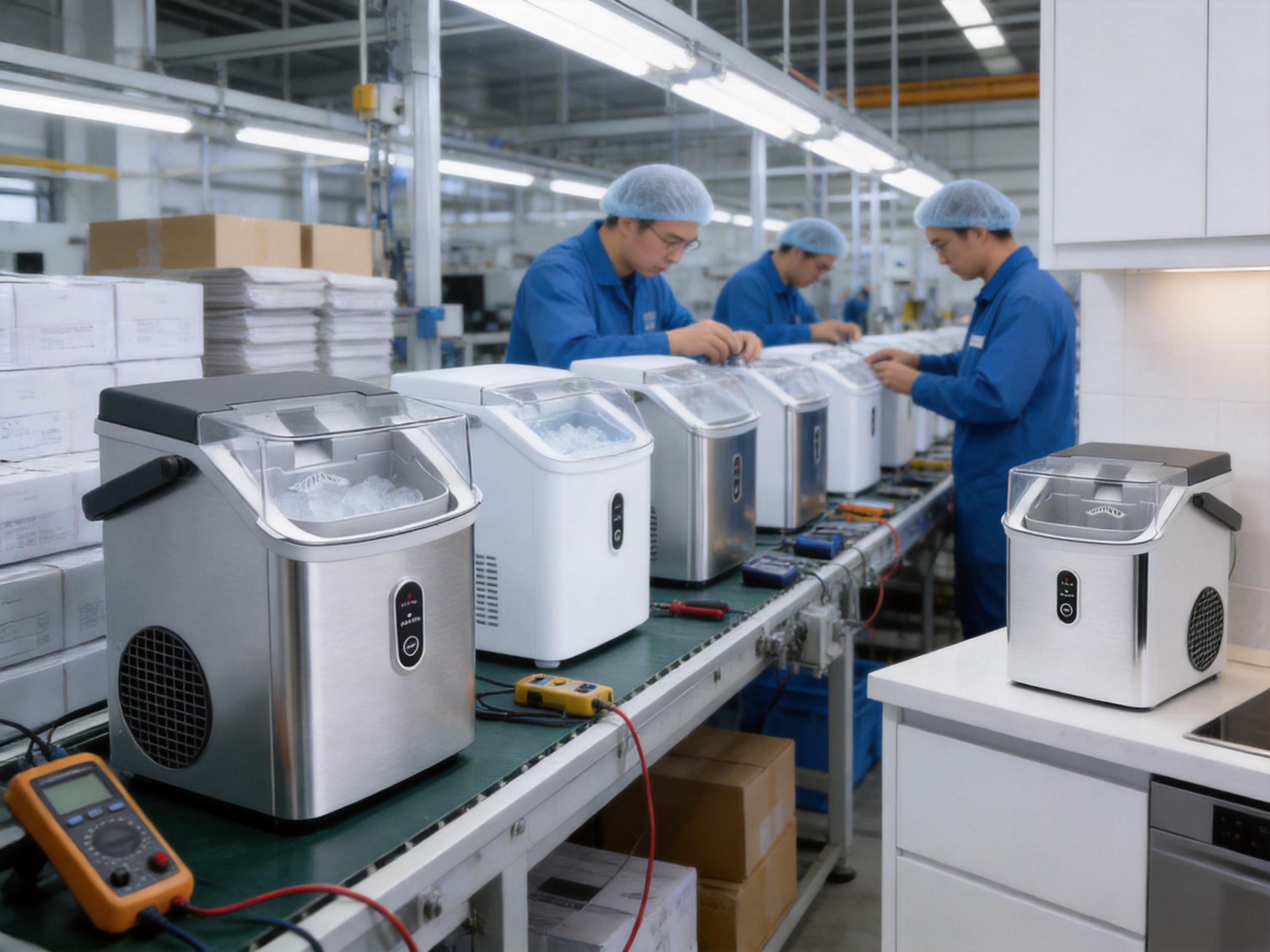
Manufacturing a household appliance also requires coordination across several stages. Product design must consider the user’s daily routine. Component selection must account for electrical load, mechanical operation, water exposure, and cleaning access. Assembly must maintain consistency from unit to unit. Final inspection should verify appearance, basic function, electrical safety, and packaging readiness.
The company’s specialization in household appliances provides a useful foundation for this type of product development. Experience with ice makers, coffee machines, and air fryers can support knowledge of heating and cooling systems, user interfaces, compact product structures, thermal management, and home appliance quality control. Each appliance category has different technical requirements, but shared manufacturing experience can strengthen production discipline and supplier coordination.
Manufacturing Strengths and Production Philosophy
Alien Technology Co., Ltd. is located in Zhouxiang, Zhejiang Province, an area known for small household appliance production and convenient logistics. This location can support access to component suppliers, manufacturing services, packaging resources, transportation networks, and skilled labor related to household appliances. Proximity to an established industrial ecosystem can help a company coordinate production efficiently and respond to market requirements.
The company states that its mission is “Smart Technology, Simplifying Life, Enhancing Happiness.” For the Home Chewing Ice Maker, this mission can be seen in the practical relationship between technology and everyday use. The appliance is not designed around unnecessary complexity. Instead, its key value comes from solving several familiar problems: hard ice, slow cooling, difficult mixing, limited food coverage, and the need for a large dedicated machine.
The company also emphasizes humanized design. In a product such as this, humanized design includes more than external appearance. It includes the ability to place the unit conveniently, handle the ice with a spoon, use it in different recipes, and incorporate it into daily beverage preparation. A useful appliance should fit naturally into routines rather than require specialized knowledge for every operation.
Reliable quality is equally important. A refrigeration appliance must operate consistently because its core function depends on controlled cooling. Stable production processes can reduce variation in electrical performance, component fit, insulation, housing assembly, and water-contact parts. Consistency is particularly valuable for business customers who need predictable results across multiple units.
The company’s stated commitment to customer satisfaction, continuous improvement, and innovation suggests a production approach that values feedback. Household appliance development does not end when a model enters the market. User comments about texture, noise, cleaning, placement, output, and service can inform future revisions. This continuous improvement cycle can strengthen later products and help manufacturers respond to changing expectations.
A pragmatic business philosophy also has practical advantages. Household appliance buyers often value dependable operation over exaggerated claims. A stable manufacturer can focus on clear specifications, responsible product positioning, supply continuity, and responsive cooperation. These strengths are important for distributors, importers, retailers, hospitality buyers, and project customers evaluating a product for regular use.
Designing for Homes, Offices, and Small Service Environments
The product’s compact format makes it relevant to more than one type of user. In a home kitchen, it can sit near a coffee machine or beverage preparation area. During warm weather, family members can prepare cold drinks without waiting for conventional ice trays to freeze. The chewable texture also adds variety to simple drinks such as water, lemonade, tea, and soda.
In an office, the machine can support a shared refreshment area. Employees may use the ice for coffee, sparkling water, juice, or informal gatherings. Because the output is soft and easy to mix, it can be more convenient than carrying large cubes from a freezer or purchasing packaged ice.
Small cafés, dessert counters, guesthouses, snack shops, and food display businesses may also find value in the product. It can supplement other beverage equipment and provide an ice format that differentiates a menu. For example, a café may use it in iced coffee or fruit drinks, while a dessert business may incorporate it into cold preparations.
Businesses should assess expected volume before choosing any countertop ice maker. The product is presented as a home chewing ice maker, so buyers with heavy commercial demand should evaluate production capacity, duty cycle, cleaning requirements, service support, and local regulations. A compact appliance may be ideal for moderate use but unsuitable as the sole ice source for a high-volume operation.
Practical Installation and Use Considerations
Before operation, users should place the machine on a stable, level, and water-resistant surface. Adequate clearance should be provided around the appliance so that heat can dissipate and the unit can be accessed for cleaning. The product should remain away from direct heat sources, excessive moisture, and areas where it could be knocked over.
The 220V/60Hz specification must be matched to the local electrical supply. Users should avoid unsuitable adapters, overloaded outlets, damaged power cords, or extension arrangements that do not meet local safety requirements. If the supply is uncertain, a qualified electrician or authorized service provider should be consulted.
Clean, potable water should be used for ice production. The water reservoir and any removable ice-contact parts should be cleaned according to the manufacturer’s instructions. Regular cleaning helps protect flavor, appearance, and hygiene. Ice should be handled with clean utensils rather than bare hands, particularly when it will be served to other people or used around food.
After transportation or relocation, refrigeration appliances may require a period of rest before being connected to power, depending on how they were handled. Buyers should follow the supplied instructions rather than relying on general assumptions. Any unusual sound, odor, leakage, electrical problem, or failure to cool should be addressed by stopping use and contacting qualified support.
Cleaning, Hygiene, and Product Longevity
Ice is a food-contact product, so cleanliness is essential. Even when the appliance appears clean externally, water-contact surfaces can accumulate mineral deposits, residue, or microorganisms if maintenance is neglected. A regular cleaning schedule is especially important in warm environments, high-use locations, and commercial settings.
Users should follow the recommended cleaning agents and procedures. Harsh chemicals, abrasive tools, unauthorized disassembly, and excessive water around electrical components can damage the appliance. Cleaning should be performed with the machine disconnected from the power supply whenever the instructions require it.
Water quality can influence maintenance. Hard water may leave mineral deposits over time, while poor-quality water can affect taste and hygiene. If local water conditions are a concern, users should follow the manufacturer’s guidance regarding filtration or descaling. Any filtration system must be maintained properly; an ignored filter can create its own hygiene problem.
Good maintenance can also support long-term performance. Blocked airflow, dirty surfaces, and neglected water-contact parts may place additional stress on the cooling system or reduce user confidence in the ice. A simple routine of emptying unused ice, wiping accessible surfaces, cleaning approved components, and checking the surrounding area can help preserve the appliance’s condition.
Responsible Refrigeration and Safety
The use of R600a requires responsible handling. R600a is a flammable refrigerant, and the appliance should not be opened, punctured, exposed to flame, or repaired by unqualified individuals. Ventilation and installation instructions should be followed carefully. If the refrigeration circuit is suspected to be damaged, the machine should be disconnected and assessed by an authorized technician.
The appliance should be used only for its intended purpose. It should not be immersed in water, operated with damaged electrical parts, or placed where children can pull on the cord. Children should use the machine only with suitable supervision. Ice should be handled carefully to prevent contamination, and cold compress applications should include a protective cloth barrier.
Safety information is not a limitation on the product’s usefulness. Instead, it is part of responsible ownership. A well-designed appliance delivers its advantages most effectively when users understand electrical compatibility, refrigeration safety, hygiene, cleaning, and proper storage.
How the Product Supports Better Beverage Preparation
Many beverage problems are related not to the recipe but to the ice. Large cubes may not cool a drink quickly enough. Hard pieces may be unpleasant to chew. Ice may remain at the bottom of a cup instead of mixing throughout the beverage. A soft, small-particle format can address these issues at the same time.
For iced coffee, users can prepare coffee, add chewable ice, and stir until the drink reaches the preferred temperature. For soda, the ice can provide rapid cooling while remaining enjoyable after the carbonation has been consumed. For fruit drinks, the particles can help create a colder and more textured serving. For blended beverages, they can function as part of the recipe rather than as separate pieces.
The product can also support portion creativity. Users may add a small amount of ice for a lightly chilled drink or a larger amount for a colder, thicker result. Because the ice is easy to scoop, it can be portioned more naturally than large frozen blocks. This makes it suitable for family members with different preferences.
Food presentation is another area where the product can contribute to a more organized service environment. Small ice particles can be distributed around vegetables, seafood, or chilled displays, creating a more continuous layer. When combined with proper food safety controls, this may improve both visual presentation and practical cooling coverage.
Commercial and Distribution Potential
For distributors and retailers, the Home Chewing Ice Maker occupies a clear product position. It is not simply another general-purpose ice machine. Its identity is based on soft texture, chewability, rapid cooling, and multi-purpose use. This makes it possible to present the appliance to customers who already understand the appeal of chewable ice or who want a new feature for their beverage routine.
Retailers can position it alongside coffee machines, air fryers, blenders, water dispensers, and other countertop appliances. Cross-category presentation may be effective because the product connects naturally with iced coffee preparation, smoothies, cold desserts, and everyday refreshments. It can appeal to consumers who are building a home beverage station as well as to small food businesses seeking compact equipment.
For overseas buyers, electrical specifications, refrigerant regulations, labeling, packaging, warranty arrangements, and local compliance requirements should be reviewed before importation. The manufacturer’s Zhejiang location and household appliance specialization may support business cooperation, but each buyer remains responsible for confirming market-specific requirements.
Business customers may also evaluate packaging strength, spare parts, technical documentation, minimum order quantities, lead times, service arrangements, and customization possibilities. These subjects should be discussed directly with the manufacturer. Clear communication at the quotation and sampling stage can reduce uncertainty and help determine whether the model is appropriate for a specific sales channel.
Why Manufacturing Experience Matters
A product’s visible appearance is only one part of its value. The internal consistency of assembly, the stability of supply, the quality of key components, and the ability to provide after-sales cooperation all influence the customer’s experience. A manufacturer that focuses on several household appliance categories may develop broader operational knowledge than a company producing a single isolated item.
Alien Technology Co., Ltd. works across ice makers, coffee machines, and air fryers. These categories require attention to thermal systems, electrical control, compact structures, user convenience, and household safety. Experience across them can support a more complete understanding of how people interact with countertop appliances. It can also encourage shared quality practices in inspection, assembly, packaging, and customer support.
The company’s emphasis on innovation should be understood in practical terms. Innovation does not always mean adding more electronic functions. It can mean creating a more useful ice texture, reducing the space required for production, improving the relationship between appliance size and daily function, or designing a product that serves more than one purpose. For this model, the distinctive output format itself is the central innovation.
Continuous improvement is similarly relevant to product development. Feedback may lead to improvements in controls, cleaning access, sound management, housing materials, packaging protection, water handling, or service documentation. A manufacturer with a stable and pragmatic approach can use this feedback to improve products without losing sight of reliability and cost control.
Questions and Answers
What type of ice does the machine produce?
The product is designed to produce soft, chewable ice in small particles. Its texture is intended to be gentler on the teeth and more satisfying to bite than conventional hard ice cubes.
Why is small-particle ice useful for cooling drinks?
Small particles can expose more surface area to the surrounding beverage. This allows more contact between the ice and the drink, which can support faster cooling, especially in iced coffee, soda, fruit drinks, and similar beverages.
Can the ice be used in smoothies?
Yes. The soft, scoopable format is suitable as a base ingredient for smoothies and similar cold drinks. Users should still follow the operating instructions and capacity limits of the blender used to process the ice.
Can it be used for shaved-ice-style desserts?
The ice can serve as a convenient base for shaved-ice-style preparations and can be combined with syrups, fruit, milk-based toppings, or other ingredients. Clean utensils and safe food handling should always be used.
Is it suitable for food displays?
Its small particles can coat food more closely than large cubes, making it potentially useful for salad bars, seafood displays, vegetables, oysters, and sashimi. Food safety procedures, clean ice, proper display equipment, and suitable temperature control remain essential.
Can the ice be used as a cold compress?
Its soft texture may allow it to conform more closely to body parts when used in a cold compress. A cloth barrier should protect the skin, and medical advice should be followed for injuries or health conditions. The appliance is not a medical device.
What is the electrical specification?
The listed power supply is 220V/60Hz. The current and power are listed as 0.55A/130W. Buyers should confirm that these specifications match the electrical system in the intended market and installation location.
What refrigerant does the machine use?
The product information lists R600a refrigerant with a 19-gram charge. Because R600a is flammable, servicing and refrigeration repairs should be handled only by qualified personnel following applicable safety requirements.
How large is the machine?
The listed machine dimensions are 224 x 333 x 325 millimeters. This compact size is intended to support countertop use in homes, offices, and smaller service environments.
Who manufactures the product?
The product is manufactured by Alien Technology Co., Ltd., a company located in Zhouxiang, Cixi City, Zhejiang Province. The company specializes in household appliances including ice makers, coffee machines, and air fryers.
What should buyers ask before placing a business order?
Buyers should confirm production capacity, packaging, documentation, warranty terms, spare parts, service support, electrical requirements, regulatory compliance, lead times, minimum order quantities, and any available customization. These details should be agreed with the manufacturer before commercial deployment.
Conclusion
The Home Chewing Ice Maker offers a distinctive approach to everyday cooling. Its primary strength is the production of soft, chewable ice that is comfortable to bite, easy to scoop, quick to mix, and practical across several applications. It can improve iced coffee, soda, smoothies, fruit beverages, cold desserts, food displays, and selected cold compress preparations.
Its 224 x 333 x 325 millimeter body and 130-watt rating support a compact household-oriented design. The 220V/60Hz power specification, R600a refrigerant, and 19-gram refrigerant charge define important installation and safety considerations. Users should verify electrical compatibility and follow all instructions for cleaning, ventilation, handling, and maintenance.
The product’s competitive advantage comes from combining texture, cooling behavior, versatility, and countertop convenience. Rather than competing only on the ability to freeze water, it is designed to change how ice is consumed and used. That focus can make it attractive to households, offices, cafés, dessert businesses, food display operators, distributors, and retailers seeking a specialized appliance.
Behind the product is a manufacturer with experience in multiple household appliance categories and a stated commitment to smart technology, humanized design, reliable quality, customer satisfaction, continuous improvement, and innovation. Its location in Zhejiang’s small-appliance manufacturing environment provides a foundation for production coordination and business cooperation. For buyers seeking a compact appliance with a clear product identity, soft chewable ice offers a practical and enjoyable alternative to traditional hard cubes.
References
1. Product specification sheet for the Home Chewing Ice Maker, model description Alien-ZJ01.
2. Manufacturer-provided product information regarding chewable ice applications, beverage cooling, food coating, smoothies, shaved ice, and cold compress use.
3. Manufacturer-provided company profile for Alien Technology Co., Ltd., including product categories, location, mission, and business philosophy.
4. General refrigeration engineering references concerning compact appliance design and hydrocarbon refrigerants.
5. General food-service guidance concerning ice hygiene, food-contact surfaces, cold food display practices, and safe handling procedures.
6. General household appliance guidance concerning electrical compatibility, countertop placement, cleaning, ventilation, and preventive maintenance.