
 English
 한국어
 Español
 Deutsch
Ice is often treated as a minor kitchen convenience, yet the quality, shape, and melting behavior of ice can significantly influence the enjoyment of beverages and the efficiency of everyday food preparation. A dependable home ice cube maker provides a practical answer for households that want fresh, attractive, and consistently shaped ice without relying entirely on freezer trays or irregularly shaped commercial ice.
The Home Ice Cube Maker, model Alien-ZF01, is designed for convenient household use while offering the clean appearance and dependable performance associated with more specialized ice-making equipment. Its compact structure, 140-watt operating power, R290 refrigerant, and regular cube production make it suitable for kitchens, home bars, offices, entertainment areas, small cafés, and hospitality environments that need an accessible supply of ice.
Unlike ordinary freezer trays, this machine is designed specifically to produce ice with greater consistency and less daily effort. Users do not need to fill multiple trays, wait for them to freeze, or struggle to release individual cubes. The appliance provides a dedicated ice-making solution that supports a more organized routine and helps ensure that drinks can be served promptly.
The product is manufactured by Alien Technology Co., Ltd., a Zhejiang-based household appliance manufacturer specializing in ice makers, coffee machines, and air fryers. The company combines practical product design with a focus on reliable quality, customer satisfaction, continuous improvement, and innovation. Its location in Zhouxiang, Zhejiang Province, places it within an important manufacturing region for small household appliances, helping support convenient logistics, component access, production coordination, and international business service.
This article examines the design advantages, functional value, energy-conscious construction, product applications, manufacturing strengths, and competitive benefits of this compact ice cube maker. It also explains how regular solid cubes can improve beverage presentation and why a dedicated appliance can be more useful than traditional freezing methods.
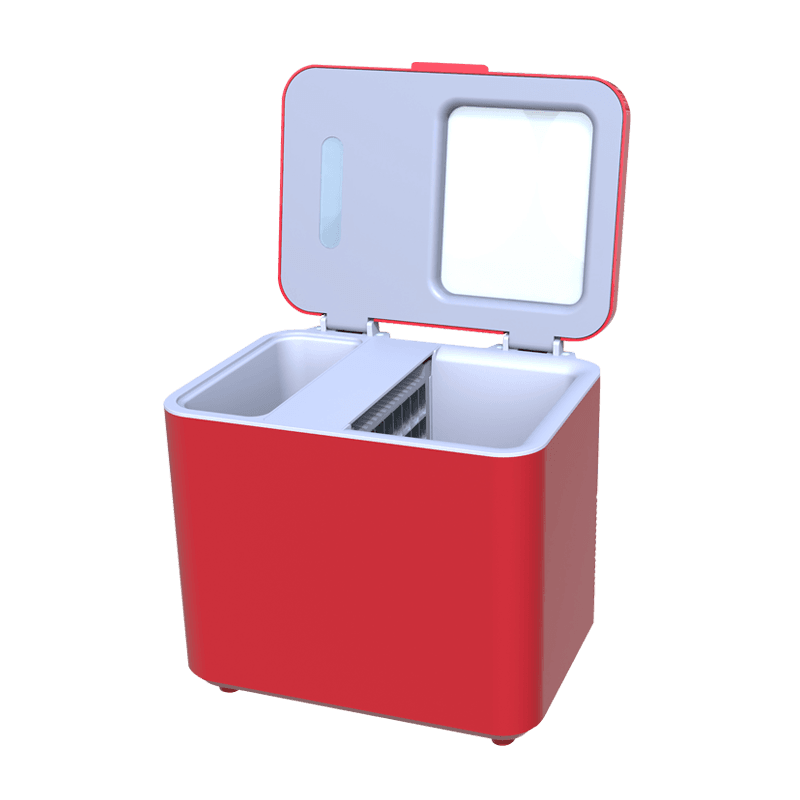
Home ice cube maker
A Practical Ice-Making Solution for Modern Homes
The needs of a modern household are different from those of a commercial ice factory. Most families do not require a large industrial machine that occupies significant floor space or demands complex installation. They need an appliance that is compact, simple to operate, easy to position, and capable of producing useful ice whenever necessary.
The Home Ice Cube Maker responds to these needs with a small footprint of approximately 325 by 295 by 252 millimeters. This compact form allows it to fit comfortably on a kitchen counter, beverage station, home bar, office pantry, or entertainment cabinet. Its dimensions are especially valuable in apartments and smaller kitchens where every section of counter space must be used efficiently.
Traditional ice trays require freezer capacity. They compete with frozen food, meal-preparation ingredients, and long-term storage. They also depend on the freezer reaching and maintaining a suitable temperature. A dedicated ice maker reduces this dependence by giving the user a separate appliance intended specifically for ice production.
The machine is also useful when a household needs more ice than its freezer can supply. During family celebrations, weekend gatherings, outdoor meals, birthdays, holidays, or warm-weather events, ordinary trays may not provide enough ice at the right time. A countertop ice maker gives users a more flexible way to prepare for these occasions.
The product’s knob-type operating design supports straightforward interaction. A simple control approach can be more suitable for household appliances than a complicated interface filled with unnecessary menus. Users can focus on the basic task of making ice rather than spending time learning a complex system.
Regular Cubes for Better Beverage Performance
One of the most important advantages of this product is the value of regular, solid ice cubes. Shape is not merely a matter of appearance. It affects how ice occupies space, how it contacts a drink, how efficiently it can be stored, and how it behaves as it melts.
Regular square-style cubes provide a clean and professional appearance. When placed in a transparent glass, they create a neat visual structure that can make a beverage look more refined. This is particularly useful for whiskey, neat spirits, cocktails, iced coffee, fruit drinks, soft drinks, and other beverages where presentation contributes to the overall experience.
Compared with irregular fragments, regular cubes generally offer more predictable contact with the surrounding drink. Their organized shape also makes them easier to arrange in glasses, ice buckets, serving bowls, and storage containers. Hosts can prepare attractive beverages more quickly because the ice looks consistent from one serving to the next.
The dense structure of solid cubes can also contribute to a slower melting rate. A cube with a relatively compact shape has a smaller surface area compared with its volume than many thin or irregular pieces. As a result, it can remain effective for a longer period while chilling the drink.
Slow melting is particularly valuable for premium beverages. When ice melts too quickly, it can dilute the drink and alter its flavor before the beverage has been fully enjoyed. Dense cubes are therefore well suited to whiskey, bourbon, spirits, iced tea, and other drinks where maintaining a balanced flavor profile matters.
Slow melting does not mean that the ice never melts. All ice eventually absorbs heat from its surroundings. However, a well-formed cube can provide a more controlled chilling experience than thin shards, crushed ice, or loosely formed fragments. This balance between cooling performance and dilution control is one of the product’s strongest advantages.
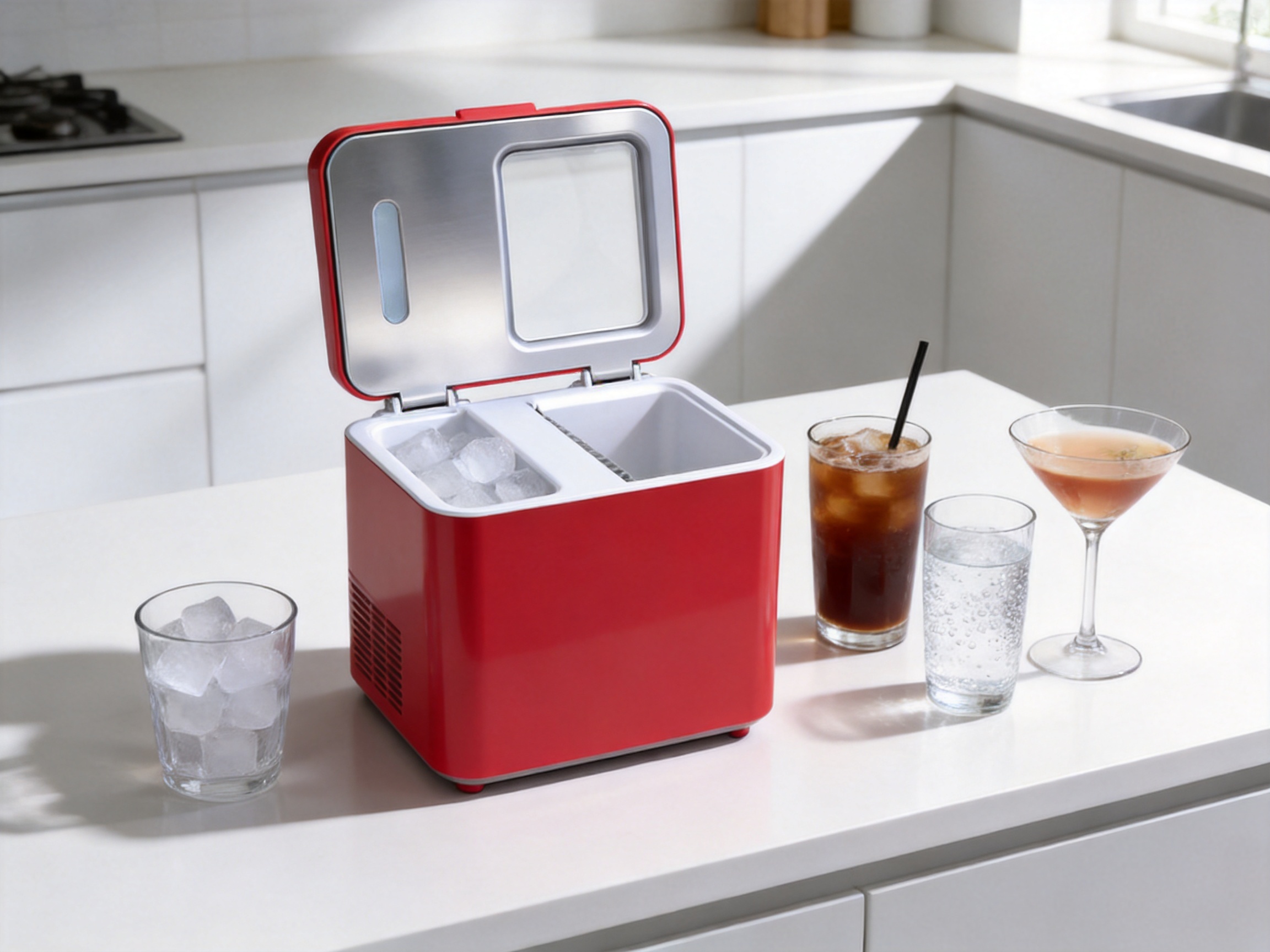
Compact Dimensions Without Compromising Usefulness
The product measures approximately 325 millimeters in length, 295 millimeters in width, and 252 millimeters in height. These dimensions make it suitable for countertops where vertical and horizontal space are both limited.
A compact appliance can be moved more easily when the kitchen layout changes. It can also be placed near a beverage station during a gathering and returned to a storage area afterward. This flexibility is an important difference between a household ice maker and a permanently installed commercial system.
Its size is also useful for small businesses and service environments that need supplementary ice but do not have enough demand to justify a large machine. Boutique cafés, small offices, guesthouses, studio kitchens, and event spaces may benefit from a compact unit that can be positioned close to the point of use.
Compactness also affects user convenience. A smaller machine is generally easier to wipe down, inspect, relocate, and integrate into an existing kitchen arrangement. The product can support a more organized countertop because it does not require a large dedicated installation area.
Despite its compact external dimensions, the machine is built around the essential functions required for ice production. This reflects an important product-design principle: remove unnecessary bulk while preserving the functions customers use most often.
Electrical Performance and Household Compatibility
The Home Ice Cube Maker is specified for a 220-volt, 50-hertz power supply. This specification is suitable for many household and commercial environments that use this electrical standard. Before operation, users should always confirm that the local power supply matches the product requirements and follow the applicable safety instructions.
The rated current and power are listed as 0.65 amperes and 140 watts. A 140-watt rating places the machine within a practical range for a countertop household appliance. It is powerful enough to support the refrigeration and ice-making process while remaining appropriate for ordinary kitchen electrical systems that are correctly installed.
Power consumption is an important consideration for any appliance that may be used repeatedly. An ice maker that balances performance with a moderate rated power can be more convenient for regular household operation than a much larger commercial unit. Users can produce ice when needed without installing a special high-capacity electrical circuit for a small appliance.
Actual energy use depends on operating conditions, ambient temperature, usage frequency, ventilation, water temperature, and maintenance. Keeping the appliance in a suitable location with adequate airflow can help it operate more effectively. Users should avoid blocking ventilation areas and should follow the manufacturer’s operating and cleaning guidance.
R290 Refrigerant and Contemporary Appliance Design
The refrigeration system uses R290 refrigerant with a stated charge of 26 grams. R290 is propane refrigerant, a substance increasingly used in modern refrigeration equipment because of its very low global warming potential compared with many older refrigerants.
The use of R290 reflects a contemporary approach to appliance engineering. Refrigerant selection affects system efficiency, environmental impact, safety design, servicing requirements, and compliance considerations. A compact ice maker using a low-charge R290 system can combine modern environmental performance with the cooling capability required for household ice production.
Because R290 is flammable, the appliance must be handled, transported, installed, and serviced according to appropriate safety requirements. Users should not attempt to open the sealed refrigeration system or modify its components. Professional service personnel should be used for refrigeration-related repairs.
The 26-gram refrigerant charge is appropriate to the product’s compact refrigeration system. A smaller charge helps support a compact design while providing the cooling medium required for the ice-making cycle. The design illustrates how refrigerant quantity, cabinet size, heat exchange, and power consumption must work together as a complete engineering system.
A modern appliance is not judged only by whether it produces ice. It is also evaluated by how efficiently it uses space, how responsibly its refrigeration system is designed, how easily customers can use it, and how reliably it performs over time. The combination of R290 technology and a compact structure supports these broader expectations.
Designed for a Wide Range of Uses
The product is suitable for more than one type of beverage. Its regular cubes can be used in soft drinks, sparkling water, juices, iced tea, cocktails, mocktails, coffee beverages, sports drinks, and alcoholic beverages.
For home entertaining, the appliance can help hosts prepare a beverage station before guests arrive. Instead of relying on a limited supply of freezer ice, users can produce and organize cubes as part of the event setup. The regular appearance of the cubes can also improve the presentation of a self-service drink area.
For coffee preparation, ice cubes can be used in cold coffee, iced lattes, chilled espresso drinks, and blended beverage preparation. The consistent shape helps users portion ice more predictably when preparing repeated servings.
In the kitchen, ice can support food preparation. It may be used to cool ingredients, help preserve texture during certain preparation steps, or create a temporary cold environment for serving. The ice can also be transferred to an insulated container or ice bucket when needed.
Ice cubes may also support first-aid and household cooling applications when placed in a suitable sealed bag or ice pack. Users should ensure that ice intended for food or drink remains hygienic and is handled separately from ice used for non-food purposes.
Small offices can place the appliance in a pantry or shared break area. Guesthouses, short-term rental properties, and hospitality rooms can use it to provide guests with a more convenient beverage experience. Small cafés and studios may use it as a supplementary source of ice during periods of moderate demand.
The versatility of the product reduces the need for separate ice-making arrangements in different parts of the home or business. One compact appliance can support beverages, food preparation, hosting, and general cooling needs.

How It Compares with Traditional Ice Trays
Ice trays are inexpensive and familiar, but they require hands-on preparation. Users must fill them with water, place them in a freezer, wait for the water to freeze, and remove the cubes manually. This process can be inconvenient when ice is needed quickly or in larger quantities.
Tray-made ice can also vary in size and shape when the trays are filled unevenly or shifted during freezing. Cubes may crack during removal, stick together, or absorb odors from other frozen food. A dedicated ice maker offers a more controlled environment for the ice-making process.
Another limitation of trays is their use of freezer space. In a crowded freezer, several trays may prevent the storage of other items. A countertop ice maker addresses this problem by separating ice production from frozen-food storage.
Traditional trays still have a place in households that use only a small amount of ice. However, for people who regularly serve cold drinks, host guests, prepare iced coffee, or need predictable ice availability, a dedicated appliance can deliver greater convenience and consistency.
Feature |
Home Ice Cube Maker |
Traditional Ice Tray |
Ice shape |
Regular, solid cubes designed for consistent presentation |
Dependent on tray design and filling accuracy |
Freezer space |
Uses a separate countertop appliance |
Requires space inside the freezer |
Daily effort |
Designed for dedicated ice production |
Requires manual filling and cube removal |
Serving presentation |
Clean and uniform appearance |
May vary according to tray and freezing conditions |
Event preparation |
Provides a flexible supplementary ice source |
May require several trays and advance planning |
Storage flexibility |
Can support ice production close to the serving area |
Ice remains tied to the freezer location |
Advantages over Irregular or Crushed Ice
Crushed ice cools beverages quickly because it has a large surface area. However, it can melt rapidly and dilute drinks more than larger, denser cubes. It may also be less suitable for premium spirits where a slower and more controlled cooling process is preferred.
Irregular ice fragments can be difficult to stack and store. Their uneven edges create unused spaces in containers, and they may be more likely to clump together after partial melting and refreezing. Regular cubes make better use of available storage space because their surfaces align more efficiently.
The regular shape also improves handling. Cubes can be transferred with a scoop or tongs, arranged in an ice bucket, and added to glasses with less mess. Their predictable dimensions help create a more consistent serving experience.
For beverages served in clear glassware, the appearance of a clean cube can be an important part of the presentation. A neat cube may make a drink look more deliberate and professionally prepared, whether it is served at home or in a small hospitality setting.
Space-Saving Storage and Stacking Efficiency
The regular form of the ice cubes contributes to efficient storage. Cubes with similar dimensions can be placed closely together, reducing empty spaces inside a storage container or ice bucket.
This advantage matters in small kitchens. Users may wish to prepare ice in advance and transfer it into an insulated container. A regular cube arrangement allows the container to hold more usable ice than it might if filled with irregular pieces of different sizes.
Efficient stacking also benefits event preparation. When ice is organized in a compact container, it is easier to estimate the available supply and monitor how much remains. This can help hosts decide when to produce another batch.
The appliance itself also saves space through its compact body. Its dimensions are suitable for a countertop environment, while its dedicated function helps free the freezer from trays and temporary ice storage. Space efficiency therefore appears at both the machine level and the cube-storage level.
Manufacturing Strengths and Product Development Approach
Alien Technology Co., Ltd. operates in Zhouxiang, Zhejiang Province, an area known for the production of small household appliances. This manufacturing environment provides access to appliance supply chains, component resources, engineering experience, production services, packaging support, and logistics networks.
The company’s product range includes ice makers, coffee machines, and air fryers. Working across several household appliance categories can support a broader understanding of consumer expectations. These categories share important requirements, including compact construction, safe electrical operation, user-friendly controls, heat or refrigeration management, appearance, durability, and ease of cleaning.
The company’s stated mission is to use smart technology to simplify life and enhance happiness. In practical terms, this means designing appliances around real household activities rather than adding complexity for its own sake. A useful product should solve a clear problem, operate in a predictable way, and fit naturally into the user’s daily routine.
The Home Ice Cube Maker reflects this philosophy through its focused design. It is not intended to be an oversized industrial system. Instead, it concentrates on the core household need for accessible, attractive, and practical ice. The compact dimensions, moderate power rating, dedicated refrigeration system, and simple control approach work together to support that purpose.
Reliable manufacturing also requires attention to consistency. The production of a household appliance involves many connected stages, including component sourcing, mechanical assembly, electrical integration, refrigeration-system preparation, inspection, functional testing, packaging, and shipment coordination.
For an ice maker, quality control is especially important because the appliance combines water, electricity, refrigeration, mechanical movement, and user contact. Each area must be considered in the design and manufacturing process. Proper assembly helps maintain stable operation, while inspection helps identify issues before products reach customers.
Product development is not limited to the first production run. Customer feedback, service information, market changes, component improvements, and evolving safety expectations can all contribute to future product refinement. A company committed to continuous improvement is better positioned to adapt its products to different household needs and regional markets.
Engineering Considerations Behind a Small Ice Maker
A compact ice maker requires careful coordination between the refrigeration circuit, water path, control system, cabinet structure, and heat-dissipation design. The available internal space is limited, so components must be arranged efficiently without making inspection or servicing unnecessarily difficult.
The refrigeration system must remove heat from the water and transfer that heat away from the ice-making area. The compressor, condenser, evaporator, refrigerant charge, fan arrangement, insulation, and cabinet ventilation all influence the final result.
The product’s 140-watt rating indicates that the machine is designed around a controlled household-scale refrigeration load. The objective is not simply to maximize power. Instead, the system must provide useful cooling performance within the limits of a compact cabinet and an ordinary household electrical supply.
Thermal management is also important. A countertop appliance needs a clear path for heat to leave the cabinet. Users should place it on a stable, level surface with suitable clearance around ventilation areas. Correct placement supports the intended operating conditions and helps reduce unnecessary strain on the refrigeration system.
Mechanical stability matters as well. A compact appliance may be moved during cleaning or storage, so its structure must be assembled securely. Stable internal positioning can help reduce vibration, noise, and wear during operation.
Material and Assembly Quality
Household appliances are exposed to repeated handling, moisture, temperature changes, and routine cleaning. For this reason, product quality depends on more than external appearance. Materials, fasteners, seals, wiring arrangements, insulation, and internal supports all contribute to the user’s long-term experience.
A well-organized assembly process helps ensure that components are positioned consistently from one unit to the next. Consistent assembly is important for electrical safety, refrigerant-system reliability, water management, and external fit and finish.
The manufacturer’s focus on reliable quality and continuous improvement suggests an approach that values repeatable production rather than one-time performance. This is particularly important for products sold internationally, where customers expect the same operating experience across different batches.
Attention to finishing details can also strengthen consumer confidence. Smooth surfaces, properly fitted panels, clear controls, stable feet, and accessible cleaning areas make a machine feel more dependable and easier to live with.
User Convenience and Maintenance
An appliance that produces ice must be kept clean. Water can leave mineral deposits, and standing moisture can create unpleasant odors if cleaning is neglected. Users should follow the product’s cleaning instructions, empty unused water when appropriate, and keep surfaces that contact ice sanitary.
The compact design can make routine maintenance more manageable because the machine is easier to access and move than a large built-in system. Its countertop position also allows the user to observe the appliance and keep the surrounding area clean.
Users should place the machine away from direct heat sources, excessive sunlight, and locations where it may be splashed. Adequate ventilation is important, and the appliance should not be covered during operation unless the instructions specifically allow it.
Regular care can support more dependable operation and extend the useful life of the machine. Cleaning should be performed with suitable materials and methods. Abrasive products, unauthorized chemicals, and attempts to dismantle sealed refrigeration components should be avoided.
Suitable Settings for the Product
In a family kitchen, the ice maker can serve daily cold drinks, weekend meals, and occasional gatherings. Its compact size allows it to remain available without dominating the room.
In a home bar, the regular cubes complement spirits and mixed drinks. Their slow melting characteristics can help preserve the intended balance of beverages that are meant to be chilled gradually.
In an office pantry, the machine can provide a convenient shared resource for water, soft drinks, iced coffee, and informal meetings. Employees do not need to transport ice from a distant freezer every time a cold beverage is prepared.
In a guesthouse or hospitality room, access to fresh ice can improve the visitor experience. The appliance can be positioned near a beverage area and integrated into a broader guest-service arrangement.
For small cafés and food-service businesses, the unit may function as an auxiliary ice source. It is not presented as a replacement for every high-volume commercial ice system, but its compact format can be valuable where moderate, supplementary production is needed.
For event organizers, the machine offers a flexible preparation tool. It can support small receptions, meeting rooms, private parties, and temporary beverage stations where a full commercial installation would be impractical.
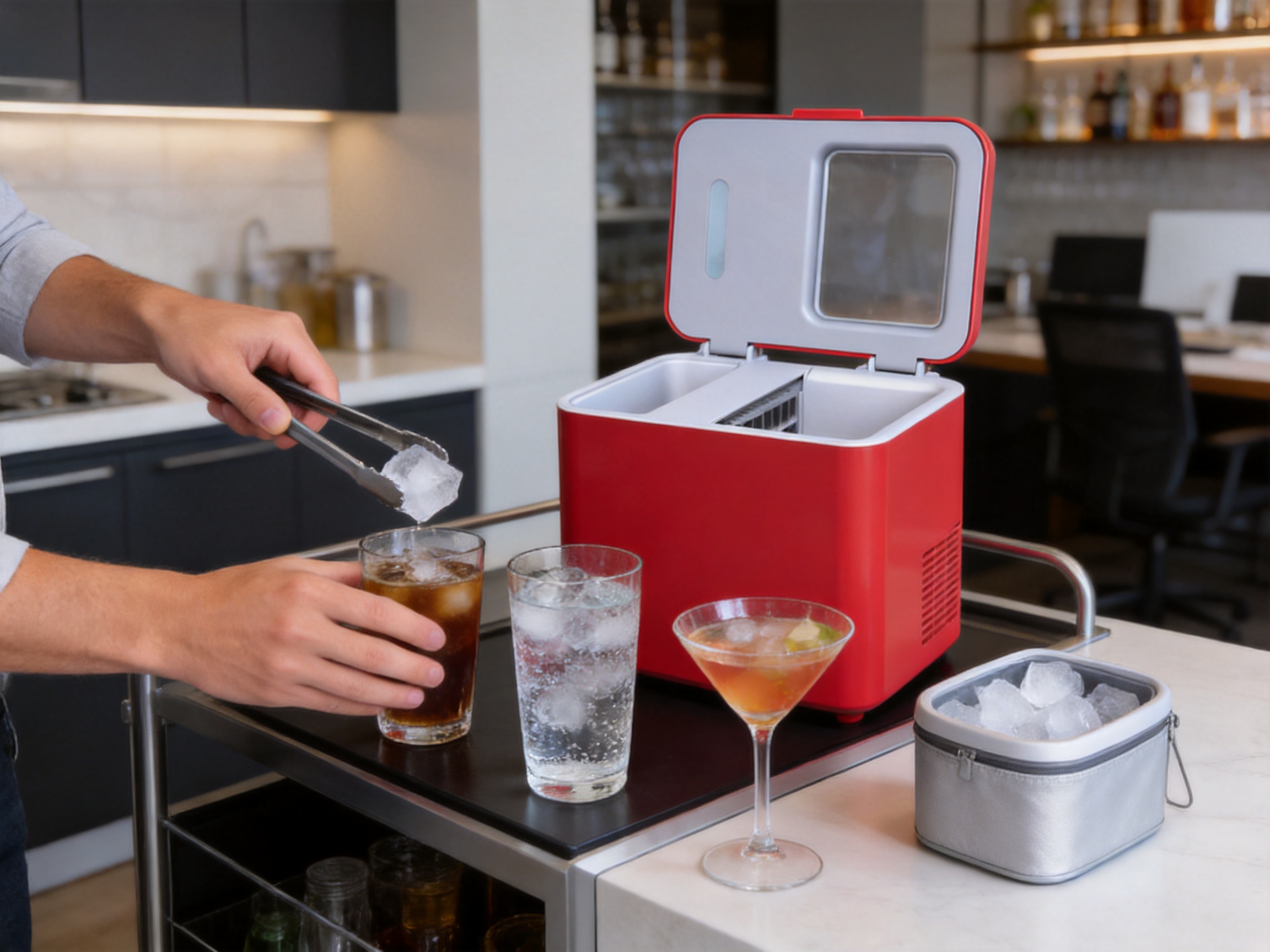
Why the Product Offers Competitive Value
The strongest competitive advantage of the Home Ice Cube Maker is the balance between compactness, regular ice formation, practical power consumption, and broad household usefulness. Many alternatives focus on only one of these characteristics.
Large commercial machines may offer higher output but require more space, higher investment, and more complex installation. Basic freezer trays are inexpensive but demand more time, use freezer space, and provide less consistency. Crushed-ice solutions cool quickly but may dilute beverages faster and offer less attractive presentation.
This product occupies a useful middle position. It is more capable and convenient than a manual tray while remaining more accessible and space-efficient than a large commercial system.
The use of R290 refrigerant adds another contemporary advantage. It demonstrates attention to current refrigeration technology and environmental considerations. The compact refrigerant charge, combined with the 140-watt specification, supports a design intended for household-scale use.
The regular cube shape strengthens the product’s appeal for beverage presentation. Consumers increasingly care about the visual quality of home-prepared drinks, especially when entertaining guests or preparing premium beverages. A clean cube can make a simple drink look more refined without requiring special serving skills.
The product also benefits from the manufacturer’s category experience. A company that produces ice makers alongside coffee machines and air fryers understands that household appliances must combine technical performance with ease of use, compact form, attractive appearance, and dependable daily operation.
Responsible Product Use
Users should read all operating instructions before using the appliance. The machine should be connected only to a compatible electrical supply, placed on a stable surface, and operated in a dry environment suitable for a household appliance.
Because the product uses R290 refrigerant, it should be kept away from open flames and potential ignition sources. The refrigeration circuit should not be punctured, modified, or repaired by unqualified personnel. If the appliance shows signs of damage, unusual odor, refrigerant leakage, abnormal noise, or electrical malfunction, it should be disconnected and inspected by an authorized professional.
Water quality can affect the appearance and taste of ice. Using clean water appropriate for drinking can help support better results. If local water is highly mineralized, regular cleaning may be especially important to reduce scale accumulation.
Ice intended for consumption should be handled with clean utensils and stored in clean containers. Ice should not be placed on unclean surfaces or mixed with materials used for non-food cooling purposes.
Frequently Asked Questions
What type of appliance is the Home Ice Cube Maker?
It is a compact household ice-making appliance designed to produce regular solid ice cubes. It is suitable for kitchens, home bars, offices, hospitality settings, and small beverage-service environments.
What are the product’s electrical specifications?
The appliance is specified for a 220-volt, 50-hertz power supply. Its listed current and power are 0.65 amperes and 140 watts.
What refrigerant does the machine use?
The refrigeration system uses R290 refrigerant with a stated charge of 26 grams. R290 has a very low global warming potential, but it is flammable, so the appliance must be handled and serviced according to appropriate safety procedures.
What are the dimensions of the ice maker?
The stated dimensions are approximately 325 by 295 by 252 millimeters. This compact size allows the machine to fit on many kitchen counters, office shelves, beverage stations, and home-bar surfaces.
Why are regular square-style cubes useful?
Regular cubes provide a clean appearance, stack efficiently, and offer predictable contact with beverages. Their dense structure can help them melt more slowly than thin or irregular ice pieces, which may reduce unnecessary drink dilution.
Can the ice maker be used for premium spirits?
Yes. The solid, regular cubes are well suited to whiskey, bourbon, neat spirits, and cocktails where controlled chilling and attractive presentation are important.
Is the product suitable for iced coffee?
Yes. It can support iced coffee, cold espresso beverages, iced lattes, and other chilled drinks. Consistent cubes can also make repeated beverage preparation more predictable.
Does the machine replace a large commercial ice maker?
It is designed primarily for household and compact-use environments. It may serve as a supplementary ice source in small businesses, but high-volume operations should select equipment according to their output requirements and applicable commercial standards.
Where should the appliance be placed?
It should be placed on a stable, level, dry surface with adequate ventilation around the appliance. It should be kept away from direct heat, excessive sunlight, water splashes, and ignition sources.
How can users maintain the machine?
Users should clean the water-contact areas and exterior surfaces according to the instructions, remove unused water when appropriate, prevent mineral buildup, and use clean water and clean utensils for consumable ice.
Can users repair the refrigeration circuit themselves?
No. The sealed refrigeration system should not be opened or modified by users. R290-related repairs must be carried out by appropriately qualified service personnel.
What makes the manufacturer suitable for international cooperation?
Alien Technology Co., Ltd. is based in Zhejiang, a major small-appliance manufacturing region. The company specializes in ice makers, coffee machines, and air fryers, and emphasizes reliable quality, customer satisfaction, continuous improvement, innovation, and convenient cooperation with new and existing customers.
Conclusion
The Home Ice Cube Maker is a practical solution for people who want more control over the quality, availability, and presentation of ice. Its compact dimensions make it suitable for modern kitchens and limited spaces, while its 140-watt power rating supports household-scale operation. The 220-volt, 50-hertz specification and R290 refrigeration system reflect a focused appliance design built around contemporary requirements.
Its regular solid cubes offer several benefits over irregular fragments and ordinary tray-made ice. They look professional, stack efficiently, provide predictable beverage cooling, and may melt slowly enough to reduce unnecessary dilution. These qualities make the product valuable for everyday drinks, premium spirits, iced coffee, entertaining, food preparation, and hospitality use.
The manufacturer’s experience in small household appliances adds further strength. Alien Technology Co., Ltd. combines product specialization with a manufacturing location known for appliance production and logistics. Its focus on reliable quality, customer satisfaction, continuous improvement, and innovation supports a product-development approach that is practical and adaptable.
For customers seeking a countertop ice-making solution that balances space efficiency, attractive ice formation, modern refrigeration technology, and broad usability, this product provides a compelling option. It brings a specialized function into an accessible household format and helps turn ice from an afterthought into an intentional part of the beverage and hosting experience.
References
Alien Technology Co., Ltd. Product Specification Sheet, Home Ice Cube Maker, Model Alien-ZF01.
Alien Technology Co., Ltd. Company Information and Product Category Materials.
International Electrotechnical Commission. Household and Similar Electrical Appliances: General Safety Principles.
International Organization for Standardization. Refrigerating Systems and Heat Pumps: Safety and Environmental Requirements.
United Nations Environment Programme. Refrigeration and Air-Conditioning Technology and Refrigerant Environmental Considerations.
General household appliance maintenance and food-contact ice-handling principles.