
 English
 한국어
 Español
 Deutsch
Ice is a small household necessity that can make a significant difference in everyday comfort. Cold drinks, iced coffee, smoothies, cocktails, chilled food, outdoor gatherings, and hospitality service all depend on a dependable supply of ice. Traditional freezer trays are inexpensive, but they are slow, awkward to fill, and often produce less ice than a household or business needs. Large commercial ice machines can solve the supply problem, but they may require considerable space, higher investment, more complex installation, and greater energy consumption.
A compact button-operated ice maker offers a practical middle solution. It is designed to provide fresh ice on demand without the complexity associated with a large built-in system. The Button-Operated Ice Maker described in this article combines simple control, quick ice production, compact dimensions, multiple ice-size options, and a low-power design. It is suitable for homes, offices, bars, recreational vehicles, small hospitality settings, and other locations where convenient ice access is important.
Its design is based on a straightforward principle: users should not need technical knowledge to make ice. By pressing a button, the machine begins its operating cycle. This simple approach makes it accessible to a wide range of users, including families, older adults, first-time appliance owners, office staff, and hospitality employees who need fast results without a complicated control panel.
Beyond its user-friendly operation, the machine reflects the manufacturing strengths of a professional small-appliance producer located in Zhejiang, China. The company specializes in ice makers, coffee machines, and air fryers, allowing it to build experience across several categories that depend on thermal management, compact mechanical design, electrical safety, water handling, and consistent quality control. Its product philosophy emphasizes practical design, reliable quality, continuous improvement, and intelligent technology that makes daily life easier.
The Everyday Problem of Producing Ice
Many households still rely on ice trays. Although trays are simple, they require users to fill them manually, place them in a freezer, wait several hours, and remove individual cubes when needed. A tray can also occupy valuable freezer space. Spilled water may freeze onto shelves, and the resulting ice can absorb food odors if it remains in an open freezer compartment.
Freezer trays also provide limited capacity. A single tray may not be enough for a family gathering, a weekend barbecue, a small celebration, or a warm day when everyone wants a cold drink. Users often need to prepare multiple trays in advance, which makes the process inconvenient and difficult to predict.
A built-in refrigerator ice dispenser offers greater convenience, but not every refrigerator includes one. Even when available, refrigerator ice systems may be slow to replenish after heavy use. They can also be expensive to repair and may not be practical for renters, offices, recreational vehicles, outdoor kitchens, or temporary event spaces.
Large commercial machines provide high output, but they are usually designed for restaurants, hotels, bars, or other high-volume operations. They can demand a dedicated location, professional installation, drainage arrangements, and a larger operating budget. For many users, that capacity is unnecessary.
A countertop ice maker addresses this gap. It allows users to produce ice when required while avoiding the space and infrastructure requirements of a large commercial unit. The Button-Operated Ice Maker is especially practical for users who prioritize quick operation and uncomplicated controls.
Product Overview
The Button-Operated Ice Maker is categorized as a bullet ice maker and is designed for compact, convenient ice production. Its product description identifies the model as Alien-Z03. The machine uses a 220V to 240V, 50Hz power supply and has a rated current and power specification of 0.9A and 150W. It uses R600a refrigerant with a listed charge of 19 grams.
The machine dimensions are 313 by 226 by 309 millimeters. This compact footprint makes it suitable for countertops, work surfaces, small beverage stations, office pantries, apartment kitchens, mobile living spaces, and other areas where floor space is limited. Its relatively small size also makes relocation easier when users need to move the machine from a kitchen to a dining area, bar counter, event table, or recreational vehicle.
Product Attribute | Specification or Description |
Product Type | Button-operated bullet ice maker |
Model Description | Alien-Z03 |
Power Supply | 220V to 240V, 50Hz |
Current and Power | 0.9A and 150W |
Refrigerant | R600a, 19 grams |
Machine Dimensions | 313 by 226 by 309 millimeters |
Operation | One-touch button control |
Ice Options | Multiple ice sizes |
Typical Uses | Homes, offices, bars, recreational vehicles, and small commercial spaces |
The specification profile demonstrates a balance between portability and usable performance. The 150W rating supports a compact refrigeration system without positioning the machine as a high-capacity industrial appliance. This makes it appropriate for users who require regular access to ice but do not need the output or installation complexity of a large commercial unit.
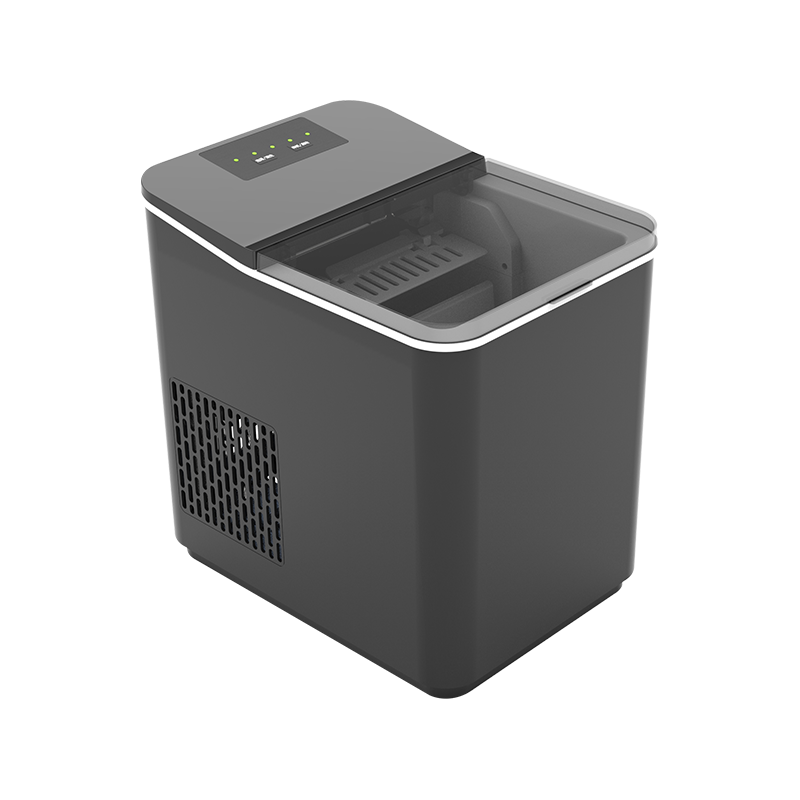
Button-Operated Ice Maker
One-Touch Operation for a Wider Range of Users
The most visible advantage of this product is its button-operated control system. Many modern appliances contain multiple menus, icons, modes, and digital settings. While advanced controls can be useful, they may also create a learning curve. A user who wants a basic function may have to read several instructions before the machine begins operating.
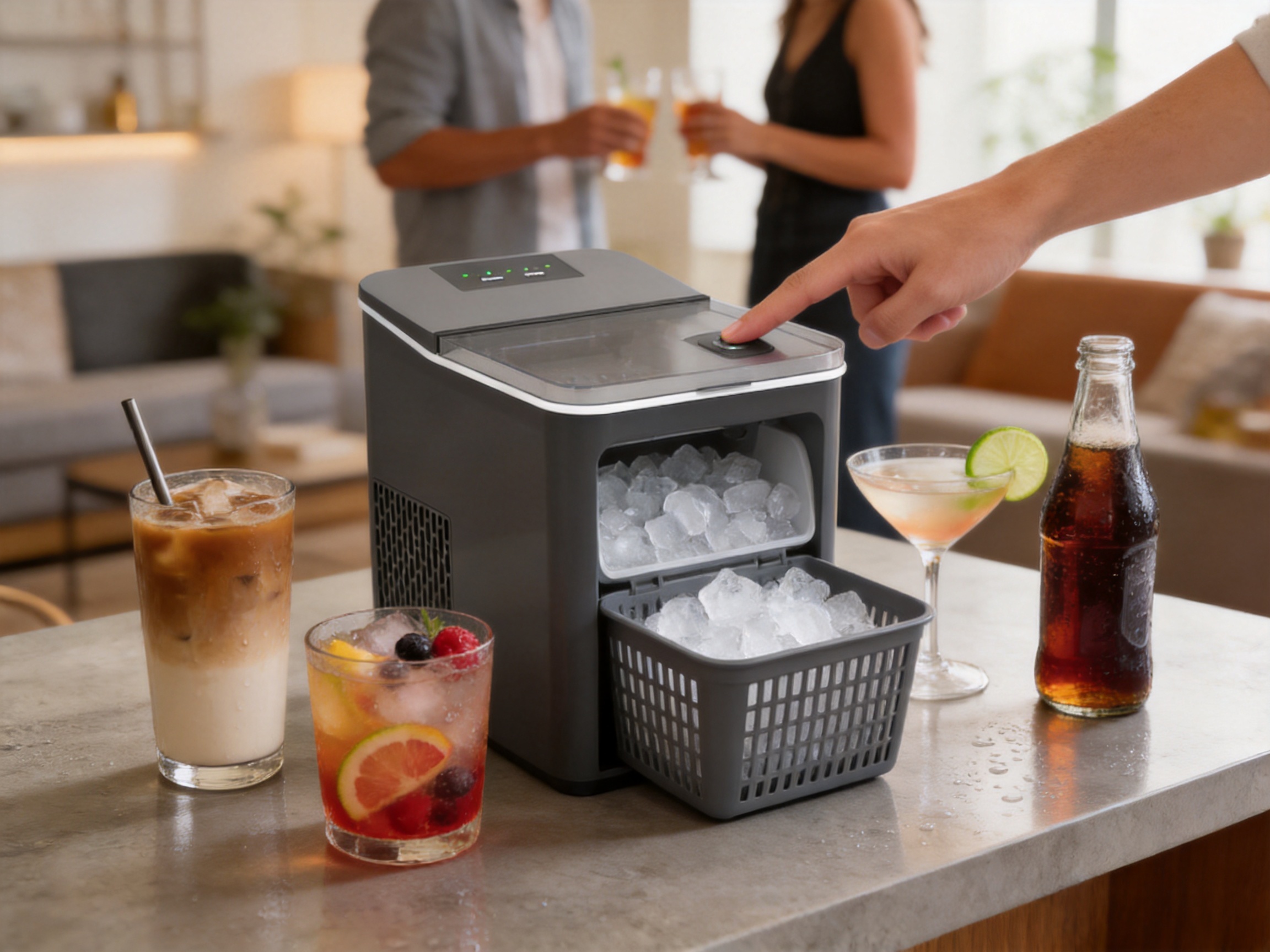
The one-touch design takes a different approach. The user can add water according to the operating instructions, select the desired setting where applicable, and press the control button to begin. This direct interaction reduces unnecessary steps and makes the appliance approachable for first-time users.
Simple controls are particularly useful in shared environments. In an office, several people may use the machine during the day. In a bar or small café, employees may need to operate it quickly during busy periods. In a family kitchen, children or older adults may prefer a clear button rather than a complex electronic interface. In a recreational vehicle, straightforward controls can make the machine easier to use in a compact and changing environment.
One-touch operation can also reduce operating errors. Every additional control creates the possibility of an incorrect setting or misunderstood command. A simpler interface helps users focus on the result rather than the appliance itself. This is an important advantage over competing products that may emphasize a large number of controls without delivering a better everyday experience.
Fast Ice Production for Daily Convenience
The product information states that the machine can produce ice in approximately 6 to 10 minutes per cycle, depending on operating conditions and selected ice size. This short cycle time is one of its strongest practical benefits. Users do not have to plan ice production many hours in advance in the same way they would with freezer trays.
Fast production is useful in many situations. A family can begin preparing cold drinks shortly before a meal. Office employees can refresh beverages during a workday. A small bar can supplement its existing ice supply during a moderately busy period. Guests at a gathering can receive fresh ice without waiting for a freezer to release a new batch.
Cycle time can vary according to ambient temperature, water temperature, ventilation, water level, selected ice size, and the overall condition of the machine. However, the stated 6-to-10-minute cycle provides a useful indication of the product's intended role: responsive, on-demand ice production for regular small-scale use.
Compared with freezer trays, the time advantage is substantial. Instead of waiting several hours, users can begin receiving ice within minutes. Compared with some countertop competitors, a short cycle can reduce the need to keep a large reserve of ice in storage. The machine is therefore well suited to users who value immediacy and convenience over maximum industrial output.
Fast operation does not mean that the machine must run continuously. Users can operate it when ice is needed and stop when sufficient ice has been produced. This flexible approach may be more suitable than leaving a large ice machine running throughout the day in a low-demand environment.
Multiple Ice Sizes for Different Beverages and Tasks
The Button-Operated Ice Maker supports multiple ice sizes, allowing users to select ice according to the beverage or task. This flexibility increases the usefulness of the appliance because different situations benefit from different ice dimensions.
Smaller ice pieces can cool drinks quickly because they offer a larger surface area in contact with the liquid. They may be appropriate for soft drinks, blended beverages, iced coffee, and smoothies. Larger pieces can be useful when users want ice to melt more slowly in a cocktail, serving glass, or insulated container.
Ice-size selection also improves presentation. A beverage prepared for guests can look more attractive when the ice size matches the glass and drink style. In a small hospitality business, this can contribute to a more consistent serving experience without requiring a complex commercial system.
Different ice sizes can also support food-related uses. Ice may be used to maintain the temperature of ingredients during short preparation periods, support a chilled serving display, or keep certain foods cool during transport. Users should always follow appropriate food-safety practices, but the availability of different sizes provides greater flexibility than a standard freezer tray.
Compared with entry-level machines that offer only one ice format, multiple-size functionality is a meaningful advantage. It allows one appliance to serve several roles instead of requiring separate equipment for different beverage preferences.
Compact Dimensions and Flexible Placement
Measuring 313 by 226 by 309 millimeters, the machine is designed for areas where space is limited. Its compact footprint is helpful in apartments, smaller kitchens, office break rooms, dormitory-style accommodation, mobile homes, and recreational vehicles.
A compact appliance is easier to position near the location where ice is consumed. A kitchen user can place it close to the refrigerator or beverage preparation area. An office can install it in a pantry or refreshment station. A bar can position it near a service counter, subject to suitable ventilation and operating requirements.
Portability is another practical benefit. Users may move the machine for a family gathering, seasonal event, outdoor dining setup, or temporary work area. Although the machine should be handled carefully and operated on a stable surface, its compact format makes it more adaptable than fixed, built-in ice equipment.
Compact design does not simply mean reducing exterior size. It requires thoughtful arrangement of the refrigeration system, water path, ice-forming components, controls, insulation, and housing. A well-organized internal layout can help preserve useful working space while maintaining a manageable exterior footprint.
This is an area where a specialist small-appliance manufacturer can offer an advantage. Experience with several compact appliance categories encourages attention to space utilization, component integration, assembly efficiency, and practical user access. The result is a machine intended to fit into real homes and workplaces rather than requiring a dedicated equipment room.
Energy-Conscious Operation
The product has a listed power rating of 150W and a current rating of 0.9A. These specifications indicate a compact appliance designed for moderate power consumption rather than heavy industrial operation. Actual electricity use depends on cycle frequency, ambient temperature, water temperature, operating duration, ventilation, and maintenance condition.
Energy-conscious design is valuable for households and small businesses that want convenient ice without adding a large appliance to their electricity budget. It is also relevant in offices, mobile spaces, and locations where available electrical capacity is limited.
The machine's compact refrigeration system is intended to deliver useful cooling performance without the scale of a commercial ice plant. Its R600a refrigerant is commonly associated with compact refrigeration equipment and is used in accordance with the product's specified system design. Refrigerant handling and servicing should be performed only by qualified professionals and in accordance with applicable regulations.
Efficient operation also depends on user behavior. Producing only the amount of ice needed, keeping air vents clear, using appropriate water, and cleaning the machine regularly can help it operate more effectively. A machine that is maintained correctly is less likely to experience unnecessary strain caused by scale, blocked airflow, or residue.
Compared with a large commercial unit running continuously, a compact on-demand ice maker can be a more appropriate choice for users with moderate ice requirements. It avoids paying for capacity that may remain unused while still providing rapid access to fresh ice.
Quiet Operation in Shared Spaces
Noise can determine where an appliance can be used. A machine that produces excessive sound may be distracting in a home kitchen, office, guest area, bedroom-adjacent space, or recreational vehicle. The Button-Operated Ice Maker incorporates a noise-reduction design intended to keep operation quiet and suitable for everyday environments.
Every refrigeration appliance produces some sound from its compressor, fan, water movement, and ice-release process. The goal is not absolute silence but a more comfortable operating sound level. A quieter design helps users keep the machine close to the area where ice is needed without allowing the appliance to dominate the room.
In an office, reduced operating noise supports concentration. In a home, it can make the machine less disruptive during meals or conversations. In a small bar or hospitality space, it helps maintain a more pleasant atmosphere for customers and staff. In a recreational vehicle, where interior space is limited, sound control becomes especially important.
Noise performance can also be affected by placement. The machine should be installed on a firm, level surface with adequate clearance around ventilation openings. Uneven surfaces can increase vibration, while restricted airflow can make the cooling system work harder. Proper installation therefore works together with the built-in noise-reduction design.
Easy Cleaning and Maintenance
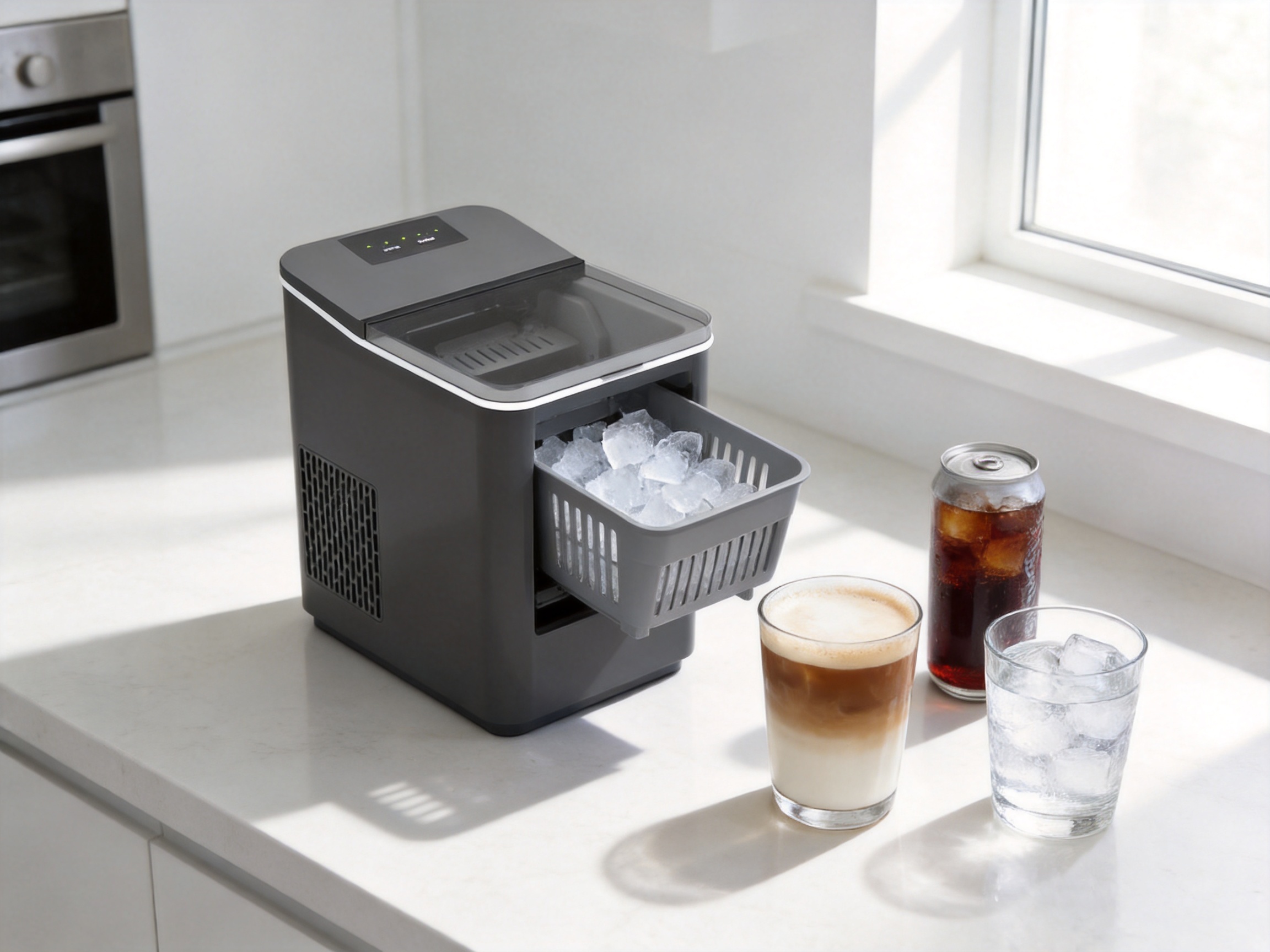
Ice comes into direct contact with water, so cleanliness is essential. The product is designed with smooth interior surfaces and a removable ice basket to make routine cleaning simpler. These details may appear basic, but they have a direct influence on everyday usability and long-term satisfaction.
A removable basket allows users to take out the produced ice and access the interior more easily. Smooth surfaces provide fewer areas where residue can collect. Together, these features can reduce the time required for basic maintenance and encourage users to clean the machine on a regular schedule.
Cleaning routines should follow the operating manual supplied with the product. In general, users should empty unused water, remove the ice basket, wipe accessible surfaces with an appropriate clean cloth, and allow components to dry as directed. The water reservoir and ice-contact areas should receive particular attention.
Regular maintenance can help reduce odor, mineral buildup, and changes in ice quality. The frequency of cleaning depends on water hardness, usage level, storage conditions, and local hygiene requirements. Users in areas with hard water may need to pay additional attention to mineral deposits.
The machine should never be immersed in water unless the instructions specifically permit it. Electrical components, controls, and the power connection must be protected from moisture. Harsh chemicals, abrasive tools, or unsuitable cleaning agents may damage surfaces and should be avoided unless approved by the manufacturer.
Easy maintenance is a competitive advantage because a machine that is difficult to clean may be used less often or maintained poorly. A straightforward cleaning process supports better hygiene, improved reliability, and a more positive ownership experience.
Bullet Ice and Practical Beverage Service
The product is categorized as a bullet ice maker. Bullet-shaped ice is popular for household beverages because it is easy to handle, comfortable to use in many drinks, and suitable for everyday cooling. The shape also makes it practical for filling glasses, pitchers, coolers, and serving containers.
Bullet ice can be used in soft drinks, fruit beverages, iced tea, coffee drinks, mixed beverages, smoothies, and chilled water. It can also be placed in an insulated cooler for short-term beverage storage. The available size options provide further control over cooling speed and melt rate.
For small hospitality operations, a bullet ice maker can support customer service during periods of moderate demand. It may function as a primary source for a small service station or as a supplemental source when a larger supply is temporarily insufficient. Operators should evaluate their daily volume carefully, as a compact countertop machine is not intended to replace high-capacity commercial equipment in every setting.
For households, the product is especially useful because it supports both routine and occasional needs. A user can produce a small amount of ice for one drink or continue operating the machine to prepare for a gathering. This flexibility is more convenient than storing multiple trays or purchasing packaged ice for every event.
How the Product Compares with Common Alternatives
Compared with Freezer Trays
Freezer trays have a low purchase cost, but they require significant preparation time and manual effort. They also occupy freezer space and may provide inconsistent quantities. The Button-Operated Ice Maker offers much faster production, easier operation, and a more predictable supply. Its removable basket and multiple ice-size options further improve convenience.
The main advantage of freezer trays is simplicity and low initial cost. Users who need ice only occasionally may find trays sufficient. However, anyone who regularly serves cold beverages or hosts gatherings can benefit from the speed and automation of a dedicated ice maker.
Compared with Refrigerator Ice Dispensers
A refrigerator dispenser can be convenient, but it is only available to users whose refrigerator includes the necessary system. Refrigerator ice production may also be limited by freezer temperature, storage capacity, and replenishment speed. A separate countertop ice maker provides an independent source of ice and can supplement a refrigerator during high-use periods.
The countertop format is also more flexible for renters, offices, mobile spaces, and users who do not want to replace their refrigerator. It offers a focused solution without requiring a major kitchen appliance purchase.
Compared with Large Commercial Ice Machines
Commercial ice machines are designed for high-volume production and demanding service environments. Their output can be essential for restaurants, hotels, clubs, and large event venues. However, they may be excessive for a household or small office. They can require more space, higher purchase and operating costs, more complex installation, and dedicated maintenance procedures.
The Button-Operated Ice Maker competes by emphasizing accessibility, compactness, and on-demand convenience. It is not positioned as a replacement for every commercial machine. Instead, it is a more proportionate solution for users whose demand is regular but moderate.
Compared with More Complicated Countertop Machines
Some countertop ice makers use extensive digital interfaces, numerous settings, wireless features, or decorative control panels. These features may appeal to certain buyers, but they can add complexity and increase the number of components that users must understand.
The button-operated design focuses on the essential task: making ice with minimal interaction. This can make the machine easier to learn, easier to share, and less intimidating. The product's strengths are therefore practical rather than purely technological. Its value comes from combining useful functions with a clear operating experience.
Manufacturing Strengths Behind the Product
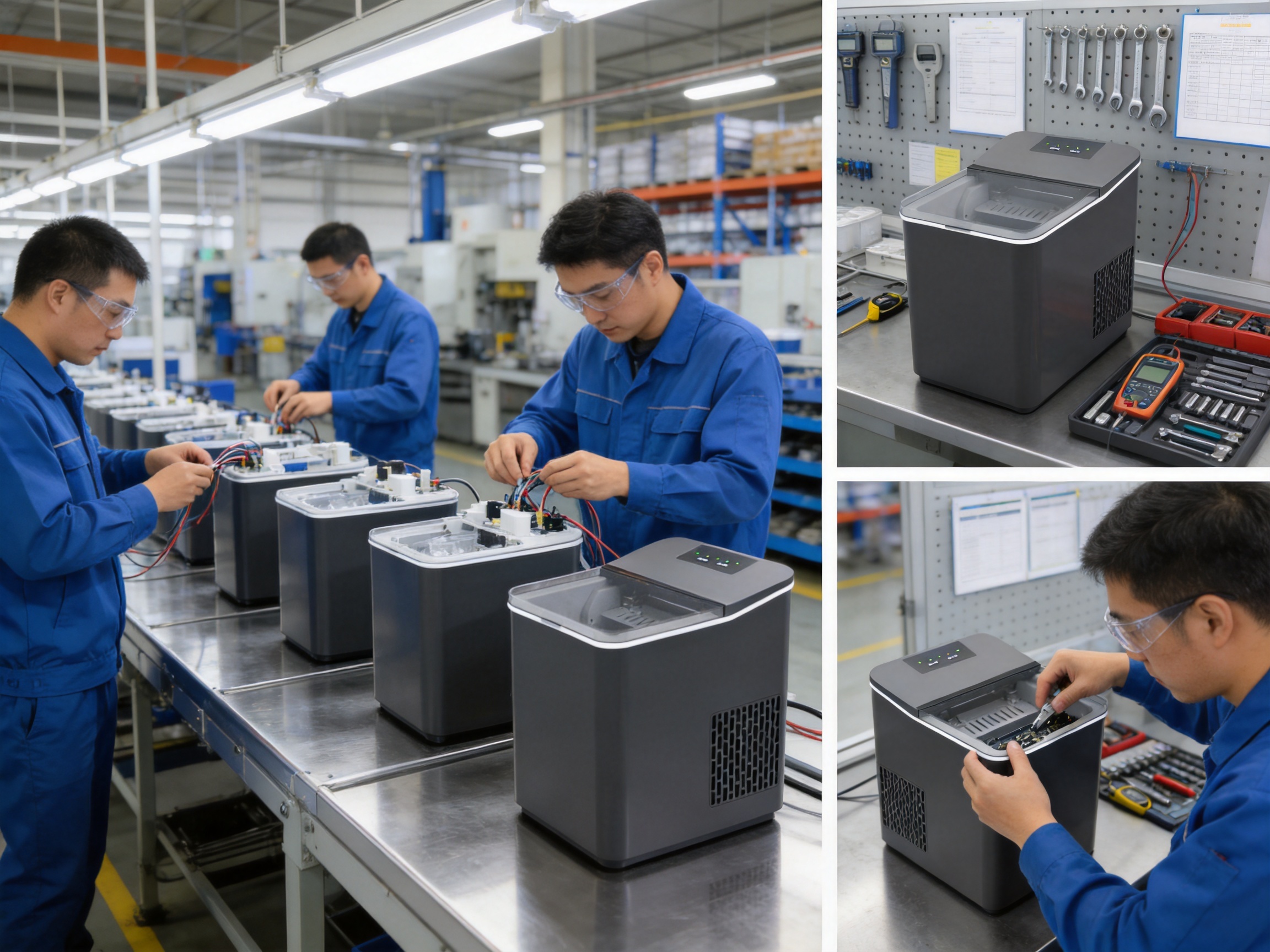
A reliable appliance begins with more than an attractive exterior. It requires coordinated design, component selection, assembly, testing, packaging, and after-sales support. The manufacturer of this ice maker specializes in small household appliances, including ice makers, coffee machines, and air fryers. This product focus provides a relevant foundation for developing compact appliances that use heating, cooling, airflow, water, controls, and electrical systems.
Experience across related product categories can support several manufacturing strengths. Coffee machines and ice makers both require careful water-path design, material selection, user-friendly controls, and attention to cleanliness. Air fryers and ice makers both depend on efficient airflow, thermal management, compact component placement, and stable electrical operation. Knowledge gained across these categories can encourage practical improvements in new products.
The company's stated mission is to use smart technology to simplify life and enhance happiness. In this ice maker, that principle appears through the focus on one-touch operation, rapid production, multiple ice sizes, quiet use, and easy maintenance. Rather than adding technology solely for appearance, the product applies technology to a daily task that benefits from speed and simplicity.
Manufacturing quality also depends on process discipline. A compact ice maker contains a refrigeration circuit, electrical components, water-contact areas, moving parts, controls, insulation, and an exterior housing. Each element must be assembled accurately. Poor alignment, inadequate sealing, incorrect wiring, or inconsistent component installation can affect performance and service life.
A professional manufacturer must therefore coordinate incoming material inspection, component assembly, wiring checks, refrigeration-system procedures, functional testing, appearance inspection, and final packaging. The precise tests and standards applied may vary by production batch and market, but these process areas are central to producing a dependable appliance.
Quality control should not be viewed as a single inspection at the end of production. It is more effective when quality is considered throughout the process. Design reviews can identify potential assembly problems before mass production. Production-line checks can detect errors early. Functional testing can confirm that controls, cooling, water handling, and ice release work together as intended.
The company also emphasizes customer satisfaction, continuous improvement, and innovation. These principles are valuable in a competitive appliance market because user feedback can reveal practical issues that laboratory testing alone may not show. Feedback about noise, cleaning, control clarity, packaging, transport, or placement can guide future product improvements.
Located in Zhouxiang, Zhejiang Province, the company benefits from a regional ecosystem associated with small household appliance manufacturing and convenient logistics. A concentrated industrial environment can support access to component suppliers, manufacturing services, technical labor, packaging resources, and transportation networks. These advantages can help a manufacturer respond efficiently to production requirements and customer orders.
Design Priorities That Support Product Reliability
Refrigeration System Integration
The refrigeration system is the core of an ice maker. It must transfer heat from the water-forming area while operating within the compact body of the appliance. The specified R600a refrigerant and 19-gram charge form part of the product's designed refrigeration system. Correct refrigerant charging, sealed connections, and controlled assembly are important for consistent cooling performance.
Because refrigerant systems require specialized handling, production processes must include suitable equipment, trained personnel, and controlled procedures. A properly assembled system helps the machine achieve the intended ice-making cycle while supporting stable operation.
Electrical Design
The machine is designed for a 220V to 240V, 50Hz supply and lists a 0.9A current and 150W power rating. Electrical design must account for the compressor, controls, fan, water-related components, and protective systems. Correct wiring, insulation, connection security, and component compatibility are essential.
Users should operate the machine only with a suitable power supply and according to the instructions. Electrical modifications should never be performed by unqualified individuals. Manufacturers and distributors should also ensure that products are prepared for the intended market and applicable requirements.
Water and Ice Contact Surfaces
Water-contact surfaces must be selected and assembled with cleanliness and durability in mind. Smooth interior surfaces make cleaning easier and can reduce areas where residue accumulates. The removable ice basket allows produced ice to be handled without requiring users to reach deeply into the machine.
Good water-path design should also support controlled filling, consistent ice formation, and convenient draining or emptying procedures. These details affect not only performance but also user confidence in the appliance.
Ventilation and Thermal Management
Compact refrigeration appliances need adequate airflow. The machine should have sufficient space around relevant ventilation areas so that heat can escape and the cooling system can work effectively. A manufacturer must consider vent placement, internal airflow, fan operation, insulation, and exterior temperature during product development.
Good thermal management supports energy-conscious operation and can reduce unnecessary stress on the compressor. It also contributes to reliable cycle performance in everyday environments.
Suitable Applications
Home Kitchens
For households, the machine provides a convenient supply of fresh ice without requiring a second refrigerator or a large freezer compartment. It can be used for family meals, weekend gatherings, sports drinks, iced coffee, and daily hydration.
Office Pantries
In an office, a shared ice maker can improve the refreshment area without requiring employees to bring ice from home. The one-touch control makes it accessible to many users, while the compact size allows it to fit into a pantry or break room.
Bars and Small Beverage Counters
Small bars and beverage counters may use the machine as a supplemental source during moderate demand. Multiple ice sizes can support different drinks, while rapid cycles can help staff respond when the available supply begins to decline.
Recreational Vehicles
People who travel in recreational vehicles often value compact appliances that provide greater independence. The machine can be useful during road trips, camping stays, and extended mobile living, provided that the electrical supply, ventilation, water handling, and operating environment are suitable.
Small Commercial Spaces
Beauty studios, meeting rooms, small retail locations, guest houses, and service businesses may need occasional ice without requiring industrial equipment. A compact ice maker can provide an efficient solution for moderate use and limited floor space.
Installation and Use Recommendations
Before first use, the machine should be placed on a stable, level surface close to an appropriate power outlet. The surrounding area should allow ventilation and should not expose the machine to excessive heat, direct water spray, or unstable conditions.
Users should inspect the machine, clean accessible water-contact components as instructed, and allow any required settling time after transportation. Refrigeration appliances may need to remain upright for a specified period after being moved. The operating manual should always take priority over general recommendations.
Use clean water suitable for the intended application. Do not overfill the reservoir, and do not add substances other than water unless the manufacturer explicitly permits them. Select the desired ice size if the control system provides that option, then begin operation using the button control.
Freshly produced ice may have a different firmness or temperature depending on the cycle and surrounding conditions. Users can transfer ice to a clean container or insulated cooler if it will not be used immediately. The machine should not be treated as a long-term freezer unless its design specifically supports that function.
After use, remove remaining water and ice as directed. Keep the interior dry when storing the machine for an extended period. Regular cleaning, proper ventilation, and careful handling can help maintain performance.
Business Value for Distributors and Buyers
For distributors, the product offers a clear sales proposition. It combines a familiar household need with an accessible control system, compact dimensions, and broad application potential. The machine can be marketed to consumers, offices, hospitality businesses, mobile-living users, and small commercial buyers.
Its product category is easy for customers to understand, while its advantages are immediately visible. A buyer can quickly identify the value of producing ice within minutes rather than waiting for freezer trays. The multiple-size function and removable basket add practical differentiation without requiring extensive product education.
The manufacturer's broader product range may also support business cooperation. A distributor interested in small household appliances could potentially evaluate ice makers alongside coffee machines and air fryers. This product-category breadth can help create a more complete appliance portfolio for retailers, importers, hospitality suppliers, and online sellers.
The company welcomes new and existing customers for business cooperation and emphasizes reliable quality, customer satisfaction, continuous improvement, and innovation. These values are relevant to buyers seeking a manufacturing partner rather than a one-time product source. Consistent communication, specification confirmation, packaging coordination, production planning, and after-sales support are all important when developing a successful supply relationship.
Questions and Answers
What type of ice does the machine produce?
The machine is categorized as a bullet ice maker. It is designed to produce bullet-shaped ice suitable for beverages, household use, office refreshments, small hospitality applications, and general cooling needs.
How quickly can it make ice?
The product information indicates an approximate cycle time of 6 to 10 minutes. Actual performance may vary according to water temperature, ambient temperature, ventilation, selected ice size, and operating conditions.
Is the machine difficult to operate?
No. It is designed for one-touch button operation. The simple control system is intended to make ice production accessible to first-time users, families, office staff, and hospitality employees.
Can users select different ice sizes?
Yes. The product supports multiple ice sizes. Different sizes can be selected according to beverage type, cooling speed, appearance, and preferred melting behavior.
Where can the machine be used?
It is suitable for homes, offices, bars, recreational vehicles, and small commercial spaces. It should always be used on a stable surface with appropriate ventilation and a compatible power supply.
What are the machine's power specifications?
The listed power supply is 220V to 240V at 50Hz. The listed current and power are 0.9A and 150W. Users should confirm that their electrical supply matches the product requirements before operation.
What refrigerant does it use?
The listed refrigerant is R600a with a 19-gram charge. Refrigerant servicing must be performed by qualified professionals using appropriate procedures and equipment.
How large is the ice maker?
The machine dimensions are 313 by 226 by 309 millimeters. Its compact size allows it to fit on many countertops and work surfaces, subject to the clearance and ventilation requirements in the operating instructions.
Is it easy to clean?
The machine is designed with smooth interior surfaces and a removable ice basket to simplify cleaning. Users should follow the supplied instructions and clean water-contact areas regularly.
Can it replace a large commercial ice machine?
It depends on the required ice volume. The Button-Operated Ice Maker is intended for households, offices, bars, recreational vehicles, and small commercial spaces with moderate demand. High-volume operations may require specialized commercial equipment.
What makes it different from freezer trays?
It produces ice much faster, requires less manual preparation, supports multiple ice sizes, and provides a dedicated ice-making function. Freezer trays remain a low-cost option for occasional use, but they are less convenient when ice is needed quickly.
How can users support efficient operation?
Users should keep ventilation areas clear, use suitable water, avoid overfilling, maintain a level position, clean the machine regularly, and operate it according to the instructions. Proper care can support reliable performance and reduce unnecessary strain.
What manufacturing strengths support the product?
The manufacturer specializes in ice makers, coffee machines, and air fryers. Its stated strengths include practical design, reliable quality, customer satisfaction, continuous improvement, innovation, and convenient logistics associated with its location in Zhejiang Province.
Conclusion
The Button-Operated Ice Maker is designed around a clear and useful idea: make fresh ice quickly without making the user manage a complicated appliance. Its one-touch control simplifies operation, while its approximate 6-to-10-minute cycle supports on-demand convenience. Multiple ice sizes expand its usefulness across beverages and serving situations, and the compact dimensions make it suitable for locations where space is limited.
The product also offers practical advantages over common alternatives. It is faster and more flexible than freezer trays, more independent than a refrigerator ice dispenser, and more proportionate for moderate demand than a large commercial ice machine. Its smooth interior surfaces and removable basket support easier cleaning, while the noise-reduction design helps it fit into shared spaces.
Its technical profile includes a 220V to 240V, 50Hz power supply, 0.9A current, 150W power rating, R600a refrigerant with a 19-gram charge, and dimensions of 313 by 226 by 309 millimeters. These specifications reflect a compact appliance intended for homes, offices, bars, recreational vehicles, and small commercial environments.
The company behind the product brings experience in household appliances and emphasizes humanized design, reliable quality, customer satisfaction, continuous improvement, and intelligent technology. Its manufacturing base in Zhejiang supports access to a mature small-appliance ecosystem and convenient logistics. Through product specialization and process-focused production, the company is positioned to serve both individual buyers and business customers seeking practical appliance solutions.
For users who want readily available ice without sacrificing counter space or ease of use, this machine provides a balanced solution. It focuses on the features that matter most in everyday operation: speed, simplicity, flexibility, manageable size, energy-conscious performance, quiet use, and straightforward maintenance.
References
Product specification sheet for the Button-Operated Ice Maker, including power supply, current, power, refrigerant, charge, and machine dimensions.
Product information summary for the Button-Operated Ice Maker, including one-touch operation, fast ice production, multiple ice sizes, quiet operation, energy-conscious design, and cleaning features.
Household refrigeration appliance design principles, including compact refrigeration systems, ventilation, thermal management, and routine maintenance.
Small commercial food-service equipment guidance concerning ice production, cleaning, water handling, and appropriate equipment selection.
Manufacturer information describing household appliance specialization, manufacturing location, company mission, quality principles, customer service values, and business cooperation objectives.