
 English
 한국어
 Español
 Deutsch
Ice is often treated as a simple accessory, yet its shape, density, melting rate, storage efficiency, and visual presentation can significantly affect the quality of a beverage. A well-designed ice maker must therefore do more than freeze water. It must provide dependable cooling, convenient operation, efficient use of space, and a construction approach suitable for repeated household or light commercial use.
The Home Ice Cube Maker, identified as model Alien-ZF01, is designed around these practical requirements. It is a compact square ice-making appliance with a 140-watt power rating, a 220-volt/50-hertz power supply, and a footprint of approximately 325 by 295 by 252 millimeters. Its design is aimed at users who want regular, professional-looking ice cubes without relying entirely on conventional freezer trays or purchasing packaged ice.
This article examines the product’s technical specifications, functional benefits, likely user applications, design advantages, manufacturing strengths, maintenance considerations, and competitive position. It also explains how the product’s compact dimensions, regular ice shape, refrigerant selection, and company background contribute to its value in a crowded small-appliance market.
1. Product Overview
The Home Ice Cube Maker is a countertop appliance intended to simplify the production of square ice cubes. Its regular form is especially useful for beverage presentation, controlled cooling, and organized storage. Unlike irregular pieces formed by manually breaking ice from a tray, square cubes can be placed consistently in glasses, buckets, containers, and freezer compartments.
The appliance uses a 220V/50Hz power supply and has a rated current and power specification of 0.65A and 140W. These figures place it within the compact household-appliance category. Its dimensions of 325X295X252mm allow it to occupy a relatively small area on a kitchen counter, beverage station, home bar, office pantry, or hospitality service area.
The machine is equipped with R290 refrigerant, with a stated charge of 26 grams. R290 is propane refrigerant commonly used in modern refrigeration equipment because of its low global warming potential compared with many traditional refrigerants. Its use reflects the broader industry movement toward refrigeration systems that balance cooling performance with environmental considerations. Because R290 is flammable, installation, service, and repair should always be performed according to applicable safety requirements and by appropriately trained personnel.
The product’s stated description, Alien-ZF01, and its alias, Knobtype-ice-maker, suggest a straightforward control concept centered on a knob. A simple control interface can be valuable in a household appliance because it reduces the learning curve and avoids unnecessary complexity. Users can concentrate on water preparation, ice production, and storage rather than navigating a complicated menu system.
At its core, this ice maker is intended to provide three practical benefits: convenient ice production, consistently shaped cubes, and a compact alternative to larger ice-making equipment. These benefits make it suitable for everyday drinks as well as special occasions when presentation and cooling quality are important.
2. Why Ice Shape and Density Matter
Not all ice performs in the same way. Ice shape determines how much surface area comes into contact with a drink, while density affects how quickly heat moves into the ice. Irregular, thin, or fragmented ice generally melts faster because more surface area is exposed to the surrounding liquid. Faster melting can dilute a beverage and alter its intended flavor profile.
Regular square cubes offer a useful balance between cooling and dilution control. Their geometric form provides a relatively compact surface area compared with many small or crushed pieces. When the cubes are sufficiently solid and dense, they can remain in a beverage for an extended period while gradually reducing its temperature.
This characteristic is particularly relevant to whiskey, bourbon, cocktails, fruit-based drinks, iced coffee, and other beverages in which excessive water can weaken aroma or flavor. A large, solid-looking cube can provide a slower cooling experience and a more refined appearance than a glass filled with small fragments.
The regular shape also improves visual consistency. In a clear glass, evenly shaped ice contributes to a clean and professional presentation. For restaurants, cafés, bars, hotels, event venues, and home entertainers, appearance can be part of the overall customer or guest experience.
Shape is also important outside the glass. Square ice cubes are easier to arrange in a container, bucket, or freezer compartment. Their predictable geometry allows users to stack or group them more effectively than irregular pieces. This can reduce wasted storage space and make it easier to estimate the quantity of ice available.
These advantages do not mean that square ice is ideal for every application. Crushed ice may be preferable for blended drinks, shaved-ice desserts, or rapid chilling. Small cubes may be convenient for certain water bottles. However, for slow melting, attractive presentation, controlled cooling, and general-purpose use, regular square cubes are a strong choice.
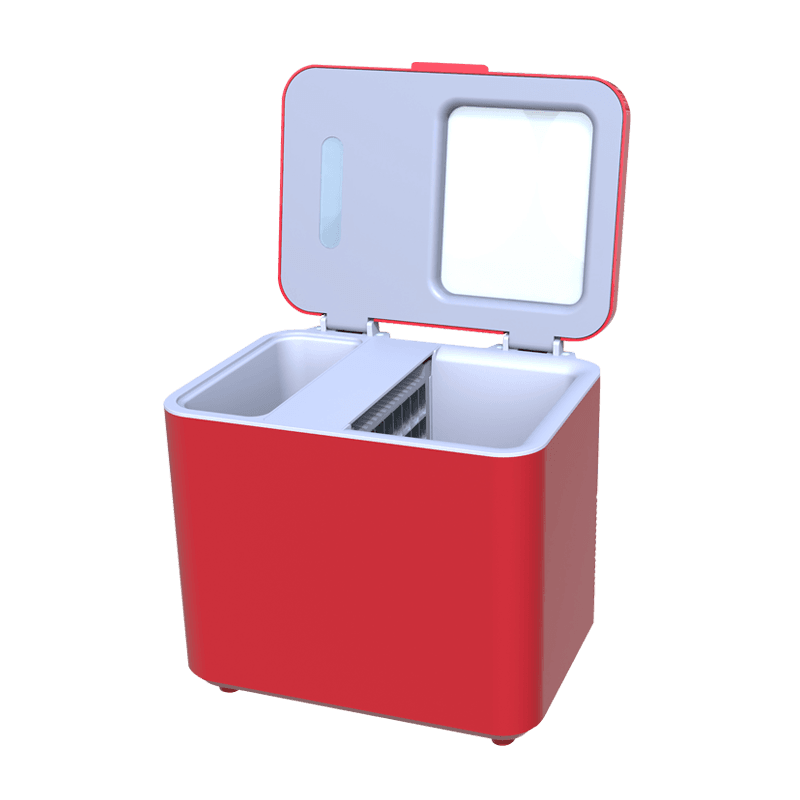
Home ice cube maker
3. Main Advantages Compared with Conventional Ice-Making Methods
3.1 Greater Convenience than Manual Freezer Trays
Traditional freezer trays require users to fill individual compartments, place the tray in a freezer, wait for the water to freeze, and then twist or flex the tray to remove the ice. This process is inexpensive, but it can be inconvenient when a larger quantity of ice is needed or when the user wants a fresh supply at short notice.
A dedicated ice maker creates a more organized and repeatable approach. Instead of occupying a freezer compartment with multiple trays, users can operate a separate appliance on a counter or designated utility surface. This is particularly helpful in homes with limited freezer capacity.
The compact dimensions of the Home Ice Cube Maker support this use case. At approximately 325 by 295 by 252 millimeters, the machine is small enough for many kitchen counters while still providing a dedicated ice-making function. Its size can also make it easier to move between a kitchen, home bar, dining area, office, or event location, provided that transportation and setup instructions are followed.
3.2 More Consistent Appearance than Irregular Homemade Ice
Ice formed in household containers often varies in shape and thickness. Even when several trays are used, cubes may not look identical. The square format of this appliance is intended to provide a more uniform visual result. Consistency is valuable for anyone who wants drinks to appear carefully prepared rather than assembled from random pieces.
Uniform cubes are especially useful when serving several guests. Each glass can receive a similar amount and arrangement of ice, making the service look more professional. This benefit is relevant to home entertaining as well as small cafés, tasting rooms, offices, and hospitality settings.
3.3 Better Storage Efficiency than Irregular Pieces
Regular shapes naturally make storage easier. Square cubes can be arranged tightly in a container, ice bucket, or freezer drawer. Irregular pieces leave gaps, and those gaps reduce the usable capacity of the storage area. By contrast, a consistent cube format allows users to organize available ice more efficiently.
This advantage becomes more noticeable when ice is prepared in advance for a gathering. Guests may require a large quantity of ice, but the available storage area may be limited. Neatly arranged cubes help users make better use of that space and reduce the need for multiple oversized containers.
3.4 A More Suitable Format for Premium Drinks
Premium spirits are often served with attention to temperature, dilution, aroma, and visual balance. A dense square cube can complement this style of service by cooling the beverage gradually. Its regular shape also fits naturally into lowball glasses and other drinkware commonly used for spirits.
The same principle applies to non-alcoholic beverages. Iced tea, cold brew coffee, fruit-infused water, lemonade, and sparkling drinks can all benefit from controlled cooling. The product is therefore not limited to a particular drinking culture or age group; it is a general-purpose ice solution for households and food-service environments.
4. Technical Specifications and Practical Meaning
Specification | Stated Detail | Practical Significance |
Product type | Home ice cube maker | Designed for convenient countertop ice production |
Model description | Alien-ZF01 | Identifies the product configuration |
Control style | Knobtype-ice-maker | Suggests a direct and simple control approach |
Power supply | 220V/50Hz | Suitable for compatible electrical systems |
Current and power | 0.65A / 140W | Indicates compact appliance energy requirements |
Refrigerant | R290 | Modern low-global-warming-potential refrigerant choice |
Refrigerant charge | 26g | Specified charge for the refrigeration system |
Machine dimensions | 325X295X252mm | Compact footprint for countertop placement |
The power specification provides useful information for planning installation. Users should confirm that their local electrical supply matches the stated 220V/50Hz requirement before operation. A suitable grounded outlet and adequate ventilation around the appliance are also important for safe and dependable performance.
The 140W rating indicates that the product is designed as a compact appliance rather than a large-scale commercial ice plant. This makes it appropriate for homes, small service points, offices, and moderate-volume applications. Users who require continuous high-volume ice production for a large restaurant or event operation may need to evaluate production capacity separately and consider whether a larger commercial machine is more suitable.
The stated dimensions are one of the product’s most practical strengths. Countertop appliances must fit around other equipment such as coffee machines, air fryers, kettles, water dispensers, and food-preparation tools. A smaller footprint allows more flexible placement, although users should still leave sufficient clearance for ventilation, access, cleaning, and electrical safety.
5. Refrigeration Design and R290 Considerations
Refrigeration is the central technical function of an ice maker. The appliance must remove heat from water and transfer that heat away from the freezing area. The selection of refrigerant influences the refrigeration circuit, energy behavior, environmental profile, and servicing requirements.
R290 is a hydrocarbon refrigerant based on propane. It has become increasingly recognized in refrigeration and cooling equipment because of its very low global warming potential relative to many legacy refrigerants. Its use can support manufacturers and consumers seeking more environmentally responsible refrigeration choices.
However, R290 is classified as flammable. This does not make the appliance unsuitable for household use, but it does make correct design, assembly, labeling, transportation, installation, and service especially important. Users should not open the sealed refrigeration circuit, attempt to recharge refrigerant, or modify the machine. Any refrigeration repair should be handled by qualified personnel using procedures appropriate for R290 systems.
The specified 26-gram charge indicates that the appliance uses a relatively small refrigerant quantity. The exact performance of the refrigeration system will also depend on compressor design, heat exchanger configuration, insulation, ambient temperature, water temperature, airflow, and control strategy. Therefore, the refrigerant specification should be viewed as one part of the overall system rather than a guarantee of a particular production speed.
Good operating practice can help the refrigeration system work effectively. The appliance should be placed away from direct sunlight, ovens, radiators, and other heat sources. Airflow openings should remain unobstructed. Users should avoid pushing the rear or sides directly against a wall if the product instructions require clearance.
6. Manufacturing Strengths and Product Development Approach
The company behind the product, Alien Technology Co., Ltd., is located in Zhouxiang, Zhejiang Province. The region is recognized as a hub for small household-appliance production and is supported by convenient logistics. This industrial environment can provide several advantages for product development, component sourcing, manufacturing coordination, and shipment to domestic and international markets.
The company specializes in household appliances including ice makers, coffee machines, and air fryers. This category experience is relevant because these products share many development requirements: compact mechanical design, electrical safety, thermal management, user-centered controls, efficient assembly, attractive appearance, and repeatable quality.
The company states a mission centered on smart technology, simplified living, and enhanced happiness. For a product such as a home ice maker, this mission can be interpreted through practical design choices. A compact body reduces the burden of installation. A straightforward control arrangement reduces operational complexity. A regular ice format improves beverage preparation. Reliable construction reduces the inconvenience associated with frequent replacement or inconsistent operation.
A strong manufacturing process begins before assembly. Product development should identify the intended user, define the required ice format, select appropriate refrigeration components, verify the electrical architecture, and assess how the appliance will be cleaned and maintained. Compact products require careful internal arrangement because the compressor, heat exchangers, controls, water-related parts, insulation, wiring, and exterior housing must all fit into a limited volume.
The manufacturing process must also coordinate multiple disciplines. Mechanical engineers focus on structural integrity and component fit. Electrical engineers address power input, wiring, protection, controls, and safe operation. Refrigeration specialists manage the sealed cooling circuit and refrigerant charge. Industrial designers consider appearance, accessibility, and user interaction. Quality personnel review consistency, inspection criteria, and production reliability.
Because the product belongs to a wider family of small appliances, experience with coffee machines and air fryers may support the company’s understanding of countertop product ergonomics. Although each appliance has different technical requirements, all must integrate into real household routines. Users expect appliances to be compact, understandable, easy to clean, and dependable over repeated cycles.
The company’s stated commitment to reliable quality, customer satisfaction, continuous improvement, and innovation provides a useful foundation for manufacturing. Continuous improvement may involve refining the control interface, improving component fit, optimizing packaging, reducing assembly variation, enhancing service access, or responding to customer feedback about everyday use.
7. Quality-Oriented Production Considerations
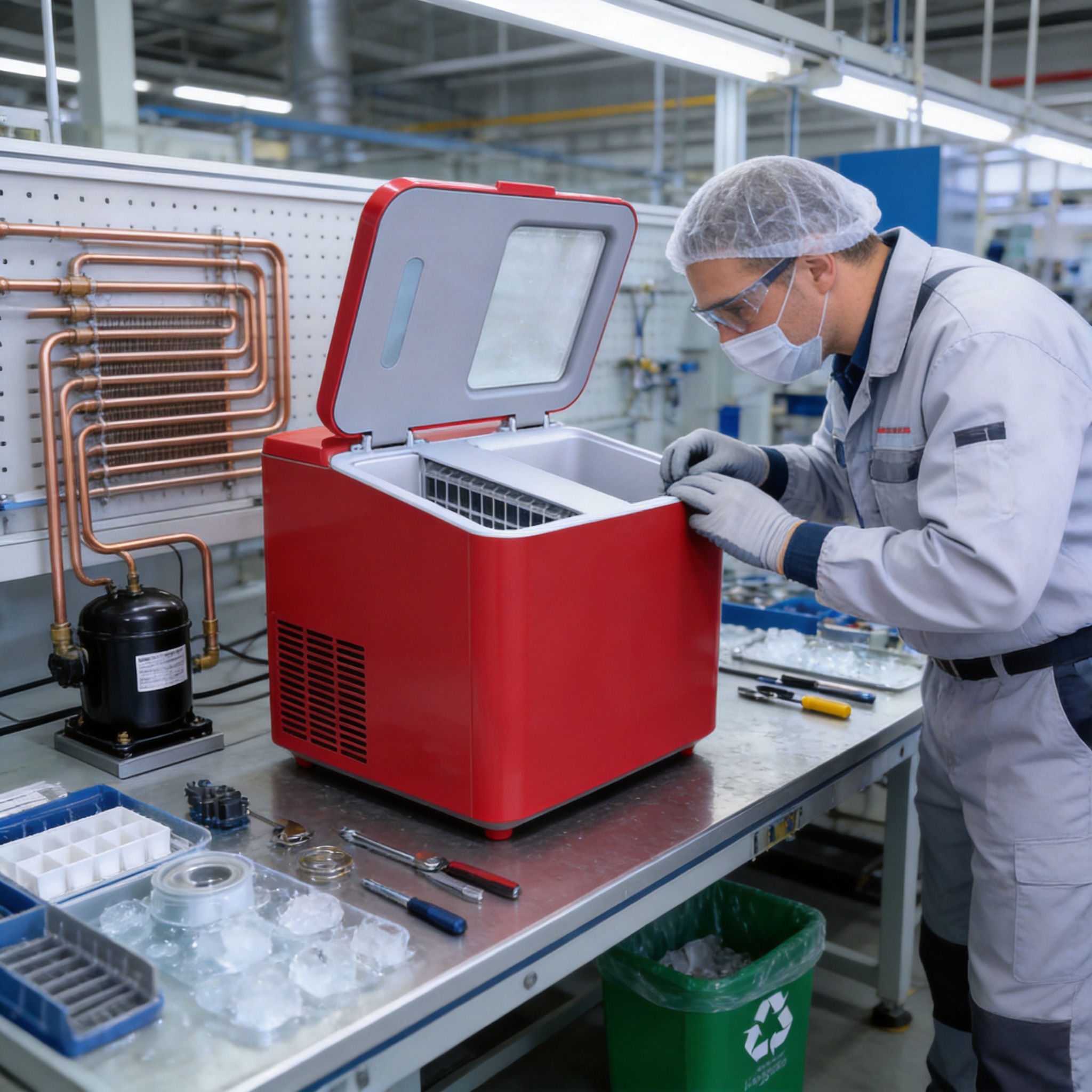
For an ice maker, quality is not limited to the external housing. The appliance must perform consistently across the water-contact system, refrigeration system, electrical system, controls, and structural components. A quality-oriented production approach should therefore evaluate the complete product rather than focusing on a single visible feature.
7.1 Dimensional Consistency
Precise dimensions are important because compact appliances depend on accurate component placement. Small variations in the housing, internal supports, tubing routes, or control assembly can affect fit and appearance. Consistent dimensions also support easier packaging, transport, and assembly.
7.2 Electrical Verification
The stated 220V/50Hz, 0.65A, and 140W specifications create a clear basis for electrical verification. Production testing may include checks of power input, wiring continuity, insulation, grounding, control operation, and abnormal operating conditions. The exact testing program should follow applicable standards and the manufacturer’s internal quality procedures.
7.3 Refrigeration-System Integrity
The sealed refrigeration circuit must be assembled carefully. Connections, tubing, compressor interfaces, and heat-exchange components require appropriate workmanship. Leak prevention is particularly important when using R290. A controlled refrigerant charge and suitable testing procedures help support safe and stable operation.
7.4 Water and Ice Contact Areas
Any area that contacts water or ice should be designed for practical cleaning and acceptable material performance. Smooth surfaces, accessible reservoirs, and limited areas for residue accumulation can improve the user experience. Although specific materials are not provided, manufacturers of ice-making appliances must consider hygiene, odor control, mineral buildup, and long-term contact with water.
7.5 Functional Testing
Finished units should be evaluated for basic operation, control response, cooling behavior, ice formation, noise, water handling, and shutoff behavior where applicable. Functional testing helps identify assembly problems before products reach customers. It also creates feedback that can be used to improve future production batches.
These considerations demonstrate why manufacturing quality is closely connected to product value. A square ice maker may appear simple from the outside, but it combines refrigeration, electrical, mechanical, and user-interface technologies in a compact enclosure.
8. Design for Everyday Use
The most successful household appliances fit naturally into daily routines. A product may have technically capable components, but if it is difficult to operate, clean, store, or understand, users may not enjoy its benefits. The Home Ice Cube Maker is positioned as a practical appliance, and its design can be evaluated through the routine of preparing, producing, handling, and storing ice.
Before operation, users should place the machine on a stable, level surface near a compatible power outlet. The area should be dry, well ventilated, and away from direct heat. Water should be added according to the product instructions, and the exterior should be kept clear of objects that might block airflow or interfere with the controls.
During operation, the appliance should be allowed to complete its freezing cycle without unnecessary movement. Moving or tilting a refrigeration appliance during operation can affect internal fluids and mechanical stability. Users should also avoid exceeding the recommended water level or placing foreign objects into the water system.
After ice is produced, it should be transferred or stored in a clean container if it will not be used immediately. Ice can absorb odors from nearby food, so a covered container is preferable for longer storage. The machine itself should be drained and cleaned at intervals appropriate to the water quality and frequency of use.
In areas with hard water, mineral deposits may accumulate more quickly. Regular cleaning can help maintain hygiene and preserve water flow. The cleaning method should follow the product documentation. Harsh chemicals, abrasive tools, or unauthorized disassembly may damage surfaces or components.
9. Applications in Different Settings
9.1 Home Kitchens
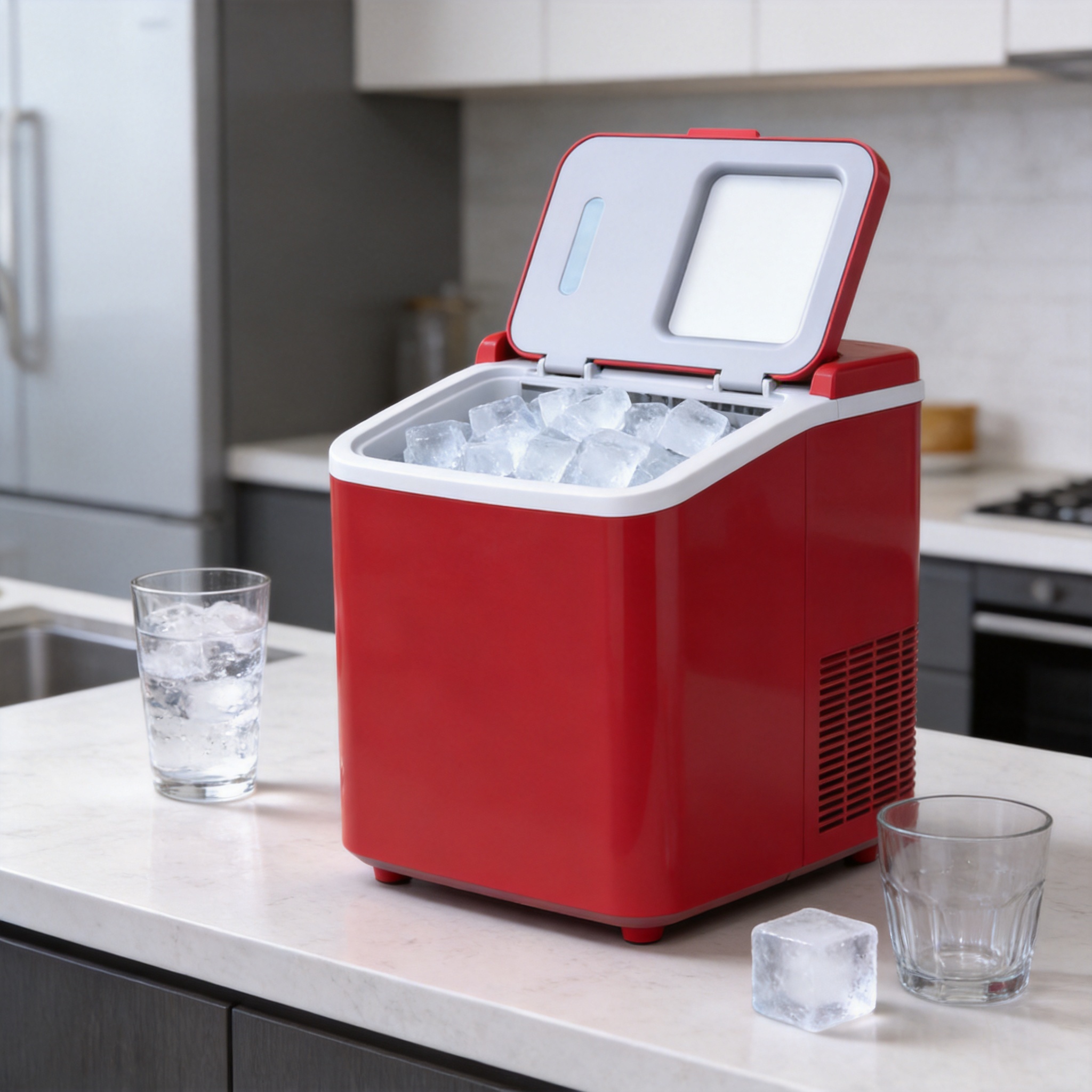
In a home kitchen, the machine provides an alternative to relying exclusively on freezer trays. It can be used for everyday water, iced tea, lemonade, fruit drinks, and family meals. Its compact body allows it to share countertop space with other small appliances when arranged carefully.
9.2 Home Bars and Entertainment Areas
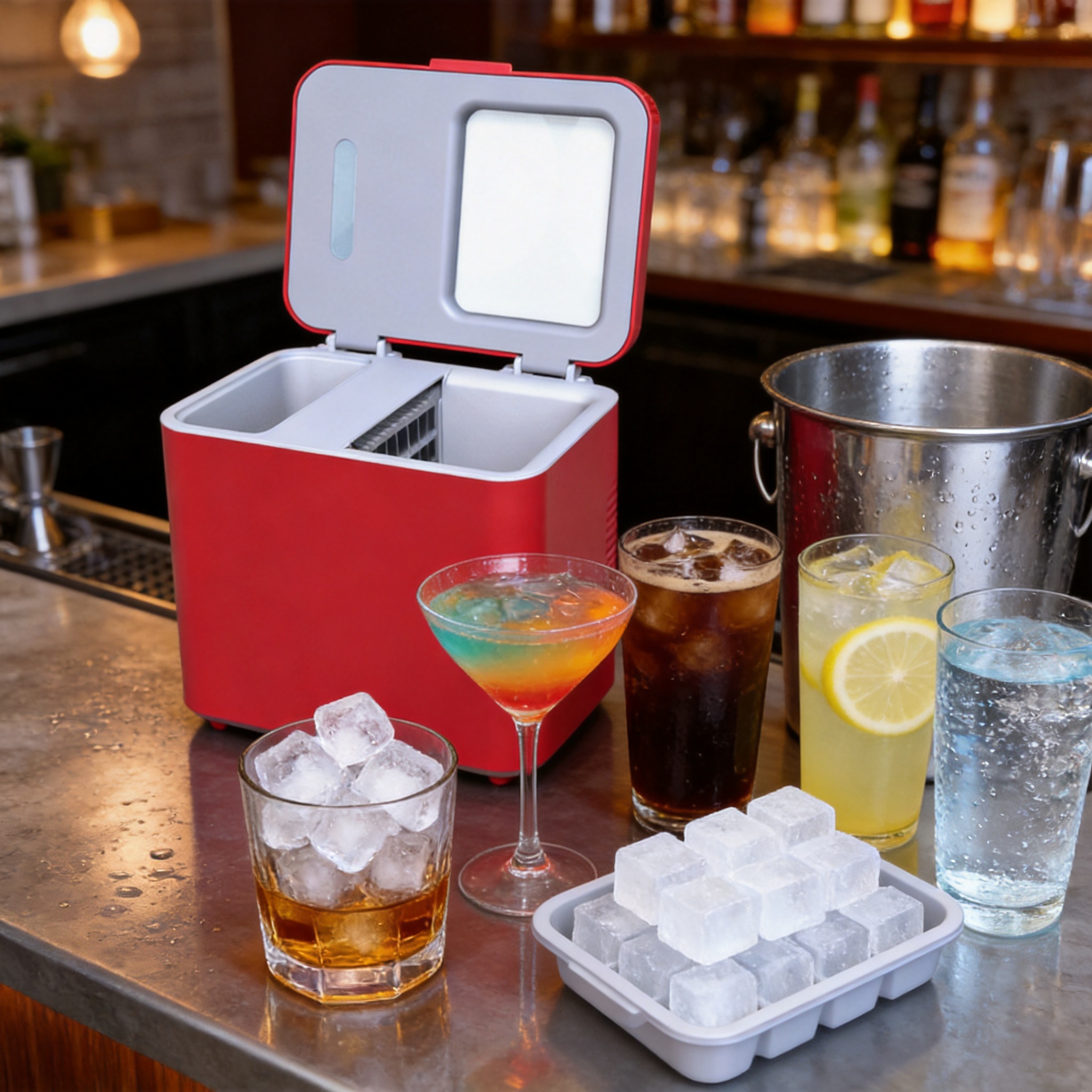
Home bartenders can use regular square cubes for whiskey, cocktails, mocktails, and mixed drinks. The slow-melting characteristics described for solid square ice can help preserve flavor during a longer conversation or tasting session. The clean geometry also contributes to an attractive presentation.
9.3 Offices and Meeting Rooms
Offices often need occasional ice for water, soft drinks, coffee-based beverages, and informal events. A dedicated countertop ice maker can be useful when a refrigerator freezer is too small or when staff members need a more organized source of ice during meetings and gatherings.
9.4 Cafés and Small Hospitality Businesses
Small cafés, guesthouses, tasting rooms, and boutique hospitality locations may value the product’s compact footprint and general-purpose cube format. It can support beverage service where demand is moderate and space is limited. Operators should assess the appliance’s actual production capacity and duty cycle before using it as the sole source of ice in a high-volume business.
9.5 Parties and Events
For private celebrations and smaller events, consistent ice can improve service efficiency. Preparing ice in advance allows hosts to focus on guests rather than repeatedly filling trays. The storage efficiency of square cubes can also make event preparation easier when refrigerator space is limited.
10. Competitive Position in the Small Ice-Maker Market
The home ice-maker market includes manual trays, freezer-integrated ice systems, compact countertop machines, and larger commercial units. The Home Ice Cube Maker occupies a practical middle position: it is more specialized and convenient than manual trays, while remaining smaller and simpler than heavy-duty commercial equipment.
Compared with manual trays, its main advantages are convenience, repeatability, and a dedicated production function. Users do not need to occupy a freezer compartment with several trays or wait for a tray to be removed by hand. The appliance also supports a more consistent square shape.
Compared with large commercial ice machines, its advantages are compactness, lower apparent power demand, and easier integration into a home or small service environment. It may be more suitable for users who need a modest quantity of ice without installing a bulky appliance.
Compared with machines that produce irregular bullet-shaped or fragmented ice, the square format offers a different beverage experience. The regular form is visually refined, stacks efficiently, and is associated with slower melting when the cubes are solid and sufficiently dense.
Compared with complex smart appliances, a knob-oriented design may appeal to users who prefer direct physical controls. Not every customer needs Wi-Fi connectivity, app notifications, or a digital menu. For many households, a clear control and dependable function are more valuable than additional software features.
The product’s competitive strengths can therefore be summarized as follows: a compact countertop footprint, a professional square ice format, a simple control concept, a modern R290 refrigerant choice, moderate 140W power consumption, and support from a company focused on household-appliance manufacturing and continuous improvement.
These advantages should be evaluated alongside practical limitations. The product is designed around a 220V/50Hz electrical specification, so it may not be directly compatible with every market. Production capacity, ice-making cycle duration, storage capacity, noise level, and water-reservoir details are not included in the available specifications and should be confirmed before purchase for a specific application.
11. Sustainability and Responsible Use
Responsible appliance use begins with selecting a product that matches the required scale. A compact machine can be more appropriate than a large commercial unit when demand is limited. Avoiding unnecessary oversizing can reduce wasted space and may simplify energy management.
The R290 refrigerant selection is another relevant consideration. Because R290 has a very low global warming potential compared with many conventional refrigerants, it aligns with broader efforts to reduce the climate impact of refrigeration. Nevertheless, the overall environmental performance of an appliance also depends on electricity use, product lifespan, repairability, packaging, transportation, and end-of-life handling.
Long service life is particularly important. A product that remains functional for many years can reduce the need for replacement and lower the material impact associated with repeated purchases. Reliable manufacturing, appropriate maintenance, careful handling, and access to responsible service all contribute to product longevity.
Users can support efficient operation by keeping ventilation areas clear, cleaning the water-contact components, using suitable water, and avoiding operation in excessively hot environments. Poor ventilation or heavy mineral buildup may force the refrigeration system to work harder and can reduce performance.
At the end of the product’s life, users should follow local regulations for electrical appliances and refrigeration equipment. The sealed refrigerant system should not be punctured or discarded carelessly. Proper recycling or collection channels help ensure that materials and refrigerants are handled safely.
12. Safety and Maintenance Guidance
Before use, confirm that the electrical supply matches 220V/50Hz and that the outlet is suitable for the rated appliance. Do not use a damaged power cord, loose outlet, or ungrounded connection where grounding is required. Water and electricity should be kept separated, and spills should be cleaned promptly after disconnecting the appliance safely.
Because the unit contains R290, users should not attempt unauthorized refrigeration repairs. Do not puncture the cabinet, drill into the housing, expose the machine to open flames, or use tools that could damage refrigerant tubing. If the appliance develops a suspected leak, unusual odor, abnormal noise, or severe performance problem, disconnect it if safe to do so and contact qualified service personnel.
Cleaning should be performed according to the instruction manual. The water reservoir, ice-contact surfaces, and removable components should be cleaned regularly. Users should avoid abrasive cleaners unless specifically approved. Ice intended for consumption must be made and stored under hygienic conditions.
The appliance should remain level during operation. If it has been transported on its side, users should follow the manufacturer’s guidance concerning settling time before connecting power. This allows the refrigeration system to stabilize and helps protect the compressor.
Maintenance is not merely a safety obligation. It also supports consistent ice quality. Clean water pathways reduce odors and residue, while clear airflow supports the refrigeration system. A clean and properly positioned appliance is more likely to deliver stable results over time.
13. How the Product Supports the Company’s Broader Strengths
The Home Ice Cube Maker reflects the type of product that benefits from focused small-appliance expertise. Its design requires the company to combine practical household usability with refrigeration engineering, compact packaging, and repeatable assembly. These are capabilities that can be developed and transferred across a product portfolio that also includes coffee machines and air fryers.
The company’s location in Zhejiang provides access to a mature small-appliance ecosystem. Proximity to component suppliers, manufacturing services, packaging providers, testing resources, and logistics networks can help shorten coordination cycles and support flexible production. It can also make it easier to respond to customized requirements from distributors and business customers.
The company’s stated emphasis on customer satisfaction is important in international business. Appliance buyers may have different electrical systems, counter dimensions, water conditions, retail expectations, and packaging requirements. A manufacturer that listens to customers and pursues continuous improvement is better positioned to adapt products and documentation to those markets.
Its stable and pragmatic business philosophy also supports long-term cooperation. Buyers often need more than a single shipment. They may require consistent specifications, communication, quality follow-up, packaging coordination, and future product development. A manufacturer that combines practical execution with innovation can provide a stronger foundation for repeat business.
For the ice-maker product specifically, the company’s strengths are visible in the way a relatively small appliance addresses several user needs at once: compact placement, regular ice shape, slow-melting potential, professional appearance, storage efficiency, and general-purpose versatility.
14. Recommended Evaluation Checklist for Buyers
Buyers should first confirm the intended use. A household user may prioritize size, appearance, simplicity, and occasional convenience. A café or hospitality buyer may place greater emphasis on production volume, duty cycle, cleaning access, service support, and operating cost.
The next step is to verify electrical compatibility. The stated requirement is 220V/50Hz. Buyers in other regions should not assume that a plug adapter alone will solve a voltage or frequency difference. Electrical compatibility must be confirmed before purchase and installation.
Available counter space should be measured carefully. The machine dimensions are approximately 325X295X252mm, but additional clearance may be necessary for ventilation, access, and cable routing. The location should also permit convenient water filling, ice removal, and cleaning.
Buyers should ask for additional information where needed, including ice production per cycle or per day, water-reservoir capacity, ice storage details, operating noise, recommended clearance, cleaning procedures, warranty terms, packaging dimensions, and spare-parts availability. These details are not included in the supplied specifications, but they can be important for procurement decisions.
Commercial buyers should also assess whether the machine is intended for continuous operation or intermittent use. A compact household-oriented machine may be ideal for moderate demand but unsuitable as the only ice source in a busy restaurant. Matching the equipment to the workload helps prevent disappointment and supports longer service life.
15. Q&A
Q1: What type of appliance is the Home Ice Cube Maker?
It is a compact countertop appliance designed to produce regular square ice cubes for household, office, entertainment, and selected small hospitality applications.
Q2: What are the machine’s dimensions?
The stated machine dimensions are 325X295X252mm. Users should allow additional space around the appliance for ventilation, operation, cleaning, and safe electrical connection.
Q3: What power supply does the product require?
The specified power supply is 220V/50Hz. Buyers should confirm that their local electrical system matches this requirement before ordering or operating the machine.
Q4: How much power does the appliance use?
The stated current and power are 0.65A and 140W. Actual energy consumption may vary with ambient temperature, operating conditions, cycle frequency, and usage patterns.
Q5: Why are square ice cubes useful?
Square cubes provide a regular appearance, stack efficiently, and can melt more slowly than small or irregular pieces when they are sufficiently solid and dense. They are suitable for drinks where controlled dilution and presentation matter.
Q6: Is the product suitable for whiskey and other spirits?
Its square ice format is suitable for whiskey, bourbon, cocktails, and other spirits because larger, denser cubes can cool beverages gradually while limiting excessive dilution. Users should select the cube quantity according to their preferred strength and temperature.
Q7: What refrigerant does the machine use?
The product uses R290 refrigerant with a stated charge of 26 grams. R290 has a low global warming potential, but it is flammable, so the sealed refrigeration system should only be serviced by qualified professionals.
Q8: Can users repair or recharge the refrigerant themselves?
No. Users should not open the refrigeration circuit, recharge refrigerant, puncture the housing, or attempt unauthorized repairs. Any refrigeration work should be completed by trained service personnel using procedures suitable for R290 equipment.
Q9: Is the appliance only for home kitchens?
No. It may also be useful in home bars, offices, meeting rooms, small cafés, guesthouses, tasting rooms, and private events. Commercial users should confirm that the product’s production capacity meets their expected demand.
Q10: How does it compare with freezer ice trays?
It offers a dedicated ice-making function, reduces dependence on freezer space, and is designed to provide a more consistent square format. Freezer trays may still be adequate for users who need only a small amount of ice occasionally.
Q11: What should users consider before choosing this model?
They should verify electrical compatibility, available counter space, ventilation requirements, expected ice demand, cleaning access, water quality, service support, and any additional production or storage specifications needed for their application.
Q12: What company manufactures the product?
The product is manufactured by Alien Technology Co., Ltd., a Zhejiang-based household-appliance company specializing in ice makers, coffee machines, and air fryers. The company emphasizes reliable quality, customer satisfaction, continuous improvement, innovation, and practical cooperation.
16. Conclusion
The Home Ice Cube Maker is designed around a clear and useful proposition: provide regular square ice in a compact countertop format for convenient daily use. Its 325X295X252mm dimensions support flexible placement, while the 140W rating and 220V/50Hz specification define its electrical profile. The use of R290 reflects a modern approach to refrigerant selection, subject to appropriate safety and service procedures.
Its strongest functional advantage is the square ice format. Solid, regular cubes can melt slowly, preserve beverage character, present attractively, and stack efficiently. These qualities distinguish the product from manual trays, irregular ice, and larger equipment that may be excessive for household or moderate-volume use.
The product also benefits from the manufacturing context of Alien Technology Co., Ltd. Located in a Zhejiang small-appliance hub, the company operates within an environment suited to product coordination, component supply, logistics, and household-appliance development. Its stated focus on humanized design, reliable quality, customer satisfaction, continuous improvement, and innovation supports a practical product-development philosophy.
For consumers and business buyers, the most important decision is to match the appliance with the intended workload. When the need is convenient, attractive, space-efficient square ice rather than industrial-scale production, this compact design offers a compelling solution. With correct installation, regular cleaning, responsible handling of the R290 refrigeration system, and suitable operating conditions, it can become a useful part of a modern kitchen, beverage station, office, or small hospitality environment.
References
1. Product specification sheet for the Home Ice Cube Maker, model Alien-ZF01.
2. Product information concerning square ice melting behavior, beverage presentation, versatility, and storage efficiency.
3. Manufacturer information for Alien Technology Co., Ltd., including company mission, product categories, location, and business philosophy.
4. General refrigeration engineering principles concerning compact ice-making appliances, heat transfer, airflow, and refrigerant systems.
5. General safety guidance for appliances using R290 hydrocarbon refrigerant.
6. General household-appliance maintenance principles concerning water-contact surfaces, ventilation, electrical compatibility, and cleaning.